
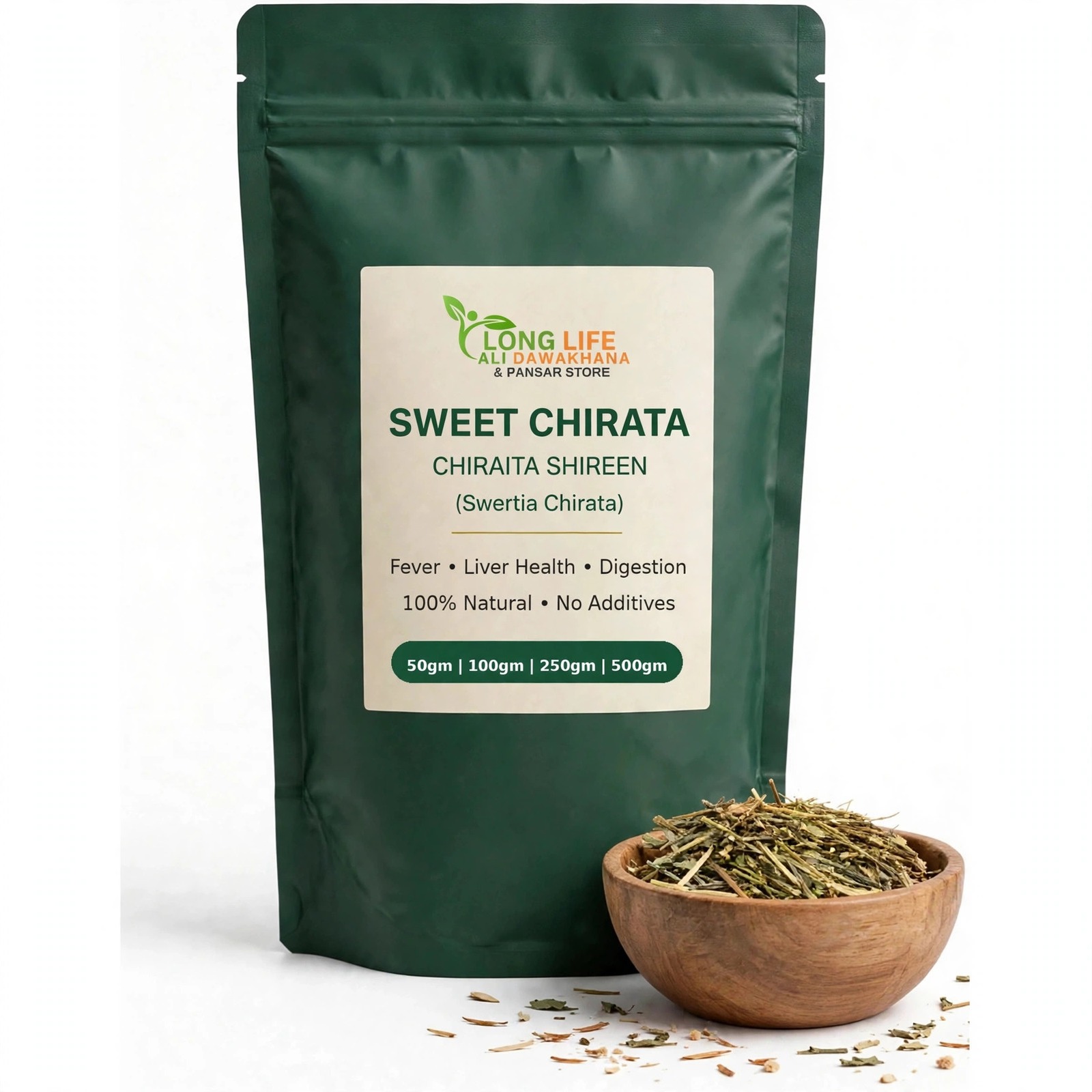
چراعیتہ شیریں (سویٹ چرائٹا) – بخار، جگر اور ہاضمے کی مشہور بوٹی
چراعیتہ شیریں، جسے انگریزی میں سویٹ چرائٹا (Sweet Chirata) کہا جاتا ہے، ہمالیہ کے پہاڑی علاقوں میں پائی جانے والی ایک مشہور جڑی بوٹی ہے جس کا نباتاتی نام سویرشیا چرائٹا (Swertia Chirata) ہے۔ یہ بوٹی صدیوں سے آیوروید، طب یونانی اور چینی طب میں بخار، جگر کے امراض، ہاضمے کی خرابی اور خون کی صفائی کے لیے استعمال ہو رہی ہے۔ سنسکرت میں اسے “کراتا تکتا” کہا جاتا ہے اور آیوروید کے حکیم اسے “تکتا راجہ” یعنی کڑوی بوٹیوں کا بادشاہ کہتے ہیں۔ چرائٹا اپنی کڑواہٹ کے لیے مشہور ہے — اس میں اماروگنٹن نامی مادہ پایا جاتا ہے جو قدرتی طور پر پائے جانے والے سب سے کڑوے مادوں میں سے ایک ہے — اور یہی کڑواہٹ اس کی دوائی طاقت کی پہچان سمجھی جاتی ہے۔ علی دواخانہ اینڈ پانسر اسٹور کی چراعیتہ شیریں 100 فیصد خالص اور صاف ستھری ہے، اس میں کوئی ملاوٹ، رنگ یا کیمیکل شامل نہیں۔ یہ سالم (Whole)، پاؤڈر (Powder) اور پسی ہوئی (Grounded) تینوں صورتوں میں دستیاب ہے۔
روایتی طور پر چرائٹا کو بخار کی بوٹی کہا جاتا ہے — ملیریا، موسمی اور وقفے وقفے سے آنے والے بخاروں میں اس کا قہوہ صدیوں سے استعمال ہوتا آیا ہے۔ جگر کے لیے یہ ایک مقوی (tonic) سمجھی جاتی ہے جو جگر کی صفائی اور اس کے افعال کو بہتر بنانے میں مدد دیتی ہے۔ ہاضمے کے لیے چرائٹا بھوک بڑھانے والی، معدے کو مضبوط کرنے والی اور قبض دور کرنے والی بوٹی مانی جاتی ہے۔ اس کے علاوہ خون صاف کرنے، جلد کے امراض، ذیابیطس (شوگر) کی روایتی دیکھ بھال، پیٹ کے کیڑوں اور جسمانی کمزوری میں بھی اس کا استعمال روایتی طور پر ہوتا رہا ہے۔ آیوروید میں چرائٹا کو ٹھنڈی، ہلکی اور کڑوی بوٹی مانا جاتا ہے جو صفرا (Pitta) اور بلغم (Kapha) کو متوازن کرتی ہے۔
چرائٹا کا استعمال ہمالیہ کے دیہات میں آج بھی روزمرہ کا حصہ ہے — نیپال کے قبائل کھانے کے بعد اس کی تازہ ڈنڈیاں چباتے ہیں تاکہ بھوک اور ہاضمہ بہتر رہے۔ روایتی حکیم چرائٹا کو کٹکی اور گلوئے کے ساتھ ملا کر جسم کی صفائی کے لیے استعمال کرتے ہیں۔ جدید تحقیق میں بھی اس بوٹی پر کافی کام ہوا ہے — لیبارٹری اور جانوروں پر ہونے والی تحقیق میں اس کے جگر کی حفاظت، سوزش کم کرنے، خون میں شکر کم کرنے اور جراثیم کش اثرات سامنے آئے ہیں، اگرچہ انسانوں پر بڑے پیمانے پر تجربات ابھی باقی ہیں۔ اس لیے چرائٹا کو روایتی بوٹی کے طور پر استعمال کریں، دوا کے متبادل کے طور پر نہیں۔
استعمال کا طریقہ: روایتی طور پر چرائٹا کا قہوہ بنا کر استعمال کیا جاتا ہے — تھوڑی سی بوٹی ایک کپ پانی میں ابال کر چھان کر نیم گرم پیا جاتا ہے۔ کڑواہٹ کم کرنے کے لیے اس میں شہد ملایا جا سکتا ہے۔ پاؤڈر کو نیم گرم پانی کے ساتھ بھی لیا جا سکتا ہے۔ بخار میں روایتی طور پر دن میں دو دفعہ قہوہ دیا جاتا ہے۔ مقدار اور مدت کے لیے اپنے حکیم یا ڈاکٹر سے مشورہ ضرور کریں، خاص طور پر اگر آپ باقاعدہ دوا لے رہے ہوں، حاملہ ہوں یا جگر کی بیماری ہو۔
Sweet Chirata (Chiraita Shireen) – Price in Pakistan, Benefits & How to Use
Direct answer: Sweet Chirata (Chiraita Shireen, Swertia chirata) is a famous bitter tonic herb of the Himalayas, used for centuries in Ayurvedic and Unani practice for fever, liver health, digestion and blood purification. Its bitterness comes from amarogentin, one of the bitterest natural compounds known — detectable by taste at a dilution of 1 in 58 million. At Ali Dawakhana and Pansar Store (Long.pk) it is available in Whole, Powder and Grounded forms in 50gm, 100gm, 250gm and 500gm packs, starting at Rs 351 for 50gm, with cash on delivery across Pakistan.
Table of Contents
- Sweet Chirata (Chiraita Shireen) Kya Hai?
- History of Chirata – From Ancient Texts to Today
- Active Compounds – What Is Inside Chirata?
- Chirata in Ayurveda, Unani & Folk Medicine
- What Does Modern Research Say?
- Sweet Chirata Ke Fayde (Detailed Benefits)
- Who Is Sweet Chirata For?
- Sweet Chirata Istemal Ka Tarika (How to Use)
- Traditional Combinations – Chirata With Other Herbs
- Dosage & Duration (Traditional Guidance)
- Side Effects & Who Should Avoid Chirata
- How to Identify Original Chirata (Quality Guide)
- Storage & Shelf Life
- Sweet Chirata vs Giloy vs Kutki
- Sweet Chirata Price in Pakistan (All Packs)
- Product Specifications
- Roman Urdu Mein Tafseel
- Aksar Puche Jane Wale Sawalat (FAQ)
Sweet Chirata (Chiraita Shireen) Kya Hai?
Sweet Chirata is the dried whole herb of Swertia chirata, a plant in the gentian family (Gentianaceae) that grows wild in the temperate Himalayas of Nepal, northern India, Bhutan, Sikkim and Tibet, at altitudes of roughly 1,200 to 3,000 metres. In Pakistan it is known as Chiraita Shireen (چراعیتہ شیریں) and also as Tharirah. In Sanskrit texts it appears as Kiratatikta and Chirayata. The plant is an annual or biennial herb with a slender stem that grows up to 60 cm tall, bearing small greenish-yellow flowers. The whole dried plant — thin stems, small leaves and flowering tops, cut into small pieces — is the part used.
The herb is famous for its intense bitterness. It contains amarogentin, considered one of the most bitter substances found in nature, along with other bitter compounds such as swertiamarin, mangiferin, swerchirin, chiratin and gentianine. In traditional medicine, that bitterness is the point: bitter herbs are believed to stimulate digestion, cleanse the liver and cool fevers. Chirata has been a standard fever remedy in South Asian households for centuries, and it is listed in the Ayurvedic pharmacopoeia as a treatment for fever, liver disorders and skin disease. This product is the dried herb only, sold whole, as a fine powder, or coarsely grounded, with nothing added.
History of Chirata – From Ancient Texts to Today
Chirata’s recorded history goes back at least a thousand years. Manuscripts from the 10th century CE, including the Rasaratna Samuchaya, mention a bitter herb named Chirata. By the 15th century it appears in the Bhavaprakasha Nighantu under the Sanskrit name Chirayata, and later in the Raj Nighantu and in regional compilations of Rajasthani and North Indian folk medicine. Traditional Ayurvedic physicians in Kashmir and Uttarakhand prized it so highly for its bitter potency that they called it “Tikta Raja” — the king of bitters. Medieval Tibetan herbals also refer to Swertia species for fever management, a practice that remains alive in remote Himalayan villages today.
In Himalayan folk medicine, tribal healers harvested chirata roots and herb each autumn, preparing decoctions to ward off the seasonal fevers that came with the changing weather. In Nepal, local people still chew the fresh stems after meals to curb appetite and aid digestion. During the British colonial period, chirata entered Western herbal medicine as “chiretta” and was listed in the British Pharmacopoeia as a bitter tonic. Today it remains one of the most traded Himalayan medicinal herbs — so heavily collected from the wild that conservationists now list it as a plant under pressure, which is one more reason to buy from a trusted source that sells the genuine herb.
Active Compounds – What Is Inside Chirata?
Chirata’s effects come from a rich mixture of bitter secoiridoid glycosides and xanthones. The table below lists the main compounds researchers have identified and what they are studied for.
| Compound | Type | What researchers have looked at |
|---|---|---|
| Amarogentin | Secoiridoid glycoside | The main source of the bitterness; studied for liver protection and anti-parasitic activity (including against Leishmania donovani, which causes kala-azar) |
| Swertiamarin | Secoiridoid glycoside | Anti-inflammatory and fever-reducing effects; liver-protective in animal studies |
| Mangiferin | Xanthone | Antioxidant, anti-inflammatory and antiviral properties |
| Swerchirin | Xanthone | Stimulates insulin release from pancreatic beta cells; lowered blood sugar in rats |
| Chiratin | Xanthone derivative | Contributes to the anti-inflammatory profile |
| Gentianine | Alkaloid | Part of the bitter complex; studied for anti-inflammatory effects |
| Amaroswerin | Secoiridoid glycoside | Another bitter principle, related to amarogentin |
Amarogentin deserves a special note: it is so bitter that the human tongue can detect it at a dilution of 1 part in 58 million parts of water. When you taste chirata’s bitterness, you are tasting amarogentin at work — stimulating the bitter receptors in the gut, which in turn is believed to trigger digestive secretions and bile flow. This is the traditional explanation for why such a small amount of the herb has such a strong effect on appetite and digestion.
Chirata in Ayurveda, Unani & Folk Medicine
In Ayurveda, chirata (Kiratatikta) is classed as Tikta (intensely bitter) in taste, Laghu (light) and Ruksha (dry) in quality, and Sheeta (cooling) in potency, with a heating post-digestive effect (ushna vipaka) that stimulates Agni, the digestive fire. It is said to pacify Pitta strongly and Kapha mildly, which is why it is traditionally chosen for fevers, liver heat, skin eruptions and sluggish digestion — conditions Ayurveda links to excess Pitta. Its primary indications in the classical texts are Jwara (fever of all types), Kushtha (skin diseases), Kamala (jaundice) and Prameha (urinary disorders including diabetes). It is a standard ingredient in classical fever formulas and liver tonics.
Unani practice uses chirata similarly, as a febrifuge and blood purifier, and in compound preparations for chronic fevers, liver and spleen disorders, and skin disease. In Siddha and regional folk practice across the Himalayan foothills, the herb is used for intermittent fever, worms, vomiting and loss of appetite. In all these systems the herb is always used in small amounts — a pinch of powder or a small handful of herb per cup — because its bitterness is so strong that a little goes a long way. Traditional practice often combines it with honey, which softens the taste without reducing the effect, or with other cooling herbs such as coriander and sandalwood in fever qahwas.
What Does Modern Research Say?
Modern science has studied chirata seriously, and the honest picture is this: there is good laboratory and animal evidence for several traditional uses, but no large human clinical trial has yet proven that chirata treats any disease. Anyone selling chirata as a proven cure for malaria, jaundice, fatty liver or diabetes is overstating the evidence. Here is what the research actually shows:
- Liver protection: A 2015 animal study in Phytotherapy Research found that swertiamarin-rich chirata extracts protected liver cells from paracetamol-induced damage. A 2024 metabolomics study identified multiple marker compounds in active chirata fractions and found antioxidant and liver-cell-protective effects in HepG2 liver cells. A comprehensive 2016 review in Frontiers in Pharmacology (Kumar & Van Staden) pulled together the research and found lab and animal evidence for anti-inflammatory, antioxidant, liver-protective and blood-sugar-lowering activity.
- Fever and malaria: A 2017 study in the Journal of Ethnopharmacology confirmed chirata extracts inhibit Plasmodium falciparum (the malaria parasite) in the laboratory. This supports the traditional use for malarial fever, but it is a long way from treating a person — no clinical trial shows chirata cures malaria.
- Blood sugar: Rodent studies going back to Sekar et al. (1987) report lower blood glucose with chirata extracts, and the xanthone swerchirin has been shown to stimulate insulin release. A 2020 review in Natural Products and Bioprospecting summarised this work. No good human trial shows chirata controls diabetes, and it must never replace diabetes medicine.
- Skin and antimicrobial effects: A 2026 in-vitro study found chirata extract had antioxidant activity and promising anti-acne activity against Propionibacterium acnes. Amarogentin has documented anti-parasitic activity against the kala-azar parasite in laboratory studies.
- Comprehensive reviews: A 2023 review in the Journal of Ethnopharmacology covered chirata’s traditional uses, phytochemistry, quality assessment and pharmacology in full, and concluded that the herb’s effects still need to be confirmed in animal studies, clinical studies and human trials.
The bottom line: chirata is a traditional herb with a strong history and promising early science — not a proven medicine. Use it as traditional support, alongside proper medical care, not instead of it.
Sweet Chirata Ke Fayde (Detailed Benefits)
1. Fever — chirata’s classic use
Chirata is Ayurveda’s most classical herb for fever, described in ancient texts as effective for virtually all fever types. The bitter compounds reduce fever through anti-inflammatory mechanisms — lowering the cytokines that trigger the fever response — and through direct antipyretic activity. In Himalayan households, a chirata qahwa taken twice daily is still the first response to a seasonal fever. For high, persistent or unexplained fever, always seek medical care first.
2. Liver health and protection
Chirata has an old reputation in jaundice and liver complaints, and modern laboratory work supports interest in its hepatoprotective potential: its compounds protect liver cells from toxic injury, reduce the liver-damage markers ALT and AST, stimulate bile production and flow, and support liver regeneration. It is a classic ingredient in traditional liver tonics and is traditionally used for sluggish liver, liver heat and recovery after jaundice.
3. Digestion and appetite
As a bitter tonic, chirata stimulates the bitter receptors in the gut, which triggers digestive secretions and bile flow. Traditionally it is taken before meals to wake up the appetite, relieve bloating and indigestion, and strengthen a weak stomach. A 2015 clinical study in the Journal of Ethnopharmacology reported improvement in patients with non-ulcer dyspepsia (indigestion without ulcers) after eight weeks of chirata supplementation.
4. Blood sugar balance (traditional)
Chirata is traditionally used in long routines for blood sugar balance. The xanthone swerchirin stimulates insulin release from the pancreas, and rodent studies report lower fasting blood glucose with chirata extracts. This is promising early science, not proof — diabetes must be managed with proper medicine, and anyone on diabetes medication should ask their doctor before using chirata, because it may add to the sugar-lowering effect.
5. Skin health and blood purification
Chirata’s blood-purifying (Raktashodhaka) action in Ayurveda corresponds to its pharmacological effect of reducing circulating inflammatory mediators — which is why it is traditionally used for inflammatory skin conditions such as acne, eczema, psoriasis, itching and boils. Laboratory work has also shown anti-acne activity against the bacteria involved in acne. For skin complaints it is traditionally taken internally as a daily qahwa for several weeks.
6. Intestinal worms
Chirata is traditionally used as part of cleansing routines for intestinal parasites. Its bitter compounds, particularly amarogentin, have documented anti-parasitic activity in laboratory studies, including against the parasite that causes kala-azar. For worm complaints, traditional practice combines chirata with other anthelmintic herbs under a hakim’s guidance.
7. Constipation and bowel regularity
In small amounts, chirata is traditionally used to ease constipation and regulate bowel movements, as part of its general action of stimulating the digestive system. It is a gentle regulator rather than a strong purgative like senna, and is better suited to long, mild routines than to quick relief.
8. Malaria and intermittent fever (traditional)
Historically, chirata was the Himalayan foothills’ traditional remedy during malarial fevers, long before modern medicines existed. Laboratory studies confirm its extracts inhibit the malaria parasite in vitro. This is traditional and laboratory evidence only — malaria is a dangerous disease that needs proper medical treatment, and chirata must never be used as a substitute for antimalarial drugs.
9. Antioxidant and anti-inflammatory support
Chirata’s xanthones (mangiferin, swerchirin) and flavonoids give it antioxidant activity — laboratory tests show its extracts scavenge free radicals in a concentration-dependent way. Its bitter compounds also modulate inflammatory cytokines. Traditionally this is understood as the herb “cooling inflammation” in the body, which is part of why it is used for so many different complaints.
10. Recovery from illness and general weakness
After a fever or a long illness, chirata is traditionally given as a tonic to restore appetite, strength and energy. Its traditional name as a bitter tonic covers exactly this: waking up a sluggish system, improving digestion so food is properly absorbed, and gradually rebuilding vitality. It is one of the classic “convalescence” herbs of Himalayan households.
11. Vomiting and nausea
Traditional texts list chirata for vomiting and nausea, particularly the nausea that comes with fever or liver sluggishness. A small, cool dose of chirata water is the traditional remedy — though persistent vomiting always needs medical attention.
Who Is Sweet Chirata For?
Sweet Chirata is traditionally suited to adults who want a natural bitter tonic for appetite, digestion, fever support or liver care — especially people who feel sluggish after illness, who suffer from poor appetite or bloating, or who follow a traditional routine for skin and blood purification. It is a favourite of people who prefer single-ingredient herbs over mixed formulas, because its effects are well understood and its bitterness is a reliable sign of authenticity.
It is not for everyone. Pregnant and breastfeeding women, young children, people with stomach ulcers, low blood pressure or low blood sugar, and anyone on diabetes or blood pressure medicine should only use it on professional advice (see the precautions section below). If you are healthy and want a traditional bitter tonic, start with a very small amount — chirata’s bitterness is intense, and a little goes a long way.
Sweet Chirata Istemal Ka Tarika (How to Use)
As a qahwa (decoction): Boil a small quantity of the herb (about half a teaspoon of the cut herb, or a quarter teaspoon of powder) in a cup of water for 5 to 10 minutes, strain and drink lukewarm. Traditionally taken once or twice a day. Add honey to taste — the herb is very bitter.
Chirata water (overnight soak): Soak a small pinch of the herb in a glass of water overnight, strain in the morning and drink on an empty stomach. This is a gentler method than boiling, and is the traditional routine for liver support and skin complaints.
For fever (traditional): A qahwa of chirata, taken twice daily, is the classic household remedy for fever. It is traditionally combined with tulsi or giloy in fever qahwas. For high or persistent fever, always seek medical care — traditional remedies support, but do not replace, proper treatment.
As a powder: A quarter to half a teaspoon of chirata powder with lukewarm water or honey, once daily before meals, is the traditional dose for appetite and digestion. Start with the smaller amount — the bitterness is intense.
For liver support (traditional): A small daily qahwa for two to three weeks is the traditional liver-cleansing routine, followed by a break. Best taken in the morning on an empty stomach, as a hakim advises.
For skin (traditional): A daily qahwa is traditionally taken for several weeks for skin complaints believed to come from impure blood, alongside a simple diet.
External use: A cooled chirata decoction is traditionally used as a wash for itchy or irritated skin, and a paste of the powder with water is occasionally applied to boils. Always test on a small area first.
Traditional Combinations – Chirata With Other Herbs
Traditional practitioners rarely use chirata alone — it is usually combined with other herbs that balance its bitterness and extend its effects:
- Chirata + Giloy (Tinospora cordifolia): the classic fever and detox combination — giloy adds immune support while chirata clears heat. A staple of traditional fever qahwas.
- Chirata + Kutki (Picrorhiza kurroa): the classic liver combination — two bitter liver tonics used together for jaundice, sluggish liver and liver cleansing routines.
- Chirata + Honey: the simplest combination — honey softens the intense bitterness and makes the qahwa drinkable, especially for children and elderly people (on a hakim’s advice).
- Chirata + Tulsi: a traditional fever combination, used in Himalayan households during seasonal fevers.
- Chirata + Coriander / Sandalwood: cooling herbs added to fever qahwas to balance chirata’s heating post-digestive effect.
- Chirata + Ghee: folk healers ground the dried root into a fine powder and mixed it with honey or ghee for a more palatable, albeit still very bitter, medicine.
Always ask a hakim before combining herbs, especially if you take regular medicine.
Dosage & Duration (Traditional Guidance)
Traditional adult ranges reported in the literature are 1 to 3 grams of powder per dose, or 20 to 30 grams of herb for a decoction (boiled in water and strained). For fever, classical texts describe 3 to 6 grams of powdered root decoction. These are traditional ranges, not medical prescriptions — the right amount depends on the person, the condition and the preparation, and a hakim’s guidance is always best.
As a general rule: start with the smallest amount (a quarter teaspoon of powder, or a small pinch of herb per cup) and increase only if it suits you. A typical traditional course is two to three weeks of daily use, followed by a break of at least a week. Do not use chirata continuously for months without a hakim’s advice. For children, the elderly and anyone with a chronic condition, professional guidance is essential.
Side Effects & Who Should Avoid Chirata
Chirata is a strong bitter herb and is generally well tolerated in small traditional amounts, but it is not without cautions:
- Pregnancy and breastfeeding: Avoid chirata during pregnancy, especially the first trimester — traditional and modern sources note potential uterine-stimulating effects. Do not use while breastfeeding except on professional advice.
- Children: Do not give chirata to young children without a hakim’s advice.
- Stomach ulcers and acidity: The herb’s bitterness stimulates stomach acid — people with ulcers, gastritis or severe acidity should avoid it or use it only on professional advice.
- Low blood pressure and low blood sugar: Chirata may lower blood pressure and blood sugar further. People with either condition should use it only on professional advice.
- Diabetes medicine: Chirata may add to the blood-sugar-lowering effect of diabetes tablets or insulin. Tell your doctor before using it, and monitor your blood sugar.
- Before surgery: Stop chirata at least two weeks before any surgery, because of its effects on blood sugar and blood pressure.
- Possible side effects: Nausea, stomach pain, dizziness or diarrhoea can occur, especially with large amounts. Stop use and seek advice if you notice any unusual reaction.
This product is a traditional herb, not a medicine, and it is not a substitute for medical treatment — especially for fever, malaria, jaundice, liver disease or diabetes, where proper diagnosis and treatment are essential.
How to Identify Original Chirata (Quality Guide)
Chirata is one of the most adulterated Himalayan herbs — cheaper lookalike species are sometimes sold in its place. Here is how to tell the genuine herb:
- Taste test: Real chirata is intensely, unmistakably bitter — one of the bitterest herbs in existence. If it is only mildly bitter, it is probably not genuine Swertia chirata.
- Appearance: The genuine herb is greenish-brown cut pieces of thin stems, small leaves and flowering tops. It should be dry and fragrant, not dusty, damp or mouldy.
- Smell: Fresh, herbal and slightly sharp — never musty or chemical.
- Source: Buy from a trusted pansar store with a reputation to protect. Ali Dawakhana and Pansar Store has sold genuine herbs in Faisalabad for generations, and every pack is the pure herb with nothing added.
- Price: Genuine Himalayan chirata is a wild-collected, conservation-sensitive herb — suspiciously cheap chirata is a warning sign.
Storage & Shelf Life
Keep chirata in an airtight jar away from sunlight, heat and moisture. Stored properly, the dried herb keeps its bitterness and potency for 12 to 18 months. If the herb loses its bitter taste, turns pale or smells musty, it has lost its quality and should be replaced. Do not store it in a damp kitchen or near the stove, and keep it out of children’s reach.
Sweet Chirata vs Giloy vs Kutki
These three bitter Himalayan herbs are often used together, but they are not the same. Here is how they compare:
| Sweet Chirata | Giloy | Kutki | |
|---|---|---|---|
| Botanical name | Swertia chirata | Tinospora cordifolia | Picrorhiza kurroa |
| Main traditional use | Fever, liver, digestion | Immunity, fever, joints | Liver, jaundice, fever |
| Taste | Intensely bitter | Bitter | Very bitter |
| Nature (Ayurveda) | Cooling, light, dry | Heating, light | Cooling, light |
| Best for | Fever + appetite + liver | Immunity + chronic fever | Liver + jaundice |
| Combines well with | Giloy, kutki, honey | Chirata, tulsi | Chirata, giloy |
| Pregnancy | Avoid | Ask a hakim | Avoid |
Many traditional formulas combine all three for a complete detox and fever tonic — ask a hakim for a combination suited to your condition.
Sweet Chirata Price in Pakistan (All Packs)
| Form | 50gm | 100gm | 250gm | 500gm |
|---|---|---|---|---|
| Whole | Rs 351 | Rs 498 | Rs 1,131 | Rs 2,185 |
| Powder | Rs 402 | Rs 422 | Rs 1,288 | Rs 2,447 |
| Grounded | Rs 402 | Rs 548 | Rs 1,181 | Rs 2,236 |
Prices include no hidden charges. Cash on Delivery is available all over Pakistan.
Product Specifications
| Product | Sweet Chirata |
|---|---|
| Botanical name | Swertia chirata (syn. Swertia chirayita) |
| Urdu name | چراعیتہ شیریں |
| Form | Whole / Powder / Grounded |
| Pack sizes | 50gm, 100gm, 250gm, 500gm |
| Ingredients | 100% chirata herb — no additives, colour or preservative |
| Taste | Intensely bitter (amarogentin) |
| Storage | Keep in an airtight jar away from sunlight and moisture |
| Shelf life | 12–18 months stored dry and airtight |
| Seller | Ali Dawakhana and Pansar Store |
| Delivery | Cash on Delivery available all over Pakistan via Long.pk |
Roman Urdu Mein Tafseel
Sweet Chirata yani Chiraita Shireen (Swertia Chirata) Himalaya ke pahari ilaqon mein ugne wali ek mashhoor karwi booti hai, jo sadiyon se Ayurveda aur Tibb-e-Unani mein bukhar, jigar ke amraz, hazme ki kharabi aur khoon ki safai ke liye istemal ho rahi hai. Sanskrit mein isay “Kiratatikta” kaha jata hai aur Ayurveda ke hakim isay “Tikta Raja” yani karwi bootiyon ka badshah kehte hain. Is ki karwahat amarogentin ki wajah se hai — yeh qudrati tor par paye jane wale sab se karwe madon mein se ek hai, jo 5 crore 80 lakh hisse pani mein mila kar bhi mehsoos ho sakta hai — aur yahi karwahat is ki dawai taqat ki pehchan samjhi jati hai. Ali Dawakhana ki Chiraita Shireen 100% khalis hai — is mein koi rang, khushbu ya milawat shamil nahi. Yeh Whole, Powder aur Grounded teeno forms mein 50gm, 100gm, 250gm aur 500gm ki packing mein dastiyab hai, qeemat sirf Rs 351 se shuru hoti hai.
Rawayati tor par is ka qahwa bana kar piya jata hai — thori si booti ek cup pani mein ubaal kar chhaan kar neem garam piyen. Karwahat kam karne ke liye shehad milaya ja sakta hai. Bukhar mein rawayati tor par din mein do dafa qahwa diya jata hai, aur hazme ke liye khane se pehle chhoti miqdar mein liya jata hai. Jigar ki safai ke liye subah khali pait chhota qahwa do se teen hafte tak liya jata hai, phir waqfa diya jata hai. Rawayati hakim chirata ko giloy aur kutki ke sath mila kar bhi istemal karte hain — yeh teeno karwi bootiyan mil kar jism ki safai aur bukhar ke liye behtareen tonic banti hain.
Asli chirata ki pehchan is ki shadeed karwahat hai — agar booti halki karwi hai to woh asli Swertia chirata nahi. Achhi chirata sabz-bhoori, khushk aur khushbudar hoti hai. Hawa-band dabbe mein dhoop aur nami se door rakhne par yeh 12 se 18 mahine tak apni taqat barkarar rakhti hai. Hamal, doodh pilane, maide ke ulcer ya sugar ki dawa lene wale afraad istemal se pehle doctor ya hakim se mashwara zaroor karen. Ghar baithay Cash on Delivery par mangwayen.
Aksar Puche Jane Wale Sawalat (FAQ)
Q: Chiraita Shireen kis liye istemal hoti hai?
Chiraita Shireen rawayati tor par bukhar, jigar ke amraz, hazme ki kharabi, bhook ki kami, khoon ki safai, jild ke amraz, qabz, pait ke keeron aur jismani kamzori ke liye istemal hoti hai — Ayurveda mein isay bitter tonic aur febrifuge mana jata hai.
Q: Sweet Chirata ki price Pakistan mein kya hai?
Ali Dawakhana and Pansar Store par Sweet Chirata (Chiraita Shireen) ki price Rs 351 se shuru hoti hai — Whole 50gm Rs 351, 100gm Rs 498, 250gm Rs 1,131 aur 500gm Rs 2,185; Powder aur Grounded Rs 402 se shuru hote hain. Cash on Delivery ke sath.
Q: Chirata ka qahwa kaisay banaya jata hai?
Aadha chaye ka chamach booti ya chothai chaye ka chamach powder ek cup pani mein 5 se 10 minute ubaal kar chhaan kar neem garam piyen. Bohat karwi hoti hai, is liye shehad mila kar pi sakte hain. Raat bhar pani mein bhigo kar subah peena bhi rawayati tareeqa hai.
Q: Kya chirata bukhar ke liye mufeed hai?
Jee haan — bukhar chirata ka sab se mashhoor istemal hai. Rawayati tor par malaria aur mousami bukharon mein is ka qahwa din mein do dafa diya jata hai. Tez ya lambi muddat ke bukhar mein doctor se ilaaj zaroor karwayen — chirata dawa ka badal nahi.
Q: Kya chirata jigar ke liye achhi hai?
Rawayati tor par chirata ko jigar ka tonic mana jata hai — yeh jigar ki safai aur is ke afaal ko behtar banane mein madad deti hai. Janwaron par tehqeeq mein bhi is ke jigar ki hifazat ke asraat samne aaye hain. Jigar ki bimari mein istemal se pehle doctor se mashwara karen.
Q: Chirata itni karwi kyun hoti hai?
Chirata mein amarogentin naam ka mada hota hai jo qudrat ke sab se karwe madon mein se ek hai — insani zuban isay 5 crore 80 lakh hisse pani mein mila kar bhi mehsoos kar sakti hai. Rawayati tib mein yahi karwahat is ki dawai taqat ki pehchan hai.
Q: Kya chirata sugar (diabetes) mein istemal hoti hai?
Rawayati tor par chirata blood sugar ke tawazun ke liye istemal hoti hai aur choohon par tehqeeq mein is ke sugar kam karne ke asraat dekhe gaye hain, lekin yeh dawa ka badal nahi — diabetes mein apni dawa jari rakhen aur doctor ke mashware se hi istemal karen, kyunke yeh dawa ke asar ko barha sakti hai.
Q: Chirata aur giloy mein kya farq hai?
Dono karwi Himalaya ki bootiyan hain lekin mukhtalif hain — chirata (Swertia chirata) bukhar, hazme aur jigar ke liye mashhoor hai jabke giloy (Tinospora cordifolia) quwat-e-mudafiat aur joron ke liye zyada istemal hoti hai. Dono aksar qahwe mein mila kar istemal hoti hain.
Q: Asli chirata ki pehchan kya hai?
Asli chirata shadeed karwi hoti hai — halki karwi booti asli nahi. Woh sabz-bhoori, khushk aur khushbudar hoti hai. Bharosemand pansar store se khareeden — Ali Dawakhana and Pansar Store ki har packing 100% khalis booti hoti hai.
Q: Original Sweet Chirata kahan se milegi?
Ali Dawakhana and Pansar Store, Faisalabad se Long.pk par online order karen — 100% khalis Sweet Chirata (Chiraita Shireen) ghar baithay Cash on Delivery par mil jayegi.
Ali Dawakhana and Pansar Store — Asli desi dawa aur khalis jadi bootiyan, ab ghar baithay Long.pk se mangwayen.

Reviews
There are no reviews yet