
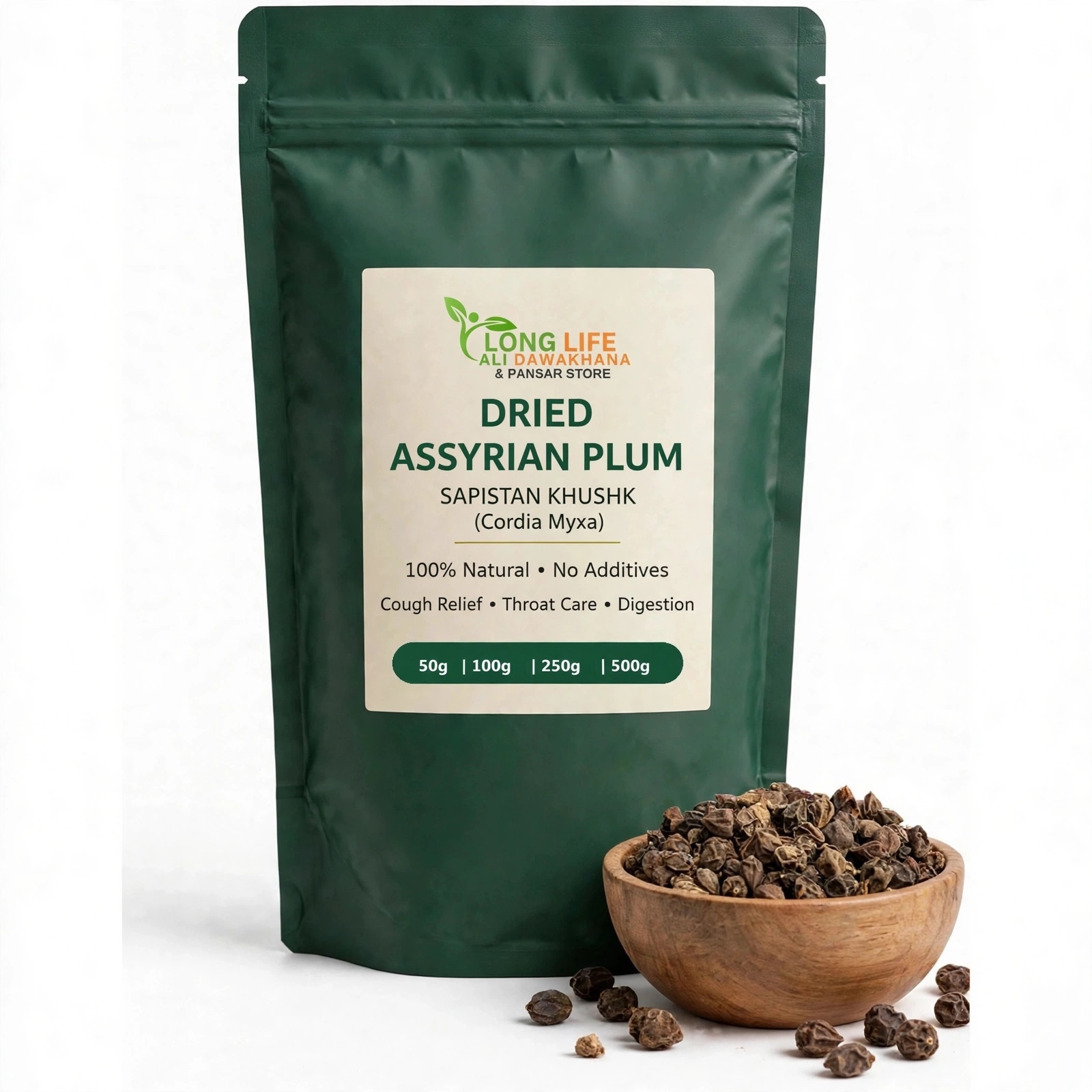
سپتان خشک (Dried Assyrian Plum) — مکمل معلومات
سپتان خشک، جسے لسوڑا بھی کہتے ہیں، ایک چھوٹا خشک میوہ ہے جو Cordia myxa درخت سے حاصل ہوتا ہے۔ یہ درخت برصغیر، مشرقِ وسطیٰ اور افریقہ میں پایا جاتا ہے اور اس کا پھل صدیوں سے آیوروید اور یونانی طب میں کھانسی، گلے کی خراش اور ہاضمے کے لیے استعمال ہو رہا ہے۔ اس کا پھل لیس دار (mucilage) ہوتا ہے — پانی میں بھگونے پر یہ جیل جیسی تہہ بناتا ہے جو گلے اور آنتوں کی جھلی کو سکون پہنچاتی ہے۔
آیوروید میں اسے شلیشماتک (Shleshmataka) کہا جاتا ہے اور سشرت سنہتا میں اسے کھانسی، بلغم اور خون کی خرابی کے لیے تجویز کیا گیا ہے۔ یونانی طب میں سپتان ایک مشہور دوا ہے — اس کا لعوق (Laooq-e-Sapistan) نزلہ، زکام، کھانسی اور برونکائٹس کے لیے استعمال ہوتا ہے۔ مصر میں خشک سپتان آج بھی مصالحہ بازاروں میں دوا کے طور پر بکتا ہے۔
سپتان خشک کے روایتی استعمال میں خشک کھانسی، گلے کی سوزش، نزلہ و زکام، بدہضمی، اور بالوں کی نشوونما شامل ہیں۔ اس کا پھل وٹامنز اور معدنیات سے بھرپور ہوتا ہے اور اسے بچوں کے دست کے لیے بھی ایک نئی تحقیق میں مفید پایا گیا ہے۔
سپتان خشک کے فائدے (روایتی استعمال)
- کھانسی اور گلہ: اس کی لیس دار تہہ گلے کی جلن کو سکون دیتی ہے اور بلغم نکالنے میں مدد دیتی ہے۔
- نزلہ و زکام: لعوقِ سپتان نزلہ، زکام اور برونکائٹس کی روایتی دوا ہے۔
- ہاضمہ: یہ معدے اور آنتوں کی سوزش کو سکون دیتا ہے — چھوٹی مقدار میں دست روکتا ہے، بڑی مقدار میں ہلکا جلاب ہے۔
- بال: آیوروید میں اسے کیشیا (بالوں کے لیے اچھا) مانا جاتا ہے۔
- زخم: اس کی چھال اور پھل کا لیپ زخموں اور جلد کے مسائل پر لگایا جاتا ہے۔
استعمال کا طریقہ
- سفوف: 2 سے 5 گرام سفوف نیم گرم پانی یا شہد کے ساتھ دن میں دو بار لیں۔
- جوشاندہ: 9 سے 15 خشک پھل یا 10 گرام چھال 200 ملی لیٹر پانی میں ابال کر آدھا کریں اور 50 سے 100 ملی لیٹر دن میں دو بار پیئیں۔
- غرغرہ: سفوف کی چائے بنا کر گلے کے لیے غرغرہ کریں۔
- جلد پر: تازہ پھل کا گودا گھی اور ہلدی ملا کر زخم یا جلد پر لگائیں۔
سپتان خشک Long.pk سے Whole، Powder یا Grounded فارم میں 50 گرام سے 500 گرام تک منگوایا جا سکتا ہے۔ قیمت صرف 169 روپے سے شروع ہوتی ہے اور پورے پاکستان میں کیش آن ڈیلیوری دستیاب ہے۔
Dried Assyrian Plum (Sapistan Khushk) – Price in Pakistan, Benefits & How to Use
Direct answer: Dried Assyrian Plum (Sapistan Khushk, Lasoora, Cordia myxa) price in Pakistan starts from Rs 169 for 50 gm (Whole form) at Long.pk, going up to Rs 1,256 for 500 gm (Powder or Grounded form). It is available in three forms — Whole, Powder and Grounded — in 50 gm, 100 gm, 250 gm and 500 gm packs, with cash on delivery across Pakistan. Sapistan is a classical Unani and Ayurvedic remedy for cough and sore throat: its fruit is rich in mucilage, which coats and soothes irritated mucous membranes, and it is also traditionally used for digestion, hair growth and wound healing. A 2026 randomised trial found its syrup significantly shortened diarrhoea in children with gastroenteritis — but it is still a traditional herb, not a medicine, and it should not replace medical treatment for serious illness.
Table of Contents
- What Is Dried Assyrian Plum?
- History of Sapistan
- Active Compounds
- Sapistan in Ayurveda, Unani & Folk Medicine
- What Does Modern Research Say?
- Detailed Benefits of Sapistan
- Fruit, Bark or Leaves?
- Who Is Sapistan For?
- How to Use Sapistan
- Traditional Combinations
- Dosage & Duration
- Side Effects & Who Should Avoid It
- How to Identify Original Sapistan
- Storage & Shelf Life
- Sapistan vs Unnab vs Behidana
- Sapistan Price in Pakistan
- Product Specifications
- Roman Urdu
- Frequently Asked Questions
What Is Dried Assyrian Plum?
The Assyrian plum (Cordia myxa L., family Boraginaceae) is a medium-sized, broad-leaved deciduous tree found across South Asia, from Myanmar in the east to Afghanistan in the west, and through the Middle East and Africa. In Urdu it is Sapistan Khushk (سپتان خشک) or Lasoora (لسوڑا), in Sanskrit Shleshmataka or Lasura, and in English the Assyrian Plum or Sebesten Plum. (Some sources use the name Cordia dichotoma for the same tree — the two names are treated as synonyms in much of the traditional literature.)
The tree bears small, round, creamy-yellow fruits that ripen to a sticky, mucilaginous pulp around a hard stone. The ripe fruit is eaten fresh in season, and the unripe fruit is pickled. The dried fruit — small, wrinkled, brown, and still rich in mucilage — is the product sold here as Dried Assyrian Plum (Sapistan Khushk).
The defining feature of the fruit is its mucilage: a sticky polysaccharide gel that binds up to ten times its weight in water. When the dried fruit is soaked or boiled, the mucilage forms a soothing, protective coating — and that coating is the basis of almost all of sapistan’s traditional uses. It is a demulcent (soothes irritated membranes), an expectorant (helps clear phlegm), and a mild anti-inflammatory, all in one small fruit.
The fruit is also genuinely nutritious: it contains fibre, protein, fatty acids (9.9% of the fruit), vitamins, and minerals including phosphorus, potassium, magnesium and iron. Studies have found no toxic heavy metals (lead, cadmium, chromium, copper) in the fruit.
History of Sapistan
Sapistan is one of the oldest cough remedies in the world. References to Cordia myxa appear in the Atharvaveda, one of the oldest texts of Indian medicine, and in the classical Ayurvedic texts Charaka Samhita and Sushruta Samhita, where it is called Lasura and praised as a mucolytic (phlegm-clearing) and demulcent. Sushruta prescribed the fruits internally for biliousness, cough and haemorrhage, and the bark decoction for a wide range of conditions.
In Unani medicine, sapistan was adopted by Persian physicians by the 10th century, who blended its fruit extract with honey and liquorice into cough syrups — valuing exactly the property modern science confirms, its ability to coat irritated mucous membranes. The classical Unani preparation Laooq-e-Sapistan (a thick, linctus-like syrup) is indicated for catarrh, coryza, chronic bronchitis and influenza, and remains in use today. Another classical formula, Lauq Khayar Shambar, combines sapistan with liquorice (aslussoos), amaltas pulp (khayar shambar) and katira gum as a cough remedy.
In Egypt, dried sapistan fruits are still sold today in spice markets as a medicine. In India, the Government of India’s AYUSH ministry included sapistan (7 fruits) in its advisory decoction for respiratory symptoms, alongside unnab (jujube) and behidana (quince seed) — the three great Unani demulcents. In rural Rajasthan, healers still crush fresh fruits into a paste with ghee and rock salt and apply it to minor burns.
Active Compounds
The fruit, bark and leaves of Cordia myxa contain mucilage polysaccharides (the signature compound), flavonoids, saponins, tannins and sterols. The fruit is also rich in fatty acids and minerals.
| Compound | Type | What researchers looked at |
|---|---|---|
| Mucilage polysaccharides | Polysaccharides | Form protective gels that coat irritated mucosa; bind up to 10x their weight in water; the basis of the cough and throat action |
| Quercetin | Flavonoid | Antioxidant and mild anti-inflammatory activity in vitro |
| Apigenin | Flavonoid | Antioxidant and anti-inflammatory flavonoid |
| Myricetin | Flavonoid | Antioxidant flavonoid; contributes to the fruit’s free-radical-scavenging activity |
| Cordifolioside | Glycoside | Bioactive glycoside identified in the fruit |
| Cordiamyxin | Alkaloid | Preliminary studies suggest mild analgesic (pain-relieving) effects; research ongoing |
| Saponins | Glycosides | Potential expectorant activity, helping mucus clearance in the airways |
| Tannins | Polyphenols | Astringent; calm excess gut motility (the antidiarrheal side) and protect wounds |
| Phenolic acids & xanthones | Polyphenols | Contribute to the antioxidant profile highlighted in the 2024 review |
| Terpenes & sterols | Terpenoids | Part of the broad phytochemical profile; sterols in the bark and fruit |
| Fatty acids (9.9%) | Lipids | Unusually high for a fruit; part of its nutritional value |
| Minerals (P, K, Mg, Fe, Na) | Minerals | Phosphorus, potassium (29 ppm), magnesium, iron and sodium (13 ppm); no toxic heavy metals detected |
The mechanism is straightforward and physical: the mucilage forms a gel that coats the throat and gut lining, shielding irritated tissue from further irritation while the saponins help loosen and clear phlegm. The flavonoids add a genuine (if modest) anti-inflammatory and antioxidant effect. This is why sapistan works best for dry, irritated coughs and sore throats — conditions where a protective coating is exactly what is needed.
Sapistan in Ayurveda, Unani & Folk Medicine
In Ayurveda, sapistan is Shleshmataka or Picchila (“the sticky one” — a direct reference to its mucilage), and also Lasura. Its classical actions include demulcent, expectorant, mucolytic and mild laxative, and it is classed as Keshya — good for the hair. Sushruta prescribed the fruits for biliousness, cough and haemorrhage; the leaves for cough and cold; and the bark decoction (50–100 ml) as a single-drug treatment. The fruit is described as cooling and soothing, pacifying Pitta, and useful for burning micturition (painful urination) as well as respiratory complaints.
In Unani medicine, sapistan is a standard cough and catarrh remedy. Its temperament is generally given as hot and dry in the second degree (though the Lauq Khayar Shambar sources describe it as moderate in hot and cold, and wet — reflecting its mucilaginous nature). Its Unani actions are munaffis-i-balgham (expectorant), musakkin (sedative, calming the cough), mulattif (demulcent) and mulayyan (laxative). It is also used as an adjuvant to purgatives, to counteract their irritating effect on the gut — the mucilage protects the intestinal lining while the purgative works. Laooq-e-Sapistan and Lauq Khayar Shambar are its two great classical preparations.
In folk medicine across Pakistan and India, lasoora is the household remedy for dry cough and sore throat: the dried fruit boiled into a decoction, or the powder mixed with honey. The ripe fruit is eaten fresh for general health and hair growth, and the bark is applied topically to ulcers, boils and skin inflammations. In Iraq, where the tree is also common, the fruit (known locally by various names) is used for the same respiratory and digestive complaints.
What Does Modern Research Say?
Sapistan has a growing research base — including a genuine randomised trial published in 2026 — though, as with all the herbs in this series, the honest picture is that the evidence is strongest for cough and diarrhoea, and thinner for the rest.
Diarrhoea in children — the strongest trial. A double-blind, randomised, placebo-controlled trial published in the Journal of Comprehensive Pediatrics (2026) tested Cordia myxa syrup (“Sepestan”, 20 mg/kg/day) in 140 children aged 1–8 with gastroenteritis at Abuzar Hospital, Ahvaz, Iran. The syrup group had a significantly shorter diarrhoea duration (3.91 days vs 4.71 days in the placebo group, P = 0.000), reduced diarrhoea frequency at 72 hours (P = 0.023), and significantly improved stool volume and consistency. The authors note the limitations — single-centre, short follow-up, narrow age range — and call for multicentre trials, but this is a real, well-conducted trial with a positive result.
Cough — the traditional headline. A study reported in the Journal of Ethnopharmacology (2015) found that Cordia myxa syrup decreased cough frequency in mild bronchitis by 30% over two weeks compared with placebo. The mucilage and saponins are credited with loosening phlegm and soothing the airways. Pharmacological reviews also confirm antitussive (cough-suppressing) and smooth-muscle-relaxant activity for the fruit extract.
Antimicrobial activity. Bhardwaj (2024, Journal of Pharmacology and Pharmaceutics) tested methanolic extracts of C. myxa leaves, fruit and bark against five bacterial strains (Bacillus subtilis, E. coli, Salmonella enterica, Staphylococcus aureus and others) by agar well diffusion. All three parts showed activity; S. aureus and B. subtilis produced the highest zones of inhibition, followed by E. coli. The mucilage extract also showed anti-parasitic activity against Leishmania infantum promastigotes in laboratory tests.
Digestive support. A small 2018 trial in India reported relief in IBS symptom scores after daily lasura bark decoctions — consistent with the traditional view that the tannins calm excess gut motility while the mucilage soothes irritated intestines.
Other findings. A 2024 review (ScienceDirect) highlighted the fruit’s rich phytochemical profile — tannins, flavonoids, phenolic acids, xanthones, terpenes and saponins — and its antioxidant potential. A 2020 animal study found reduced paw oedema (swelling) in rodents given C. myxa extract. A study on rats subjected to chronic unpredictable stress (PMC9985794) reported antioxidant and antidepressant-like effects for the fruit extract — animal evidence only, and a long way from any human claim. In rural clinics, a 10% lasura fruit paste applied topically accelerated wound closure by 15% versus controls.
The honest summary: sapistan’s cough and throat action is well supported by its mucilage chemistry and by a positive bronchitis study, and the 2026 diarrhoea trial is a genuine step forward. For its other traditional uses — hair, skin, fever, immunity — the evidence is still mostly animal and laboratory work, and should be treated as promising rather than proven.
Detailed Benefits of Sapistan
Cough Relief & Sore Throat
This is sapistan’s headline benefit. The fruit’s mucilage coats the throat and airways, soothing the irritation that drives a dry cough, while the saponins help loosen phlegm so it can be cleared. The 2015 bronchitis study (30% reduction in cough frequency over two weeks) and the classical Laooq-e-Sapistan tradition both point the same way. It works best for dry, irritated coughs and sore throats — the kind where the throat feels raw and every cough makes it worse.
Digestive Support (Diarrhoea & IBS)
Sapistan has an interesting duality: in small doses it is antidiarrheal (the tannins calm excess gut motility), while in larger doses it acts as a mild laxative (the mucilage adds bulk and soothes). The 2026 children’s diarrhoea trial gives the antidiarrheal side real clinical weight, and the 2018 IBS trial supports its use for irritable bowel symptoms. The mucilage also soothes the gut lining, which is why Unani physicians use it alongside purgatives to protect the intestines.
Hair Growth (Keshya)
In Ayurveda, sapistan is classed as Keshya — good for the hair — and the ripe fruit is traditionally eaten for hair growth. The fruit is rich in vitamins and minerals (including iron), which supports general hair health, but there is no clinical trial proving it grows hair. Treat this as a traditional nutritional claim, not a proven treatment for hair loss.
Skin & Wound Healing
The bark is high in tannic acid and is traditionally applied topically to erysipelas, ulcers, boils and skin inflammations. The fruit paste (with ghee and turmeric) is applied to minor burns and wounds in folk practice, and the rural-clinic finding of 15% faster wound closure with a 10% fruit paste gives this some support. The tannins form a protective layer over the wound while the flavonoids reduce oxidative stress at the injury site.
Fever & Respiratory Infections
Sapistan is traditionally used for fever, catarrh, coryza, chronic bronchitis and influenza — as part of the classical Unani approach to respiratory infection, where the demulcent soothes the airways while other herbs address the infection. It is a supportive remedy, not a treatment for serious respiratory disease.
Urinary Comfort
The fruit is traditionally used for burning micturition (painful urination) and urinary tract complaints — the mucilage soothes the urinary passages in the same way it soothes the throat. This is a traditional use with limited modern evidence.
Antioxidant & Immune Support
The fruit’s flavonoids (quercetin, apigenin, myricetin) and phenolic compounds give it measurable antioxidant activity in laboratory models, and reviews list immunomodulatory effects for C. myxa extracts. These are general, background benefits — real, but modest, and not a reason to use sapistan on their own.
Joint Inflammation
The 2020 animal study (reduced paw oedema in rodents) supports the folk use of sapistan preparations for joint swelling and arthritic discomfort. This is a secondary use — sapistan is not a first-choice joint herb — but the anti-inflammatory evidence is real.
Fruit, Bark or Leaves?
All parts of the Cordia myxa tree are used, but the fruit is the main medicinal part and the one with the trial evidence.
| Part | Traditional use | Notes |
|---|---|---|
| Fruit (dried) | Cough, sore throat, diarrhoea, digestion, hair | The primary part; richest in mucilage; the product sold here |
| Fruit (fresh/ripe) | General health, hair growth, nutrition | Eaten fresh in season; rich in vitamins and minerals |
| Bark | Cough, IBS, skin (topical), ulcers, boils | High in tannic acid; decoction 50–100 ml; applied topically for erysipelas |
| Leaves | Cough, cold, fever, tuberculosis (traditional) | Decoction used for cough and cold; antimicrobial activity confirmed in lab |
| Roots | Traditional formulas | Used in classical preparations; not a home-use part |
| Seeds | Inside the fruit | The pulp around them is the useful part for home use |
For home use, the dried fruit is the safest and most practical part: it has the best evidence, the gentlest action, and the simplest preparation (powder with honey, or a decoction).
Who Is Sapistan For?
Sapistan suits adults with dry, irritated coughs and sore throats who want a traditional demulcent remedy — particularly people who prefer a gentle, food-like herb over a strong cough syrup. It also suits people looking for a traditional digestive soother, and anyone following Unani practice who uses Laooq-e-Sapistan or similar preparations.
It is not for everyone: pregnant and nursing women should limit use to 2 g daily of fruit powder and only after professional advice, children under 5 need paediatric guidance (the 2026 trial used a standardised syrup under hospital supervision — not home powder), and people with severe kidney or liver impairment should avoid it. Anyone on anticoagulants should avoid concentrated extracts.
How to Use Sapistan
Powder with honey (the classic method). Take 2–5 g of sapistan fruit powder mixed with warm water or honey, twice a day, for cough and digestion. For a gentler effect, 1–2 teaspoons in warm water or honey once or twice daily is the common household dose.
Decoction. Boil 10 g of dried fruit (or bark) in 200 ml of water until it reduces to about 50 ml. Take 1–2 tablespoons three times a day — or take the bark decoction in the classical dose of 50–100 ml. The traditional fruit dose is 9–15 dried fruits per decoction.
Gargle. Make a tea from the powder (boiled and strained) and gargle with it for a sore throat — the mucilage coats the throat directly.
Syrup. The traditional Laooq-e-Sapistan is a thick syrup made by boiling the fruit with honey; the modern equivalent is a standardised Cordia myxa syrup. For children over 5, 2–4 teaspoons daily (by weight, on professional advice).
Skin paste. Mash fresh fruit pulp (or mix the powder) with ghee and a pinch of turmeric, and apply to minor wounds, burns or skin irritations up to twice a day.
Traditional Combinations
- Sapistan + Mulethi (Liquorice): the classic Unani cough pair — liquorice’s soothing, sweet root plus sapistan’s mucilage. Both appear in Lauq Khayar Shambar and in countless cough syrups.
- Sapistan + Amaltas: the Lauq Khayar Shambar combination — amaltas pulp (2 parts) with sapistan (1.5 parts), liquorice (1.5 parts) and katira gum (1 part), made into a thick lauq (dose 7 g) for cough, catarrh and bronchitis.
- Sapistan + Honey: the classical vehicle — honey carries the mucilage, soothes the throat in its own right, and makes the preparation palatable.
- Sapistan + Unnab (Jujube): two of the three great Unani demulcents together — the AYUSH advisory decoction pairs them (with behidana) for respiratory symptoms.
- Sapistan + Behidana (Quince Seed): the third demulcent — quince seeds also release mucilage, and the combination is a standard Unani throat and cough preparation.
- Sapistan + Ginger: for a cold, wet cough — ginger’s warming, stimulating action balances sapistan’s cooling mucilage.
Dosage & Duration
The figures below are traditional Ayurvedic and Unani doses from the classical texts and modern Ayurvedic sources. They are given for information — your practitioner’s instruction takes priority.
| Form | Traditional dose | Notes |
|---|---|---|
| Fruit powder | 2–5 g, twice daily | With warm water or honey; for cough and digestion |
| Fruit powder (household) | 1–2 tsp, once or twice daily | In warm water or honey |
| Dried fruits | 9–15 fruits per decoction | Boil in water, strain, drink |
| Bark/fruit decoction | 50–100 ml, twice daily | Boil 10 g in 200 ml water, reduce to 50 ml |
| Syrup (children over 5) | 2–4 tsp daily | By weight; on professional advice |
| Topical paste | As needed, up to twice daily | Fruit pulp with ghee and turmeric |
| Pregnant/nursing women | Max 2 g fruit powder daily | Only after professional consultation |
Duration: for cough and sore throat, sapistan is traditionally used for 1–2 weeks, until symptoms resolve. For digestive support, courses of 2–4 weeks are common. If a cough persists beyond 2 weeks, or is accompanied by fever, blood, or breathlessness, see a doctor — sapistan is a supportive remedy, not a treatment for serious respiratory disease.
Side Effects & Who Should Avoid It
Sapistan is gentle as herbs go — it is a food-like fruit with a long history of safe use — but the cautions are real.
Possible side effects: larger doses act as a laxative and can cause loose stools. Concentrated extracts may cause gut distress, particularly in people on heavy tannin diets. Allergic reactions are possible, though uncommon.
Who should be careful:
- Pregnant and nursing women — limit use to no more than 2 g daily of fruit powder, and only after professional consultation.
- Children under 5 — need paediatric Ayurvedic advice with exact titration by weight. The 2026 diarrhoea trial used a standardised syrup in a hospital setting — it does not mean home powder is safe for young children.
- People on anticoagulants — avoid concentrated extracts; the tannins and mucilage may interact with blood-thinning medication.
- People with severe kidney or liver impairment — contraindicated: plants with high mucilage can complicate fluid balance.
- People with heavy tannin diets — avoid concentrated extracts to reduce the risk of gut distress.
A note on serious illness: sapistan eases mild coughs and mucus, but it is no substitute for medical treatment in serious pulmonary conditions — tuberculosis, pneumonia, asthma or chronic bronchitis need proper medical care.
How to Identify Original Sapistan
- Fruits: the dried fruits are small (about 1–2 cm), round, wrinkled and brown, with a hard stone inside. They should feel firm, not soft or crumbly.
- Mucilage test: soak a dried fruit in water — it should release a sticky, gel-like mucilage within minutes. If there is no stickiness, the fruit is old or poor quality.
- Smell: a mild, sweet, fruity smell. A musty, sour or fermented smell means damp storage — reject it.
- Powder: sapistan powder is light brown, fine and slightly sticky to the touch. Very pale powder may be cut with filler.
- No mould: the fruit is sugary and can attract moisture — reject any fruit or powder with white or green mould spots.
- Buy from a trusted store: Long.pk sources its Sapistan Khushk from established pansar suppliers, and the fruit is packed in sealed pouches that protect it from moisture and contamination.
Storage & Shelf Life
Store sapistan in an airtight container or its sealed pouch, away from light, heat and moisture. The fruit is sugary and absorbs moisture easily, so keep the pouch sealed between uses and do not store it in a damp place. A cool, dry kitchen cupboard is ideal. The dried fruit keeps its potency for 12–18 months when stored properly. The powder loses strength faster (use within 9–12 months of grinding). Do not store it in the bathroom or near the stove, where steam and heat degrade it.
Sapistan vs Unnab vs Behidana
These three are the great demulcent (mucilage) remedies of Unani medicine, and they are often used together — the AYUSH advisory decoction contains all three. Each has its own strength.
| Feature | Sapistan | Unnab (Jujube) | Behidana (Quince Seed) |
|---|---|---|---|
| Botanical name | Cordia myxa | Ziziphus jujuba | Cydonia oblonga (seed) |
| Main action | Demulcent + expectorant | Demulcent + mild sedative | Demulcent (pure mucilage) |
| Signature use | Cough + diarrhoea | Cough + sleep + blood | Sore throat + cough |
| Mucilage | High (fruit pulp) | Moderate | Very high (seed coat) |
| Extra benefit | Digestive (antidiarrheal) | Calming, blood tonic | Skin (face masks) |
| Human trials | 2026 RCT (diarrhoea) | Several small trials | Limited |
| Taste | Sweet, sticky | Sweet, apple-like | Bland, slippery |
| Pregnancy | Limit to 2 g (advised) | Generally considered safe in food amounts | Generally considered safe |
| Price (Long.pk, from) | Rs 169 / 50 gm | (16 original herbs) | — |
Which to choose: for cough with digestive upset, sapistan. For cough with poor sleep or anxiety, unnab. For a pure throat-coating demulcent (or a skin mask), behidana. For a full Unani cough decoction, all three together is the classical choice.
Sapistan Price in Pakistan
Prices checked 19 November 2026 (following pansaar.com, rounded to whole rupees). Cash on Delivery available across Pakistan.
| Form | 50 gm | 100 gm | 250 gm | 500 gm |
|---|---|---|---|---|
| Whole | Rs 169 | Rs 304 | Rs 557 | Rs 768 |
| Powder | Rs 321 | Rs 388 | Rs 709 | Rs 1,256 |
| Grounded | Rs 326 | Rs 388 | Rs 704 | Rs 1,256 |
Best value: the 500 gm Whole pack at Rs 768 works out to about Rs 154 per 100 gm, against Rs 338 per 100 gm for the 50 gm pack — less than half the unit price. If you use sapistan regularly for coughs through the winter, the 500 gm Whole pack is the obvious choice. The Powder and Grounded forms cost more than Whole at small sizes (grinding and sieving add cost), which is normal across the herb range.
Product Specifications
| Product Name | Dried Assyrian Plum (Sapistan Khushk) |
| Urdu Name | سپتان خشک (also لسوڑا / Lasoora) |
| Botanical Name | Cordia myxa L. (syn. Cordia dichotoma) |
| Family | Boraginaceae |
| Forms Available | Whole / Powder / Grounded |
| Weights Available | 50 gm / 100 gm / 250 gm / 500 gm |
| Price Range | Rs 169 – Rs 1,256 |
| Purity | 100% Natural, No Additives |
| Origin | Pakistan / South Asia |
| Shelf Life | 12–18 months (dried fruit); 9–12 months (powder) |
| Storage | Airtight container, cool & dry place, away from sunlight |
| Seller | Ali Dawakhana and Pansar Store |
| Delivery | Cash on Delivery across Pakistan |
Roman Urdu
Dried Assyrian Plum (Sapistan Khushk, Lasoora, Cordia myxa) aik chhota khushk mewa hai jo sadiyon se Ayurveda aur Unani tib mein khansi aur galay ke liye istemal ho raha hai. Is ka phal lais-daar (mucilage) hota hai — pani mein bhigonay par yeh gel jaisi teh banata hai jo galay aur aanton ki jhilli ko sukoon deti hai. Unani tib mein is ka Laooq-e-Sapistan nazla, zukam, khansi aur bronchitis ki mashhoor dawa hai.
Sapistan ke fawaid mein khushk khansi aur galay ki kharash mein aaram, hazme ki behtri, baalon ki nashonuma, aur zakhmon par istemal shamil hain. Is mein mucilage, quercetin, myricetin aur saponins jaise murakkabat paaye jate hain. Aik 2026 ki trial mein is ke sharbat ne bachon ke dast ki muddat kam ki.
Sapistan istemal karne ka aasan tareeqa: 2 se 5 gram safoof neem garam pani ya shehed ke saath din mein do baar lein. Ya 9 se 15 khushk phal pani mein ubaal kar joshanda bana kar piyen. Galay ke liye is ki chai se ghararay bhi kiye ja saktay hain. Haamla khawateen 2 gram se zyada na lein aur pehle mahir se mashwara karein.
Long.pk se Sapistan Khushk Whole, Powder aur Grounded form mein 50 gm se 500 gm tak dastiyab hai — qeemat sirf Rs 169 se shuru. Pure Pakistan mein Cash on Delivery ki sahulat mojood hai.
Frequently Asked Questions
Q: Sapistan kis kaam aata hai?
Sapistan Khushk (Cordia myxa) ka phal lais-daar hota hai jo galay aur aanton ko sukoon deta hai. Yeh khushk khansi, galay ki kharash, nazla-zukam, hazme aur baalon ke liye rawayati tor par istemal hota hai.
Q: Sapistan ki Pakistan mein qeemat kya hai?
Long.pk par Sapistan Khushk ki qeemat Rs 169 se shuru hoti hai (50 gm Whole) aur Rs 1,256 tak jati hai (500 gm Powder/Grounded). Whole, Powder aur Grounded — teeno forms 50, 100, 250 aur 500 gm mein dastiyab hain.
Q: Sapistan khansi ke liye kaise istemal karein?
2 se 5 gram safoof neem garam pani ya shehed ke saath din mein do baar lein. Ya 9 se 15 khushk phal ubaal kar joshanda bana kar piyen. Galay ke liye is ki chai se ghararay bhi faida-mand hain.
Q: Kya sapistan bachon ko de saktay hain?
5 saal se baray bachon ko 2 se 4 chammach sharbat rozana, wazan ke hisaab se, mahir ki rehnumai mein diya ja sakta hai. 5 saal se chhotay bachon ko bina doctor ke mashwaray ke na dein.
Q: Sapistan aur Unnab mein kya farq hai?
Dono Unani lais-daar (demulcent) dawayen hain. Sapistan khansi ke saath hazme mein bhi madad deta hai, jab ke Unnab neend aur khoon ke liye bhi mufeed mana jata hai. Dono ko aik saath bhi joshanday mein istemal kiya jata hai.
Q: Kya sapistan dast mein madad karta hai?
Aik 2026 ki trial mein Cordia myxa ke sharbat ne bachon ke dast ki muddat 4.71 din se 3.91 din tak kam ki. Chhoti miqdar mein is ke tannins dast roktay hain, jab ke bari miqdar halka julaab hai.
Q: Sapistan baalon ke liye kaisa hai?
Ayurveda mein sapistan ko Keshya (baalon ke liye achha) mana jata hai aur is ka phal vitamins aur iron se bharpoor hota hai. Lekin baal uganay ka koi clinical saboot nahi hai — yeh aik rawayati ghizai dawa hai.
Q: Sapistan se koi nuqsan ho sakta hai?
Munasib miqdar mein yeh aam tor par mehfooz hai. Bari miqdar se dast ho saktay hain. Haamla khawateen 2 gram se zyada na lein, aur gurday ya jigar ki shadeed beemari walay isay istemal na karein.
Q: Asli sapistan ki pehchan kya hai?
Asli khushk phal chhotay, gol, jhurri-daar aur bhooray hotay hain. Pani mein bhigonay par lais-daar gel nikalti hai — agar chipchipahat na ho to phal purana ya halka hai.
Q: Sapistan ko kitni dair tak rakh saktay hain?
Hawa-band dabbe mein, thandi aur khushk jagah par, khushk phal 12 se 18 mahine tak theek rehta hai. Safoof (powder) 9 se 12 mahine mein istemal kar lena behtar hai.
Ali Dawakhana and Pansar Store — Asli desi dawa aur khalis jadi bootiyan, ab ghar baithay Long.pk se mangwayen.

Reviews
There are no reviews yet