
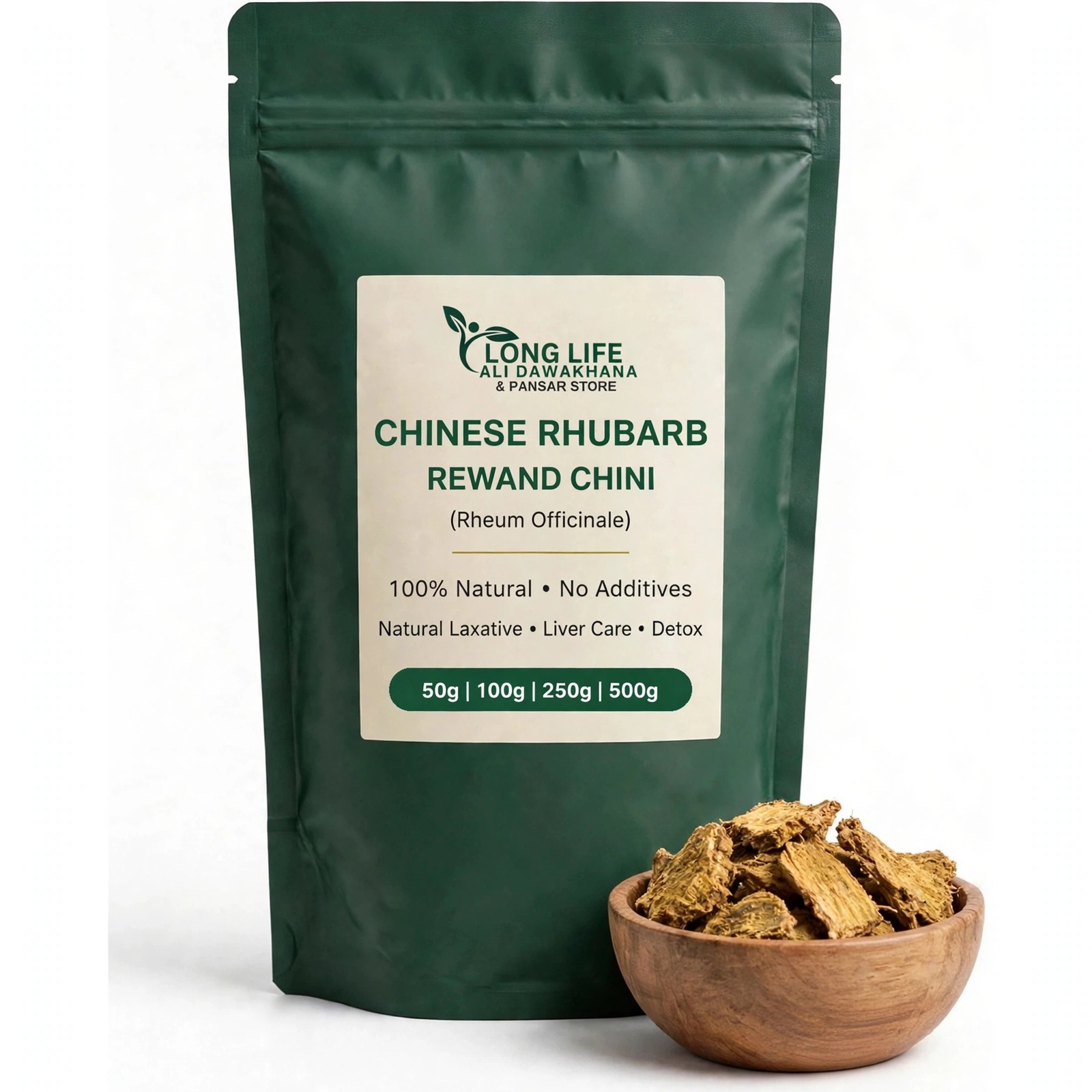
Chinese Rhubarb (Rewand Chini, Rheum officinale) is the classic Chinese and Unani purgative root, traditionally used for short-term relief of constipation, liver health, jaundice and digestion. Its root contains anthraquinones (rhein, emodin) that stimulate the bowel — the stalk is food and the leaves are poisonous, so only the root is the medicine. At Long.pk it is available in Whole, Powder and Grounded forms (50 gm to 500 gm) from Rs 228, with Cash on Delivery across Pakistan.
چینی ریوند (Chinese Rhubarb) — مکمل معلومات
چینی ریوند، جسے ریوند چینی یا دا ہوانگ (Da Huang) بھی کہتے ہیں، چین کی سب سے مشہور جلاب والی جڑ ہے۔ یہ Rheum officinale پودے کی خشک جڑ اور ریزوم ہے، جو دو ہزار سال سے چینی طب میں استعمال ہو رہی ہے۔
ریوند کی خاص بات اس کی دوہری فطرت ہے: زیادہ مقدار میں یہ ایک طاقتور جلاب ہے (anthraquinones کی وجہ سے)، لیکن کم مقدار میں یہ قابض (astringent) ہے — tannins کی وجہ سے پیٹ کو مضبوط کرتی ہے۔ اسی لیے چینی طب میں اسے کبھی جلاب کے طور پر اور کبھی پیٹ کی دوا کے طور پر استعمال کیا جاتا ہے۔
اہم فرق: دوا صرف جڑ ہے۔ ریوند کا ڈنٹھل (stalk) کھانے کی چیز ہے — اس میں جلاب کا اثر نہیں ہوتا۔ اور ریوند کے پتے زہریلے ہیں (oxalate کی وجہ سے) — انہیں کبھی نہ کھائیں۔
یونانی طب میں ریوند چینی کو جگر، یرقان، قبض اور ہاضمے کے لیے استعمال کیا جاتا ہے۔ آیوروید میں بھی یہ ایک طاقتور جلاب اور ڈیٹاکس بوٹی ہے۔
ریوند کو صرف مختصر مدت (زیادہ سے زیادہ ایک سے دو ہفتے) کے لیے استعمال کریں۔ لمبے عرصے تک استعمال سے جلاب کی عادت، پوٹاشیم کی کمی اور آنتوں کی کمزوری ہو سکتی ہے۔ حاملہ خواتین، دودھ پلانے والی مائیں اور 12 سال سے کم عمر بچے اسے استعمال نہ کریں۔
چینی ریوند کے فائدے (روایتی استعمال)
- طاقتور جلاب: یہ آنتوں کو تحریک دے کر قبض دور کرتی ہے — senna جیسی، لیکن tannins کی وجہ سے نرم اثر۔
- جگر: روایتی طور پر جگر کی صفائی اور یرقان کے لیے استعمال ہوتی ہے۔
- ہاضمہ: کڑواہٹ کی وجہ سے پیٹ کے رس اور صفرا کو تحریک دیتی ہے۔
- جلد: روایتی طور پر خون صاف کرنے اور جلد کے مسائل کے لیے استعمال ہوتی ہے۔
- کم مقدار میں قابض: چھوٹی مقدار میں یہ دست روکنے میں بھی مدد کرتی ہے۔
استعمال کا طریقہ
- جلاب کے طور پر: صرف مختصر مدت کے لیے — یورپی معیار کے مطابق 20 سے 30 ملی گرام hydroxyanthracenes (rhein کے حساب سے) رات کو ایک بار، زیادہ سے زیادہ ایک ہفتہ۔
- قہوہ: آدھا سے ایک گرام جڑ 250 ملی لیٹر پانی میں 10 منٹ ابال کر شام کو پیئیں۔
- لمبے عرصے تک استعمال نہ کریں: ایک سے دو ہفتے سے زیادہ استعمال آنتوں کو کمزور کر دیتا ہے۔
چینی ریوند Long.pk سے Whole، Powder یا Grounded فارم میں 50 گرام سے 500 گرام تک منگوایا جا سکتا ہے۔ قیمت صرف 228 روپے سے شروع ہوتی ہے اور پورے پاکستان میں کیش آن ڈیلیوری دستیاب ہے۔
Chinese Rhubarb (Rewand Chini) – Price in Pakistan, Benefits, Uses & Safety
Direct answer: Chinese Rhubarb (Rewand Chini, Da Huang, Rheum officinale) price in Pakistan starts from Rs 228 for 50 gm (Whole form) at Long.pk, going up to Rs 3,291 for 500 gm (Grounded form). It is available in three forms — Whole, Powder and Grounded — in 50 gm, 100 gm, 250 gm and 500 gm packs, with cash on delivery across Pakistan. It is the classic Chinese purgative root (Da Huang), used for over 2,000 years, and the European Medicines Agency recognises it for short-term relief of occasional constipation (maximum one week). Its signature is a dual nature: a strong laxative at normal doses, but astringent at low doses, because it contains both anthraquinones and tannins. The medicine is the root only — the stalk is food with no laxative effect, and the leaves are poisonous (high oxalate) and must never be eaten.
Table of Contents
- What Is Chinese Rhubarb?
- History of Rhubarb
- Active Compounds
- Chinese Rhubarb in Ayurveda, Unani & Folk Medicine
- What Does Modern Research Say?
- Detailed Benefits of Chinese Rhubarb
- Root, Stalk or Leaves?
- Who Is Chinese Rhubarb For?
- How to Use Chinese Rhubarb
- Traditional Combinations
- Dosage & Duration
- Side Effects & Who Should Avoid It
- How to Identify Original Chinese Rhubarb
- Storage & Shelf Life
- Chinese Rhubarb vs Senna vs Dried Aloe
- Chinese Rhubarb Price in Pakistan
- Product Specifications
- Roman Urdu
- Frequently Asked Questions
What Is Chinese Rhubarb?
Chinese Rhubarb (Rheum officinale, syn. the closely related Rheum palmatum — the two are the official medicinal species, often used interchangeably) is the dried root and rhizome of the medicinal rhubarb plant, family Polygonaceae. In Urdu it is Rewand Chini (ریوند چینی), in Chinese Da Huang (大黄, “the great yellow”), in Ayurveda Revand Chini, and in European herbal literature medicinal rhubarb, rhei radix or Turkey rhubarb. Other medicinal species include Rheum tanguticum (Tangut rhubarb), Rheum emodi and Rheum webbianum — the Indian and Himalayan rhubarbs native to India, Pakistan and Nepal.
There are about 60 species of Rheum, of which 40 are Chinese and at least 18 have medicinal properties. The official drug — as defined by the European and British Pharmacopoeias — is the dried underground parts (rhizome and root) of Rheum officinale or Rheum palmatum or their hybrids, and must contain not less than 2.2% hydroxyanthracene derivatives calculated as rhein. In practice, dried root slices test at 3–5% total anthraquinones by weight.
The dried root is unmistakable: yellowish-brown to dark brown chunks with a vivid yellow interior when cut, a bitter taste, and a characteristic smell. The yellow colour comes from the anthraquinones themselves — the same compounds that make it a medicine.
The dual nature. Rhubarb root contains two classes of compounds with opposing effects: anthraquinones (rhein, emodin, sennosides) that stimulate the bowel, and tannins that are astringent — they tighten and tone the gut lining. At normal doses the laxative effect dominates; at low doses the astringent effect shows, which is why rhubarb has traditionally been used both for constipation and (in small doses) for diarrhoea. No other laxative herb in this series has this dual action.
History of Rhubarb
Rhubarb is one of the oldest purgatives in the world. Its first well-documented appearance is in the Chinese pharmacopeia Shennong Ben Cao Jing (The Divine Farmer’s Classic of Materia Medica), around the 3rd century AD, where Da Huang is described as bitter and cold, clearing accumulations in the stomach and intestines. It has been used in traditional Chinese and Tibetan medicine for over 2,000 years, gradually spreading along the trade routes to India, Russia, Europe and North America.
In traditional Chinese medicine, Da Huang is the chief herb of the Purgatives category — bitter and cold, entering the Heart, Large Intestine, Liver and Stomach channels. It drains heat and purges excess from the intestines, and is the chief purgative in the classic formulas Da Cheng Qi Tang and Xiao Cheng Qi Tang (used for severe heat-accumulation with high fever, constipation and abdominal fullness). The Chinese also use it for gastric ulcers, chronic kidney disease, pregnancy-induced hypertension, jaundice and blood stasis.
In medieval Europe, rhubarb arrived via Russia and Turkey — hence the old names “Turkey rhubarb” and “Russian rhubarb” — and became one of the most valuable drugs in the European pharmacopoeia. European herbalists recommended it as a laxative and diuretic, and for kidney stones, gout and liver diseases with jaundice. It was so valuable that in the 17th and 18th centuries, rhubarb root was traded at prices comparable to saffron.
In South Asia, the indigenous Himalayan species (Rheum emodi, Rheum webbianum) have long been used in Ayurvedic and Unani practice, and the imported Chinese species was recognised as stronger — Ayurvedic texts note that Da Huang has a sharper dhatu-shodhana (tissue-cleansing) effect, making it suitable for severe constipation, jaundice and skin eruptions tied to ama (toxins).
Active Compounds
| Compound | Type | What researchers looked at |
|---|---|---|
| Rhein | Anthraquinone (with carboxy group) | The reference compound for standardisation (≥2.2% hydroxyanthracenes as rhein); anti-inflammatory; supports liver detox via cytochrome P450 modulation; boosts bile flow; hepatoprotective in animal models |
| Emodin | Anthraquinone | Promotes bowel movements by inhibiting aquaporin channels; reduces bacterial adhesion; anti-inflammatory (inhibited COX-2 in cell models of ulcerative colitis); may cause mild cramping |
| Aloe-emodin | Anthraquinone | Stimulates peristalsis; mild antimicrobial activity against Candida species, E. coli and Staphylococcus aureus |
| Chrysophanol (chrysophamol) | Anthraquinone | One of the first anthraquinones isolated from rhubarb; contributes to the laxative effect |
| Physcion | Anthraquinone | Another free anthraquinone present in nearly all rhubarb species |
| Sennosides A & B | Anthraquinone glycosides | The same active glycosides as senna; converted by gut bacteria into rhein-anthrone in the colon |
| Tannins (incl. gallic acid derivatives) | Polyphenols | Astringent — tighten the gut lining; responsible for rhubarb’s low-dose anti-diarrhoeal effect and for moderating the laxative action |
| Glucorhein | Anthraquinone glycoside | The glycoside of rhein; a storage form that gut bacteria convert to active rhein |
| Stilbenes (e.g. rhaponticin — in R. rhaponticum, not this species) | Stilbenes | The menopause extract ERr 731 comes from R. rhaponticum — a different species; not present in medicinal rhubarb root |
Mechanism. Like senna and aloe latex, rhubarb’s anthraquinone glycosides pass through the stomach and small intestine unchanged, and are broken down by bacteria in the colon into active anthraquinones (mainly rhein and rhein-anthrone), which stimulate peristalsis, increase water secretion into the bowel, and reduce water absorption. Onset is typically 6–12 hours — which is why anthraquinone laxatives are taken at night. The tannins act in the opposite direction at low doses, which is why the dose matters so much with rhubarb.
Chinese Rhubarb in Ayurveda, Unani & Folk Medicine
In Ayurveda, Chinese rhubarb is Revand Chini, and it is used as a purgative (virechana) and detoxifying herb. Ayurvedic texts note its sharper dhatu-shodhana (tissue-cleansing) effect compared with the indigenous Himalayan rhubarb, making it suitable for severe constipation, jaundice, and skin eruptions tied to ama (toxins). It is used in classical formulations for digestive stagnation and liver complaints, always as a short-term purgative rather than a daily tonic.
In Unani medicine, Rewand Chini is a standard drug: used as a purgative, for liver disorders and jaundice, for digestive complaints, and as a blood purifier. Unani physicians value the same dual action — purgative at full dose, stomachic and astringent at low dose — and use it in compound preparations for sluggish digestion and liver congestion.
In traditional Chinese medicine, Da Huang is the chief purgative: bitter and cold, it “drains heat and purges accumulation” from the intestines, “clears damp-heat and fire toxicity” (used for jaundice, dysentery and heat-toxin patterns), and “invigorates blood and dispels stasis” (used for fixed abdominal pain, traumatic injury and menstrual disorders where stasis and heat are intertwined). Raw Da Huang is the strongest purgative form; processed forms (wine-fried, steamed) are gentler. The classic teaching is that this is not a gentle detox herb — if the bowels are not actually blocked or heat-laden, raw rhubarb is the wrong tool.
In folk medicine across Pakistan and the Himalayas, the indigenous rhubarb species (Rheum emodi, Rheum webbianum) are used for the same purposes — constipation, liver complaints, jaundice — and the dried root is a standard item in every pansar’s shop.
What Does Modern Research Say?
Rhubarb has a genuine, if uneven, research base — strongest for constipation, with interesting early work in kidney and liver disease.
Constipation — the clearest evidence. A 2019 randomised trial published in the Journal of Ethnopharmacology found that 10 g of dried R. officinale root powder daily for two weeks improved bowel movement frequency by 35% compared with placebo. A placebo-controlled trial (Laboratoires Ortis, 42 mostly female adults with long-standing constipation) tested rhubarb root extract at 12.5 mg or 25 mg of anthraquinone derivatives (as rhein) daily: the higher amount improved stool frequency and consistency versus placebo, with a difference apparent by the first week; the lower amount improved consistency at four weeks. Some participants experienced abdominal pain. The European Medicines Agency recognises this short-term use — its monograph accepts standardised rhubarb root preparations for occasional constipation, at 20–30 mg hydroxyanthracene derivatives (as rhein) once at night, for a maximum of one week.
Liver — animal evidence. A 2021 in-vivo study on rats showed that rhein attenuated elevated liver enzymes (AST/ALT) induced by acetaminophen (paracetamol) overdose — a hepatoprotective effect. This is animal evidence only, and does not establish that rhubarb protects the human liver.
Anti-inflammatory and antimicrobial — laboratory evidence. Emodin inhibited COX-2 expression in cell models of ulcerative colitis, and aloe-emodin showed efficacy against E. coli and Staphylococcus aureus strains. Topical poultices of powdered root mixed with honey have a folk track record for soothing psoriasis patches — though high-quality clinical trials are still pending.
Kidney disease — early human work. The Chinese use rhubarb in chronic renal failure, and there is early clinical work in kidney disease (rhubarb is proposed to slow the progression of chronic renal failure in patients with high serum creatinine). The evidence is preliminary, and rhubarb is contraindicated in kidney failure in Western herbal practice — the two positions reflect different preparations and different clinical contexts, and this is not a use to attempt without a practitioner.
Processing matters. A 2024 review in Frontiers in Pharmacology (PMID 39170703) summarised rhubarb’s compounds, processing methods, pharmacology, toxicology and clinical research, and confirmed that raw and processed Da Huang are significantly different medicines — raw rhubarb is substantially harsher and more purgative than the wine-fried or steamed forms. This product is the raw dried root.
What is NOT established. The use of rhubarb in the herbal Essiac formula for cancer lacks the support of controlled clinical trials. The menopause benefits belong to ERr 731, an extract of Rheum rhaponticum — a different species — and do not apply to this product. And a 90-day rat study identified rhein as a toxic metabolite at high chronic doses — one more reason rhubarb is a short-term medicine.
The honest summary: rhubarb is an effective short-term laxative with a well-understood mechanism, a 2,000-year history, and a European monograph behind it — and a herb whose long-term use is ruled out by its own safety profile. The EMA’s position (short-term, occasional constipation only, maximum one week) is the right frame for this product.
Detailed Benefits of Chinese Rhubarb
Every benefit below is described as it appears in the traditional literature and research.
Constipation Relief (Short-Term)
This is rhubarb’s real, established use. The anthraquinones stimulate the colon powerfully — comparable to senna, with the tannins moderating the effect slightly. It works in 6–12 hours, taken at night. The EMA accepts it for occasional constipation, short-term only (maximum one week). It is not a treatment for chronic constipation, and long-term use causes dependence — the bowel becomes reliant on stimulation and stops working on its own.
Liver Support (Traditional)
In Unani and Chinese medicine, rhubarb is used for liver disorders and jaundice — in TCM it “clears heat” from the liver, and rhein boosts bile flow. The 2021 rat study (rhein protecting the liver from acetaminophen damage) gives this some laboratory support, but there is no human clinical evidence. Any liver-related use must be practitioner-directed.
Digestive Stimulant (Bitter Action)
Rhubarb’s bitterness stimulates gastric and biliary secretions — the classic “bitter stomachic” action. At low doses, where the tannins dominate, it tones the gut and can help with sluggish digestion and mild diarrhoea. This is the astringent side of the dual nature, and it is unique among the anthraquinone laxatives.
Blood Purification & Skin (Traditional)
In traditional terms, rhubarb is described as a blood purifier — largely because a purge was historically understood as cleansing the blood — and it is used for skin eruptions tied to ama (toxins) in Ayurveda. Topical poultices of powdered root with honey have a folk track record for psoriasis patches, though clinical trials are still pending. Modern medicine does not recognise the blood-purification mechanism, and the claim should be understood as traditional reasoning.
Anti-Inflammatory Action (Laboratory)
Emodin’s inhibition of COX-2 in cell models of ulcerative colitis, and rhein’s anti-inflammatory activity, suggest rhubarb’s compounds have genuine anti-inflammatory potential. This is laboratory evidence only — it does not mean rhubarb treats inflammatory bowel disease in people (in fact, rhubarb is contraindicated in IBD).
Kidney Support (Early Research)
The Chinese use of rhubarb in chronic renal failure is the most intriguing modern lead — early human work suggests it may slow the progression of chronic kidney disease in patients with high serum creatinine. But rhubarb is also contraindicated in kidney failure in Western practice, and the oxalate content is a concern for kidney-stone formers. This is practitioner-only territory, not a home use.
Root, Stalk or Leaves?
This is the most important distinction for anyone buying or using rhubarb. The three parts of the plant are completely different — one is a medicine, one is a food, and one is a poison.
| Part | What it is | Main use | Safety |
|---|---|---|---|
| Root & rhizome (dried) | The underground parts; anthraquinones + tannins | Strong stimulant laxative; short-term only | EMA-accepted for occasional constipation; max 1 week; contraindicated in pregnancy, children under 12, IBD, obstruction |
| Stalk (petiole) | The thick red/green stems; culinary rhubarb | Food — cooked in pies, jams, chutneys | Safe to eat when cooked; no noticeable laxative effect; contains some oxalic acid, so avoid in large quantities if prone to kidney stones |
| Leaves | The large green leaf blades | Nothing — discard them | POISONOUS — very high oxalate content; eating rhubarb leaves can cause serious poisoning (kidney damage, convulsions); never consume |
| Raw Da Huang | Unprocessed dried root | The strongest purgative form | Harsher than processed forms; the form sold here |
| Processed Da Huang (wine-fried, steamed) | Root processed with wine or steam | Gentler purgative; more blood-moving, less bowel-purging | Used in TCM for blood stasis rather than constipation |
| ERr 731 extract | Extract of Rheum rhaponticum (a different species) | Menopausal symptoms (hot flushes) | A different medicine entirely — this product is NOT for menopause |
This product is the dried root and rhizome. Buy it for its laxative and traditional Unani/TCM uses — not for cooking (use the stalk) and never eat the leaves.
Who Is Chinese Rhubarb For?
Chinese rhubarb is for adults with occasional constipation who want a traditional, short-term laxative — used for a few days at most, under the EMA’s guidance (maximum one week). It is also for practitioners of Unani, Ayurvedic and Chinese medicine who use rewand chini / Da Huang in compound preparations, and for people who want the low-dose astringent action for sluggish digestion.
It is not for long-term use. It is not for pregnant or breastfeeding women, children under 12, or anyone with kidney disease, kidney stones (oxalate), liver disease, heart disease, inflammatory bowel disease, intestinal obstruction, or unexplained abdominal pain. It is not for anyone taking digoxin, diuretics, corticosteroids, or diabetes medication — unless their doctor explicitly approves it. And it is not a menopause remedy (that is a different rhubarb species) or a cancer treatment.
How to Use Chinese Rhubarb
As a laxative (short-term only). Take the standardised dose at night (see Dosage below), for occasional constipation, for a maximum of one week. Drink plenty of water — stimulant laxatives dehydrate you. Expect a bowel movement in 6–12 hours. If constipation persists beyond a week, see a doctor rather than continuing the rhubarb.
As a decoction. Simmer 0.5–1 g of root in 250 ml of water for 10 minutes, strain, and drink in the evening. In TCM, the root is decocted for less than 10 minutes as a purgative — longer cooking reduces the purgative effect (the anthraquinones break down with prolonged heat).
As a powder. The powder can be taken in capsules or mixed with warm water or honey. The dose is small — a few grams at most — and must be measured, not guessed.
Externally. A paste of powdered root mixed with honey is traditionally applied to the skin for psoriasis patches and minor skin complaints. Do not apply to broken skin, and stop if irritation develops.
What NOT to do. Do not take rhubarb daily for weeks or months. Do not take it to “detox” for an extended period. Do not give it to children. Do not use it during pregnancy. Do not eat the leaves. Do not confuse the root with the culinary stalk — the stalk has no laxative effect.
Traditional Combinations
- Rhubarb + Ginger: ginger is traditionally added to rhubarb preparations to moderate griping and cramping — a standard corrective for drastic purgatives.
- Rhubarb + Liquorice (Mulethi): liquorice’s soothing, demulcent root protects the gut lining when a strong purgative is given.
- Rhubarb + Haritaki: two purgatives together in classical detox formulas — haritaki’s gentler action complements rhubarb’s drastic one.
- Rhubarb + Fennel (Saunf): fennel’s carminative action reduces the griping and gas that anthraquinone laxatives can cause.
- Rhubarb + Honey: honey is a traditional vehicle for small-dose powders, masking the bitterness; also the base for the external skin paste.
- Da Huang + Mang Xiao (Glauber’s salt): the classic TCM combination in Da Cheng Qi Tang — the salt softens hardness while the rhubarb purges. Practitioner use only.
Dosage & Duration
The figures below follow the European Medicines Agency’s herbal monograph for standardised rhubarb root, and the TCM materia medica. They are given for information — your practitioner’s instruction takes priority.
| Form | Dose | Notes |
|---|---|---|
| Standardised root (EMA) | 20–30 mg hydroxyanthracene derivatives (as rhein), once daily at night | For occasional constipation; the standard anthraquinone laxative dose |
| Maximum duration (EMA) | 1 week | Two or three uses in that week are often sufficient |
| Maximum duration (ESCOP) | 1–2 weeks | Never continuously |
| Root decoction | 0.5–1 g root per 250 ml water, simmered 10 minutes, evening | The standard home preparation |
| TCM decoction | 3–12 g, decocted (raw, cooked <10 minutes) | Raw = strongest purgative; longer cooking weakens the effect |
| Mother tincture | 20–30 drops in the evening, diluted in water | A standard Western herbal preparation |
| Low-dose (astringent) | Well below the laxative dose | For sluggish digestion / mild diarrhoea; practitioner-directed |
Duration: rhubarb is a short-term medicine. One week is the maximum for self-use (EMA); two weeks is the absolute maximum under any guidance (ESCOP). Long-term use causes laxative dependence (the bowel stops working without stimulation), chronic potassium loss, and melanosis coli. If you need a laxative for more than a week, the underlying cause needs medical attention — not more rhubarb.
Side Effects & Who Should Avoid It
Possible side effects: abdominal cramps and griping, diarrhoea, dehydration, electrolyte imbalance (especially low potassium), and (with long-term use) laxative dependence, melanosis coli (a benign dark pigmentation of the colon lining, which fades after stopping — it is NOT cancer), and a harmless red-brown discolouration of the urine. Overuse drains potassium, which is dangerous alongside digoxin, diuretics and corticosteroids.
Serious risks documented in the literature:
- Kidney damage: rhubarb is contraindicated in kidney failure, and its oxalate content makes it dangerous for anyone with a history of oxalate kidney stones. A 90-day rat study identified rhein as a toxic metabolite at high chronic doses.
- Electrolyte loss: chronic use causes hypokalemia (low potassium), which affects the heart and interacts dangerously with digoxin and diuretics.
- Laxative dependence: the bowel becomes reliant on stimulation and stops working on its own; stopping after long use causes paradoxical worsening of constipation.
Who must avoid it:
- Pregnant women — contraindicated; rhubarb is a strong purgative with emmenagogue (menstruation-stimulating) effects and blood-moving action.
- Breastfeeding women — avoid; anthraquinone metabolites pass into breast milk and cause diarrhoea in nursing infants.
- Children under 12 — never give rhubarb root to children; they are especially vulnerable to dehydration.
- People with kidney disease or a history of oxalate kidney stones — avoid; the oxalate and the kidney are both at risk.
- People with liver disease — avoid without a practitioner’s direction; the liver evidence is animal-only.
- People with heart disease — avoid; potassium loss affects the heart, especially alongside digoxin.
- People with intestinal obstruction, narrowing, atony, appendicitis, inflammatory bowel disease (Crohn’s, ulcerative colitis), or abdominal pain of unknown cause — EMA contraindications.
- People with severe dehydration — EMA contraindication.
- People on digoxin, diuretics, corticosteroids, or diabetes medication — risk of dangerous potassium loss and blood-sugar changes; only under a doctor’s supervision.
- During menstruation and post-partum — contraindicated in TCM (cold, downward-draining, blood-moving nature).
Regulatory status: EMA accepts standardised rhubarb root for short-term use in occasional constipation only. European and British Pharmacopoeias require ≥2.2% hydroxyanthracene derivatives as rhein. Not FDA-approved as a laxative.
How to Identify Original Chinese Rhubarb
- Chunks: genuine dried rhubarb root comes as yellowish-brown to dark brown chunks with a vivid yellow interior when cut or broken. The yellow colour is the anthraquinones — pale, washed-out root is poor quality.
- Taste: intensely bitter and astringent — the bitterness is the anthraquinones, the astringency is the tannins. If it is not bitter, it is not medicinal rhubarb (taste only a tiny fragment).
- Powder: rhubarb powder is yellowish-brown, fine and very bitter. Very pale powder may be cut with filler.
- Smell: a characteristic sharp, slightly medicinal, earthy smell. A musty or fermented smell means damp storage — reject it.
- No mould: reject any chunks or powder with white or green mould spots.
- Not the stalk: the medicinal product is the root — long, fibrous, red-green stalks are culinary rhubarb, not the medicine.
- Buy from a trusted store: Long.pk sources its Rewand Chini from established pansar suppliers, and the root is packed in sealed pouches that protect it from moisture and contamination.
Storage & Shelf Life
Store rhubarb root in an airtight container or its sealed pouch, away from light, heat and moisture — and out of reach of children, clearly labelled. A cool, dry cupboard is ideal. The dried root keeps its potency for 18–24 months when stored properly. The powder loses strength faster (use within 9–12 months of grinding). Do not store it in the bathroom or near the stove, where steam and heat degrade it. Keep it separate from food herbs — its bitterness and laxative strength mean it should never be mistaken for an ordinary herb.
Chinese Rhubarb vs Senna vs Dried Aloe
These three are the great anthraquinone laxatives of traditional medicine — all three work by the same mechanism (gut bacteria convert their glycosides into irritant anthraquinones in the colon), but they differ in strength, tradition and safety profile.
| Feature | Chinese Rhubarb (Rewand Chini) | Senna (Sana Makki) | Dried Aloe (Elwa) |
|---|---|---|---|
| Botanical name | Rheum officinale | Senna alexandrina | Aloe barbadensis |
| Active compounds | Rhein, emodin, sennosides + tannins | Sennosides A & B | Aloin (barbaloin), aloe-emodin |
| Strength | Moderate to strong | Strong | Very strong |
| Dose (hydroxyanthracenes) | 20–30 mg (as rhein) | 10–30 mg (as sennoside B) | 10–30 mg (as barbaloin) |
| Max duration | 1 week (EMA) / 1–2 weeks (ESCOP) | 1 week | 1 week |
| Dual action | Yes — laxative at full dose, astringent at low dose | No | No |
| FDA status | Not FDA-approved as a laxative | FDA-approved OTC laxative | Removed from OTC laxatives (2002) |
| EMA status | Accepted, short-term only | Accepted, short-term only | Accepted, short-term only |
| Extra traditional use | Liver, jaundice, blood stasis | Blood purifier, skin | Liver, skin (external) |
| Kidney concern | Oxalate — avoid with kidney stones | None established | Kidney failure at 1 g/day |
| Pregnancy | Contraindicated | Avoid | Absolutely contraindicated |
| Price (Long.pk, from) | Rs 228 / 50 gm | Rs 351 / 50 gm | Rs 253 / 50 gm |
Which to choose: for occasional constipation, senna is the safest of the three (FDA-approved, best studied). Rhubarb is the choice when you also want the bitter digestive and liver action, or the low-dose astringent effect. Dried aloe is the strongest and best reserved for cases where senna has not worked, or for traditional Unani use under a practitioner’s direction.
Chinese Rhubarb Price in Pakistan
Prices checked 19 November 2026 (following pansaar.com, rounded to whole rupees). Cash on Delivery available across Pakistan.
| Form | 50 gm | 100 gm | 250 gm | 500 gm |
|---|---|---|---|---|
| Whole | Rs 228 | Rs 397 | Rs 1,223 | Rs 2,557 |
| Powder | Rs 363 | Rs 582 | Rs 1,426 | Rs 2,759 |
| Grounded | Rs 444 | Rs 759 | Rs 1,709 | Rs 3,291 |
Best value: unusually, the 100 gm Whole pack at Rs 397 is the best value per gram in the Whole range (about Rs 397 per 100 gm, against Rs 456 for the 50 gm pack and Rs 511 for the 500 gm pack) — pansaar’s own pricing does not get cheaper per gram at the larger sizes for this herb. Given that the therapeutic dose is measured in grams (0.5–1 g per decoction), even the 50 gm pack (Rs 228) contains 50–100 doses — buy the smallest size your practitioner recommends. The Powder and Grounded forms cost more than Whole (grinding and sieving add cost), which is normal across the herb range.
Product Specifications
| Product Name | Chinese Rhubarb (Rewand Chini) |
| Urdu Name | ریوند چینی (Rewand Chini) |
| Botanical Name | Rheum officinale |
| Family | Polygonaceae |
| Forms Available | Whole / Powder / Grounded |
| Weights Available | 50 gm / 100 gm / 250 gm / 500 gm |
| Price Range | Rs 228 – Rs 3,291 |
| Purity | 100% Natural, No Additives |
| Origin | China / Pakistan / South Asia |
| Shelf Life | 18–24 months (dried root); 9–12 months (powder) |
| Storage | Airtight container, cool & dry place, away from sunlight; keep out of reach of children |
| Seller | Ali Dawakhana and Pansar Store |
| Delivery | Cash on Delivery across Pakistan |
Roman Urdu
Chinese Rhubarb (Rewand Chini, Da Huang, Rheum officinale) cheen ki sab se mashhoor julaab wali jar hai — do hazaar saal se istemal ho rahi hai. Is ki khaas baat is ki dohari fitrat hai: zyada miqdar mein yeh taqatwar julaab hai, lekin kam miqdar mein yeh qabiz (astringent) hai — is liye cheeni tib mein isay qabz aur pait dono ke liye istemal kiya jata hai. Europe ki dawa agency (EMA) isay sirf mukhtasar muddat (zyada se zyada aik hafta) ke liye qabz mein qabool karti hai.
Dawa sirf jar hai — is ka danthal (stalk) khane ki cheez hai jis mein julaab ka asar nahi hota, aur is ke pattay zehreelay hain (oxalate ki wajah se) — inhen kabhi na khayen. Unani tib mein rewand chini jigar, yarqan aur hazmay ke liye istemal hoti hai.
Is ki khurak EMA ke mutabiq 20 se 30 mg hydroxyanthracenes (rhein ke hisaab se) raat ko aik baar hai, zyada se zyada aik haftay tak. Haamla khawateen, bachay, aur gurday ya jigar ke mareez isay istemal na karein.
Long.pk se Rewand Chini Whole, Powder aur Grounded form mein 50 gm se 500 gm tak dastiyab hai — qeemat sirf Rs 228 se shuru. Pure Pakistan mein Cash on Delivery ki sahulat mojood hai.
Frequently Asked Questions
Q: Rewand chini kis kaam aati hai?
Rewand Chini (Rheum officinale) aik taqatwar julaab hai — qabz ke liye istemal hoti hai. Unani aur cheeni tib mein yeh jigar, yarqan aur hazmay ke liye bhi istemal hoti hai. Kam miqdar mein yeh qabiz bhi hai — pait ko mazboot karti hai.
Q: Rewand chini ki Pakistan mein qeemat kya hai?
Long.pk par Rewand Chini ki qeemat Rs 228 se shuru hoti hai (50 gm Whole) aur Rs 3,291 tak jati hai (500 gm Grounded). Whole, Powder aur Grounded — teeno forms 50, 100, 250 aur 500 gm mein dastiyab hain.
Q: Rewand chini aur khane wali rhubarb mein kya farq hai?
Dawa sirf jar hai — is mein anthraquinones hotay hain jo julaab ka kaam kartay hain. Khane wali rhubarb ka danthal (stalk) aik sabzi hai jis mein julaab ka asar nahi hota. Aur pattay zehreelay hain — inhen kabhi na khayen.
Q: Rewand chini kitni dair tak le saktay hain?
Zyada se zyada aik hafta (EMA) ya do haftay (ESCOP). Lambi muddat tak istemal se julaab ki aadat, potassium ki kami aur aant ki kamzori ho sakti hai. Agar qabz aik haftay se zyada rahe to doctor ko dikhayen.
Q: Kya rewand chini haamla khawateen le sakti hain?
Nahi — bilkul nahi. Rewand chini aik taqatwar julaab hai jis ke khoon ko harkat dene wale asraat hain. Doodh pilane wali maaen aur 12 saal se kam umar bachay bhi isay istemal na karein.
Q: Kya rewand chini gurdon ke liye nuqsan-deh hai?
Haan — is mein oxalate hota hai, is liye gurday ki pathri (oxalate stones) walay isay bilkul istemal na karein. Gurday ke mareez bhi isay doctor ki ijazat ke baghair istemal na karein.
Q: Rewand chini senna se behtar hai ya nahi?
Dono anthraquinone julaab hain aur aik hi tareeqay se kaam kartay hain. Senna zyada mehfooz hai (FDA-approved, zyada tehqeeq). Rewand chini ka faida is ki dohari fitrat hai — kam miqdar mein qabiz bhi hai — aur is ka jigar par rawayati istemal hai.
Q: Kya rewand chini menopause ke liye hai?
Nahi. Menopause ke liye istemal hone wala extract (ERr 731) aik alag nasal (Rheum rhaponticum) se banta hai. Yeh product (Rheum officinale) menopause ke liye nahi hai.
Q: Rewand chini ka qehwa kaisay banayen?
Aadha se aik gram jar 250 ml pani mein 10 minute ubaal kar shaam ko peeyen. Zyada dair pakane se julaab ka asar kam ho jata hai.
Q: Asli rewand chini ki pehchan kya hai?
Asli khushk jar bhoori-peeli hoti hai aur katne par andar se chamkeeli peeli nazar aati hai. Is ka zaiqa shadeed karwa aur qabiz hota hai. Agar karwahat na ho to yeh asli dawa nahi hai.
Ali Dawakhana and Pansar Store — Asli desi dawa aur khalis jadi bootiyan, ab ghar baithay Long.pk se mangwayen.

Reviews
There are no reviews yet