
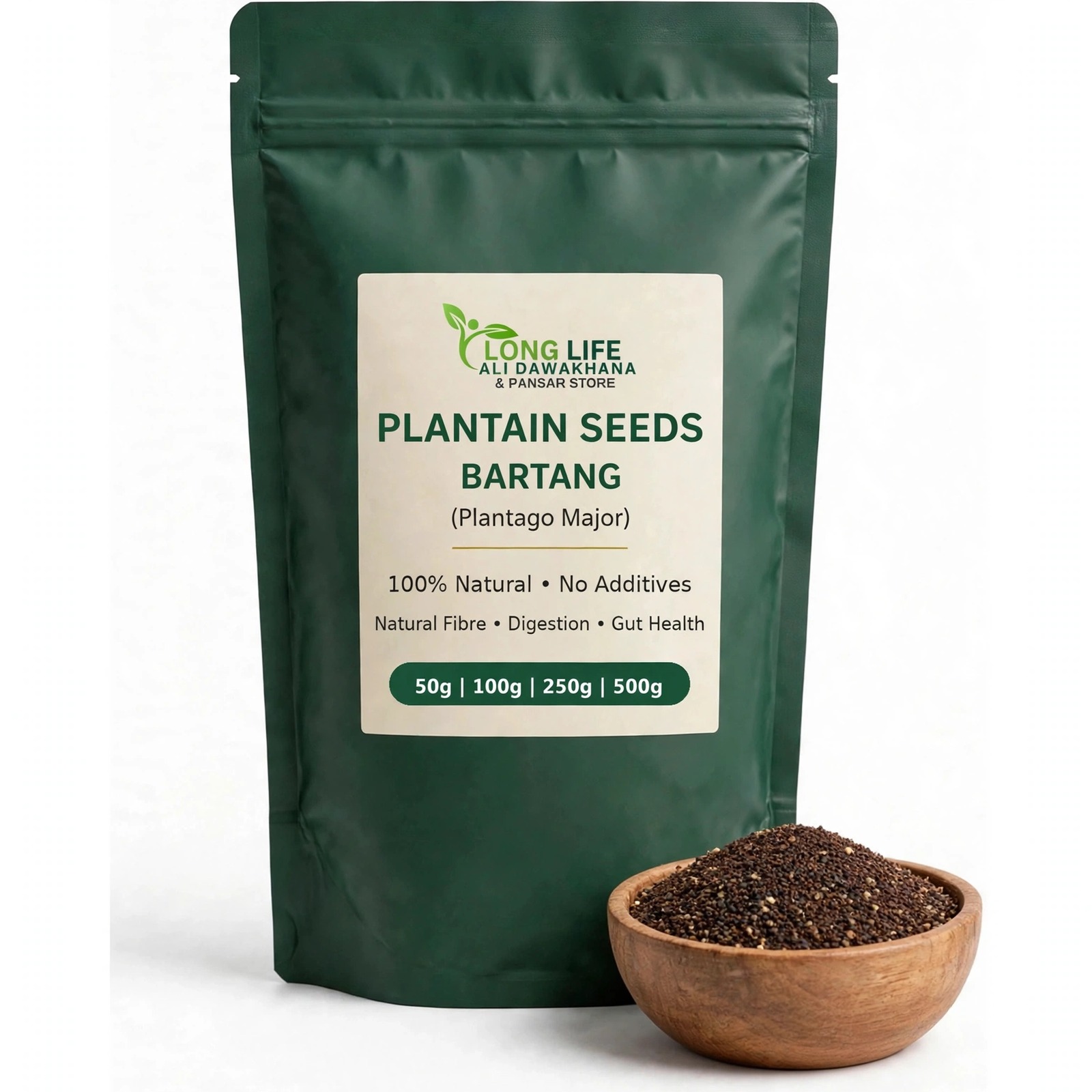
Plantain Seeds (Bartang, Plantago major) are a gentle mucilage-rich bulk fibre traditionally used for digestion, gut health and regularity, and in folk medicine for wounds, coughs and urinary health. Not to be confused with psyllium (isabgol), which comes from a different species (Plantago ovata). At Long.pk they are available in Whole, Powder and Grounded forms (50 gm to 500 gm) from Rs 203, with Cash on Delivery across Pakistan.
بارتنگ (Plantain Seeds) — مکمل معلومات
بارتنگ، جسے انگریزی میں Broadleaf Plantain یا Greater Plantain کہتے ہیں، ایک مشہور جڑی بوٹی ہے جو دنیا بھر میں پائی جاتی ہے۔ اس کا نباتاتی نام Plantago major ہے۔ یہ وہی پودا ہے جس کے پتے زخموں پر لگائے جاتے ہیں — اسکینڈے نیویا میں اسے “groblad” یعنی “شفا کا پتا” کہا جاتا ہے۔
اہم فرق: بارتنگ اسپغول (isabgol) نہیں ہے۔ اسپغول ایک الگ نسل (Plantago ovata) کی بھوسی ہے۔ بارتنگ کے بیجوں میں بھی mucilage ہوتا ہے جو پانی میں پھول کر جیل بناتا ہے، اور اسی لیے یہ ہاضمے کے لیے اسی طرح کام کرتے ہیں — لیکن دونوں الگ دوائیں ہیں۔
بارتنگ کے بیجوں میں 10 سے 20 فیصد mucilage ہوتا ہے — ایک قدرتی فائبر جو آنتوں کو نرم کرتا ہے، قبض اور دست دونوں میں مدد کرتا ہے، اور پیٹ کی جلن کو سکون دیتا ہے۔ چینی طب میں بارتنگ کے بیج (Che Qian Zi) پیشاب کی نالی اور گرمی دور کرنے کے لیے استعمال ہوتے ہیں۔
بارتنگ کے پتے زخموں کے لیے مشہور ہیں — جدید تحقیق میں زخموں پر اس کا اثر چاندی کے مرہم (silver sulfadiazine) جتنا پایا گیا۔ بیج زیادہ تر ہاضمے اور پیشاب کے لیے استعمال ہوتے ہیں۔
بیج ہمیشہ کافی پانی کے ساتھ لیں — کم از کم ایک گلاس (250 ملی لیٹر) فی خوراک۔ خشک بیج کبھی نہ نگلیں — یہ گلے یا آنت میں پھول کر رکاوٹ بن سکتے ہیں۔
بارتنگ کے فائدے (روایتی استعمال)
- ہاضمہ: mucilage آنتوں کو نرم کرتا ہے اور قبض و دست دونوں میں مدد کرتا ہے۔
- زخم (پتے): پتے زخموں، جلنے اور جلد کی سوزش پر لگائے جاتے ہیں۔
- کھانسی: جرمن کمیشن E نے اسے کھانسی اور گلے کی سوزش کے لیے منظور کیا ہے۔
- پیشاب: چینی طب میں بیج پیشاب کی نالی کی سوزش کے لیے استعمال ہوتے ہیں۔
- پیٹ کے السر: بیجوں کا mucilage پیٹ کی اندرونی جھلی کو سکون دیتا ہے۔
استعمال کا طریقہ
- بیج: 5 سے 10 گرام بیج کم از کم 250 ملی لیٹر پانی یا دودھ میں ملا کر پیئیں۔ دن میں 2 سے 3 لیٹر پانی پینا ضروری ہے۔
- کبھی خشک نہ لیں: بیج ہمیشہ پانی میں بھگو کر یا پانی کے ساتھ لیں۔
- دوا سے وقفہ: بیج کھانے کے 2 گھنٹے پہلے یا بعد میں کوئی دوا نہ لیں — mucilage دوا کے جذب ہونے میں رکاوٹ ڈال سکتا ہے۔
بارتنگ Long.pk سے Whole، Powder یا Grounded فارم میں 50 گرام سے 500 گرام تک منگوایا جا سکتا ہے۔ قیمت صرف 203 روپے سے شروع ہوتی ہے اور پورے پاکستان میں کیش آن ڈیلیوری دستیاب ہے۔
Plantain Seeds (Bartang) – Price in Pakistan, Benefits, Uses & Safety
Direct answer: Plantain Seeds (Bartang, Plantago major) price in Pakistan starts from Rs 203 for 50 gm (Whole form) at Long.pk, going up to Rs 2,405 for 500 gm (Powder or Grounded form). They are available in three forms — Whole, Powder and Grounded — in 50 gm, 100 gm, 250 gm and 500 gm packs, with cash on delivery across Pakistan. The seeds are rich in mucilage (10–20% of dry weight) — a gentle bulk-forming fibre that soothes the gut, helps both constipation and diarrhoea, and supports regularity. Plantain seeds are NOT psyllium (isabgol) — psyllium is the husk of a different species, Plantago ovata. The two have similar bulk-forming properties, but different evidence bases: psyllium has the large cholesterol and IBS trials, while Plantago major has the wound-healing trials (for the leaves) and smaller seed trials. Always take the seeds with plenty of water — at least 250 ml per dose — and never take them dry.
Table of Contents
- What Are Plantain Seeds?
- History of Plantain
- Active Compounds
- Plantain Seeds in Ayurveda, Unani & Folk Medicine
- What Does Modern Research Say?
- Detailed Benefits of Plantain Seeds
- Seeds or Leaves?
- Who Are Plantain Seeds For?
- How to Use Plantain Seeds
- Traditional Combinations
- Dosage & Duration
- Side Effects & Who Should Avoid Them
- How to Identify Original Plantain Seeds
- Storage & Shelf Life
- Plantain Seeds vs Psyllium vs Flaxseed
- Plantain Seeds Price in Pakistan
- Product Specifications
- Roman Urdu
- Frequently Asked Questions
What Are Plantain Seeds?
Plantain Seeds (Bartang, Plantago major L.) are the tiny dark brown seeds of the broadleaf plantain — a perennial herb in the Plantaginaceae family, native to Europe and Asia and now naturalised on every continent. In Urdu it is Bartang (بارتنگ), in English Broadleaf Plantain or Greater Plantain, in Chinese Che Qian Zi (車前子, the seeds) and Che Qian Cao (the whole plant), and in Scandinavia groblad (“healing leaf”).
The Plantago genus contains about 250 species, of which the most familiar are Plantago major (broadleaf plantain), Plantago lanceolata (narrowleaf or ribwort plantain) and Plantago ovata — better known as psyllium. P. major is a low-growing plant with broad, ribbed basal leaves and a tall flower spike that produces 13,000 to 15,000 seeds per plant — seeds that can remain viable in soil for up to 60 years, which is why plantain follows humans everywhere. (It is not related to the edible plantain banana, Musa paradisiaca.)
The seeds are the mucilage store of the plant: they contain 10–20% mucilage polysaccharides by dry weight (the leaves contain only about 2–6%). When the seeds meet water, the mucilage swells into a soft gel — the same behaviour as chia seeds or flaxseed. That gel is the medicine: it bulks the stool, softens it, and slows the transit of sugars and fats, and feeds the gut bacteria that produce short-chain fatty acids.
The psyllium distinction. Psyllium husk (ispaghula, isabgol) is the outer coat of Plantago ovata seeds — a different species, grown mainly in India and Pakistan. P. major seeds are distinct from psyllium but have similar bulk-forming properties. The two are often confused, and the big clinical trials (cholesterol, IBS) belong to psyllium, not to P. major. This article keeps the two separate and attributes each piece of evidence to the right species.
History of Plantain
Plantain is one of the most widely distributed medicinal herbs on Earth, used across virtually every traditional healing system. In Europe, it has been a wound herb since antiquity — the Anglo-Saxons called it “waybread” and listed it among the nine sacred herbs of the Lacnunga (a 10th-century medical text). In Scandinavia, it is still groblad, the “healing leaf”, and remains the first remedy for minor wounds. In North America, Indigenous peoples called it “White Man’s Footprint” because it arrived with European settlers and sprang up wherever they walked.
In traditional Chinese medicine, plantain has been used for over 2,000 years: the seeds (Che Qian Zi) are the primary medicinal, valued for their diuretic and heat-clearing action on the urinary tract, while the whole plant (Che Qian Cao) is used more topically and for respiratory conditions. In Persian medicine, plantain is used for wounds, ulcers and inflammation — and the Iranian traditional use for pressure ulcers has been validated by a modern randomised trial. In Ayurveda, plantain (Bartang) is used for wounds, coughs, urinary complaints and digestive disorders. In Brazil, it is Transagem or Erva-de-orelha, known for wound healing and anti-inflammatory use.
The modern regulatory picture reflects that long history: the German Commission E (Germany’s official herbal medicines authority) approves plantain for cough and skin inflammation, and the British Herbal Pharmacopoeia describes its actions as “demulcent & laxative”, indicated for chronic constipation, dysentery, chronic diarrhoea and cystitis.
Active Compounds
| Compound | Type | What researchers looked at |
|---|---|---|
| Aucubin (0.3–1.5% dry weight) | Iridoid glycoside | The signature compound; anti-inflammatory and antimicrobial; converted in the liver to the active aglycone aucubigenin; promotes dermal (skin) healing |
| Catalpol (0.3–1.0% dry weight) | Iridoid glycoside | Anti-inflammatory; studied for liver and kidney protection in animal models |
| Mucilage polysaccharides (10–20% in seeds) | Polysaccharides | Xylose, galuronic acid, rhamnose and arabinose; the bulk-forming fibre; fermented by colonic bacteria into short-chain fatty acids; soothes mucous membranes |
| Allantoin | Purine derivative | Wound healing — promotes fibroblast proliferation (the cells that rebuild tissue) and cell rejuvenation |
| Plantamajoside | Phenylethanoid glycoside | Antioxidant and anti-inflammatory; the compound that distinguishes P. major from other plantain species |
| Verbascoside | Phenylethanoid glycoside | Antioxidant, anti-inflammatory and antimicrobial |
| Caffeic acid & chlorogenic acid | Phenolic acids | Antioxidant and anti-inflammatory |
| Ursolic acid | Triterpenoid | Anti-inflammatory; studied for muscle and metabolic effects |
| Flavonoids (incl. quercetin) | Flavonoids | Antioxidant; the pressure-ulcer trial ointment was standardised to quercetin 1.88 mg/100 g |
| Tannins | Polyphenols | Astringent — tone tissues and help stop minor bleeding |
| Planteose | Oligosaccharide | A seed-specific sugar; part of the seed’s mucilage chemistry |
| Sorbitol | Sugar alcohol | A mild osmotic laxative in its own right (small amounts) |
Mechanism. The seeds work in two ways. First, the mucilage swells in water to form a gel that bulks the stool, softens it, and slows the transit of sugars and fats — a gentle bulk-forming laxative that, unlike stimulant laxatives, does not irritate the bowel. Second, the iridoid glycosides (aucubin, catalpol) and plantamajoside provide the anti-inflammatory and antimicrobial action that underlies the wound-healing and respiratory uses — though those are mainly the leaves’ story, and the seeds contain less of them.
Plantain Seeds in Ayurveda, Unani & Folk Medicine
In Ayurveda, plantain (Bartang) is used as a cooling, soothing herb for wounds, coughs, urinary complaints and digestive disorders. The leaves are applied as a poultice to wounds and insect bites; the seeds are taken for constipation, diarrhoea and urinary inflammation. The herb is described as cooling and moistening — it soothes tissues that are raw, inflamed or overworked.
In Unani medicine, Bartang is used for wounds, ulcers, coughs, bronchitis and urinary tract inflammation. The seeds’ mucilage is valued as a demulcent — it coats and soothes irritated mucous membranes in the gut, the urinary tract and the throat.
In traditional Chinese medicine, the distinction between parts is precise: the seeds (Che Qian Zi) are the primary medicinal, with stronger diuretic and heat-clearing effects — used for urinary difficulty, oedema, diarrhoea and eye inflammation. The whole plant (Che Qian Cao) is used more for respiratory conditions and external wounds. Both are classed as cold in nature, clearing heat and promoting urination.
In Western folk medicine, plantain is the classic first-aid herb: a crushed leaf applied to a bee sting, a nettle sting, a cut or a blister. The seeds are the gentler internal medicine — a bulk fibre for the gut, used for constipation, IBS and diverticular disease. Herbalist Matthew Wood describes plantain as cooling, moistening, softening (emollient) and astringent — a rare combination that allows it to both soothe and tone at the same time.
What Does Modern Research Say?
Plantago major has an unusually strong clinical-trial record for a traditional herb — though the strongest evidence is for the leaves (topical), not the seeds, and this article keeps that distinction clear.
Wound healing — the strongest evidence (leaves, topical). A randomised controlled trial (n=130) found that topical Plantago major formulations significantly improved stage 1 pressure ulcer healing versus control over 14 days (PMID 33548748). A quasi-experimental study found P. major comparable to silver sulfadiazine for second-degree burn wound healing (PMIDs 35966146, 9359829). These trials used leaf preparations, not seeds — but they validate the traditional wound use that made plantain famous.
Ulcerative colitis — seed evidence. A randomised controlled trial (n=51) found that 3,600 mg daily of roasted P. major seeds for 8 weeks reduced abdominal tenderness and reflux symptoms in ulcerative colitis patients (PMID 34265576). This is the most direct trial evidence for the seeds themselves, though the study data is incomplete in available sources and more robust trials are needed.
Diabetic nephropathy — seed evidence. A randomised open-label controlled trial tested 20 g/day of P. major seeds for 60 days in patients with diabetic kidney disease (PMID 38797623) — a high dose, used only under trial conditions.
NAFLD (fatty liver) — seed evidence. A trial (n=74) gave 4 g/day of P. major for 12 weeks in non-alcoholic fatty liver disease, with positive results reported.
Acute bronchitis — syrup evidence. A trial tested P. major syrup 30 ml/day for 10 days in acute bronchitis (PMID 39359439).
Antimicrobial — laboratory evidence. P. major extracts are effective against common pathogens including Staphylococcus aureus, Escherichia coli and Pseudomonas aeruginosa in the laboratory — including some antibiotic-resistant strains.
The honest summary: the evidence is strongest for topical wound healing (leaves). The seed evidence is promising but thinner — one ulcerative colitis RCT, one diabetic nephropathy trial, one NAFLD trial — and no meta-analyses of human RCTs have been identified. The bulk-forming fibre action of the seeds is well established by analogy with psyllium, but the large psyllium trials (16 constipation RCTs pooled in 2022; 28 cholesterol trials pooled in 2018) belong to P. ovata, not P. major, and should not be claimed for this product.
Detailed Benefits of Plantain Seeds
Every benefit below is described as it appears in the traditional literature and research. The seeds-vs-leaves distinction is stated for each one.
Digestive Regularity (Bulk Fibre)
This is the seeds’ real, established use. The mucilage swells in water to form a gel that adds bulk to the stool, softens it, and normalises transit — helping both constipation and diarrhoea. Unlike stimulant laxatives (senna, rhubarb, aloe), it does not irritate the bowel, and it can be used long-term. The bulk-forming action is the same mechanism as psyllium, and the British Herbal Pharmacopoeia lists chronic constipation, dysentery and chronic diarrhoea among the indications.
Gut Soothing (Demulcent)
The mucilage coats and soothes inflamed mucous membranes in the gut — the classic demulcent action. This is why the seeds are used for IBS, diverticular disease, gastritis and ulcerative colitis (the 3,600 mg/day trial). The gel also slows the absorption of sugars and fats, which is the basis for the blood-sugar and cholesterol claims made for soluble fibre generally.
Urinary Health (Diuretic)
In TCM, the seeds (Che Qian Zi) are the primary diuretic of the plant — used for urinary difficulty, burning urination, and urinary tract inflammation. The British Herbal Pharmacopoeia lists cystitis among the indications. The diuretic action is gentle (it promotes urination without the harshness of a drug diuretic), and the mucilage soothes the urinary tract lining at the same time.
Wound Healing (Leaves)
The famous wound-healing benefit belongs to the leaves, not the seeds — the pressure-ulcer RCT and the burn study both used leaf preparations. The allantoin (which promotes fibroblast proliferation) and aucubin (anti-inflammatory, antimicrobial) are concentrated in the leaves. If you want plantain for wounds, use the leaves as a poultice or a leaf-based ointment, not the seeds.
Cough & Respiratory (Leaves & Syrup)
The German Commission E approves plantain for cough and mucous membrane irritation — the mucilage coats the throat and soothes the cough reflex, and the aucubin provides anti-inflammatory action. The acute bronchitis trial used a syrup (30 ml/day for 10 days). The seeds contribute mucilage to this action, but the leaf is the traditional respiratory part.
Blood Sugar & Cholesterol (Fibre Effect)
Soluble fibre slows the absorption of sugars and binds bile acids (which the liver replaces by drawing on blood cholesterol). The large trials for this effect belong to psyllium — 28 cholesterol trials pooled in 2018 found LDL cholesterol fell by 0.33 mmol/L at a median dose of about 10.2 g/day, and psyllium trials for glycemic control used 6.8–13.6 g/day for 6–12 weeks. P. major seeds have the same fibre mechanism, but the specific trials for P. major are the diabetic nephropathy and NAFLD studies, not the cholesterol meta-analyses.
Skin (External)
The leaves are applied to skin inflammations, insect bites, nettle stings and minor wounds — the German Commission E approves topical use for skin inflammation. The seeds’ mucilage, soaked in water, can be used as a soothing skin preparation, but the leaves are the standard part for skin.
Seeds or Leaves?
The parts of the plantain plant are not interchangeable — and that matters for choosing the right product.
| Part | What it is | Main use | Notes |
|---|---|---|---|
| Seeds | Tiny dark brown seeds; mucilage 10–20% | Bulk fibre for digestion, gut soothing, urinary health | The product sold here. Gentle, long-term use. Must be taken with plenty of water |
| Leaves (fresh) | Broad green leaves; aucubin, allantoin, plantamajoside | Wound poultice, insect bites, skin inflammation | The famous wound herb. Crushed leaf applied directly to the skin |
| Leaves (dried/extract) | Dried leaves or leaf extract | Cough syrup, skin ointment, pressure-ulcer treatment | German Commission E approved for cough + skin inflammation; the pressure-ulcer and burn trials used leaf preparations |
| Whole plant (Che Qian Cao) | Leaves + stems + seeds | TCM: respiratory conditions, external wounds, heat-clearing | Used more topically and for respiratory conditions in TCM |
| Seeds (Che Qian Zi) | Seeds alone | TCM: diuretic, urinary tract, heat-clearing | The primary TCM medicinal — stronger diuretic and clearing effects than the whole plant |
| Psyllium husk (P. ovata) | Husk of a different species’ seeds | Bulk laxative, cholesterol, IBS | A different species with the big clinical trials; not this product |
This product is the seeds. Buy it for digestion, gut health and urinary support — for wounds and coughs, the leaves are the traditional part.
Who Are Plantain Seeds For?
Plantain seeds are for adults who want a gentle, natural bulk fibre for digestive regularity — constipation, IBS, diverticular disease, or simply more fibre in the diet. They are also for people who want the traditional demulcent action for an irritated gut or urinary tract, and for practitioners of Unani, Ayurvedic and Chinese medicine who use Bartang / Che Qian Zi in compound preparations.
They are not for anyone with bowel obstruction, faecal impaction, or difficulty swallowing — the mucilage can make an obstruction worse. They are not for anyone who cannot drink enough water with each dose. They are not a substitute for psyllium if your doctor specifically prescribed ispaghula (though the two are similar, they are different species with different evidence). And they are not a wound treatment — for wounds, use the leaves.
How to Use Plantain Seeds
As a bulk fibre. Mix 5–10 g (1–2 teaspoons) of seeds in at least 250 ml of cold water, milk or juice, stir, and drink immediately — before the mucilage thickens. Take 1–3 times a day. Drink more than 2 litres of water through the day, or the fibre can make constipation worse. Expect results in 2–3 days (bulk laxatives work slowly — they are not a quick fix).
Soaked overnight. Soak the seeds in water overnight to release the mucilage, then drink the gel-like liquid in the morning. This is the gentlest preparation and the easiest on a sensitive stomach.
As a powder. The powder can be mixed into smoothies, yoghurt or porridge — but still with plenty of fluid. The powder thickens faster than the whole seeds, so drink it promptly.
Externally (mucilage). Soak the seeds in water and use the mucilaginous liquid as a soothing skin preparation, or as a hair rinse. The leaves are the standard part for skin, but the seed mucilage is a gentle alternative.
What NOT to do. Never take the seeds dry. Never take them without enough water. Do not take them at the same time as medicines — keep a 2-hour gap. Do not take very high doses (the mucilage can cause GI obstruction).
Traditional Combinations
- Plantain Seeds + Psyllium (Isabgol): the two bulk fibres together — psyllium for the strong gel, plantain seeds for the demulcent and diuretic action. A common combination in Unani practice for chronic constipation.
- Plantain Seeds + Fennel (Saunf): fennel’s carminative action reduces the gas and bloating that fibre can cause in the first week or two.
- Plantain Seeds + Liquorice (Mulethi): two demulcents together — liquorice soothes the gut lining while the plantain mucilage bulks and coats it.
- Plantain Seeds + Honey: honey is a traditional vehicle for seed powders, and adds its own soothing action for the throat and gut.
- Plantain Seeds + Flaxseed (Alsi): two mucilage seeds together — flaxseed adds omega-3 fatty acids and lignans, plantain adds the iridoid glycosides.
- Plantain Leaves + Honey (external): the traditional wound poultice — crushed leaves mixed with honey, applied to cuts and skin inflammations.
Dosage & Duration
The figures below come from the British Herbal Pharmacopoeia, the clinical trials, and the psyllium literature (marked where it applies to psyllium, not P. major). They are given for information — your practitioner’s instruction takes priority.
| Form | Dose | Notes |
|---|---|---|
| Seeds (British Herbal Pharmacopoeia) | 5–10 g (2–4 tsp) per dose, adults; 3 g (1.5 tsp) children | With at least 250 ml water per dose |
| Seeds (ulcerative colitis trial) | 3,600 mg/day roasted seeds, 8 weeks | Reduced abdominal tenderness and reflux symptoms (n=51) |
| Seeds (NAFLD trial) | 4 g/day, 12 weeks | Positive results reported (n=74) |
| Seeds (diabetic nephropathy trial) | 20 g/day, 60 days | High dose, trial conditions only — do not self-prescribe |
| Psyllium (Drugs.com, for comparison) | 3–6 g/day general; 10.2 g/day for cholesterol | These are P. ovata doses, not P. major doses |
| Syrup (acute bronchitis trial) | 30 ml/day, 10 days | Leaf-based syrup, not seeds |
| Topical ointment (pressure-ulcer trial) | Daily for 14 days | Leaf preparation, standardised to quercetin 1.88 mg/100 g |
Duration: unlike the stimulant laxatives in this series, plantain seeds can be used long-term — they are a food-grade fibre, not a drug. Start with a half dose for the first week (the gut bacteria need time to adjust, and mild gas in the first week or two is normal), then increase to the full dose. Drink plenty of water throughout the day.
Side Effects & Who Should Avoid Them
Plantain seeds are among the safest herbs in this series — but the mucilage demands respect.
Possible side effects: flatulence, bloating, nausea, vomiting, indigestion and sternum pain — mostly in the first week or two, as the gut adjusts to the extra fibre. Starting with a half dose and increasing slowly reduces these.
Serious risks (rare):
- Choking and GI obstruction: the mucilage swells rapidly in water. Taking the seeds dry, or without enough fluid, can cause choking or a blockage in the gut. A case of giant phytobezoar (a trapped mass of psyllium husks) has been reported. Chest pain, vomiting, or difficulty swallowing or breathing after a dose means stop and get urgent help.
- Allergic reactions: plantain pollen contains allergenic glycoproteins that bind IgE. Reactions range from sneezing and watery eyes to (rarely) anaphylaxis and occupational asthma. People with plantain pollen allergy should avoid the seeds.
- Drug absorption: the mucilage slows gastric emptying and can reduce the absorption of co-ingested medicines. Keep a 2-hour gap between the seeds and any medication.
Who must avoid them:
- People with bowel obstruction or faecal impaction — the bulk fibre can make an obstruction worse.
- People with difficulty swallowing — choking risk from the swelling mucilage.
- People with plantain pollen allergy — risk of allergic reaction, including anaphylaxis.
- People who cannot drink enough water — the fibre needs fluid to work safely.
Pregnancy — a genuine disagreement in the sources. Drugs.com advises avoiding plantain in pregnancy, citing documented uterine activity and laxative effects. Some herbalists (e.g. Whelan) consider plantain safe in pregnancy and breastfeeding. The cautious position is to consult a doctor before using plantain seeds in pregnancy — do not assume safety from either source alone.
Regulatory status: German Commission E approves plantain for cough and skin inflammation. British Herbal Pharmacopoeia lists it as demulcent & laxative. Not FDA-approved for any medical use.
How to Identify Original Plantain Seeds
- Seeds: genuine plantain seeds are tiny (1–2 mm), dark brown to almost black, oval, with a smooth, slightly shiny surface. They should feel dry and free-flowing — damp or clumped seeds are poor quality.
- Mucilage test: soak a teaspoon of seeds in water for 10 minutes — they should swell and form a visible gel around each seed, like chia seeds. If no gel forms, the seeds are old or not plantain.
- Powder: plantain seed powder is brown, fine and slightly gritty. Very pale powder may be cut with filler.
- Smell: a mild, earthy, slightly grassy smell. A musty or fermented smell means damp storage — reject it.
- No mould: reject any seeds or powder with white or green mould spots.
- Not psyllium: psyllium husk is pale, flaky and light; plantain seeds are dark, small and dense. If the product looks like pale flakes, it is isabgol, not bartang.
- Buy from a trusted store: Long.pk sources its Bartang from established pansar suppliers, and the seeds are packed in sealed pouches that protect them from moisture and contamination.
Storage & Shelf Life
Store plantain seeds in an airtight container or their sealed pouch, away from light, heat and moisture. A cool, dry cupboard is ideal. The whole seeds keep their potency for 24 months or more when stored properly — they are one of the most stable dried herbs (the seeds remain viable in soil for up to 60 years). The powder loses strength faster (use within 12 months of grinding). Do not store them in the bathroom or near the stove, where steam and heat degrade them.
Plantain Seeds vs Psyllium vs Flaxseed
These three are the great mucilage seeds — all three swell in water, bulk the stool, and soothe the gut — but they differ in species, evidence and extra benefits.
| Feature | Plantain Seeds (Bartang) | Psyllium (Isabgol) | Flaxseed (Alsi) |
|---|---|---|---|
| Botanical name | Plantago major | Plantago ovata (husk) | Linum usitatissimum |
| Part used | Whole seeds | Seed husk | Whole seeds |
| Mucilage | 10–20% (seeds) | Very high (husk) | Moderate (seed coat) |
| Main action | Bulk fibre + demulcent + diuretic | Bulk fibre (strongest gel) | Bulk fibre + omega-3 + lignans |
| Extra compounds | Aucubin, catalpol, allantoin, plantamajoside | Minimal (mostly fibre) | Omega-3 (ALA), lignans, protein |
| Wound healing | Yes (leaves — RCT evidence) | No | No |
| Cholesterol trials | None for P. major | 28 trials pooled (LDL −0.33 mmol/L) | Moderate evidence |
| IBS trials | None for P. major | 275 adults, 12 weeks, 10 g | Limited |
| Constipation trials | None for P. major | 16 RCTs pooled (1,251 adults) | Moderate evidence |
| Diuretic | Yes (TCM: Che Qian Zi) | No | No |
| Long-term use | Yes — food-grade fibre | Yes — food-grade fibre | Yes — food-grade fibre |
| Must take with water | Yes — min 250 ml per dose | Yes — min 150 ml per dose | Yes |
| Pregnancy | Consult a doctor (sources disagree) | Generally considered safe | Generally considered safe |
| Price (Long.pk, from) | Rs 203 / 50 gm | — | — |
Which to choose: for cholesterol or IBS, psyllium has the strongest trial evidence. For a gentle fibre with added wound-healing, diuretic and anti-inflammatory tradition, plantain seeds are the choice. For omega-3 and lignans as well as fibre, flaxseed is the choice. All three can be used long-term, and all three must be taken with plenty of water.
Plantain Seeds Price in Pakistan
Prices checked 19 November 2026 (following pansaar.com, rounded to whole rupees). Cash on Delivery available across Pakistan.
| Form | 50 gm | 100 gm | 250 gm | 500 gm |
|---|---|---|---|---|
| Whole | Rs 203 | Rs 388 | Rs 1,181 | Rs 2,236 |
| Powder | Rs 506 | Rs 717 | Rs 1,350 | Rs 2,405 |
| Grounded | Rs 506 | Rs 717 | Rs 1,350 | Rs 2,405 |
Best value: the 100 gm Whole pack at Rs 388 is the best value per gram in the Whole range (about Rs 388 per 100 gm, against Rs 406 for the 50 gm pack and Rs 447 for the 500 gm pack) — pansaar’s own pricing does not get cheaper per gram at the larger sizes for this herb. At the usual dose of 5–10 g a day, the 100 gm pack lasts 10–20 days and the 500 gm pack lasts 50–100 days. The Powder and Grounded forms cost more than Whole (grinding and sieving add cost), which is normal across the herb range — and for this herb, Powder and Grounded are priced identically.
Product Specifications
| Product Name | Plantain Seeds (Bartang) |
| Urdu Name | بارتنگ (Bartang) |
| Botanical Name | Plantago major |
| Family | Plantaginaceae |
| Forms Available | Whole / Powder / Grounded |
| Weights Available | 50 gm / 100 gm / 250 gm / 500 gm |
| Price Range | Rs 203 – Rs 2,405 |
| Purity | 100% Natural, No Additives |
| Origin | Pakistan / South Asia / Europe |
| Shelf Life | 24+ months (whole seeds); 12 months (powder) |
| Storage | Airtight container, cool & dry place, away from sunlight |
| Seller | Ali Dawakhana and Pansar Store |
| Delivery | Cash on Delivery across Pakistan |
Roman Urdu
Plantain Seeds (Bartang, Plantago major) aik naram aur mehfooz bulk fibre hain — in mein 10 se 20 faisad mucilage hota hai jo pani mein phool kar gel banata hai aur aanton ko naram karta hai. Yeh qabz aur dast dono mein madad kartay hain, aur pait ki jalan ko sukoon detay hain. Cheeni tib mein bartang ke beej (Che Qian Zi) peshaab ki naali aur garmi door karne ke liye istemal hotay hain.
Ahem farq: bartang isabgol nahi hai. Isabgol aik alag nasal (Plantago ovata) ki bhoosi hai. Dono ke bulk-forming asraat aik jaisay hain, lekin dono alag dawayen hain — cholesterol aur IBS ki barri tehqeeq isabgol ki hai, jab ke zakhmon ki tehqeeq bartang (pattay) ki hai.
Bejon ko hamesha kaafi pani ke saath lein — kam az kam aik glass (250 ml) fi khurak — aur kabhi khushk na niglein. Khurak 5 se 10 gram hai, din mein 1 se 3 baar. Dawa se 2 ghantay ka waqfa rakhen.
Long.pk se Bartang Whole, Powder aur Grounded form mein 50 gm se 500 gm tak dastiyab hai — qeemat sirf Rs 203 se shuru. Pure Pakistan mein Cash on Delivery ki sahulat mojood hai.
Frequently Asked Questions
Q: Bartang kis kaam aata hai?
Bartang (Plantago major) ke beej aik naram bulk fibre hain — qabz aur dast dono mein madad kartay hain, pait ki jalan ko sukoon detay hain, aur peshaab ki naali ke liye istemal hotay hain. Is ke pattay zakhmon ke liye mashhoor hain.
Q: Bartang ki Pakistan mein qeemat kya hai?
Long.pk par Bartang ki qeemat Rs 203 se shuru hoti hai (50 gm Whole) aur Rs 2,405 tak jati hai (500 gm Powder/Grounded). Whole, Powder aur Grounded — teeno forms 50, 100, 250 aur 500 gm mein dastiyab hain.
Q: Bartang aur isabgol mein kya farq hai?
Isabgol (Plantago ovata) ki bhoosi hai — aik alag nasal. Bartang (Plantago major) ke beej hain. Dono bulk fibre hain aur aik hi tareeqay se kaam kartay hain, lekin cholesterol aur IBS ki barri tehqeeq isabgol ki hai, jab ke zakhmon ki tehqeeq bartang ki hai.
Q: Bartang ke beej kaisay lein?
5 se 10 gram beej kam az kam 250 ml pani, doodh ya juice mein mila kar foran pee lein — mucilage gaarha hone se pehle. Din mein 2 se 3 litre pani peena zaroori hai. Natija 2 se 3 din mein nazar aata hai.
Q: Kya bartang ke beej khushk le saktay hain?
Nahi — kabhi nahi. Mucilage pani mein phoolta hai aur galay ya aant mein rukawat ban sakta hai. Hamesha kaafi pani ke saath lein.
Q: Kya bartang lambi muddat tak le saktay hain?
Haan — yeh aik food-grade fibre hai, dawa nahi. Senna ya rhubarb ke bar-aks, isay lambi muddat tak istemal kiya ja sakta hai. Pehle haftay aadhi khurak se shuru karein — gas ya phoolna aam hai.
Q: Bartang zakhmon ke liye kaisa hai?
Zakhmon ke liye pattay istemal hotay hain, beej nahi. Aik trial mein bartang ke pattay pressure ulcers mein aur jalan (burns) mein chandi ke marham jitnay mufeed paaye gaye. Beej hazmay aur peshaab ke liye hain.
Q: Bartang dawa ke saath le saktay hain?
Mucilage dawa ke jazb hone mein rukawat daal sakta hai — bejon aur dawa ke darmiyan 2 ghantay ka waqfa rakhen.
Q: Bartang kon istemal na karay?
Aant ki rukawat ya qabz ki shadeed soorat (faecal impaction) walay, nigalne mein mushkil walay, aur plantain pollen se allergy walay isay istemal na karein. Haamla khawateen doctor se mashwara karein.
Q: Asli bartang ki pehchan kya hai?
Asli beej chhote (1–2 mm), gehray bhooray se kaalay, aur chamakdar hotay hain. Pani mein bhigone par in ke gird gel ban jata hai — jaisay chia seeds. Agar gel na banay to beej puranay ya naqli hain.
Ali Dawakhana and Pansar Store — Asli desi dawa aur khalis jadi bootiyan, ab ghar baithay Long.pk se mangwayen.
Reviews
There are no reviews yet