
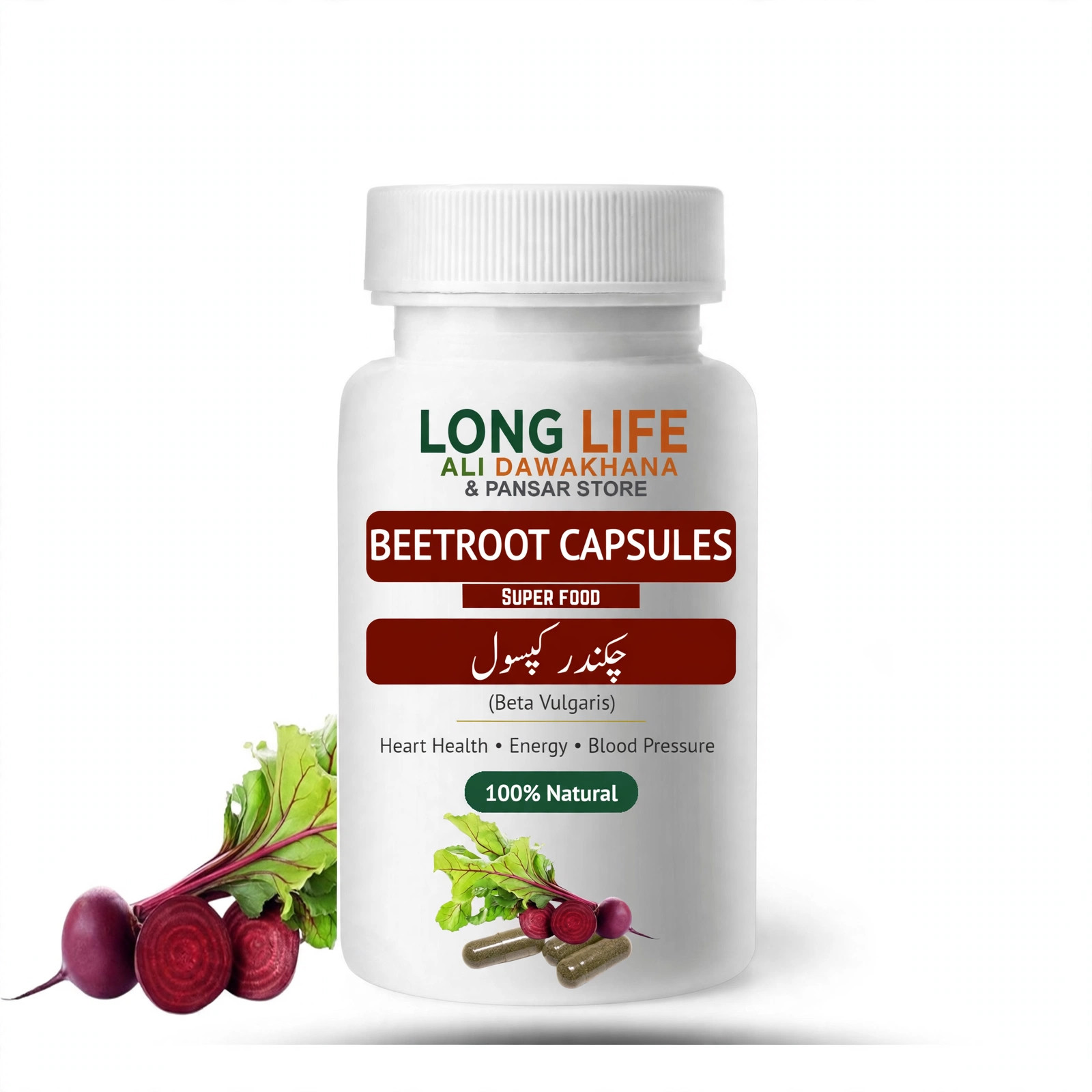
Beetroot Capsules (Chuqandar ke Capsule, Beta vulgaris) are capsules of beetroot powder, a natural source of dietary nitrate that the body converts into nitric oxide, a compound that relaxes blood vessels and supports heart health, healthy blood pressure, energy and stamina. Randomised trials of beetroot juice show a real blood-pressure effect (around 4–8 mmHg lower systolic pressure), but the trials tested juice with known nitrate content — this product’s nitrate content per capsule is not stated, and no trial has tested these capsules directly. At Long.pk they are available in 60-capsule (Rs 900) and 90-capsule (Rs 1,300) packs, with Cash on Delivery across Pakistan.
چکندر کے کپسول (Beetroot Capsules) — مکمل معلومات
چکندر کے کپسول، جنہیں انگریزی میں Beetroot Capsules کہتے ہیں، چکندر (Beta vulgaris) کی جڑ کے پاؤڈر یا مرتکز عرق سے تیار کیے جاتے ہیں۔ چکندر ایک مشہور سبزی ہے جو صدیوں سے کھانے اور دوا دونوں کے طور پر استعمال ہوتی آئی ہے۔ اس میں قدرتی نائٹریٹ (nitrate) پایا جاتا ہے جو جسم میں نائٹرک آکسائیڈ (nitric oxide) میں بدل کر خون کی نالیوں کو کھولتا ہے اور بلڈ پریشر کو متوازن رکھنے میں مدد کرتا ہے۔
اہم انتباہ: چکندر کے کپسول لینے کے بعد پیشاب یا پاخانہ سرخ ہو سکتا ہے — یہ عام طور پر بے ضرر ہوتا ہے۔ گردے کی پتھری والے افراد، بلڈ پریشر کی دوا لینے والے اور دل کی دوا (جیسے sildenafil) لینے والے افراد ڈاکٹر سے مشورہ کر کے استعمال کریں۔ اس پراڈکٹ کی کوئی مخصوص روزانہ خوراک درج نہیں ہے — لیبل کی ہدایت اور ڈاکٹر کے مشورے پر عمل کریں۔
چکندر کے کپسول کے فائدے
- دل اور خون: بلڈ پریشر کو متوازن رکھنے اور دل کی صحت میں مددگار۔
- توانائی اور قوت: جسمانی توانائی اور برداشت (stamina) بڑھانے میں معاون۔
- اینٹی آکسیڈنٹ: جسم کو فری ریڈیکلز کے نقصان سے بچانے میں مدد۔
- خون کی گردش: خون کی نالیوں کو کھول کر گردش بہتر بناتا ہے۔
- دماغ: دماغ تک خون کی فراہمی بہتر کرنے میں مددگار (ابتدائی تحقیق)۔
استعمال کا طریقہ
- کپسول پانی کے ساتھ نگلیں، ترجیحاً کھانے کے ساتھ یا کھانے کے بعد۔
- روزانہ خوراک لیبل پر دی گئی ہدایت کے مطابق لیں — خود سے خوراک نہ بڑھائیں۔
- اینٹی بیکٹیریل ماؤتھ واش کے استعمال سے پرہیز کریں کیونکہ یہ منہ کے ان بیکٹیریا کو مار دیتا ہے جو نائٹریٹ کو نائٹرک آکسائیڈ میں بدلتے ہیں۔
چکندر کے کپسول Long.pk سے 60 کپسول (Rs 900) اور 90 کپسول (Rs 1,300) کے پیک میں منگوائے جا سکتے ہیں اور پورے پاکستان میں کیش آن ڈیلیوری دستیاب ہے۔
Beetroot Capsules (Chuqandar ke Capsule) – Price in Pakistan, Benefits, Uses & Safety
Direct answer: Beetroot Capsules (Chuqandar ke Capsule, Beta vulgaris) price in Pakistan is Rs 900 for 60 capsules and Rs 1,300 for 90 capsules at Long.pk, with cash on delivery across Pakistan. They are capsules of beetroot powder — described by the source as prepared from beetroot powder or concentrated extract — and their main active principle is dietary nitrate, which the body converts into nitric oxide, a natural vasodilator that relaxes blood vessels. Randomised trials of beetroot juice show a genuine effect on blood pressure (systolic pressure roughly 4–8 mmHg lower) and a small benefit for exercise endurance in recreationally active people. But every one of those trials used beetroot juice with a known nitrate content, and this product’s nitrate content per capsule is not stated — so the trial evidence supports the ingredient, not these capsules directly, and this article says so plainly wherever it matters. No mg strength and no specific daily dose are stated for this product: follow the label and your doctor’s advice.
Table of Contents
- What Are Beetroot Capsules?
- History of Beetroot
- Active Compounds
- Beetroot in Unani, Ayurveda & Folk Medicine
- What Does Modern Research Say?
- Detailed Benefits of Beetroot Capsules
- Beetroot and Men’s Health — What the Evidence Actually Says
- Who Are Beetroot Capsules For?
- How to Use Beetroot Capsules
- Traditional Combinations
- Dosage & Duration
- Side Effects & Who Should Avoid Them
- How to Identify Original Beetroot Capsules
- Storage & Shelf Life
- Beetroot Capsules vs Pomegranate vs Garlic
- Beetroot Capsules Price in Pakistan
- Product Specifications
- Roman Urdu
- Frequently Asked Questions
What Are Beetroot Capsules?
Beetroot Capsules — Urdu Chuqandar ke Capsule (چکندر کے کپسول) — are capsules filled with beetroot powder, made from the root of Beta vulgaris L., the common beetroot (also called garden beet or red beet), a member of the Amaranthaceae family. The source describes the product as “prepared from beetroot powder or concentrated extract”. A capsule is simply a convenient way to take beetroot without juicing a root vegetable every day: no peeling, no red-stained hands, no earthy taste.
Names: In Urdu beetroot is Chuqandar (چکندر); in Hindi Chukandar; in Arabic Shamandar (شمندر); in Sanskrit Palanki is sometimes used for beet (though the classical Sanskrit texts more often mean spinach-like greens by that name — the identification is not certain). The English name “beetroot” distinguishes the root vegetable from its relatives: sugar beet (the white industrial beet grown for sugar), chard (grown for its leaves) and mangelwurzel (fodder beet). All of them are the same species, Beta vulgaris, bred in different directions.
Which part is used? The root — the deep red, round storage root — is the part in these capsules. The leaves (beet greens) are also edible and nutritious, richer in some minerals than the root, but they are not what is in the capsule. The root’s deep red colour comes from betalains, pigments found in almost no other food plant, and its most studied active compound is dietary nitrate — beetroot is one of the richest dietary sources of nitrate known.
What is NOT stated about this product. Three things a careful buyer should know: the source states no mg strength per capsule, no nitrate content per capsule, and no specific daily dose. That is common for herbal capsule products, but it matters here more than usual — because the clinical evidence for beetroot is dose-dependent on nitrate (see the research section), and without a stated nitrate content there is no way to compare a capsule with the juice used in the trials. This article does not invent those numbers, and it does not pretend the gap does not exist.
History of Beetroot
The wild ancestor of beetroot is the sea beet (Beta vulgaris subsp. maritima), a leafy plant of Mediterranean and Atlantic coastlines that has been gathered since prehistoric times. The ancient Greeks and Romans grew beets mainly for their leaves — the root was thin, pale and woody, and it was the leaves that went into the pot and the medicine chest. Hippocrates (c. 460–370 BCE) recommended beet leaves for wounds, and the Roman naturalist Pliny the Elder (1st century CE) listed beet as a treatment for fevers and constipation. The Roman physician Apicius included beets in his cookery, and the root was valued as a medicine long before anyone bred it fat and sweet.
The swollen red root we know today is a much later invention. Beetroot as a root vegetable was developed in Europe in the 16th and 17th centuries, and it spread east along the trade routes — into Russia, where it became the heart of borscht, and into the Ottoman and Mughal worlds, where it joined the Unani materia medica as Chuqandar. In 1747 the German chemist Andreas Marggraf discovered that beetroot contains sucrose identical to cane sugar, and his student Franz Karl Achard turned that discovery into the sugar beet industry — by the 19th century, beet sugar was a strategic crop across Europe, and the beet family split into the food beet and the industrial sugar beet.
The modern scientific story of beetroot began only in 2007–2008, and it is one of the fastest journeys from laboratory curiosity to supermarket health food in nutrition science. In 2007, Larsen and colleagues at the Karolinska Institute in Stockholm showed that dietary nitrate from vegetables lowers blood pressure in healthy volunteers. In 2008, Webb and colleagues in London showed that 500 ml of beetroot juice lowered blood pressure within hours — and that the effect disappeared when the nitrate was removed, proving that nitrate, not some other compound, was doing the work. Within a few years, beetroot juice was being tested in athletes (the 2012 London Olympics saw several teams drinking it), in people with high blood pressure, and in patients with heart failure and peripheral artery disease. The capsule form followed the juice: the same root, dried and powdered, in a form that needs no fridge and no juicer. That convenience is real — but the capsules have not been through the trials the juice has, and the rest of this article keeps that distinction in view.
Active Compounds
The chemistry of Beetroot Capsules is dominated by one compound that most foods barely contain: dietary nitrate. But the root carries a second family of compounds — the betalain pigments — that no other common vegetable has at all.
Dietary nitrate (NO₃⁻) — the key compound. Beetroot is one of the richest dietary sources of nitrate, typically around 250 mg of nitrate per 100 g of fresh root (roughly 4 mmol), though the amount varies with the soil, the season and the variety — nitrate-rich soil grows nitrate-rich beets. In the body, nitrate follows a remarkable pathway: it is absorbed from the gut, concentrated in the saliva, and converted by bacteria on the tongue into nitrite (NO₂⁻), which the stomach acid and the blood then convert into nitric oxide (NO) — a gas that relaxes the smooth muscle of blood vessels, widening them and lowering blood pressure. This is the nitrate–nitrite–NO pathway, and it is the mechanism behind almost every trial result in this article. One practical consequence: antibacterial mouthwash kills the tongue bacteria that do the first conversion, and studies have shown it measurably reduces the blood-pressure effect of dietary nitrate. The bacteria are part of the medicine.
Betalains — the red pigments. The deep red colour of beetroot comes from betanin (a red-violet betacyanin) and vulgaxanthin (a yellow betaxanthin). Betalains are powerful antioxidants in the laboratory — betanin has shown stronger free-radical scavenging than some better-known plant pigments — and they are the reason beetroot stains everything it touches, including urine (see beeturia in the side-effects section). How much betalain survives drying and encapsulation, and how much of it is absorbed from a capsule, is not well established — the pigments are sensitive to heat, light and stomach acid.
Betaine (trimethylglycine). Beetroot is one of the richest food sources of betaine, a compound the body uses as a methyl donor — it helps convert homocysteine (an amino acid linked to heart risk when elevated) back into methionine. Betaine supplements have been studied for lowering homocysteine and for exercise performance, with modest and mixed results; the amount in a beetroot capsule is far smaller than supplement doses.
Folate, potassium, manganese and vitamin C. A serving of beetroot provides useful amounts of folate (important for blood formation and, in pregnancy, for the baby’s development), potassium (which itself helps blood pressure), manganese and a modest amount of vitamin C. A capsule contains a fraction of a fresh root, so these nutrients are present in small amounts — the capsule is a nitrate and betalain product, not a multivitamin.
Natural sugars and fibre. Fresh beetroot is about 7% natural sugars and 2–3% fibre. The fibre stays behind in the pulp when juice is made, and a dried powder retains some of it; the sugars remain in the powder in small amounts — worth noting for diabetics (see the side-effects section), but modest in capsule quantities.
| Compound | What it does | Evidence level |
|---|---|---|
| Dietary nitrate | Converts to nitric oxide; relaxes blood vessels; lowers blood pressure | Human trials (juice) |
| Betalains (betanin, vulgaxanthin) | Antioxidant pigments; the red colour | Laboratory + composition |
| Betaine | Methyl donor; homocysteine metabolism | Mixed human data (supplement doses) |
| Folate | Blood formation; cell growth | Established nutrition |
| Potassium | Helps blood-pressure regulation | Established nutrition |
| Vitamin C | Antioxidant; supports iron absorption | Established nutrition |
Beetroot in Unani, Ayurveda & Folk Medicine
Beetroot’s classical record is thinner than the records of the herbs that fill the rest of the Long.pk range — and this article says so honestly. Chuqandar is a relative newcomer to South Asian medicine: the root vegetable reached India and Persia centuries after the classical Unani and Ayurvedic texts were written, so it has no entry in the Canon of Medicine or the Charaka Samhita comparable to the great classical drugs. What follows is the later Unani and folk record, not an ancient one.
In Unani medicine, chuqandar is described as hot and moist in temperament (first degree), with a softening and opening action. The later Unani texts and the pansar tradition use it as a blood builder — the red root, by the old doctrine of signatures, was thought to enrich the blood — and as a gentle remedy for constipation, liver sluggishness and low energy. The juice of the root is used in folk practice as a liver tonic, and the cooked root is a common home food for people recovering from illness or blood loss. The leaves, where they are used, are treated as a cooling, cleansing green for the liver and bowels. None of these uses was ever tested in a trial; they rest on the folk observation that a red, iron- and folate-containing root seems to help pale, tired people — an observation modern nutrition partly supports (folate and iron do matter for blood formation) without proving the traditional claims.
In Ayurveda, beetroot (sometimes called Raktakanda in modern Ayurvedic writing) is a minor entry: it is described as sweet, heavy and cooling-to-warming depending on the source, used for Pitta and Vata complaints, for anaemia-type weakness and for constipation. It is a food first and a medicine second, and it does not appear in the classical formulations the way the great Ayurvedic roots do.
In European folk medicine, beetroot has a longer record: the root was used for fevers, constipation and skin complaints, beet juice for liver and gallbladder troubles, and — in the 20th century — the Hungarian physician Alexander Ferenczi popularised crude beetroot juice as a folk cancer remedy in the 1950s. That claim has no clinical support and this article does not repeat it as a benefit: laboratory studies of betalains show anti-inflammatory and antioxidant activity, but there is no human evidence that beetroot treats or prevents cancer.
The honest summary: beetroot’s traditional record is a food-medicine record — a nourishing root used for blood, liver and bowels — and its modern reputation rests almost entirely on the nitrate research of the last fifteen years, not on classical authority. That is the opposite pattern from most herbs in this series, and it is worth knowing.
What Does Modern Research Say?
Beetroot has one of the strongest human-trial records of any food in this series — but the trials tested juice, and this section keeps that fact in front of the reader at every step.
The mechanism — the nitrate–nitrite–NO pathway. The body’s own nitric oxide system (the L-arginine–NO pathway) weakens with age and disease. Dietary nitrate provides a second route: nitrate from food is absorbed, concentrated in saliva, converted by tongue bacteria to nitrite, and then to nitric oxide in the blood and tissues. Nitric oxide relaxes blood-vessel walls, improves blood flow, and reduces the work the heart must do. The pathway was only fully described in the 2000s, and it overturned the old view of nitrate as a mere food contaminant: at dietary levels, from vegetables, nitrate is a nutrient with a job to do. Antibacterial mouthwash disrupts the first step — studies show it reduces the blood-pressure effect of nitrate-rich food — because the tongue bacteria are doing essential work.
Blood pressure — the strongest evidence. This is where the trials are most convincing. Siervo et al. (2013) pooled 16 randomised trials with 254 participants and found beetroot juice lowered systolic blood pressure by 4.4 mmHg on average, with a clear dose-response (more nitrate, bigger drop); the diastolic drop of 1.1 mmHg was not statistically significant. Bahadoran et al. (2017) pooled 22 trials and found systolic down 3.55 mmHg and diastolic down 1.32 mmHg. Benjamim et al. (2022), looking only at people with hypertension, found systolic down 4.95 mmHg across 7 trials. The single most impressive trial is Kapil et al. (2015, Hypertension): 68 patients with high blood pressure drank 250 ml of beetroot juice daily for 4 weeks in a double-blind, placebo-controlled trial — clinic blood pressure fell 7.7/2.4 mmHg, 24-hour ambulatory pressure fell 7.7/5.2 mmHg, home pressure fell 8.1/3.8 mmHg, endothelial function improved by about 20%, and the effect did not fade over the month. Grönroos et al. (2024) pooled 11 trials with 349 participants and found clinic systolic pressure down 5 mmHg, but rated the certainty of the evidence LOW and found no significant effect on 24-hour blood pressure. What is missing: no trial has shown that beetroot prevents heart attacks or strokes — the evidence stops at blood pressure and blood-vessel function, which are risk factors, not outcomes.
Exercise performance — real but small, and not for everyone. Senefeld et al. (2020) pooled 80 randomised trials and found beetroot improved exercise performance with a small effect size (d = 0.174) — real, but modest, roughly the size of effect a good pair of running shoes might give. The benefit appears in recreationally active young men and in people with poor circulation; it disappears in well-trained endurance athletes (VO₂max ≥ 65 ml/kg/min), whose nitric oxide systems are already optimised. A 2025 umbrella review confirmed endurance improved in non-athletes (SMD 0.26). The most striking single finding is in patients with peripheral artery disease (Kenjale et al.): beetroot juice let them walk 18% longer before claudication pain set in. Trial doses were 300–600 mg of nitrate (5–8 mmol), taken 2–3 hours before exercise — a dose tied to juice with measured nitrate content.
Brain blood flow — a small pilot, nothing more. Presley et al. (2011, Wake Forest) gave beetroot juice to 14 older adults and found increased blood flow to the white matter of the frontal lobes — the brain’s executive region. It is an intriguing finding, and it fits the mechanism, but it is a single small pilot with no cognitive outcome: nobody has shown beetroot improves memory or thinking.
The capsule-vs-juice gap — the central honesty point of this article. Every trial above used beetroot juice with a known nitrate content — typically 250–500 ml of juice, or a nitrate-standardised shot. Capsules are a different product: most capsule labels state no nitrate content, the nitrate dose per capsule is unknown, and no published trial has tested beetroot capsules for blood pressure or exercise performance. Drying may also change the betalain content, and a capsule delivers far less total beetroot than a glass of juice. None of this means the capsules do nothing — they contain the same root, and the nitrate pathway works from any dietary source — but the honest position is that the trial numbers in this article belong to juice, and the capsules are an extrapolation. A buyer who wants the trialled effect should know that the evidence is for juice; a buyer who wants the convenience of capsules should know that convenience is what they are paying for.
Detailed Benefits of Beetroot Capsules
Every benefit below is labelled with its evidence level: juice trials (randomised trials of beetroot juice — not of these capsules), traditional (Unani/folk use), lab (test-tube or animal work) or pilot (one small human study). The capsule-vs-juice gap from the research section applies to all of them.
Blood Pressure Support (Juice Trials)
The best-supported benefit in the article. Across five meta-analyses, beetroot juice lowers systolic blood pressure by roughly 4–5 mmHg on average, and by 7–8 mmHg in people who already have high blood pressure (Kapil 2015). A drop of 5 mmHg, sustained, is clinically meaningful — population studies link it to roughly a 10% lower risk of stroke — but no trial has shown beetroot itself prevents strokes or heart attacks. Beetroot is a food that supports healthy blood pressure; it is not a replacement for blood-pressure medicine, and anyone on antihypertensive drugs should tell their doctor before taking it (see the side-effects section).
Heart & Blood Vessel Health (Juice Trials)
Beyond the blood-pressure numbers, the Kapil 2015 trial found beetroot juice improved endothelial function by about 20% — the endothelium is the inner lining of the blood vessels, and its health is one of the earliest markers of cardiovascular risk. The mechanism is the same nitric oxide pathway: relaxed vessels, better flow, less strain on the heart. The folate and betaine in beetroot add a second, smaller contribution through homocysteine metabolism. Again, these are juice findings, and they are risk-factor findings — better numbers, not proven prevention.
Exercise & Stamina (Juice Trials)
Beetroot juice improves endurance exercise by a small but real amount in recreationally active people — the pooled effect across 80 trials is modest (d = 0.174), and the 2025 umbrella review confirmed the benefit in non-athletes (SMD 0.26). The mechanism is improved oxygen efficiency: muscles need slightly less oxygen to do the same work when nitric oxide levels are higher. The effect is absent in elite endurance athletes, whose systems are already efficient, and it is strongest in people with poor circulation — patients with peripheral artery disease walked 18% longer before pain. For a gym-goer or a weekend walker, the honest expectation is a small edge, not a transformation. Organic Moringa Leaf Powder is another traditional energy tonic on Long.pk — its iron and nutrient density complement beetroot’s circulatory action for people who feel generally run down.
Energy & General Vitality (Traditional + Indirect)
In the pansar tradition, chuqandar is a blood builder for pale, tired people — and the modern record gives that idea partial support: folate and iron matter for blood formation, better circulation means better oxygen delivery, and the exercise trials show a real (if small) stamina effect. But there is no trial showing beetroot treats fatigue as a symptom, and tiredness has many causes — anaemia, thyroid problems, poor sleep, low vitamin D — that a beetroot capsule will not fix. Treat this as a general tonic claim, not a treatment.
Brain Blood Flow (Pilot Only)
One small pilot (Presley 2011, 14 older adults) found beetroot juice increased blood flow to the frontal lobes. It is a promising hint — the frontal lobes govern planning and decision-making, and their blood supply falls with age — but it is one pilot with no test of memory or thinking. No claim about memory, focus or dementia prevention can be made from it.
Antioxidant Protection (Lab + Composition)
The betalain pigments are potent antioxidants in laboratory tests, and beetroot’s overall antioxidant capacity is high for a vegetable. Whether the betalains in a dried capsule survive digestion in meaningful amounts is not established — they are sensitive to heat, light and acid. This benefit is real at the level of the food’s chemistry and unproven at the level of the capsule.
Liver Support (Traditional + Lab)
Beetroot is a folk liver tonic in both Unani and European tradition, and the betaine it contains is involved in liver methylation pathways; animal studies show betaine protects the liver against fat accumulation and alcohol damage. There are no human trials of beetroot for liver disease, and the betaine dose in a capsule is far below the doses used in supplement studies. Traditional use, early science, no clinical proof.
Digestion & Bowels (Traditional)
The Unani and folk record uses chuqandar as a gentle remedy for constipation — the fibre and the softening temperament. A capsule contains little fibre compared with the whole root, so this is the weakest benefit in the list for the capsule form: the whole vegetable is the better choice for digestion.
Beetroot and Men’s Health — What the Evidence Actually Says
This product sits in Long.pk’s Man Health category, so this section answers the question many buyers will have — honestly, because the honest answer is not the one the supplement advertisements give.
The claim you will see online is that beetroot treats erectile dysfunction (ED) — sometimes called “nature’s Viagra”. The logic sounds plausible: erections depend on blood flow, nitric oxide drives blood flow, beetroot raises nitric oxide, therefore beetroot helps erections. The logic is real. The evidence is not there. No adequately powered randomised trial has tested beetroot or dietary nitrate for erectile dysfunction with validated scoring (such as the IIEF questionnaire) as a primary endpoint. There are small, uncontrolled observations and a great deal of extrapolation — but no trial that a doctor could act on. Anyone selling beetroot as a treatment for ED is selling the mechanism, not the evidence.
The arginine confusion. You may also see a meta-analysis quoted in beetroot marketing: 10 trials, 540 men, odds ratio 3.37 for improvement in mild-to-moderate ED. That meta-analysis tested L-arginine, an amino acid that feeds the body’s own nitric oxide pathway — not beetroot, and not dietary nitrate. Arginine and nitrate are two different routes to nitric oxide, and evidence for one is not evidence for the other. This article does not present the arginine result as beetroot evidence.
Testosterone and libido. Beetroot does not raise testosterone — there is no trial and no mechanism suggesting it does — and no trial shows a direct effect on libido. Any man whose low energy or low libido comes from low testosterone, depression, poor sleep or vascular disease needs a diagnosis, not a beetroot capsule.
What beetroot CAN honestly offer men. General circulatory support: the same nitric oxide pathway that lowers blood pressure and improves exercise endurance also supports healthy blood flow everywhere, including the pelvic circulation — and vascular health is genuinely one of the foundations of sexual health. Beetroot is best understood as a heart-and-circulation food that happens to sit in the Man Health category, not as a treatment for any specific male condition. Men with erectile dysfunction should see a doctor: ED is often the first symptom of cardiovascular disease, diabetes or low testosterone, and all three are treatable — but only if they are diagnosed.
Who Are Beetroot Capsules For?
Beetroot Capsules suit people who:
- Want to support healthy blood pressure with a food-based supplement — alongside, not instead of, any prescribed medicine.
- Want a convenient alternative to juicing beetroot every day — no juicer, no mess, no earthy taste.
- Are recreationally active and want a small, evidence-backed edge for endurance and stamina.
- Want general circulatory support — including men browsing the Man Health category who understand the honest limits in the section above.
- Follow a heart-friendly diet and want a nitrate-rich food in capsule form.
- Feel generally run down and want a traditional blood-building tonic with modern research behind its main ingredient.
They are not for people with calcium-oxalate kidney stones, anyone on blood-pressure medicine or PDE5 inhibitors (such as sildenafil) without a doctor’s advice, pregnant or breastfeeding women without medical advice, or anyone looking for a treatment for erectile dysfunction, heart disease or any diagnosed condition. See the side-effects section for the full list.
How to Use Beetroot Capsules
Swallow with water. Take the capsules with a full glass of water, preferably with or after food — food slows the stomach and reduces the chance of mild stomach upset. Swallow the capsules whole; do not open them and pour the powder into water or food unless the label says you can.
Follow the label for the daily amount. The source states no specific daily dose for this product — the label on the bottle is the authority, and your doctor’s advice overrides it. Do not invent a dose from the trial literature: the trials used juice, not capsules, and their doses (300–600 mg of nitrate, 2–3 hours before exercise) cannot be translated into a number of capsules without knowing the nitrate content per capsule.
Protect the nitrate pathway. The nitrate in beetroot needs the bacteria on your tongue to become nitric oxide. Avoid antibacterial mouthwash around the time you take the capsules — studies show it kills those bacteria and reduces the effect. Ordinary toothpaste and brushing are fine.
Timing. For general heart and blood-pressure support, a regular daily routine matters more than the time of day. For exercise, the juice trials dosed 2–3 hours before the workout — if you are taking the capsules for stamina, that timing is the sensible pattern to follow, while remembering the trials tested juice.
What to expect. Beetroot works through blood chemistry, not stimulation: there is no caffeine-like kick. The blood-pressure effect in the juice trials appeared within hours of a dose and was sustained over 4 weeks of daily use. Do not expect to “feel” anything specific — the honest marker is a blood-pressure reading over weeks, not a sensation.
Traditional Combinations
- Beetroot + Moringa — a general energy and blood tonic: moringa’s iron and nutrient density pairs with beetroot’s circulatory action for people who feel run down. Organic Moringa Leaf Powder is the traditional partner here.
- Beetroot + Jujube (Unab) — a Unani-style blood tonic pairing: jujube berries are the classical blood-nourishing fruit, and beetroot adds the circulatory side. Jujube Berries (Unab) is the classical partner.
- Beetroot + Liquorice (Mulethi) — a digestive pairing: liquorice soothes the stomach lining and sweetens the earthy taste for people who also eat the root. Liquorice Root (Mulethi) is the classical digestive herb.
- Beetroot + Vitamin C foods — a practical pairing: vitamin C in the stomach helps convert nitrite to nitric oxide, so taking the capsules with an orange or a glass of lemon water is a sensible habit.
- Beetroot + Leafy greens — a dietary pairing: spinach, rocket and lettuce are also rich in dietary nitrate, so a nitrate-rich diet multiplies the effect of the capsule.
- Beetroot + Brahmi — for those interested in the brain-blood-flow research: brahmi is the classical herb for memory and mental clarity, and the two make a sensible combination for older adults. Brahmi Booti (Centella) is the classical brain tonic.
Dosage & Duration
This product has no stated daily dose. The source gives no specific dose for these capsules — its only guidance is “as needed or as suggested by your doctor or pharmacist”. This article does not invent a dose. Follow the label on the bottle and your doctor’s advice. The table below is trial context only — it describes what the juice studies used, so buyers can understand the research, and it must not be read as a dose for these capsules.
| Context | Dose used | What it was |
|---|---|---|
| Kapil 2015 (blood pressure trial) | 250 ml beetroot juice daily × 4 weeks | Juice, ~6 mmol nitrate/day |
| Webb 2008 (blood pressure) | 500 ml beetroot juice, single dose | Juice, ~11 mmol nitrate |
| Exercise trials (Senefeld 2020) | 300–600 mg nitrate (5–8 mmol), 2–3 hours before exercise | Juice or nitrate-standardised shots |
| These capsules | Not stated — follow the label | Capsules; nitrate content per capsule not stated |
Why the trial doses cannot be converted to capsules. A glass of juice contains a known amount of nitrate (measured in the study). A capsule contains an unknown amount — the label does not state it, and the nitrate content of beetroot powder varies with the root, the soil and the drying process. Any “take X capsules to match the trials” advice would be a guess, and this article does not guess.
Duration. The blood-pressure trials ran for 1–4 weeks of daily juice; there are no long-term trials of daily beetroot capsules. For ongoing use, the sensible approach is to use the capsules in courses and review with your doctor — especially if you take blood-pressure medicine, since the combined effect needs monitoring. If you use them for exercise, take them on training days in the 2–3 hour window the trials used.
Side Effects & Who Should Avoid Them
Beetroot is a food, and at food quantities it is safe for almost everyone — but concentrated capsules deserve the same cautions as any supplement.
Beeturia — red urine and red stools. After eating beetroot, 10–15% of people pass red or pink urine (beeturia) and red stools. It is caused by the betalain pigments passing through unchanged, and it is harmless — but it is alarming the first time, and it can be mistaken for blood. If the red colour appears only after taking the capsules and you feel well, it is almost certainly beeturia. If you have red urine without taking beetroot, or with pain, fever or other symptoms, see a doctor — that is a different matter.
Kidney stones — the most important caution. Beetroot is high in oxalate, and oxalate is the main ingredient of the commonest kind of kidney stone (calcium oxalate). People who have had calcium-oxalate stones, or who have a strong family history of them, should avoid beetroot capsules or use them only on a doctor’s advice. Drinking plenty of water and eating calcium with oxalate-rich food reduces absorption, but a concentrated capsule is not the place to test that.
Blood-pressure medicines — additive effect. Because beetroot lowers blood pressure, it can add to the effect of antihypertensive drugs and, in theory, push blood pressure too low — causing dizziness, especially on standing. If you take blood-pressure medicine, tell your doctor you are taking beetroot capsules and monitor your readings. Do not stop or reduce your medicine because you started a supplement.
PDE5 inhibitors (sildenafil and similar) — theoretical caution. Drugs for erectile dysfunction (sildenafil/Viagra, tadalafil/Cialis) also work through the nitric oxide pathway, and combining two nitric-oxide-boosting agents could in theory lower blood pressure more than either alone. There is no trial of the combination, and the risk is theoretical — but men taking these drugs should ask their doctor before adding beetroot capsules.
Pregnancy and breastfeeding — consult a doctor. Beetroot as a food is fine in pregnancy (and its folate is genuinely useful), but there is no safety data for concentrated beetroot capsules in pregnancy or breastfeeding. The cautious advice is to eat the vegetable and skip the capsule unless a doctor advises otherwise.
Diabetes — modest sugar content. Beetroot contains natural sugars (about 7% of the fresh root). The amount in a capsule is small, but diabetics counting every gram should know it is there, and should watch their blood sugar when starting any new supplement.
Stomach upset. Some people get mild nausea, stomach discomfort or loose stools from beetroot, especially on an empty stomach. Taking the capsules with food usually solves it.
Allergies. Beetroot allergy is rare but real — itching, rash or swelling after taking the capsules means stop and seek advice. People with allergies to other Amaranthaceae plants (spinach, chard, quinoa) should be cautious.
Surgery. As a general precaution, stop taking the capsules two weeks before planned surgery, because of the possible effects on blood pressure.
How to Identify Original Beetroot Capsules
Appearance: The capsules should be uniform in size and colour — the powder inside is a deep red-brown, and a translucent capsule shows that colour through the shell. Capsules that are pale, patchy or unevenly filled suggest poor manufacturing or old stock.
Smell: Open a capsule (if you are willing to sacrifice one): the powder should smell earthy and sweet, like fresh beetroot. A musty, sour or chemical smell means the stock is damaged or adulterated.
What to check on the label: the botanical name (Beta vulgaris), the pack size (60 or 90 capsules), a manufacturing and expiry date, and a batch number. What this product’s label does not state: the mg strength per capsule and the nitrate content. That is a gap in the product’s labelling, not a mark against an individual bottle — but a buyer comparing brands should know that a brand which states its nitrate content is giving more information than one which does not.
What to avoid: capsules with no expiry date, bottles with a broken or missing seal, powder that has clumped into hard lumps (moisture damage), and any product that promises to treat erectile dysfunction, heart disease or cancer — those claims are not supported by evidence, and a seller making them is not a seller to trust.
At Long.pk: the capsules are sourced as a finished product and sold in the sealed bottle as supplied. If your bottle ever arrives with a broken seal, damp capsules or no expiry date, contact us.
Storage & Shelf Life
- Keep the bottle tightly closed in a cool, dry place away from direct sunlight. Heat and moisture are the enemies of any capsule — a damp bathroom cabinet is the worst place to keep them.
- Do not refrigerate unless the label says so. Fridge moisture can soften capsule shells.
- Shelf life: follow the expiry date printed on the bottle — the source states no specific shelf life for this product, and this article does not invent one. As a general guide, sealed herbal capsules keep 12–24 months from manufacture; once opened, use within a few months.
- Keep out of reach of children. The bottle looks like any supplement bottle, and children should not take adult supplements.
- Discard capsules that have stuck together, changed colour, developed a musty smell, or passed their expiry date.
Beetroot Capsules vs Pomegranate vs Garlic
| Feature | Beetroot Capsules (Chuqandar ke Capsule) | Pomegranate | Garlic |
|---|---|---|---|
| Botanical name | Beta vulgaris | Punica granatum | Allium sativum |
| Part used | Root (powder in capsules) | Fruit / juice / peel | Bulb (cloves) |
| Key compound | Dietary nitrate → nitric oxide | Punicalagins, anthocyanins | Allicin and sulphur compounds |
| Main traditional use | Blood builder, liver tonic, constipation | Heart tonic, digestion, blood | Circulation, infection, digestion |
| Blood-pressure evidence | Juice trials: systolic −4 to −8 mmHg | Juice trials: small effect (~5 mmHg systolic in some meta-analyses) | Aged garlic extract: systolic −8 mmHg in hypertensive patients (Ried 2016) |
| Exercise evidence | Small benefit in non-athletes | Very limited | Very limited |
| Best for | Blood pressure + stamina in one product | Antioxidant heart support | Blood pressure + immune support |
| Key caution | Oxalate / kidney stones; beeturia | Sugar content in juice; drug interactions | Blood thinning; stomach upset; odour |
| Price at Long.pk (from) | Rs 900 (60 capsules) | — | — |
Which to choose? For blood pressure plus exercise stamina, beetroot is the best-evidenced of the three for the combination — garlic’s blood-pressure evidence is arguably stronger for pressure alone (aged garlic extract, systolic −8 mmHg in hypertensive patients), but garlic has no exercise evidence. For antioxidant heart support with a pleasant food, pomegranate is the choice — but its juice is sugary, and its blood-pressure evidence is thinner. The three are not rivals: a heart-friendly diet can include all of them, and the honest difference is that beetroot is the only one with trial evidence for both blood pressure and physical performance.
Beetroot Capsules Price in Pakistan
| Pack size | Price | Price per capsule |
|---|---|---|
| 60 Capsules | Rs 900 | Rs 15.00 |
| 90 Capsules | Rs 1,300 | Rs 14.44 |
Price range: Rs 900 – Rs 1,300. Prices follow the source (newpansari.pk), verified by selecting each variant.
Best value: The 90-capsule pack at Rs 1,300 is the best value at Rs 14.44 per capsule, against Rs 15.00 per capsule for the 60-capsule pack — a saving of Rs 0.56 per capsule, or about Rs 50 across a 90-capsule supply. The saving is modest, so a first-time buyer may still prefer the 60-capsule pack (Rs 900) as a trial before committing to the larger pack.
How long does a pack last? That depends on the daily dose, and the source states no specific daily dose for this product — so this article does not give a “days per pack” figure. Once you know the dose on your bottle’s label, divide the pack size by the daily capsule count to work out how long it lasts.
Cash on Delivery is available across Pakistan. Prices include no hidden charges — what you see is what you pay at the door.
Product Specifications
| Product Name | Beetroot Capsules (Chuqandar ke Capsule) |
| Urdu Name | چکندر کے کپسول (Chuqandar ke Capsule) |
| Botanical Name | Beta vulgaris L. |
| Family | Amaranthaceae (amaranth family) |
| English Names | Beetroot, Garden Beet, Red Beet |
| Arabic Name | Shamandar (شمندر) |
| Part Used | Root (powder or concentrated extract, in capsules) |
| Form | Capsules |
| Pack Sizes | 60 Capsules / 90 Capsules |
| Price Range | Rs 900 – Rs 1,300 |
| Price per Capsule | 60 caps: Rs 15.00; 90 caps: Rs 14.44 |
| Key Compound | Dietary nitrate (content per capsule not stated) |
| Strength per Capsule | Not stated on the source |
| Daily Dose | Not stated on the source — follow the label and your doctor’s advice |
| Category | Pansar Store > Man Health |
| Temperament (Unani) | Hot and moist (first degree) |
| Additives | None stated — 100% natural per source |
| Shelf Life | See the expiry date on the bottle |
| Storage | Tightly closed bottle, cool and dry, away from sunlight |
| Seller | Ali Dawakhana and Pansar Store |
| Delivery | Cash on Delivery across Pakistan |
Roman Urdu
Beetroot Capsules (Chuqandar ke Capsule) chukandar (Beta vulgaris) ki jarr ke powder se banay jatay hain. In ka sab se ahem juz dietary nitrate hai, jo jism mein nitric oxide mein badal kar khoon ki naliyon ko kholta hai aur blood pressure ko mutawazan rakhnay mein madad karta hai. Beetroot juice par honay wali research mein systolic blood pressure taqreeban 4 se 8 mmHg tak kam hota paya gaya, aur exercise mein bhi halki behtari dekhi gayi — lekin yeh tamaam trials juice par huay thay, capsules par nahi, aur is product mein nitrate ki miqdar batanay ka koi record nahi hai. Is liye trial ke nataij ko juice ka saboot samajhna chahiye, capsules ka nahi.
Mardana sehat ke baray mein saaf baat yeh hai ke beetroot ke erectile dysfunction (ED) ke ilaaj ka koi bara trial nahi hua — yeh dawa ED ka ilaaj nahi hai, sirf aam khoon ki gardish ki madad karta hai. Beetroot testosterone bhi nahi barhata. ED ki shikayat ho to doctor se ruju karein — yeh aksar dil ki bemari, diabetes ya testosterone ki kami ki pehli nishani hoti hai.
Ehtiyaat: capsules lene ke baad peshab ya pakhana surkh ho sakta hai — yeh aam tor par be-zarar hota hai. Gurday ki pathri walay afraad, blood pressure ki dawa lene walay aur sildenafil jaisi dawa lene walay doctor se mashwara kar ke istemal karein. Is product ki koi makhsoos rozana khurak darj nahi hai — label ki hidayat aur doctor ke mashwaray par amal karein. Antibacterial mouthwash se parhez karein, kyun ke yeh munh ke un bacteria ko maar deta hai jo nitrate ko nitric oxide mein badaltay hain.
Qeemat: Long.pk par Beetroot Capsules Rs 900 (60 capsules) aur Rs 1,300 (90 capsules) mein dastiyab hain — 90 capsules wala pack behtar qeemat hai (Rs 14.44 fi capsule). Cash on Delivery pooray Pakistan mein mojood hai.
Frequently Asked Questions
Q: Beetroot Capsules kis kaam aate hain?
Beetroot Capsules (Chuqandar ke Capsule) beetroot powder ke capsule hain — in mein mojood dietary nitrate jism mein nitric oxide mein badal kar khoon ki naliyon ko kholta hai. Yeh dil ki sehat, blood pressure ko mutawazan rakhnay, tawanai aur stamina ke liye istemal hotay hain. In ke fawaid ka saboot beetroot juice ke trials se hai — capsules par koi bara trial nahi hua.
Q: Beetroot Capsules ki Pakistan mein qeemat kya hai?
Long.pk par Beetroot Capsules ki qeemat Rs 900 se Rs 1,300 tak hai — 60 capsules Rs 900 (Rs 15.00 fi capsule) aur 90 capsules Rs 1,300 (Rs 14.44 fi capsule). 90 capsules wala pack behtar qeemat hai. Cash on Delivery pooray Pakistan mein dastiyab hai.
Q: Kya Beetroot Capsules blood pressure kam karte hain?
Beetroot juice ke trials mein systolic blood pressure taqreeban 4 se 8 mmHg tak kam hota paya gaya — sab se behtareen trial (Kapil 2015) mein high blood pressure ke mareezon mein 7.7 mmHg ki kami aayi. Lekin yeh trials juice par huay thay, capsules par nahi, aur is product mein nitrate ki miqdar darj nahi hai. Beetroot blood pressure ki dawa ka badal nahi hai — dawa lene walay doctor se mashwara kar ke istemal karein.
Q: Kya Beetroot Capsules mardana kamzori (erectile dysfunction) ka ilaaj hain?
Nahi. Beetroot ya nitrate ka erectile dysfunction par koi bara randomised trial nahi hua — ED ke ilaaj ka dawa khoon ki gardish ke mechanism se lagaya gaya andaza hai, saboot nahi. Arginine par honay wali research beetroot ka saboot nahi hai. Beetroot testosterone bhi nahi barhata. ED ho to doctor se ruju karein — yeh aksar dil ki bemari ya diabetes ki pehli nishani hoti hai.
Q: Beetroot Capsules kaise istemal karte hain?
Capsule ko aik glass pani ke saath niglein, tarjeeh khane ke saath ya khane ke baad. Rozana khurak label par di gayi hidayat ke mutabiq lein — is product ki koi makhsoos khurak darj nahi hai, is liye khud se khurak na barhayein. Antibacterial mouthwash se parhez karein, kyun ke yeh nitrate ko nitric oxide mein badalne walay munh ke bacteria ko maar deta hai.
Q: Kya Beetroot Capsules se peshab laal hota hai?
Haan, ho sakta hai — isay beeturia kehte hain. Beetroot ke surkh rang (betalain) ki wajah se 10 se 15% logon ka peshab ya pakhana surkh ho jata hai. Yeh aam tor par bilkul be-zarar hota hai. Lekin agar peshab mein surkhi beetroot liye baghair aaye, ya dard ya bukhaar ke saath ho, to doctor ko dikhayein.
Q: Beetroot juice aur capsules mein kya farq hai?
Tamaam clinical trials beetroot juice par huay hain — aik glass juice mein nitrate ki miqdar naapi hui hoti hai (aam tor par 300 se 600 mg). Capsules mein nitrate ki miqdar darj nahi hoti aur capsules par koi trial nahi hua. Capsule ki sahulat asal hai (koi juicer nahi, koi zaiqa nahi), lekin trial ke nataij juice ke hain — capsule khareedne walay ko yeh farq maloom hona chahiye.
Q: Kin logon ko Beetroot Capsules nahi lene chahiye?
Calcium-oxalate gurday ki pathri walay afraad, blood pressure ki dawa lene walay (doctor ke mashwaray ke baghair), sildenafil jaisi dawa (PDE5 inhibitors) lene walay mard (doctor ke mashwaray ke baghair), aur hamila ya doodh pilane wali khawateen (doctor ke mashwaray ke baghair). Allergy ya pait ki takleef ho to istemal band kar dein.
Q: Kya Beetroot Capsules testosterone barhate hain?
Nahi. Beetroot ke testosterone barhanay ka koi trial nahi hai aur na hi koi mechanism is ki taraf ishara karta hai. Libido par bhi koi seedha asar sabit nahi hua. Beetroot ka faida khoon ki gardish aur dil ki sehat tak mehdood hai — testosterone ki kami ho to doctor se test karwayein.
Q: Beetroot Capsules kitne arsay tak istemal kar sakte hain?
Blood pressure ke trials 1 se 4 haftay tak chalay — rozana capsules ke lambi muddat ke istemal par koi trial nahi hai. Aam istemal ke liye courses mein lena aur doctor se mashwara karna behtar hai, khaas tor par agar aap blood pressure ki dawa lete hain. Exercise ke liye training walay dinon mein workout se 2 se 3 ghantay pehle lena trials ke mutabiq hai.
Related Products: For a general daily energy tonic, see Organic Moringa Leaf Powder — its iron and nutrient density complement beetroot’s circulatory action. For a classical blood-nourishing fruit, see Jujube Berries (Unab) — the Unani blood tonic that pairs with beetroot. For memory and mental clarity alongside the brain-blood-flow research, see Brahmi Booti (Centella). For digestion and stomach comfort, see Liquorice Root (Mulethi).
Ali Dawakhana and Pansar Store — Asli desi dawa aur khalis jadi bootiyan, ab ghar baithay Long.pk se mangwayen.
Reviews
There are no reviews yet