
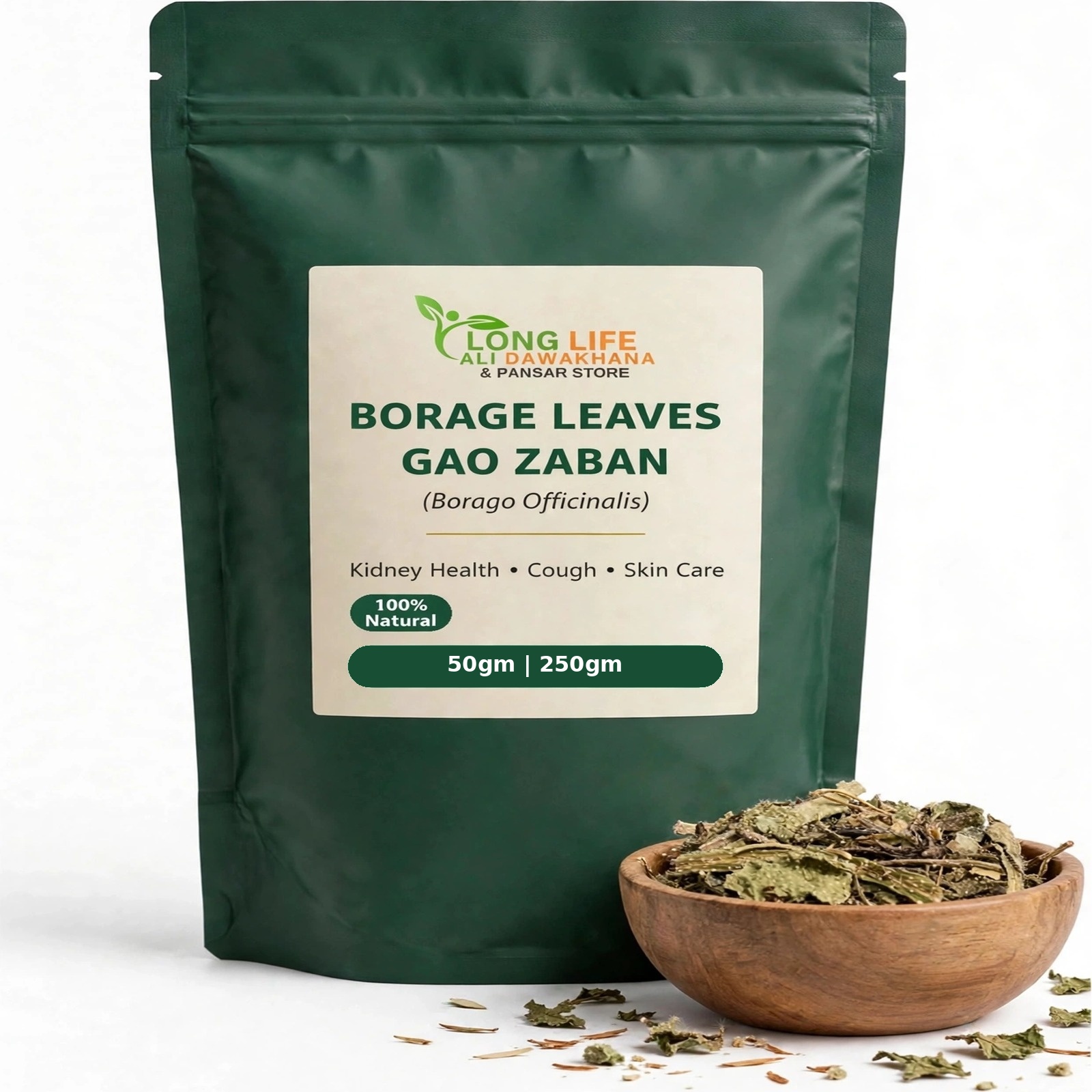
Borage Leaves (Gao Zaban, Borago officinalis) are the dried leaves of the borage plant — a Mediterranean vegetable (borrajas) and a traditional Unani medicine used as a diuretic for kidney complaints and a demulcent for cough. They carry the most serious safety warning in the range: the 9 documented liver-vein disease cases from borage were all from leaf tea. Whole and Powder (50 gm and 250 gm) from Rs 351, Cash on Delivery across Pakistan.
گاؤ زبان (بوریج لیوز) — مکمل معلومات
گاؤ زبان بوریج کے پودے (Borago officinalis) کے خشک پتے ہیں — بحیرہ روم کی سبزی اور طب یونانی کی دوا، گردے و پیشاب کی شکایت، کھانسی اور بخار کے لیے۔
اہم انتباہ: پتوں میں پیرولیزائیڈین الکلائیڈز (PAs) ہوتے ہیں جو جگر کو نقصان پہنچا سکتے ہیں — SOS کے 9 کیسز سب پتے کی چائے سے ہوئے۔ چائے صرف 1 ہفتے تک لیں، حمل میں ہرگز نہ لیں۔
Borage Leaves (Gao Zaban) – Price in Pakistan, Benefits, Uses & Safety
Direct answer: Borage Leaves (Gao Zaban, Borago officinalis) cost Rs 351 for 50 gm to Rs 1,637 for 250 gm at Long.pk, in Whole and Powder forms. The 9 documented SOS cases were all from leaf tea; the UK Food Standards Agency advises avoiding borage leaf teas.
- What Are Borage Leaves?
- History of Borage Leaves
- Active Compounds
- Borage Leaves in Unani, Ayurveda & Folk Medicine
- What Does Modern Research Say?
- Detailed Benefits of Borage Leaves
- Leaf vs Flower: The Leaf Is the Riskier Part
- Who Are Borage Leaves For?
- How to Use Borage Leaves
- Traditional Combinations
- Dosage & Duration
- Side Effects & Who Should Avoid Them
- How to Identify Original Borage Leaves
- Storage & Shelf Life
- Borage Leaves vs Comfrey vs Coltsfoot
- Borage Leaves Price in Pakistan
- Product Specifications
- Roman Urdu
- Frequently Asked Questions
What Are Borage Leaves?
Borage Leaves (Gao Zaban, Borago officinalis L.) are the dried leaves of the borage plant, a Mediterranean herb. Gao Zaban means “cow’s tongue” — the leaves are broad, oval and bristly. This product is the dried leaf — not the flower, seed or seed oil. The leaves hold more pyrrolizidine alkaloids than the flowers.
History of Borage Leaves
As a vegetable, borage leaves have been eaten in the Mediterranean for centuries — borrajas in Spain, Italy and Greece. In Unani medicine, Gao Zaban is a diuretic, a demulcent for cough, and a cooling tonic. In European folk medicine, an adrenal tonic and a remedy to “dispel melancholy”.
Active Compounds
The leaf has two faces. The good face: mucilage, vitamin C, β-carotene, iron (more than spinach) and potassium. The dangerous face: hepatotoxic pyrrolizidine alkaloids at 15–120 µg/g — more than the flower. GLA is in the seed oil.
Borage Leaves in Unani, Ayurveda & Folk Medicine
In Unani medicine, Gao Zaban is a diuretic, a demulcent for cough, a diaphoretic in fevers, and a cooling tonic. In Ayurveda it is a minor herb for cough and fever. In European folk medicine, an adrenal tonic and blood cleanser. In Mediterranean cuisine, they are a vegetable — cooked in soups or sautéed.
What Does Modern Research Say?
The liver-injury cases. A 2018 Hepatology International analysis reviewed 37 confirmed SOS cases. Borage leaf tea accounted for 9 — second only to comfrey — after daily infusions for 4–12 weeks.
Regulatory position. EFSA (2017): “no safe level of dietary PA exposure can be established”. The UK Food Standards Agency advises avoiding borage leaf teas.
Efficacy — traditional only. Borage leaf and flower have no controlled human evidence. The GLA evidence (Cochrane 2013) belongs to the seed oil.
Detailed Benefits of Borage Leaves
1. Kidney & Urinary
A diuretic for kidney disorders and fluid retention. Contraindicated with kidney stones.
2. Cough & Respiratory
A demulcent coating the throat and chest; the leaves are used as an expectorant.
3. Digestion & Gut
The mucilage protects mucous membranes; the fibre prevents constipation and stabilises blood sugar.
4. Skin
Crushed foliage was used for stings, bug bites and eczema. Do not apply to broken skin.
5. Fever & Recovery
A febrifuge and diaphoretic, an adrenal tonic during fevers and recovery.
6. Mood & Nerves
A nervine — used to “dispel melancholy”. Brahmi Booti (Centella) is another classical calming herb.
7. Joints & Rheumatism
Used for rheumatism; the diuretic action for gout.
8. Nutrition
Per 100 g: 21 kcal, vitamin C ~35 mg, iron ~41% of RDA — more iron and magnesium than spinach. Organic Moringa Leaf Powder (Sohanjna Powder) is another iron-rich green.
Leaf vs Flower: The Leaf Is the Riskier Part
| Feature | Dried Leaf (this product) | Dried Flower (Gul-e-Gaozaban) | Refined Seed Oil |
|---|---|---|---|
| Toxic unsaturated PAs | YES — 15–120 µg/g | Main PA is thesinine (saturated, NONTOXIC) | None after refining |
| Documented SOS cases | 9 cases from LEAF TEA (EU 2005–2017) | None from flower tea | None |
The key point: the leaves are the part with the documented toxic PAs and SOS cases — the riskier product, with the strictest safety rules in the range.
Who Are Borage Leaves For?
- People who eat Mediterranean cuisine and want the borrajas vegetable — cooked occasionally, in food amounts.
- Traditional Unani medicine users who use Gao Zaban as a diuretic and demulcent, in short courses, under a practitioner’s guidance.
Not for pregnancy or breastfeeding (likely unsafe), liver disease, children, kidney stones, or GLA (buy the seed oil).
How to Use Borage Leaves
As a cooked vegetable (the safest use). Boil or sauté the dried leaves as you would spinach — in soups, with garlic and potatoes. Eat occasionally.
Tea (short courses only). Steep 1–2 teaspoons in a cup of hot water for 5–10 minutes. Use for 1 week at most, then a break of at least 2 weeks.
What NOT to do. Do not drink borage leaf tea daily for weeks, or use it in pregnancy, with liver disease or kidney stones. Do not combine with other PA herbs (comfrey, coltsfoot).
Traditional Combinations
| Combination | Purpose |
|---|---|
| Borage Leaves + garlic (Lehsan) | Aragonese vegetable — sautéed with garlic, served with potatoes |
| Borage Leaves + liquorice (Mulethi) | Cough and throat — two demulcents together |
Dosage & Duration
- As a cooked vegetable: eat occasionally, in food amounts.
- Tea (traditional): 1–2 teaspoons per cup, steeped 5–10 minutes, 1–3 times daily.
- Duration — THIS IS THE CRITICAL PART: use tea for 1 week at most, then a break of at least 2 weeks. The liver-injury cases followed daily infusions for 4–12 weeks.
- Take away from other PA-containing herbs — comfrey, coltsfoot and other pyrrolizidine alkaloid herbs; the risk adds up.
Side Effects & Who Should Avoid Them
Borage Leaves carry the most serious safety warning in the Long.pk range — pyrrolizidine alkaloids that damage the liver.
Pyrrolizidine alkaloids (PAs). The leaves contain hepatotoxic 1,2-unsaturated PAs at 15–120 µg/g. In the liver they form reactive radicals that injure the sinusoidal endothelial cells — causing hepatic sinusoidal obstruction syndrome (SOS), which can progress even after PA consumption is stopped.
Documented human cases. A 2018 Hepatology International analysis reviewed 37 confirmed SOS cases in the EU (2005–2017). Borage leaf tea accounted for 9 — second only to comfrey — after daily infusions for 4–12 weeks. Boiling water extracts over 80% of the PAs into the tea.
Regulatory position. EFSA (2017): “no safe level of dietary PA exposure can be established”. The UK Food Standards Agency recommends avoiding borage leaf teas.
Who should avoid them:
- Pregnant women — AVOID. Likely unsafe in pregnancy.
- Breastfeeding women — AVOID. Likely unsafe while breastfeeding.
- People with liver disease — AVOID. PAs might make liver disease worse.
- Children — AVOID. No safety data; the liver is more vulnerable in children.
- People with kidney stones — AVOID. Traditional contraindication.
- People taking hepatotoxic medications (acetaminophen, statins, methotrexate).
- People who drink heavily — alcohol and PAs both damage the liver.
- People using other PA-containing herbs (comfrey, coltsfoot, Senecio species).
How to Identify Original Borage Leaves
- Colour: olive-green to brownish-green, with a few thin brown stems. Very dark or black leaves are old or spoiled.
- Texture: broad, crinkly and rough, dotted with tiny white bristly hairs. Smooth, hairless leaves are not borage.
- Smell: mild, fresh, slightly cucumber-like. Musty means damp storage — reject it.
- Borage vs comfrey: comfrey has similar hairy leaves but is far more hepatotoxic. Buy from a trusted pansar.
Storage & Shelf Life
Store in an airtight jar, cool, dark and dry. The dried leaves keep 12 months.
Borage Leaves vs Comfrey vs Coltsfoot
| Feature | Borage Leaves (Gao Zaban) | Comfrey (Symphytum officinale) | Coltsfoot (Tussilago farfara) |
|---|---|---|---|
| Toxic unsaturated PAs | Intermedine, lycopsamine, supinine, amabiline (15–120 µg/g) | Symphytine, echimidine, lycopsamine (higher levels) | Senkirkine, senecionine |
| Safety | MAY BE UNSAFE — short courses only | UNSAFE internally — external use only | MAY BE UNSAFE — short courses only |
All three share the same toxin; the difference is the dose and the route.
Price in Pakistan
| Form | 50 gm | 250 gm |
|---|---|---|
| Whole | Rs 351 | Rs 1,637 |
| Powder | Rs 422 | Rs 1,451 |
Range: Rs 351–1,637. Best value: Powder 250 gm at Rs 5.80 per gram — powder cheaper per gram than Whole.
Specifications
| Product name | Borage Leaves (Gao Zaban) |
| Urdu name | گاؤ زبان (Gao Zaban) |
| Botanical name | Borago officinalis L. |
| Family | Boraginaceae |
| Part used | Dried leaves |
| Forms | Whole / Powder |
| Weights | 50 gm, 250 gm |
| Price Range | Rs 351 – Rs 1,637 |
| Origin | Mediterranean region; cultivated in Pakistan and India |
| Purity | 100% natural dried leaves, no additives |
| Key compounds | Pyrrolizidine alkaloids, mucilage, saponins, tannins, vitamin C, iron, potassium |
| GLA content | Trace only in the leaf (GLA is in the seed oil, 20–26%) |
| Shelf life | 12 months |
| Storage | Airtight container, cool, dark, dry place |
| Seller | Ali Dawakhana and Pansar Store |
Roman Urdu Summary
Borage Leaves (Gao Zaban) — Borago officinalis — borage ke poday ke khushk patte hain, bahira-e-room ki sabzi aur tab-e-Yunani ki dawa — gurday aur khaansi ke liye. Patton mein pyrrolizidine alkaloids hotay hain jo jigar ko nuqsaan pahuncha sakte hain — SOS ke 9 cases sab pattay ki chai se huay. Chai sirf 1 haftay tak lein, hamal mein hargiz na lein. Whole aur Powder, 50 gm aur 250 gm — Rs 351 se shuru.
Frequently Asked Questions
Q: Gao Zaban kis kaam aata hai?
Gurday, khaansi aur bukhaar ke liye. Koi insani trial nahi hai.
Q: Kya Borage Leaves jigar ke liye khatarnak hain?
Ji — patton mein PAs hotay hain. Pattay ki chai se 9 SOS cases milay. Chai sirf 1 haftay tak lein.
Q: Borage Leaves aur Borage Flower mein kya farq hai?
Patta diuretic aur sabzi hai; phool dil ka tonic hai. Patta ziyada khatarnak hai.
Q: Kya Borage Leaves sabzi ke tor par kha saktay hain?
Ji — bahira-e-room mein sadiyon se khaye jatay hain. Kabhi kabhaar paka kar khayen.
Q: Borage Leaves ki khurak kya hai?
1–2 chammach aik cup mein, rozana 1–3 baar. Sirf 1 haftay tak, phir 2 haftay waqfa.
Q: Kya Borage Leaves hamila khawateen le sakti hain?
Nahi — hamal aur doodh pilanay mein likely unsafe hain.
Q: Kya Borage Leaves mein GLA hota hai?
Nahi — GLA tail mein hota hai, patton mein trace miqdaar hai.
Q: Borage Leaves ki price kya hai?
Rs 351 (50 gm) se Rs 1,637 (250 gm) tak. Best value Powder 250 gm hai.
Q: Asli Borage Leaves ki pehchan kya hai?
Zaitooni sabz, choray, safed baal. Hamwaar patte borage nahi hain.
Q: Borage Leaves ko kaise store karein?
Airtight jar mein, thandi khushk jagah par. 12 mahinay chaltay hain.
Related Products
- Organic Moringa Leaf Powder (Sohanjna Powder) — another iron-rich leafy green.
- Brahmi Booti (Centella) — the classical calming and memory herb, sharing Borage’s nerve-tonic use.
- Jujube Berries (Unab) — a calming tonic for sleep, pairing with Borage’s mood-lifting tradition.
- Plantain Seeds (Bartang) — a traditional gut remedy, complementing Borage’s demulcent action.
Ali Dawakhana and Pansar Store — Asli desi dawa aur khalis jadi bootiyan, ab ghar baithay Long.pk se mangwayen.
Reviews
There are no reviews yet