
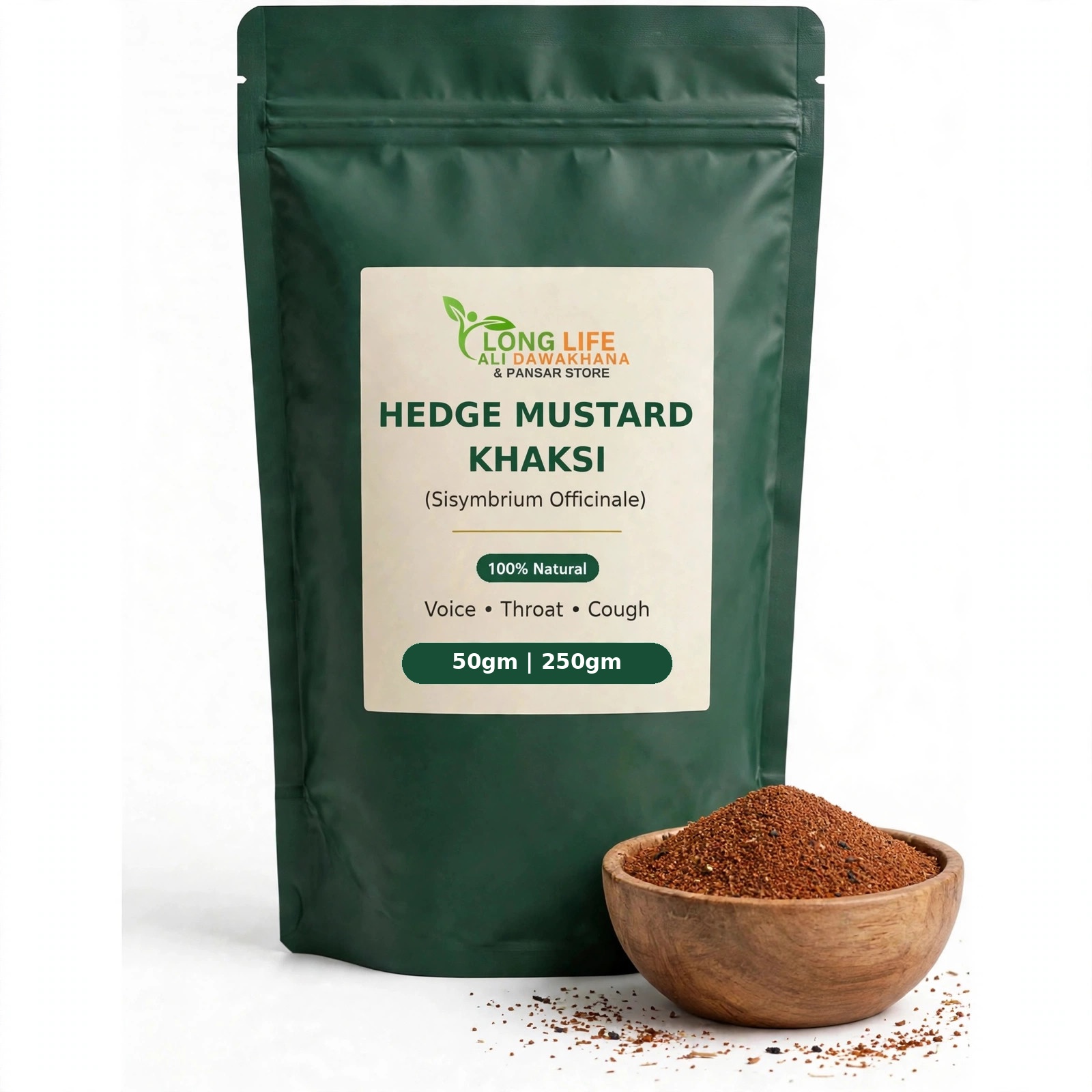
Hedge Mustard (Khaksi, Sisymbrium officinale) is the seed of Europe’s “singer’s herb” — famous since Louis XIV for hoarseness, loss of voice, sore throat and cough. One small study of 104 patients found it eased vocal tract disability. Whole seeds from Rs 169, Cash on Delivery across Pakistan.
خاکسی (Hedge Mustard) — مکمل معلومات
خاکسی یورپ کی مشہور “گانے والوں کی بوٹی” ہے — آواز کی خرابی، گلے کی خراش اور کھانسی کے لیے صدیوں سے استعمال ہوتی ہے۔ یہاں اس کے بیج فروخت ہوتے ہیں۔
اہم انتباہ: بخار، سانس کی تکلیف یا دو ہفتے سے زیادہ جاری آواز کی خرابی میں ڈاکٹر سے رجوع کریں۔ حاملہ خواتین اور 6 سال سے چھوٹے بچے استعمال نہ کریں۔
Hedge Mustard (Khaksi) – Price in Pakistan, Benefits, Uses & Safety
Direct answer: Hedge Mustard (Khaksi, Sisymbrium officinale) starts from Rs 169 for 50 gm (Whole seeds) at Long.pk, up to Rs 623 for 250 gm — Whole seeds only, no Powder form, cash on delivery across Pakistan. Europe’s “singer’s herb” for hoarseness and loss of voice: its isothiocyanates activate the throat’s TRPA1 channel. But there are no large randomised trials.
- What Is Hedge Mustard?
- History of Hedge Mustard
- Active Compounds
- Hedge Mustard in Unani, Ayurveda & Folk Medicine
- What Does Modern Research Say?
- Detailed Benefits of Hedge Mustard
- Seeds vs Leaves — What This Product Actually Is
- Who Is Hedge Mustard For?
- How to Use Hedge Mustard
- Traditional Combinations
- Dosage & Duration
- Side Effects & Who Should Avoid It
- How to Identify Original Hedge Mustard Seeds
- Storage & Shelf Life
- Hedge Mustard vs Mustard Seeds vs Watercress
- Hedge Mustard Price in Pakistan
- Product Specifications
- Roman Urdu
- Frequently Asked Questions
What Is Hedge Mustard?
Hedge Mustard — Urdu خاکسی (Khaksi) — is the seed of Sisymbrium officinale, a Brassicaceae plant. The product is the SEED — tiny reddish-brown seeds. Not common mustard: kitchen mustard is Brassica juncea (rai) or Sinapis alba (sarson) — a different genus.
History of Hedge Mustard
Hedge Mustard has been a voice medicine since antiquity. Its golden age was France: by the seventeenth century it was herbe aux chantres, “considered up to the time of Louis XIV an infallible remedy for loss of voice” — Jean Racine recommended its syrup to the poet Boileau, who had lost his voice. Culpeper praised it for chest and voice; today the University of Milan runs the “Erisimo a Milano” programme.
Active Compounds
Figures are for the aerial parts; seed percentages are not published. Total glucosinolates 0.63–0.94%; glucoputranjivin is the main one (58.3%); mucilage 10.9–13.5%. Crush the seed and myrosinase splits the glucosinolates into isothiocyanates — potent TRPA1 agonists (Borgonovo 2019). Crush fresh: the isothiocyanates form within a minute of crushing with water, and pre-ground seed loses them to the air.
Hedge Mustard in Unani, Ayurveda & Folk Medicine
Hedge Mustard comes from the European herbal tradition, not the classical Unani or Ayurvedic texts — there is no deep record of it as Khaksi in the Canon or the Charaka Samhita, and this article does not invent one. In the subcontinent it is used in the warming, expectorant class of mustard seed — a throat and chest seed for hoarseness and cough, as tea or with honey. European folk medicine holds the real record: France for the voice, England for chest and coughs (Culpeper), Italy for sore throats.
What Does Modern Research Say?
One small clinical study, plus laboratory mechanism work — no large randomised trial. The clinical study used aerial-part extracts, not seeds.
Calcinoni 2017: 104 patients with vocal tract discomfort felt better on Sisymbrium preparations — but it was an open-label cohort study, not a placebo-controlled trial.
Borgonovo 2019: the two isothiocyanates were potent TRPA1 agonists; the glucosinolates were inactive.
De Nisi 2021 (Foods): isothiocyanates were higher when entire seeds and flowers were used; honey enriched with seeds delivers them. Missing: no placebo-controlled trial, no trial of the seeds specifically.
Detailed Benefits of Hedge Mustard
Evidence levels: traditional, lab/animal, or small clinical (Calcinoni 2017).
1. Hoarseness & Voice Loss (Traditional + Small Clinical)
The singer’s herb for three centuries. Calcinoni 2017 (104 patients) found it eased vocal tract disability.
2. Sore Throat (Traditional + Lab)
Mucilage coats the throat; isothiocyanates stimulate its nerves. Liquorice Root (Mulethi) is the classical partner.
3. Cough & Chest (Traditional + Lab)
Antitussive and myorelaxant on tracheal muscle in the laboratory. Jujube Berries (Unab) is the Unani cough fruit.
4. Wheezing (Traditional ONLY)
No clinical evidence — NOT a treatment for asthma or bronchitis.
5. Digestion & Urinary (Traditional)
A carminative and mild diuretic in folk use. Minor uses.
6. Antidote Tradition (Historical ONLY)
The Greeks held it an antidote to poisons. No modern evidence — poisoning is a medical emergency.
Seeds vs Leaves — What This Product Actually Is
The product and the research are not the same plant part. The product is the SEED — tiny reddish-brown seeds, sold whole. The research is mostly on the AERIAL PARTS — the clinical study used leaves, flowers and stems, and the chemistry figures are for the dried flowering aerial parts. What the seeds share: the glucosinolate family — Foods 2021 found isothiocyanates were higher when entire seeds and flowers were used. What is NOT established: seed-specific percentages, and any trial of the seeds alone. Crush them fresh — the isothiocyanates form only when the crushed seed meets water.
Who Is Hedge Mustard For?
- Voice professionals — singers, actors, teachers, speakers — who want the traditional voice herb.
- People with recurrent hoarseness or sore throats who want a traditional tea or gargle.
Not for pregnancy, breastfeeding, children under 6, thyroid conditions (without advice), mustard allergy, or fever, shortness of breath or hoarseness over two weeks.
How to Use Hedge Mustard
Seed tea. Lightly crush 1 teaspoon (2–3 g) of seeds. Pour over freshly boiled water, cover and steep 10–15 minutes, then strain. Drink warm, 2–3 times a day.
Honey (“voice honey”). Mix crushed seeds into honey; take 1 teaspoon slowly, 2–3 times a day.
Crush fresh, every time. The isothiocyanates form only when the crushed seed meets water.
Traditional Combinations
- Khaksi + Liquorice (Mulethi) — liquorice coats, hedge mustard clears.
- Khaksi + Plantain Seeds (Bartang) — the mucilage pair: plantain coats and calms the throat.
Dosage & Duration
No dose-finding study exists for raw seeds — all doses are traditional.
| Preparation | Dose | Frequency |
|---|---|---|
| Seed tea (1 tsp crushed seeds) | 1 cup | 2–3 times daily |
| Decoction (5 g seeds) | Half cup (100 ml) | 2–3 times daily |
| Honey with crushed seeds | 1 teaspoon | 2–3 times daily |
| Gargle (warm decoction) | Gargle 30 seconds | 2–3 times daily |
Duration: short courses — a few days to two weeks. Hoarseness over two weeks needs a doctor.
Side Effects & Who Should Avoid It
Side effects at traditional doses are uncommon — but it is a mustard-family plant with real cautions.
- Thyroid — the goitrogen caution. Mustard-family glucosinolates can interfere with the thyroid’s iodine uptake in large amounts over long periods. A short course is unlikely to matter — but people with hypothyroidism or on thyroid medicine should consult their doctor first.
- Mustard allergy. Same family as mustard, cabbage, broccoli and horseradish — cross-reaction is possible. Stop if you develop a rash, itching, swelling or breathing difficulty.
- Pregnancy and breastfeeding — avoid unless a clinician advises. No safety data for medicinal doses.
- Children under 6 — avoid without professional guidance. No safety data for young children.
- Not for serious symptoms. Not a treatment for fever, shortness of breath, purulent (coloured) sputum, coughing blood, or hoarseness over two weeks. Any of these needs a doctor.
- Stomach upset. Strong decoctions can irritate the stomach; the pungency can cause heartburn. Take after meals, and start with a weak tea.
- Skin. Crushed mustard-family seeds can irritate the skin. External use only as a short poultice, never on broken skin.
How to Identify Original Hedge Mustard Seeds
- Appearance: genuine seeds are tiny, reddish-brown and fine-grained — dry and free-flowing.
- The crush test — the best test. Crush a few with a drop of water — they should smell sharp and mustardy-pungent within a minute. If they smell of nothing, the stock is old.
- What to avoid: dusty or pale seeds, musty stock, seeds mixed with chaff, and common mustard seed sold as Khaksi — mustard seeds are larger and yellow, brown or black. Avoid pre-ground seed.
Storage & Shelf Life
Whole seeds: 18–24 months. Airtight container, cool and dry. Do not grind in advance.
Hedge Mustard vs Mustard Seeds vs Watercress
| Feature | Hedge Mustard (Khaksi) | Mustard Seeds (Rai / Sarson) | Watercress |
|---|---|---|---|
| Botanical name | Sisymbrium officinale | Brassica juncea / Sinapis alba | Nasturtium officinale |
| Part used | Seeds | Seeds | Leaves |
| Key compound | Glucoputranjivin → isopropyl isothiocyanate | Sinigrin → allyl isothiocyanate | Gluconasturtiin → PEITC |
| Main traditional use | Voice, throat, cough | Digestion, cooking, poultice | Vitamin C, digestion, skin |
| Evidence level | Small clinical study (voice) | Food + some lab work | Nutritional + lab work |
Hedge Mustard Price in Pakistan
| Form | 50 gm | 250 gm |
|---|---|---|
| Whole | Rs 169 | Rs 623 |
Price range: Rs 169–623. Whole form only — no Powder form. Best value: Whole 250 gm at Rs 2.49 per gram. Cash on Delivery across Pakistan.
Product Specifications
| Product Name | Hedge Mustard (Khaksi) |
| Urdu Name | خاکسی (Khaksi) |
| Botanical Name | Sisymbrium officinale (L.) Scop. (syn. Erysimum officinale) |
| Family | Brassicaceae (mustard/cabbage family) |
| English Names | Hedge Mustard, London Rocket, Desert Mustard, Singer’s Herb |
| Part Used | Seeds (dried) |
| Forms | Whole only |
| Weights | 50 gm, 250 gm |
| Price Range | Rs 169–623 |
| Key Compound | Glucosinolates (glucoputranjivin) → isothiocyanates |
| Temperament | Warming |
| Additives | None — 100% natural |
| Shelf Life | Whole seeds 18–24 months |
| Storage | Airtight container, cool and dry, away from sunlight |
| Seller | Ali Dawakhana and Pansar Store |
| Delivery | Cash on Delivery across Pakistan |
Roman Urdu
Khaksi (Hedge Mustard) Europe ki mashhoor “singer’s herb” hai — sadiyon se awaz ki kharabi aur galay ki kharash ke liye istemal hoti hai. Yahan is ke beej farokht hotay hain. 104 mareezon ki chhoti study mein behtari dekhi gayi, lekin baray trials nahi huay. Istemaal: 1 chammach beej kachal kar garam pani mein 10 se 15 minute rakh kar din mein 2 se 3 baar piyein. Hamila khawateen aur 6 saal se chhotay bachay istemal na karein. Qeemat: Rs 169 se Rs 623 — Whole beej, 50 gm aur 250 gm. Cash on Delivery pooray Pakistan mein.
Frequently Asked Questions
Q: Khaksi kis kaam aati hai?
Awaz ki kharabi, galay ki kharash aur khaansi ke liye.
Q: Khaksi ki Pakistan mein qeemat kya hai?
Rs 169 se Rs 623 tak — Whole beej. Cash on Delivery dastiyab hai.
Q: Khaksi aur sarson (mustard) mein kya farq hai?
Mukhtalif pauday hain. Khaksi awaz ki booti hai; sarson khanay ka beej hai.
Q: Kya Khaksi waqai awaz ke liye kaam karti hai?
Rawayati tor par haan. 104 mareezon ki study mein behtari dekhi gayi.
Q: Khaksi kaisay istemal karte hain?
Chai, shehed ya ghararay — beej kachal kar din mein 2 se 3 baar istemal karein.
Q: Khaksi ke beej hain ya pattay?
Beej hain — chhotay surkh-bhooray beej.
Q: Kya Khaksi hamila khawateen le sakti hain?
Nahi — doctor ke mashwaray ke baghair nahi. 6 saal se chhotay bachon ke liye bhi nahi.
Q: Khaksi kitne din tak istemal karni chahiye?
Chhotay courses mein — kuch din se 2 haftay tak.
Q: Kya Khaksi thyroid ke liye nuqsan deh hai?
Thyroid ke mareez pehle doctor se mashwara karein.
Q: Asli Khaksi ki pehchan kya hai?
Chhotay, surkh-bhooray, bareek beej. Kachalnay par teiz sarson jaisi khushboo aani chahiye.
Related Products
- Liquorice Root (Mulethi) — the classical throat-soothing partner.
- Plantain Seeds (Bartang) — mucilage that coats and calms the throat.
- Jujube Berries (Unab) — the Unani cough and throat fruit.
- Organic Moringa Leaf Powder — a daily tonic for general health.
Ali Dawakhana and Pansar Store — Asli desi dawa aur khalis jadi bootiyan, ab ghar baithay Long.pk se mangwayen.
Reviews
There are no reviews yet