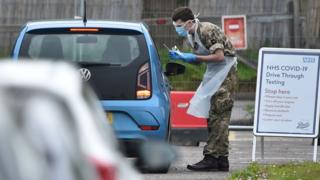
Up to 10 million key workers and their households can now book a coronavirus test online or through their employer.
The move allows all essential workers in England to register for tests on the government’s website, if they or a family member have virus symptoms.
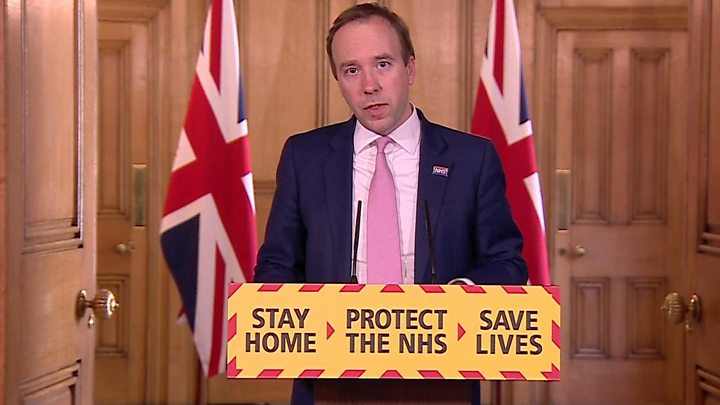
Health Secretary Matt Hancock said the expanded testing programme was “part of getting Britain back on her feet”.
The government remains some way short of its target of 100,000 tests a day in England by the end of this month.
Thursday’s figures showed 23,560 tests were carried out, though Mr Hancock said capacity had now increased to 51,000 per day.
The data also showed a further 616 people died with the virus in UK hospitals, bringing the total number of deaths to 18,738.
- How close is the UK to 100,000 tests a day?
- First patients injected in UK vaccine trial
Mobile testing units
The health secretary announced the new testing arrangements at Thursday’s Downing Street coronavirus briefing, along with a commitment to recruit 18,000 people to trace contacts of those infected.
Those who can now register for a test include NHS and social care workers, police officers, teachers, those in the justice system, supermarket and food production workers, journalists and transport workers.
Previously, a smaller group of key workers – those whose work is deemed critical to the Covid-19 response – were eligible for testing.
The aim is to allow essential staff to safely return to work.
Image copyright
Comic Relief Image caption
The Duke and Duchess of Cambridge and their children Prince George, Princess Charlotte and Prince Louis joined in the clap for NHS carers on Thursday
Mr Hancock said once people enter their details online they will be sent a text or email inviting them to either book an appointment at a drive-through centre or to request a home test kit, though the latter are currently in limited supply.
He told BBC Breakfast the home kits would be collected by courier and would initially start in “small numbers” before the service grows.
A help desk has been established to aid the process, while mobile units run by the Army are travelling around the country to where they are needed, such as care homes.
The test involves taking a swab of the nose and the back of the throat.
Mr Hancock has said the “majority” of people will get their result in 24 hours, but for some it might take a bit longer.
The result will be added to a person’s medical record so their doctor is informed, he added.
Key workers who are unable to access the government’s website will still be able to apply for a test, as employers are able to book on behalf of their staff.
Until now, hospitals have been carrying out tests, along with a network of about 30 drive-through centres in car parks, airports and sports grounds.
Labour’s shadow health minister, Justin Madders, told the BBC he welcomed the move to expand testing to key workers but questioned whether anything was being done to improve ease of access to the tests.
He said many people were having to drive for more than an hour to testing stations, which was probably “the biggest obstacle to people getting the test”.
Mr Hancock said the current capacity for carrying out tests was now “ahead of our plans”.
“Our ultimate goal is that everyone who could benefit from a test gets a test,” he said.
The Welsh government has previously outlined plans to expand testing to key workers and Northern Ireland’s health minister has announced the nation’s testing programme is being expanded to include front-line workers in the private sector.
Scotland is prioritising tests for NHS staff and has yet to announce any expansion of testing to key workers.
Image copyright
Getty Images
Mr Hancock also detailed plans for a network of contact tracers that will be used when the lockdown is eased, insisting a process of “test, track and trace” would be “vital” to stop a second peak of the virus.
The hope is that regional outbreaks of the virus can be kept under control by isolating people with the virus, and then tracing their contacts and isolating them.
The health secretary said infrastructure would be put in place so that contact tracing can be rolled out on a “large scale”.
Prof John Newton, co-ordinator of the UK’s coronavirus testing programme, has said the government is “on track” to reach 100,000 tests a day by the end of April.
He said new types of test – including ones that do not rely on reagents which are in short supply – would help to reach the target.
Elsewhere, Mr Hancock said the plan for easing lockdown restrictions set out by Scotland’s First Minister, Nicola Sturgeon, was “very similar” to the UK government’s approach.
Ms Sturgeon has reiterated that the framework was published to spark a “grown-up conversation” with the public over the key factors in deciding when to lift restrictions.
She told BBC Breakfast it was “important” to be clear with the public about the thought process “because it will effect all of our lives potentially for quite a long time to come, adding that the Scottish government will release a “much more detailed plan” in the future.
She said the devolved nations and UK government were “working very well” and should “try to align our decision-making”, adding nations should have “good reasons” for taking their own separate decisions.
In other developments:
- Baroness Doreen Lawrence has been appointed as the Labour party’s race relation adviser and will lead a review into the impact of coronavirus on BAME communities amid concerns the virus may be disproportionately impacting them
- Gatwick Airport has said it expects it will take up to four years for passenger numbers to return to recent levels once the coronavirus pandemic recedes
- US President Trump has said Prime Minister Boris Johnson sounded “sharp and energetic” in a phone call on Tuesday.
- The first human trial in Europe of a coronavirus vaccine has begun in Oxford – with the first two volunteers being injected
- Stars and royals raised more than £27m on BBC One charity special The Big Night In
- Tobias Ellwood, Conservative chair of the defence select committee, said the government has been “too slow in procuring the necessary” personal protective equipment for frontline staff
- A submarine crew were filmed having a party during the coronavirus lockdown, prompting a Royal Navy investigation
Are you a key worker who is planning to book a coronavirus test on the UK government website? Share your experiences by emailing haveyoursay@bbc.co.uk.
Please include a contact number if you are willing to speak to a BBC journalist. You can also contact us in the following ways: