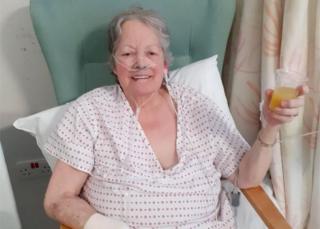
Many Covid-19 patients continue to need care at home, once they leave hospital. The story of Mary Blessington illustrates how the path to recovery can involve U-turns, writes Dr John Wright of Bradford Royal Infirmary.
We’ve already had our second spike – in care homes – and we know the third is waiting impatiently in the wings. Epidemics often have long and bumpy tails.
If you catch Covid-19, your risk of death if you’re over 80 is 15%. If you are under 50, it is less than 1%. We were late in protecting our care home residents and far too many have died far too early. But most of our older people live independently, many of them alone.
Our new Covid-era NHS will have to adapt quickly to care for them, whenever possible keeping them out of hospitals, where the virus abounds, but also looking after them when they are discharged as survivors.
In Bradford we are fortunate to have an innovative team called the Virtual Ward, who’ve been fulfilling this role for the last couple of years. It’s almost as though they knew Covid was coming.
It was a member of staff on the Virtual Ward that noticed all was not well with Mary Blessington, after she was discharged and returned to her loving husband, Michael.
Image copyright Craig Blessington
Mary and Michael were both admitted to hospital with Covid-19 on the same day, having most likely caught the virus at the funeral of one of their sons on 16 March. They have been together since the age of 13 and, coincidentally or not, it was when they were placed side by side on the same ward that they began to recover. (I wrote about this here.)
Michael was discharged first, and the family was overjoyed when Mary was allowed home a few days later.
But Elaine Martin, a trainee advanced clinical practitioner who visited Mary at home, noticed that she was still having difficulty breathing, and that she was deeply worried both about her husband’s health and her own prospects of recovery.
“She was still having symptoms, she still felt breathless and chest tightness but I think a lot of it was anxiety. She felt she was going to die, and her husband had recovered but has an underlying condition, so there was a lot of anxiety,” Elaine says.
The decision was taken to bring Mary back to hospital – which was fortunate, because that night her condition worsened.
Image copyright Craig Blessington
It was thought she might only have hours to live, so Michael and the couple’s two surviving sons came to the hospital early in the morning, put on PPE and sat with her, saying their goodbyes.
But I am glad to say Mary recovered again. She remains very poorly, and is receiving help for her anxiety, but we hope she is on the mend.
Mary is only 67. We have had numerous older parents who have recovered on our wards from Covid-19, but there is a good reason for keeping older people out of hospital if we can and sending them home as soon as it is safe to do so. For elderly patients, every day in hospital leads to “deconditioning”, a loss of physical and mental functioning. For some, the strange environment can cause delirium – a condition with symptoms ranging from drowsiness, confusion and rambling speech to hallucinations.
The Virtual Ward allows elderly patients to remain instead in familiar surroundings, or to return to them quickly – perhaps enjoying the company of a spouse, children or friends – while also continuing to receive complex clinical care. Staff are on call 24/7, and patients remain the responsibility of the doctors who referred them.
“There are really important clinical reasons for people to be in hospital, of course, but for multiple reasons, elderly people just do better at home,” says Kate Moore, an occupational therapist trained to understand what equipment and adaptations frail people need at home after being discharged from hospital.
“People get weaker when they’re in hospital, there’s incontinence, not eating and drinking, all those things seem to get worse for people when they’re in a hospital bed, and especially in a world where people are wearing masks and they might feel very disorientated. So we try to replicate the care of the ward but in people’s own homes.”