
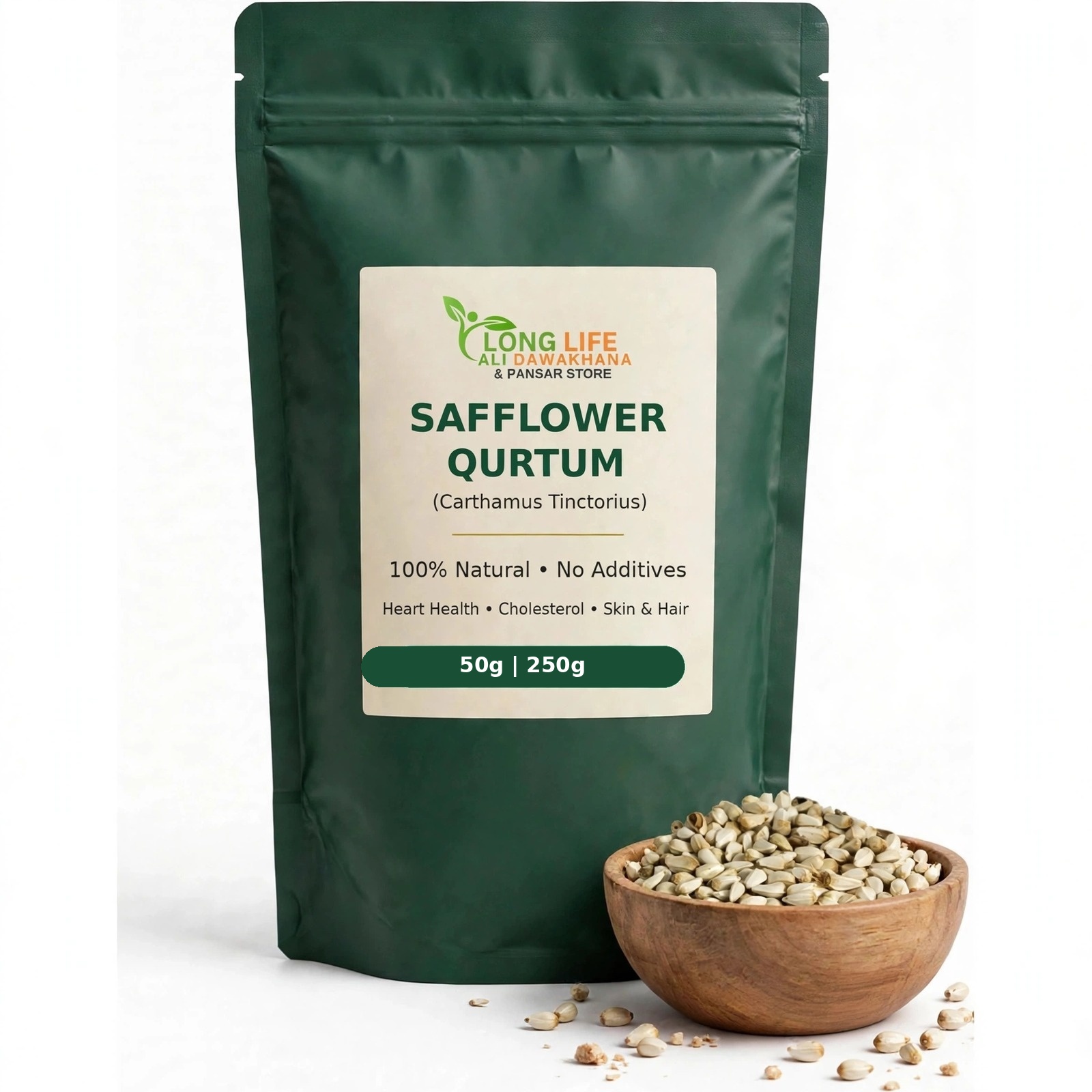
Safflower (Qurtum) is the seed of Carthamus tinctorius, a thistle-like plant cultivated for over 4,000 years for its oil-rich seeds and its dye flowers. The seeds are rich in linoleic acid, an omega-6 fatty acid linked to healthy cholesterol levels, and are eaten roasted, ground into powder, or pressed for oil. Prices start at Rs 208 for 50 gm, available in Whole and Powder forms (50 gm and 250 gm) with cash on delivery across Pakistan.
قرطم — دل، کولیسٹرول اور جلد کے لیے مفید بیج
قرطم ایک قدیم بیج ہے۔ اس میں لینولیک ایسڈ (omega-6) وافر ہے جو کولیسٹرول متوازن رکھتا ہے۔ بیج بھون کر یا پیس کر لیں — روزانہ 10 سے 20 گرام کافی ہیں۔ حاملہ خواتین دوا کی مقدار میں استعمال نہ کریں۔ قیمت 208 روپے سے شروع، کیش آن ڈیلیوری ہے۔
Safflower (Qurtum) — The Ancient Oilseed for Heart & Skin
Direct answer: Safflower (Urdu: Qurtum, قرطم; Carthamus tinctorius) seeds are rich in linoleic acid (omega-6, 70–80% of the oil). The cholesterol trials belong to the oil, the blood-moving medicine is the flower, and CLA is manufactured from the oil.
- What Is Safflower?
- History: 4,000 Years from Dye Vat to Oil Press
- Active Compounds
- Safflower in Unani, Ayurveda & Chinese Medicine
- What Does Modern Research Say?
- Benefits of Safflower Seeds
- Seeds vs Flowers vs Oil: Three Products, Three Different Medicines
- Who Is Safflower For?
- How to Use Safflower Seeds
- Traditional Combinations
- Dosage & Duration
- Side Effects & Who Should Avoid It
- Quality Guide: How to Buy Good Safflower Seeds
- Storage
- Safflower vs Sunflower vs Flaxseed
- Price in Pakistan
- Specifications
- Roman Urdu Summary
- Frequently Asked Questions
What Is Safflower?
Safflower is a thistle-like annual in the daisy family (Asteraceae). The product is the seed — a small, plump, white teardrop (achene) with 32–40% oil and 11–17% protein. In Pakistan it is Qurtum (قرطم); the flower is Hong Hua in Chinese medicine.
History: 4,000 Years from Dye Vat to Oil Press
Synthetic dyes ended the dye trade in the 19th century and safflower became an oilseed; in the 1990s it became the raw material for CLA supplements.
Active Compounds
| Compound group | Key constituents | What it does |
|---|---|---|
| Polyunsaturated fats | Linoleic acid (omega-6, 70–80%) | Essential fat; lowers LDL; skin barrier |
| Monounsaturated fats | Oleic acid (omega-9, ~10%; up to 80% high-oleic) | Heart-healthy; cooking stability |
| Quinochalcones (flowers only) | Hydroxysafflor yellow A (HSYA), safflower yellow, carthamin | Flower compounds; HSYA most studied |
Two oil types: high-linoleic (best unheated) and high-oleic (stable at high heat). These seeds are high-linoleic.
Safflower in Unani, Ayurveda & Chinese Medicine
In Unani medicine, Qurtum is hot in temperament; the seeds are a gentle purgative (mulayyin) and tonic; the flowers are used for menstrual pain. In Traditional Chinese Medicine the dried florets (Hong Hua) are a blood-moving herb for blood stasis and menstruation.
What Does Modern Research Say?
Oil and cholesterol. In a 2018 randomised trial (Journal of Nutritional Biochemistry), 30 mL of cold-pressed oil daily for eight weeks cut LDL ~12% and raised HDL ~5%. But 30 mL is ~270 calories — far more than a spoonful of seeds.
CLA and weight loss. CLA is made by chemically converting safflower oil’s linoleic acid. Meta-analyses: only ~0.7 kg weight and 1.3 kg fat over placebo (2023: 70 trials, 4,159 participants). The trans-10,cis-12 isomer worsened insulin sensitivity 15–20% in 12 weeks, raised inflammatory markers (CRP, TNF-alpha) and lipoprotein(a); liver injury (one transplant) reported. CLA does not occur in the seeds.
HSYA (flower research). The flower’s signature compound, studied in China as hospital injections for angina and stroke recovery — not transferable to eating seeds.
Benefits of Safflower Seeds
1. Supports Healthy Cholesterol Levels
Safflower oil lowers LDL when it replaces saturated fat — 2018 trial: 30 mL/day, 8 weeks, LDL −12%, HDL +5%.
2. Heart-Friendly Fats for Everyday Cooking
Seeds are 32–40% oil, very low in saturated fat; swapping butter/ghee for unsaturated fats supports heart health.
3. Nourishes Skin and Hair
Linoleic acid builds the skin barrier, holding moisture in. Safflower oil is a standard moisturiser and hair-oil ingredient.
4. Gentle Laxative and Digestive Support
Qurtum seeds are a mild Unani laxative (mulayyin); ~25% fibre helps. Golden Shower (Amaltas) is another gentle laxative.
5. Steady Energy and Everyday Nutrition
Seeds offer protein, fibre, calcium, phosphorus and iron. Organic Moringa Leaf Powder is another nutrient-dense tonic.
6. Bone Health Support
Animal studies found seed compounds inhibit bone resorption. No human trials: not an osteoporosis treatment.
7. Blood-Sugar Support
Extracts lowered blood sugar in animal studies only; no human diabetes trial exists, and related CLA worsened insulin sensitivity.
8. Women’s Health and Menstrual Comfort
This belongs mainly to the flowers: Hong Hua is a classic Chinese remedy for painful menstruation; the menstrual evidence is flower evidence.
Seeds vs Flowers vs Oil: Three Products, Three Different Medicines
| Seeds (this product) | Flowers (Hong Hua) | Oil | |
|---|---|---|---|
| What it is | White plump achenes | Dried florets | Pressed from the seeds |
| Key compounds | Linoleic acid, protein | HSYA, safflower yellow, carthamin | Linoleic/oleic acid |
| Traditional use | Laxative, tonic, food | Blood-moving, menstrual pain | Cooking, skin, cholesterol |
| Modern evidence | Nutrition; animal bone studies | HSYA research (injectable) | Human cholesterol trials |
| Pregnancy | Avoid medicinal doses | Avoid: stimulates uterus | Food amounts normal |
Who Is Safflower For?
- People working on cholesterol — heart-friendly fats, with medical advice.
- Seed-eaters — roasted safflower works like sunflower seeds.
- People with dry skin or hair.
- Mild, occasional constipation — a gentle food-based laxative.
Not for: pregnant women (medicinal amounts), pre-surgery patients, or anyone seeking proven weight loss.
How to Use Safflower Seeds
Roasted: dry-roast 3–5 minutes; eat 10–20 g as a snack or on salads. Powder: 1 tsp (3–5 g) in warm milk with honey, once or twice daily. External (oil only): a few drops on dry skin or hair ends. Not for flower tea — Hong Hua tea uses the florets.
Traditional Combinations
| Combination | Purpose | How to use |
|---|---|---|
| Safflower + flaxseed (Alsi) | Omega-6 + omega-3 balance | Equal parts, 1 tbsp in milk |
| Safflower + almonds (Badam) + milk | Strength, skin tonic | Ground, in warm milk + honey |
| Safflower + honey | Gentle laxative, tonic | 1 tsp powder + honey, morning |
| Safflower + turmeric (Haldi) | Anti-inflammatory; aids curcumin | Both in warm milk |
| Safflower petals + rose petals | Menstrual comfort (petals only) | Steep 3 g each, 10 min |
| Safflower + sesame (Til) | Winter seed mix | Roasted, ground, with jaggery |
Dosage & Duration
- Whole seeds: 10–20 g/day (1–2 tbsp), roasted or raw.
- Seed powder: 3–5 g (1 tsp) once or twice daily, in milk or honey.
- As a laxative: 15–20 g seeds, or 5–10 g powder, at night — effect in 8–12 hours. A few days only.
- Duration: as a food, indefinitely; as a tonic/laxative, 2–4 weeks, then a break.
- Do not exceed the dose — large amounts cause diarrhoea and cramping.
Side Effects & Who Should Avoid It
Do NOT use in medicinal amounts if you:
- Are pregnant. The flowers stimulate uterine contractions; safflower is contraindicated in pregnancy. Avoid medicinal doses of seeds and all use of flowers. Breastfeeding women should also avoid medicinal doses.
- Are scheduled for surgery — safflower may slow clotting; stop medicinal use two weeks before and tell your surgeon.
Use with caution if you:
- Take blood thinners (warfarin, aspirin, clopidogrel, heparin) — safflower may increase bleeding risk. Tell your doctor.
- Are allergic to daisy-family plants (ragweed, chrysanthemums, daisies, marigolds, sunflowers, chamomile) — stop use if itching, rash, swelling or breathing difficulty occur.
- Have diabetes — related CLA worsened insulin sensitivity in trials; monitor blood sugar.
- Have a sensitive stomach — large doses cause diarrhoea, cramping and nausea.
Quality Guide: How to Buy Good Safflower Seeds
- Plump, white, shiny seeds — cream-white with light tan mottling; shrivelled or dull seeds are old.
- Smell them: fresh is faintly nutty; rancid or paint-like means oxidised oil — reject them.
- Buy whole seeds — they keep longer than powder; grind only what you need.
Storage
Store airtight, cool, dark and dry. Whole seeds keep 12 months; powder 3–6 months (refrigerate to extend). Never store warm or return damp seeds to the jar. Discard if rancid, stale or paint-like.
Safflower vs Sunflower vs Flaxseed
| Feature | Safflower (Qurtum) | Sunflower (Surajmukhi) | Flaxseed (Alsi) |
|---|---|---|---|
| Botanical name | Carthamus tinctorius | Helianthus annuus | Linum usitatissimum |
| Family | Asteraceae (daisy) | Asteraceae (daisy) | Linaceae (flax) |
| Main fat | Linoleic (omega-6, 70–80%) | Linoleic (omega-6, ~65%) | ALA (omega-3, ~55%) |
| Protein (per 100 g) | 12–17 g | ~21 g | ~18 g |
| Fibre (per 100 g) | ~25 g | ~9 g | ~27 g |
| Key traditional use | Laxative, tonic, dye | Food, oil, vitamin E | Laxative, omega-3, lignans |
| Human evidence | Oil cholesterol trials | Nutrition; vitamin E | Cholesterol, BP, constipation |
| Pregnancy caution | Avoid medicinal doses | Food-safe | Avoid large doses |
| Best for | Omega-6, skin, laxative | Snacking, vitamin E | Omega-3, constipation, lignans |
Price in Pakistan
| Form | 50 gm | 250 gm |
|---|---|---|
| Whole | Rs 208 | Rs 670 |
| Powder | Rs 238 | Rs 763 |
Prices follow Pansaar, rounded to whole rupees. Range: Rs 208–763. Best value: Whole 250 gm, Rs 2.68/g. Cash on delivery across Pakistan.
Specifications
| Product name | Safflower (Qurtum) |
| Urdu name | قرطم (Qurtum) |
| Botanical name | Carthamus tinctorius L. |
| Family | Asteraceae (daisy family) |
| Part used | Seeds (achenes) |
| Forms | Whole / Powder |
| Weights | 50 gm, 250 gm |
| Origin | Cultivated; native to the Fertile Crescent region, grown across Asia and the Mediterranean |
| Purity | 100% natural dried seeds, no additives |
| Oil content | 32–40% (high-linoleic type, 70–80% linoleic acid) |
| Key compounds | Linoleic acid, oleic acid, vitamin E, calcium, phosphorus, iron |
| Shelf life | Whole seeds 12 months; powder 3–6 months |
| Storage | Airtight container, cool, dark, dry place |
| Seller | Ali Dawakhana and Pansar Store |
Roman Urdu Summary
Safflower (Qurtum) aik qadeem tail-daar beej hai. Is mein linoleic acid (omega-6) wafar hota hai jo cholesterol mutawazan rakhta hai. Beej bhun kar ya pees kar liye jatay hain.
Yaad rakhein: cholesterol trials tail par huay hain, phool (Hong Hua) khoon ki gardish ki dawa hain, aur CLA beejon mein nahi. Hamila khawateen dawa ki miqdar mein istemal na karein.
Frequently Asked Questions
Q: Qurtum kis kaam aata hai?
Oilseed rich in linoleic acid (omega-6), linked to healthy cholesterol; a gentle Unani laxative.
Q: Kya safflower cholesterol kam karta hai?
Oil trial (2018): 30 mL daily for eight weeks lowered LDL ~12%, raised HDL ~5%.
Q: Kya safflower se weight loss hota hai?
No — not from the seeds. The claims belong to CLA, manufactured from safflower oil.
Q: Safflower seeds, flowers aur oil mein kya farq hai?
Seeds: food, rich in linoleic acid. Flowers (Hong Hua): blood-moving medicine. Oil: cholesterol evidence.
Q: Kya pregnant women qurtum use kar sakti hain?
No, not in medicinal amounts — the flowers stimulate uterine contractions.
Q: Qurtum kaise khayen?
Dry-roast 3–5 minutes; eat 10–20 g as a snack, or stir ground seeds into warm milk.
Q: Kya qurtum zaffran (saffron) hai?
No. Safflower petals were used as a cheap saffron substitute, but the plants are unrelated.
Q: High-linoleic aur high-oleic safflower oil mein kya farq hai?
High-linoleic (70–80%) is best unheated. High-oleic (up to 80% oleic acid) suits frying.
Q: Qurtum ki price kya hai?
Rs 208 (50 gm Whole) to Rs 763 (250 gm Powder). Best value: Whole 250 gm.
Q: Qurtum ko kitne arse tak store kar sakte hain?
Whole seeds: ~12 months airtight, cool and dry. Powder: 3–6 months — refrigerate it.
Related Products
- Organic Moringa Leaf Powder (Sohanjna Powder) — a nutrient-dense daily tonic rich in iron, calcium and vitamins, complementing Safflower’s nutritional role.
- Jujube Berries (Unab) — iron-rich tonic for blood health and energy.
- Plantain Seeds (Bartang) — another traditional seed, used for respiratory and digestive complaints.
- Golden Shower (Amaltas) — the traditional gentle laxative and digestive tonic, a natural partner for Safflower’s laxative use.
Ali Dawakhana and Pansar Store — Asli desi dawa aur khalis jadi bootiyan, ab ghar baithay Long.pk se mangwayen.
Reviews
There are no reviews yet