
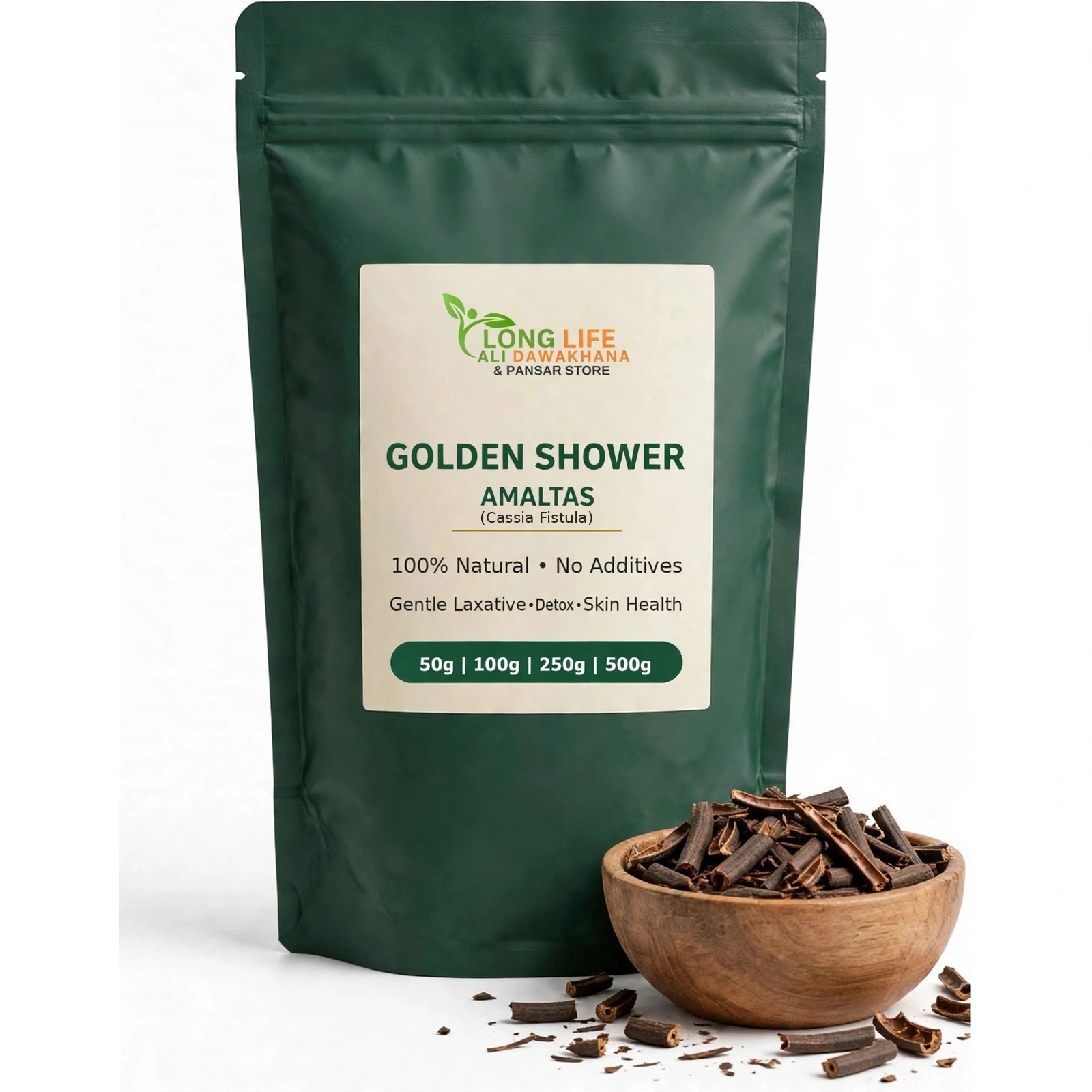
املتاس (Golden Shower) — مکمل معلومات
املتاس برصغیر کے خوبصورت ترین درختوں میں سے ایک ہے۔ گرمیوں میں اس پر پیلے پھولوں کے لمبے لٹکتے گچھے آتے ہیں جو سونے کی بارش جیسے لگتے ہیں، اسی لیے اسے انگریزی میں Golden Shower Tree یا Golden Rain Tree کہا جاتا ہے۔ اس کا نباتاتی نام کیشیا فسٹیولا (Cassia fistula) ہے اور یہ تھائی لینڈ کا قومی درخت بھی ہے۔
آیوروید میں املتاس کو ارگوَدھ کہا جاتا ہے، جس کا مطلب ہے “بیماریوں کو ختم کرنے والا”۔ اس کی پھلیوں کے اندر میٹھا کالا گودا ہوتا ہے جو آیوروید کا سب سے نرم اور محفوظ جلاب (mild laxative) مانا جاتا ہے۔ چرک سنہتا اور سشرت سنہتا جیسی قدیم کتابوں میں اس کا ذکر موجود ہے، اور بھاوپرکاش نگھنٹو میں اسے قبض، جلد کے امراض اور بخار کے لیے تجویز کیا گیا ہے۔
املتاس کا گودا قبض کے لیے خاص طور پر مشہور ہے — یہ سینا (Sana Makki) سے زیادہ نرم ہوتا ہے اور عام طور پر پیٹ میں مروڑ پیدا نہیں کرتا۔ اسی لیے یہ بچوں اور بزرگوں کے لیے بھی استعمال کیا جاتا ہے۔ اس کے علاوہ یہ خون صاف کرنے، جلد کے مسائل اور بخار میں بھی مفید مانا جاتا ہے۔
املتاس کے فائدے (روایتی استعمال)
- قبض: املتاس کا گودا آیوروید کا سب سے نرم جلاب ہے — آنتوں کو آہستہ سے متحرک کرتا ہے اور پاخانہ نرم کرتا ہے، بغیر مروڑ کے۔
- خون کی صفائی: اسے خون صاف کرنے والا (Raktashodhak) مانا جاتا ہے اور جلد کے مسائل میں استعمال ہوتا ہے۔
- جلد: جلد کے امراض جیسے ایگزیما، داد اور خارش میں اس کا استعمال روایتی ہے۔
- بخار: اس کی ٹھنڈی تاثیر پِتّ والے بخار میں مفید مانی جاتی ہے۔
- بواسیر: قبض دور کر کے یہ بواسیر کے مریضوں کو آرام پہنچاتا ہے۔
استعمال کا طریقہ
- گودا بھگو کر: 10 سے 15 گرام گودا رات کو نیم گرم پانی میں بھگو دیں، صبح چھان کر پی لیں۔
- سفوف: 3 سے 6 گرام سفوف نیم گرم پانی یا شہد کے ساتھ رات کو سونے سے پہلے لیں۔
- جوشاندہ: 50 سے 100 ملی لیٹر جوشاندہ دن میں دو بار لیا جا سکتا ہے۔
- جلد پر: سفوف کو عرقِ گلاب یا پانی میں ملا کر متاثرہ جلد پر لگائیں۔
املتاس Long.pk سے Whole، Powder یا Grounded فارم میں 50 گرام سے 500 گرام تک منگوایا جا سکتا ہے۔ قیمت صرف 135 روپے سے شروع ہوتی ہے اور پورے پاکستان میں کیش آن ڈیلیوری دستیاب ہے۔
Golden Shower (Amaltas) – Price in Pakistan, Benefits & How to Use
Direct answer: Golden Shower (Amaltas, Cassia fistula) price in Pakistan starts from Rs 135 for 50 gm (Whole form) at Long.pk, going up to Rs 861 for 500 gm (Powder or Grounded form). It is available in three forms — Whole, Powder and Grounded — in 50 gm, 100 gm, 250 gm and 500 gm packs, with cash on delivery across Pakistan. Amaltas is Ayurveda’s gentlest laxative: its fruit pulp (Phal Majja) is a mild purgative (Mridu Virechana) that relieves constipation without the cramping of stronger laxatives, and it is also traditionally used as a blood purifier, skin remedy and fever herb. A 2018 double-blind trial found it significantly improved bowel frequency compared with placebo — but it is still a traditional herb, not a medicine, and high doses cause diarrhoea.
Table of Contents
- What Is Golden Shower (Amaltas)?
- History of Amaltas
- Active Compounds
- Amaltas in Ayurveda, Unani & Folk Medicine
- What Does Modern Research Say?
- Detailed Benefits of Amaltas
- Pulp, Leaves, Flowers or Bark?
- Who Is Amaltas For?
- How to Use Amaltas
- Traditional Combinations
- Dosage & Duration
- Side Effects & Who Should Avoid It
- How to Identify Original Amaltas
- Storage & Shelf Life
- Amaltas vs Senna vs Triphala
- Amaltas Price in Pakistan
- Product Specifications
- Roman Urdu
- Frequently Asked Questions
What Is Golden Shower (Amaltas)?
Amaltas (Cassia fistula L.) is a deciduous tree of the legume family (Fabaceae), native to the Indian subcontinent and now grown across tropical Asia. In Urdu and Hindi it is Amaltas (املتاس), in Sanskrit Aragvadha (literally “disease-destroyer”), and in English the Golden Shower Tree, Golden Rain Tree or Indian Laburnum. It is the national tree of Thailand, and its flower is Thailand’s national flower.
The tree is famous for its spectacular display in late spring and summer: long, pendulous racemes of bright yellow flowers that hang like a shower of gold — hence the English name. The flowers are followed by long, cylindrical, dark brown pods, 30–60 cm long, that hang from the branches like sticks. Inside each pod is a sweet, dark brown-black pulp arranged around the seeds — and that pulp is the medicinal heart of the tree.
The dried pulp (and the dried pod pieces sold by pansar stores) is the product sold here as Golden Shower (Amaltas). The pulp is sweet and slightly bitter in taste, cooling in nature, and rich in anthraquinone glycosides — the same family of compounds that makes senna a laxative, but present here in gentler concentrations, which is why amaltas is classed as a mild purgative rather than a strong one.
Every part of the tree is used in traditional medicine — pulp, leaves, flowers, bark, roots and seeds — but the fruit pulp is by far the most important part, and the one with the strongest research backing. The dried pulp keeps well, makes a simple overnight soak or decoction, and is one of the most widely used traditional laxatives in South Asia.
History of Amaltas
Amaltas enters the written record with the classical Ayurvedic texts of the 1st millennium CE. Charaka Samhita and Sushruta Samhita both reference it as Aragvadha, and Caraka classifies it as a mild purgative safe for long-term use when combined with honey. Bhavaprakasha Nighantu (verses 148–150, page 66 of the standard edition) gives the full profile: heavy, sweet in taste, cooling, purgative, treating fever, heart disorders, bleeding disorders and painful conditions, pacifying Vata, and — as a fruit — mildly purgative, appetite-stimulating, and useful for skin disease and Pitta-Kapha disorders. Dhanvantari Nighantu and Raja Nighantu describe the tree’s varieties and confirm the fruit pulp as the primary useful part.
In Ayurveda, amaltas carries some of the most flattering names of any herb: Aragvadha (disease-destroyer), Rajvriksha (king of trees, for its bright yellow flowers) and Sarvarogaprashmani (that which pacifies all diseases). The last is a traditional compliment, not a medical claim — but it shows how highly the classical physicians valued it. Of all the herbs used for mild purgation, amaltas is described as the best.
In Unani medicine, amaltas (Amaltas in Unani texts too) became a standard mild laxative and blood purifier, used for constipation, skin disease and fever, and its pulp is a standard ingredient in Unani purgative preparations. In Thai traditional medicine, the ripe pod pulp is a recognised laxative drug — Thai researchers have standardised it and confirmed it as an efficacious and safe herbal laxative. Folk use across Pakistan, India and Southeast Asia has always been practical: soak the pulp overnight, drink it in the morning, and let nature take its course.
Active Compounds
The fruit pulp and other parts of Cassia fistula contain anthraquinones (the laxative compounds), flavonoids, tannins and sterols. Rhein is the major anthraquinone in the pod pulp.
| Compound | Type | What researchers looked at |
|---|---|---|
| Rhein | Anthraquinone | The major anthraquinone in the pod pulp; stimulates intestinal peristalsis and chloride secretion in the colon |
| Emodin | Anthraquinone | Laxative anthraquinone; also studied for anti-inflammatory and antimicrobial activity |
| Physcion | Anthraquinone | Contributes to the mild laxative effect |
| Chrysophanol | Anthraquinone | Laxative anthraquinone found in the pods and leaves |
| Sennosides A & B | Anthraquinone glycosides | The same laxative glycosides as senna, but in lower concentrations — part of why amaltas is gentler |
| Fistulic acid | Anthraquinone | Isolated from the alcoholic extract of the pods (1,4-dihydroxy-6,7-dimethoxy-2-methylanthraquinone-3-carboxylic acid) |
| Quercetin | Flavonoid | Antioxidant and anti-inflammatory flavonoid |
| Kaempferol | Flavonoid | Anti-inflammatory flavonoid, isolated from the flowers |
| Catechin | Flavonoid | Antioxidant; contributes to the pulp’s free-radical-scavenging activity |
| Lupeol | Triterpenoid | Anti-inflammatory triterpenoid from the bark |
| β-Sitosterol | Phytosterol | Plant sterol from the bark |
| Tannins | Polyphenols | Astringent compounds in the bark; contribute to skin and wound uses |
| Pectin & sucrose | Carbohydrates | Present in the pulp; pectin adds bulk and soothes the gut lining |
The mechanism is well understood: the anthraquinone glycosides in the pulp are converted by gut bacteria into their active forms, which stimulate the muscles of the intestinal wall (peristalsis) and provoke chloride ion secretion in colon cells, drawing water into the bowel and softening the stool. The effect is the same family of action as senna and rhubarb — but amaltas contains lower concentrations of sennosides than senna, and its pulp also contains soothing pectin, which is why it is gentler and less likely to cause cramping.
Amaltas in Ayurveda, Unani & Folk Medicine
In Ayurveda, amaltas is Aragvadha, and its profile is one of the most complete in the classical texts. It is sweet and slightly bitter in taste, heavy (guru) in quality, and cooling (sheeta virya) in potency. It pacifies Pitta and Kapha — some sources say all three doshas — and its classical actions include Mridu Virechana (mild purgation), Raktashodhana (blood purification), Shothahara (anti-inflammatory) and Jwaraghna (fever-reducing). The fruit is classed as Sramsana (mild purgative), Sulahara (relieves colic) and Ruchya (appetiser). It is described as the best of all mild purgatives, and as a premier kushtha (skin disease) remedy — used for eczema, ringworm, scabies and psoriasis. Its cooling energy specifically targets Pitta-type fever with burning sensation and excessive thirst.
In Unani medicine, amaltas is a standard mild laxative and blood purifier, used for constipation, skin disorders, fever and liver complaints. Its temperament is generally given as cold and moist, which fits its cooling, stool-softening action. The pulp is used in Unani compound preparations for chronic constipation and for cleansing the bowel before other treatments.
In folk medicine across Pakistan and India, amaltas is the household remedy for constipation: the pulp soaked overnight in water and taken in the morning. It is also used for skin problems (paste on the affected area), for fever (decoction), and — in some regions — the flowers are used to decorate the hair, and the pod pulp is used to flavour tobacco. In Thailand, the ripe pod pulp is an officially recognised traditional laxative, and Thai researchers have standardised its preparation.
What Does Modern Research Say?
Amaltas has better human evidence than most traditional laxative herbs — though, as with all the herbs in this series, the honest picture is that the evidence is strongest for constipation and thinner for everything else.
Constipation — the best evidence. Multiple randomised controlled trials have shown that amaltas pulp powder (3–6 g) reduces transit time in mild chronic constipation. A double-blind trial in 2018 found significant improvement in bowel frequency compared with placebo after 10 days of use. Thai researchers (Sakulpanich et al.) standardised extracts from ripe pod pulp collected across 10 provinces and found them to be efficacious and safe herbal laxatives, with the laxative activity traced to the anthraquinone glycosides. A 2026 review in the International Journal of Scientific Research and Technology (published on Zenodo, November 2026) concluded that “evidence is stronger for constipation, while many other applications remain supported mainly by preclinical studies.”
Anti-inflammatory activity. A 2017 study in the Journal of Ethnopharmacology found that ethanolic extracts of C. fistula significantly reduced paw oedema (swelling) in rats, supporting the traditional use for joint swelling and pain. A 2020 in-vitro study found that amaltas flower extract inhibited COX-2 expression by 45% — a hint of potential in osteoarthritis, though laboratory evidence only.
Liver and kidney protection. Preliminary rodent studies indicate hepatoprotective (liver-protecting) effects for C. fistula extracts, and nephroprotective activity has also been reported in animal models. Human trials are ongoing; no firm clinical conclusion can be drawn yet.
Safety. Acute toxicity studies in rodents with different plant extracts showed no deaths or major behavioural changes, and Sakulpanich et al. reported that the leaves and flowers have no acute or chronic toxic effect when given orally. That said, the laxative effect itself is the main safety issue: high doses cause diarrhoea, cramps, dehydration and electrolyte loss, exactly as with any anthraquinone laxative.
The honest summary: amaltas is one of the better-evidenced traditional laxatives — it has randomised trials and a standardised preparation behind it, which is more than most herbs can claim. For constipation, it is a reasonable, gentle, evidence-supported traditional choice. For its other traditional uses — skin, fever, liver — the evidence is still mostly animal and laboratory work, and should be treated as promising rather than proven.
Detailed Benefits of Amaltas
Gentle Laxative & Constipation Relief
This is amaltas’s headline benefit, and the one with real trial evidence. The fruit pulp is one of Ayurveda’s most favoured mild laxatives (mridu virechana), effective for chronic constipation in people of all ages, including children and the elderly. Unlike harsh purgatives, it softens the stool and promotes smooth bowel movements without causing abdominal cramps — the anthraquinones stimulate peristalsis while the pulp’s pectin soothes the gut. The 2018 double-blind trial and the Thai standardisation work give this traditional use genuine scientific weight.
Blood Purification & Detox
In Ayurveda, amaltas is a Raktashodhak (blood purifier): by clearing the bowel gently and regularly, it is said to reduce the body’s toxic load (ama) and clear the skin from within. This is traditional reasoning rather than a proven mechanism — modern medicine does not recognise “blood purification” as amaltas performs it — but regular, gentle bowel regulation is genuinely associated with better skin and a lighter feeling, and the pulp’s antioxidant flavonoids add a real (if modest) protective effect.
Skin Health (Eczema, Ringworm, Scabies)
Amaltas is classified as a premier kushtha remedy in Ayurveda — used for eczema, ringworm, scabies and psoriasis, both internally (as a blood purifier) and externally (as a paste or oil). The anthraquinones and flavonoids have antimicrobial activity in laboratory models, and the cooling, anti-inflammatory action suits hot, itchy, inflamed skin. For external use, the pulp or powder is mixed with rose water or plain water and applied to the affected area.
Fever (Pitta-Type)
The cooling energy (sheeta virya) of amaltas makes it a traditional remedy for Pitta-type fever — fever with burning sensation, excessive thirst and inflammation. The fruit pulp decoction is given during the course of fever, and classical texts describe amaltas as continuously indicated in fever treatment, partly as a detoxifier that clears the digestive tract.
Liver Support
Preliminary animal studies suggest hepatoprotective effects for C. fistula extracts, and the traditional use of the pulp as a detoxifier fits the same picture. This is a promising area, not a proven one — human trials are ongoing, and amaltas should not be used as a treatment for liver disease.
Piles (Haemorrhoids)
By relieving chronic constipation gently, amaltas reduces the straining that aggravates piles. Ayurvedic practitioners commonly prescribe it for piles patients where gentle detoxification is needed without aggravating Vata. It treats the constipation that drives the piles, not the piles themselves — but for many sufferers, that is the main problem.
Joint Pain & Inflammation
The 2017 rat study (reduced paw oedema) and the 2020 COX-2 finding (45% inhibition by flower extract in vitro) give some support to the traditional use of amaltas for joint swelling and pain. The leaves are also used in folk medicine for rheumatism. This is a secondary use — amaltas is not a first-choice joint herb — but the anti-inflammatory evidence is real.
Appetite & Digestion
The fruit is classed as Ruchya (appetiser) in Ayurveda, and the pulp is traditionally used for dyspepsia and sluggish digestion. By clearing the bowel and reducing ama (undigested residue), it is said to restore appetite and digestive fire (agni).
Pulp, Leaves, Flowers or Bark?
All parts of the amaltas tree are used, but the fruit pulp is the main medicinal part and the one with the trial evidence.
| Part | Traditional use | Notes |
|---|---|---|
| Fruit pulp | Gentle laxative, blood purifier, skin, fever | The primary part; richest in anthraquinone glycosides; the product sold here |
| Leaves | Skin disease, rheumatism, ulcers, malaria, erysipelas | Contain free rhein, glucosides and sennosides A & B; used as poultice or decoction |
| Flowers | Fever, skin disease, biliousness | Contain kaempferol and a proanthocyanidin; COX-2 inhibition shown in vitro (2020) |
| Bark | Skin disease, leprosy, fever | Contains tannins, lupeol, β-sitosterol, hexacosanol; used as decoction |
| Roots | Adenopathy, leprosy, skin disease, tubercular glands | Used in classical formulas; not a home-use part |
| Seeds | Antibilious, carminative, laxative | Inside the pods; the pulp around them is the useful part for home use |
For home use, the fruit pulp is the safest and most practical part: it has the best evidence, the gentlest action, and the simplest preparation (soak overnight, drink in the morning).
Who Is Amaltas For?
Amaltas suits adults with mild to moderate chronic constipation who want a gentle, traditional laxative — particularly people who find senna too harsh or cramping, and older people who need a mild, reliable bowel regulator. It also suits people looking for a traditional blood purifier or skin remedy, and anyone who prefers a herb with actual trial evidence behind its main use.
It is not for everyone: pregnant and breastfeeding women should avoid internal use, people with diarrhoea or inflammatory bowel conditions should not use it, and anyone on medication that affects potassium or fluid balance should check with their doctor first. Children 6–12 can use a reduced dose (1–2 g) under guidance; younger children should not take it internally without expert supervision.
How to Use Amaltas
Overnight soak (the classic method). Take 10–15 g of dried fruit pulp (or pod pieces), soak in warm water overnight, strain in the morning and drink the liquid — with warm water, at bedtime or first thing in the morning. This is the standard traditional preparation for constipation relief.
Powder (Churna). Take 3–6 g of amaltas pulp powder mixed with warm water or honey, once or twice a day — usually after dinner, so it works overnight. For a gentler effect, start at 2–3 g (elderly people often start at 2 g with milk).
Decoction. Boil the pulp or pod pieces in water and take 50–100 ml of the decoction twice a day. This is the preparation used for fever and for general detox.
For purgation (stronger effect). The classical purgative dose is 10–20 g of fruit pulp — used only under a practitioner’s guidance, and not as a routine. For everyday constipation, the 3–6 g powder dose or the overnight soak is the right level.
Skin paste. Mix the powder with rose water or plain water to make a paste and apply to the affected skin (eczema patches, ringworm, itchy areas) once or twice a day. Amaltas oil (taila) can also be applied thinly to affected skin areas 1–2 times a day.
Traditional Combinations
- Amaltas + Triphala: the classic gentle bowel combination — triphala’s three fruits (amalaki, haritaki, bibhitaki) plus amaltas pulp, taken after dinner for overnight cleansing. Amaltas powder 3–5 g mixed with triphala is a standard preparation.
- Amaltas + Honey: the classical vehicle (anupan) — Caraka Samhita describes amaltas as safe for long-term use when combined with honey.
- Amaltas + Haritaki: two mild purgatives together for stubborn constipation; haritaki adds a gentle toning action to the bowel.
- Amaltas + Senna (Sana Makki): a stronger combination for severe constipation — but use with care, as both are anthraquinone laxatives and the effect adds up. Not for routine use.
- Amaltas + Rose Water: for skin — the pulp powder mixed with rose water as a cooling, cleansing face and skin paste.
- Amaltas + Giloy: for fever with constipation — giloy’s antipyretic action plus amaltas’s gentle purgation and cooling.
Dosage & Duration
The figures below are traditional Ayurvedic doses from the classical texts and modern Ayurvedic sources. They are given for information — your practitioner’s instruction takes priority.
| Form | Traditional dose | Notes |
|---|---|---|
| Fruit pulp (fresh/dried) | 10–15 g once daily | Soak in warm water overnight; take at bedtime for constipation |
| Pulp powder | 3–6 g, once or twice daily | With warm water or honey; elderly start at 2 g with milk |
| Pulp powder (gentle) | 3–5 g once daily | Mix with warm water or triphala; take after dinner |
| Decoction | 50–100 ml, twice a day | For constipation, fever or detox |
| Flowers | 5–10 g | Decoction or infusion |
| Root bark decoction | 50–100 ml | Practitioner-guided |
| For purgation | 10–20 g fruit pulp | Only under practitioner guidance; not routine |
| Children (6–12 years) | 1–2 g powder once daily | Reduced dose; under guidance |
Duration: for constipation, amaltas is traditionally used for 1–2 weeks, then reviewed. The 2018 trial showed significant improvement after 10 days. Caraka Samhita describes it as safe for long-term use with honey — but, like all anthraquinone laxatives, it should not be relied on indefinitely without addressing the underlying cause of constipation (diet, water, fibre, movement). If constipation persists beyond 2 weeks, see a doctor.
Side Effects & Who Should Avoid It
Amaltas is gentle as laxatives go, and acute toxicity studies found no serious toxic effects — but it is still an anthraquinone laxative, and the cautions are real.
Possible side effects: high doses cause abdominal cramps, diarrhoea, dehydration and electrolyte (potassium) loss — the same risks as senna, though milder at normal doses. Prolonged or high-dose use may contribute to mild dehydration if fluid intake is not maintained. Excessive use may aggravate Vata (cold, dry qualities) and worsen cold-related conditions.
Who should be careful:
- Pregnant women — internal use is contraindicated: the laxative action and possible uterine-stimulating effects (noted in animal models at high doses) make it risky. Avoid without physician supervision.
- Breastfeeding women — avoid internal use; anthraquinones can pass into breast milk and affect the baby.
- Young children and infants — not recommended for small children; children 6–12 use the reduced dose only under guidance.
- People with diarrhoea or inflammatory bowel disease (IBD) — do not use; it will worsen the condition.
- People who are dehydrated — do not use until rehydrated.
- People with low blood pressure (hypotension) — use cautiously.
- People on diuretics, heart medication or potassium-affecting drugs — check with your doctor first, because electrolyte loss can interact with these medicines.
A note on dependence: like all stimulant laxatives, amaltas should not be used as a permanent crutch. If you need a laxative every day for more than a couple of weeks, the underlying cause needs attention — diet, hydration, fibre and movement matter more than any herb.
How to Identify Original Amaltas
- Pods: the dried pods are long, cylindrical, dark brown to almost black, hard and heavy for their size. Light, hollow-feeling pods are old or empty.
- Pulp: the pulp inside is dark brown-black, sticky-sweet and slightly bitter. It should smell sweet and fruity, not sour or musty.
- Powder: amaltas pulp powder is dark brown, fine and slightly sticky to the touch. Very pale powder may be cut with filler.
- Taste: sweet at first, then slightly bitter — the bitterness is the anthraquinones. If there is no bitter note, the pulp is old or weak.
- No mould: the pulp is sugary and can attract moisture — reject any pulp or powder with white or green mould spots, or a fermented smell.
- Buy from a trusted store: Long.pk sources its Amaltas from established pansar suppliers, and the pulp is packed in sealed pouches that protect it from moisture and contamination.
Storage & Shelf Life
Store amaltas in an airtight container or its sealed pouch, away from light, heat and moisture. The pulp is sugary and absorbs moisture easily, so keep the pouch sealed between uses and do not store it in a damp place. A cool, dry kitchen cupboard is ideal. The dried pulp and pod pieces keep their potency for 12–18 months when stored properly. The powder loses strength faster (use within 9–12 months of grinding). Do not store it in the bathroom or near the stove, where steam and heat degrade it.
Amaltas vs Senna vs Triphala
These three are the great traditional bowel herbs of South Asian medicine, and they are often confused. All three relieve constipation — but they work differently, and the right choice depends on the person.
| Feature | Amaltas | Senna (Sana Makki) | Triphala |
|---|---|---|---|
| Botanical name | Cassia fistula | Senna alexandrina | Three fruits: Amalaki, Haritaki, Bibhitaki |
| Main action | Mild purgative (anthraquinones) | Strong purgative (sennosides) | Gentle bowel tonic + mild laxative |
| Gentleness | Gentlest anthraquinone laxative | Stronger; more cramping | Gentlest overall; no cramping |
| Onset | 6–12 hours (overnight) | 6–12 hours (overnight) | Gradual (days of regular use) |
| Best for | Chronic constipation, elderly, children 6+ | Short-term constipation, bowel prep | Daily bowel regulation, digestion |
| Skin use | Yes (kushtha remedy) | No | Yes (general detox) |
| Human trials | 2018 double-blind trial (positive) | Multiple RCTs; FDA-approved OTC | Several small trials |
| Pregnancy | Avoid | Avoid | Avoid (practitioner-guided only) |
| Long-term use | Traditionally OK with honey | Max 1 week (EMA guidance) | Traditionally OK for daily use |
| Price (Long.pk, from) | Rs 135 / 50 gm | Rs 351 / 50 gm | — |
Which to choose: for gentle, reliable constipation relief — especially for older people or anyone who finds senna too harsh — amaltas. For fast, strong, short-term relief, senna. For daily bowel regulation and general digestive health, triphala.
Amaltas Price in Pakistan
Prices checked 19 November 2026 (following pansaar.com, rounded to whole rupees). Cash on Delivery available across Pakistan.
| Form | 50 gm | 100 gm | 250 gm | 500 gm |
|---|---|---|---|---|
| Whole | Rs 135 | Rs 211 | Rs 489 | Rs 523 |
| Powder | Rs 304 | Rs 363 | Rs 489 | Rs 861 |
| Grounded | Rs 304 | Rs 363 | Rs 489 | Rs 861 |
Best value: the 500 gm Whole pack at Rs 523 is remarkable value — only Rs 34 more than the 250 gm pack (Rs 489), so double the quantity for almost the same price. If you use amaltas regularly, the 500 gm Whole pack is the obvious choice. The Powder and Grounded forms cost more than Whole at small sizes (grinding and sieving add cost), which is normal across the herb range.
Product Specifications
| Product Name | Golden Shower (Amaltas) |
| Urdu Name | املتاس |
| Botanical Name | Cassia fistula L. |
| Family | Fabaceae |
| Forms Available | Whole / Powder / Grounded |
| Weights Available | 50 gm / 100 gm / 250 gm / 500 gm |
| Price Range | Rs 135 – Rs 861 |
| Purity | 100% Natural, No Additives |
| Origin | Pakistan / South Asia |
| Shelf Life | 12–18 months (dried pulp/pods); 9–12 months (powder) |
| Storage | Airtight container, cool & dry place, away from sunlight |
| Seller | Ali Dawakhana and Pansar Store |
| Delivery | Cash on Delivery across Pakistan |
Roman Urdu
Golden Shower (Amaltas, Cassia fistula) bar-e-sagheer ka mashhoor darakht hai jis par garmiyon mein peelay phoolon ke lambe guchchay lataktay hain. Ayurveda mein isay Aragvadha kehte hain, yani “beemariyon ko khatam karne wala”. Is ki phaliyon ke andar meetha kala gooda hota hai jo Ayurveda ka sab se naram julaab (mild laxative) mana jata hai — qabz ke liye behtareen, aur Sana Makki se zyada naram, kyun ke is se pait mein maror nahi hota.
Amaltas ke fawaid mein qabz ka naram ilaaj, khoon ki safai, jild ke masail (eczema, daad, kharish) mein behtri, bukhaar mein aaram, aur bawaseer mein qabz door kar ke aaram shamil hain. Is mein rhein, emodin aur sennosides jaise murakkabat paaye jate hain. Aik 2018 ki double-blind trial mein is ne qabz mein placebo se behtar natija diya.
Amaltas istemal karne ka aasan tareeqa: 10 se 15 gram gooda raat ko neem garam pani mein bhigo dein, subah chhaan kar pee lein. Safoof 3 se 6 gram tak neem garam pani ya shehed ke saath raat ko liya ja sakta hai. Haamla khawateen aur doodh pilane wali maaen isay andar se istemal na karein. Zyada miqdar se dast aur pait mein dard ho sakta hai.
Long.pk se Amaltas Whole, Powder aur Grounded form mein 50 gm se 500 gm tak dastiyab hai — qeemat sirf Rs 135 se shuru. Pure Pakistan mein Cash on Delivery ki sahulat mojood hai.
Frequently Asked Questions
Q: Amaltas kis kaam aata hai?
Amaltas (Cassia fistula) ka gooda Ayurveda ka sab se naram julaab hai — qabz ke liye istemal hota hai. Is ke ilawa yeh khoon saaf karne, jild ke masail aur bukhaar mein bhi rawayati tor par istemal hota hai.
Q: Amaltas ki Pakistan mein qeemat kya hai?
Long.pk par Amaltas ki qeemat Rs 135 se shuru hoti hai (50 gm Whole) aur Rs 861 tak jati hai (500 gm Powder/Grounded). Whole, Powder aur Grounded — teeno forms 50, 100, 250 aur 500 gm mein dastiyab hain.
Q: Amaltas aur Sana Makki mein kya farq hai?
Dono anthraquinone julaab hain, lekin Amaltas zyada naram hai aur aam tor par pait mein maror nahi deta, jab ke Sana Makki taqatwar hai aur maror de sakti hai. Amaltas buzurgon aur bachon ke liye behtar hai; Sana Makki fori aur taqatwar araam ke liye hai.
Q: Amaltas ka gooda kaise istemal karein?
10 se 15 gram gooda raat ko neem garam pani mein bhigo dein, subah chhaan kar pee lein. Ya 3 se 6 gram safoof neem garam pani ya shehed ke saath raat ko lein. Asar aam tor par 6 se 12 ghanton mein hota hai.
Q: Kya amaltas se qabz ka mustaqil ilaaj hota hai?
Amaltas qabz mein madad deta hai aur 2018 ki trial mein is ka asar sabit hua, lekin mustaqil qabz ki asal wajah (khana, pani, resha, harkat) ka ilaaj zaroori hai. Do hafton se zyada musalsal istemal se pehle doctor se mashwara karein.
Q: Kya haamla khawateen amaltas le sakti hain?
Nahi — haamla khawateen ko amaltas andar se istemal nahi karna chahiye, kyun ke is ke julaab asar aur bachah-dani par mumkin asraat khatarnak ho saktay hain. Doodh pilane wali maaen bhi parhaiz karein.
Q: Amaltas bachon ko de saktay hain?
6 se 12 saal ke bachon ko 1 se 2 gram safoof din mein aik baar, kisi mahir ki rehnumai mein diya ja sakta hai. Chhotay bachon ko bina mahir ke mashwaray ke na dein.
Q: Amaltas se koi nuqsan ho sakta hai?
Munasib miqdar mein yeh aam tor par mehfooz hai. Zyada miqdar se pait mein dard, dast, pani ki kami aur namkiyaat ki kami ho sakti hai. Dast ya aant ki soozish (IBD) walay isay istemal na karein.
Q: Amaltas jild ke liye kaisa hai?
Amaltas ko Ayurveda mein jild ke amraaz (eczema, daad, khujli) ka behtareen ilaaj mana jata hai. Safoof ko arq-e-gulaab ya pani mein mila kar mutasira jild par lagayen.
Q: Asli amaltas ki pehchan kya hai?
Asli phaliyan lambi, sakht aur gehre bhooray-kaale rang ki hoti hain. Andar ka gooda gehra bhoora-kaala, meetha aur halka karwa hota hai. Phaphundi ya khatti boo wali cheez na lein.
Ali Dawakhana and Pansar Store — Asli desi dawa aur khalis jadi bootiyan, ab ghar baithay Long.pk se mangwayen.
Reviews
There are no reviews yet