
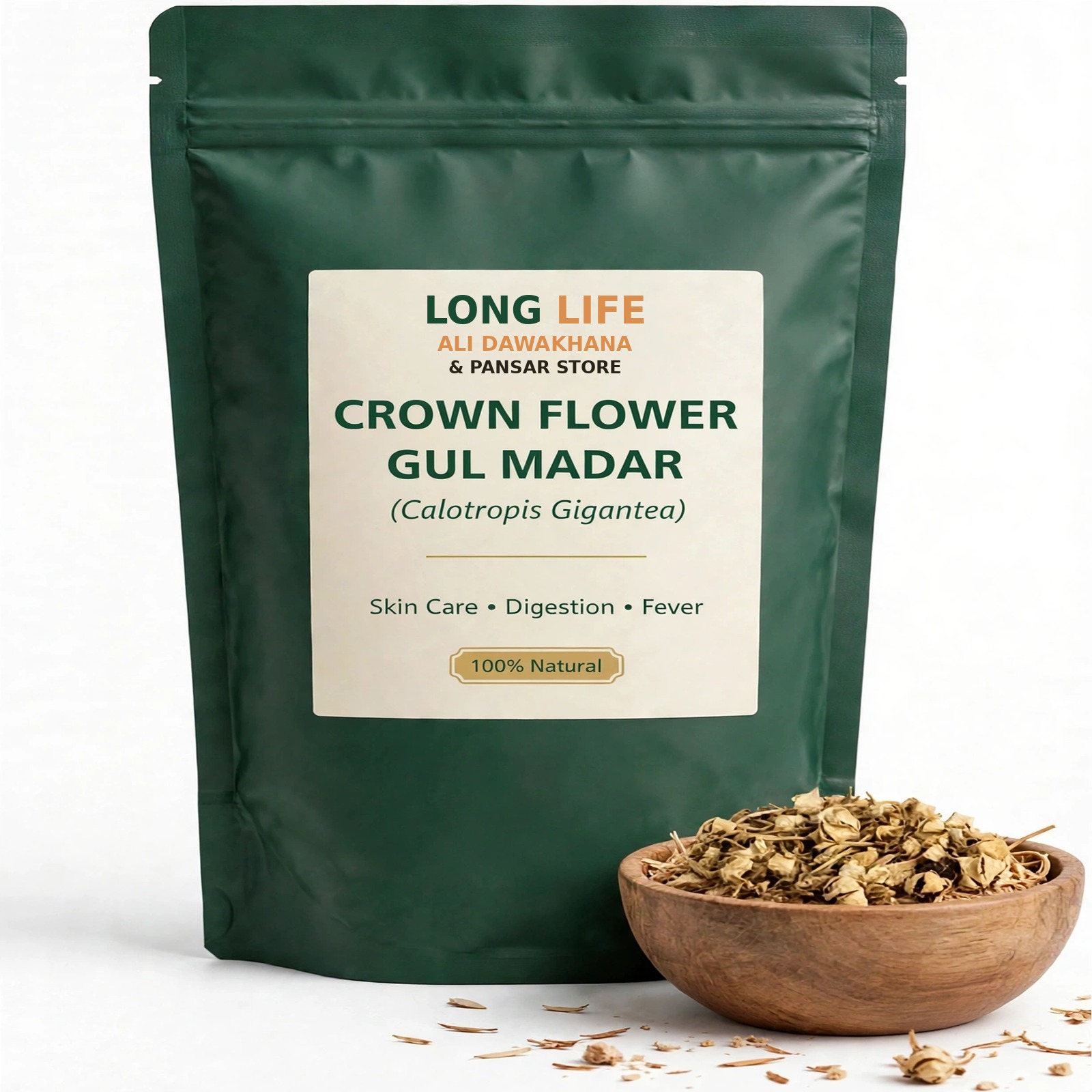
Crown Flower (Gul Madar, Calotropis gigantea), known in Ayurveda as Arka, is a traditional remedy used for skin diseases, joint pain, asthma, fever and digestion — and it is also a poisonous plant. Every part of it contains cardiac glycosides related to digoxin, and its milky latex can seriously damage the eyes. Internal use is practitioner-only; this article gives no home dose. At Long.pk it is available in Whole and Powder forms (50 gm and 250 gm) from Rs 120, with Cash on Delivery across Pakistan.
گل مدار (کراؤن فلاور) — مکمل معلومات
گل مدار (Crown Flower)، سائنسی نام Calotropis gigantea، آیوروید میں ارک (Arka) — جلد، جوڑوں کے درد، دمہ اور بخار کے لیے استعمال ہوتا ہے۔
لیکن یہ پودا زہریلا ہے: ہر حصے میں کارڈیک گلائیکوسائیڈز ہیں۔ صرف ماہر حکیم کی نگرانی میں استعمال کریں۔
Crown Flower (Gul Madar) – Price in Pakistan, Benefits, Uses & Safety
Direct answer: Crown Flower (Gul Madar, Calotropis gigantea) costs Rs 120 for 50 gm (Whole) to Rs 510 for 250 gm (Powder) at Long.pk. No home dose is given in this article.
- What Is Crown Flower?
- History of Crown Flower
- Active Compounds
- Crown Flower in Ayurveda, Unani & Folk Medicine
- What Does Modern Research Say?
- Detailed Benefits of Crown Flower
- Flowers vs Latex: Which Part Is Which
- Who Is Crown Flower For?
- How to Use Crown Flower
- Traditional Combinations
- Dosage & Duration
- Side Effects & Who Should Avoid It
- How to Identify Original Crown Flower
- Storage & Shelf Life
- Crown Flower vs Foxglove vs Oleander
- Crown Flower Price in Pakistan
- Product Specifications
- Roman Urdu
- Frequently Asked Questions
What Is Crown Flower?
Crown Flower (Gul Madar, Calotropis gigantea) is a latex-bearing shrub of the milkweed family. Every part bleeds a thick white milky latex when cut, where the danger concentrates: cardiac glycosides and a vesicant allergen. Long.pk sells the dried flowers — the mildest part — but they too contain cardiac glycosides.
History of Crown Flower
In Ayurveda, C. gigantea is Arka — named in the Charaka Samhita and the Sushruta Samhita — and the texts list it among the poisonous group of drugs. The most famous preparation is Swarnabhasma, used for diabetes.
Active Compounds
| Compound | Type | What researchers looked at |
|---|---|---|
| Calotropin | Cardenolide | Most potent — similar to digoxin |
| Uscharin | Cardenolide | In latex (0.45%) |
| Calotoxin | Cardenolide | In latex (0.15%) and leaves |
Crown Flower in Ayurveda, Unani & Folk Medicine
In Ayurveda, Arka is used for fever, worms, skin diseases, piles, asthma and cough; the flowers for asthma, catarrh and fever. Doses are small, purified and practitioner-given. In Unani medicine, Gul Madar is anthelmintic and wound-healing.
What Does Modern Research Say?
Almost all research is laboratory and animal work — there are no human clinical trials. Analgesic (flowers) in animal models; anti-inflammatory, antimicrobial and wound-healing activity in lab studies. Anticancer — cell lines ONLY: cytotoxic against MCF-7 and HeLa cells. Laboratory evidence only — the anticancer claim must never be made for this product. Antifertility — animal: “pregnancy prevention” is reported.
Detailed Benefits of Crown Flower
1. Skin Diseases & Wounds
Kushtha medicine for skin diseases. Antibacterial in lab studies.
2. Joint Pain & Swelling
Roasted leaves bandaged over painful joints.
3. Asthma & Respiratory Complaints
For asthma and cough. Not a substitute for asthma medication.
4. Fever
A traditional fever remedy — not a malaria treatment.
5. Digestion & Appetite
Appetizer and anti-flatulent in Unani medicine.
6. Intestinal Worms
Anthelmintic in the classical texts. Do not self-prescribe.
7. Diabetes
Used for diabetes in Ayurvedic practice. Weak evidence — never use without medical supervision.
8. Pain Relief
Analgesic in animal models. No human trial.
Flowers vs Latex: Which Part Is Which
| Part | What it is | Traditional use | Toxicity |
|---|---|---|---|
| Flowers (this product) | Dried blooms | Asthma, catarrh, anorexia, fever | Mildest part — still contains cardiac glycosides |
| Leaves | Thick pale-green leaves | Roasted, bandaged over joints | Calotropin, uscharin, calotoxin; sheep developed arrhythmias within 4 hours |
| Root bark | The bark of the root | Asthma, bronchitis, leprosy | Calotropin, calactin, uscharidin |
| Latex | Thick white milky sap | External only: skin infections, wounds, toothache | Most dangerous — uscharin 0.45%, calotoxin 0.15%, calactin 0.15%; severe eye damage |
Who Is Crown Flower For?
- Ayurvedic, Unani and Siddha practitioners who use Arka in compound formulations.
- Users directed to the flowers by a qualified practitioner.
Not for home use — not for pregnant or breastfeeding women, children, or anyone with a heart condition. Dried Aloe is a gentler choice.
How to Use Crown Flower
Internal use — practitioner only. Small, measured amounts, dosed by a qualified practitioner.
What NOT to do. Do not eat the fresh plant. Do not chew the leaves, flowers or stems. Do not break the plant open and touch the latex — and never let the latex near your eyes. Do not make a tea, decoction or extract at home and drink it: life-threatening poisoning has been reported after ingestion of plant extracts and tea. Do not use the latex on broken skin. Do not give any part of the plant to children or pets.
Traditional Combinations
| Combination | Purpose | How it is used |
|---|---|---|
| Crown Flower + honey (Shehed) | Vehicle | Powder in honey, practitioner-given amounts |
| Roasted leaves + sesame oil | Muscular pain, eczema | Leaves warmed in sesame oil, applied |
Dosage & Duration
No home dose is given in this article — deliberately.
Cardiac glycoside levels vary by season, soil and preparation; traditional doses are small and practitioner-given; the therapeutic-toxic gap is narrow.
For comparison only — not as a recommendation — rats given 1 ml/kg of latex died within 2 hours, and sheep developed arrhythmias within 4 hours.
If a practitioner prescribes the flowers, follow their dose exactly, and seek medical help at once if you feel nauseous, dizzy, or notice your heartbeat slowing or becoming irregular.
Side Effects & Who Should Avoid It
How the poison works. The cardiac glycosides inhibit the sodium-potassium pump — the same mechanism as digoxin. An uncontrolled dose causes marked bradycardia, heart block, ventricular dysrhythmias, low blood pressure, and in severe cases asystole and cardiovascular collapse. High potassium (hyperkalaemia) is prominent in severe acute poisoning.
Possible effects of poisoning:
- Mild to moderate: nausea, vomiting, abdominal pain, lethargy, slow heartbeat; chronic exposure adds malaise, loss of appetite, delirium and visual changes.
- Severe: severe bradycardia, heart block, vomiting, shock.
- Nervous system: fatigue, lethargy, malaise, headache, confusion, agitation, dizziness.
- Eyes (from latex contact): severe inflammation — conjunctivitis, iridocyclitis, keratitis, corneal endothelial damage — with vision loss and photophobia.
- Skin: mild dermatitis, mainly an allergic reaction to the latex.
Do NOT use Crown Flower if you:
- Are pregnant — antifertility activity is reported; abortion is listed as an adverse reaction.
- Are breastfeeding — no safety data; the glycosides could pass to the infant.
- Are giving it to a child — children can be poisoned by chewing plant parts.
- Have a heart condition (slow heartbeat, heart block, arrhythmia, heart failure) or take heart medication, especially digoxin.
- Take any cardioactive medication — calotropin resembles digoxin, so interaction is a risk.
Use only with a practitioner’s and a doctor’s supervision if you:
- Take blood-pressure medication, diuretics or potassium supplements.
- Have kidney or liver disease.
- Have low blood pressure.
If poisoning is suspected: stop use at once, do not induce vomiting, and seek emergency help immediately. Tell the medical team it is Calotropis gigantea — treatment (including digoxin-specific antibody fragments) depends on knowing the cause. If latex gets into the eyes, rinse with clean water for at least 15 minutes and seek urgent eye care.
How to Identify Original Crown Flower
- Cupped buds: pale tan to cream, papery, 2–4 cm across. Very dark pieces are old; green pieces immature.
- Dry and crisp; reject anything soft, damp or mouldy.
- Not the latex: sticky material or white milky residue means contamination — do not use it. Not C. procera (more poisonous).
Storage & Shelf Life
Store in an airtight jar, in a cool, dark, dry place. Keep it out of reach of children and pets. Whole flowers keep 12–18 months; powder 9–12 months.
Crown Flower vs Foxglove vs Oleander
| Feature | Crown Flower (Gul Madar) | Foxglove (Digitalis) | Oleander (Kaner) |
|---|---|---|---|
| Botanical name | Calotropis gigantea | Digitalis purpurea | Nerium oleander |
| Family | Apocynaceae | Plantaginaceae | Apocynaceae |
| Key cardiac glycosides | Calotropin, calotoxin, uscharin, calactin | Digoxin, digitoxin | Oleandrin, nerin |
| Mechanism | Inhibits Na⁺/K⁺-ATPase | Inhibits Na⁺/K⁺-ATPase | Inhibits Na⁺/K⁺-ATPase |
| Traditional use | Skin, joints, asthma, fever | Dropsy, wounds | Skin, heart, pain |
| Modern medicine | None | Digoxin is a heart drug | None — too toxic |
| Most dangerous part | Latex | Leaves | Leaves and sap |
| Eye danger | Severe — keratitis, vision loss | Low | Moderate |
| Human trials | None | Extensive (for digoxin) | None |
| Home use | Practitioner only — no home dose | Never — prescription only | Never |
| Availability | Sold as a traditional herb | Garden flower | Ornamental |
Price in Pakistan
| Form | 50 gm | 250 gm |
|---|---|---|
| Whole | Rs 120 | Rs 450 |
| Powder | Rs 220 | Rs 510 |
The range is Rs 120–510; best value is the Whole 250 gm pack at Rs 1.80 per gram.
Specifications
| Product name | Crown Flower (Gul Madar) |
| Urdu name | گل مدار (Gul Madar) |
| Sanskrit name | Arka, Sweta Arka |
| Botanical name | Calotropis gigantea (L.) R. Br. (giant milkweed / crown flower) |
| Family | Apocynaceae (milkweed family; formerly Asclepiadaceae) |
| Part used | Dried flowers |
| Forms | Whole / Powder |
| Weights | 50 gm, 250 gm |
| Origin | Pakistan, India, Sri Lanka, Thailand, Southeast Asia |
| Purity | 100% natural dried flowers, no additives |
| Key compounds | Calotropin, calotoxin, uscharin, calactin (cardenolides); giganteol, amyrin, β-sitosterol |
| Shelf life | Whole flowers 12–18 months; powder 9–12 months |
| Storage | Airtight container, cool, dark, dry place; keep out of reach of children and pets |
| Seller | Ali Dawakhana and Pansar Store |
Roman Urdu Summary
Crown Flower (Gul Madar) — Calotropis gigantea — Ayurveda mein Arka kehlata hai. Yeh jild ke amraz, joron ke dard aur damah ke liye istemal hota hai — lekin yeh aik zehrila poda hai.
Phool sab se halka hissa hain — lekin sirf hakeem ki nigrani mein istemal karein. Koi ghar ki khurak nahi di gayi. Hamila khawateen, bachay aur dil ke mareez istemal na karein.
Frequently Asked Questions
Q: Gul Madar kis kaam aata hai?
Jild ke amraz, joron ke dard aur damah ke liye.
Q: Kya Gul Madar zehrila hai?
Ji haan — is ke cardiac glycosides digoxin jaisay hain.
Q: Gul Madar ka doodh (latex) aankhon mein chala jaye to kya karein?
Aankh ko foran pani se 15 minute dhoyen aur doctor se ruju karein.
Q: Gul Madar ki khurak kya hai?
Koi ghar ki khurak nahi di gayi.
Q: Kya pregnant women Gul Madar use kar sakti hain?
Bilkul nahi — is mein antifertility asraat hain.
Q: Gul Madar aur Aak (Calotropis procera) mein kya farq hai?
C. gigantea safed phool hai; C. procera ziyada zehrila hai.
Q: Gul Madar ki price kya hai?
Rs 120 se Rs 510 tak.
Q: Gul Madar dil ki dawa ke saath le sakte hain?
Nahi — doctor se poochay baghair bilkul nahi.
Q: Asli Gul Madar ki pehchan kya hai?
Halke tan ya cream rang ke, kaghaz jaisay phool.
Q: Gul Madar ko kaise store karein?
Airtight jar mein — bachon se door.
Related Products
- Dried Aloe (Elwa) — a gentler traditional skin and digestive herb, a safer everyday choice for skin complaints than the practitioner-only crown flower.
- Henna Leaves (Mehndi Patti) — the traditional skin and hair herb, used for centuries for healthy skin and hair.
- Chharila (Lichen) — traditionally used for skin problems, headaches and digestion, a milder companion herb.
- Organic Moringa Leaf Powder (Sohanjna Powder) — a daily nutrition and energy tonic, a safe everyday alternative to a toxic practitioner-only herb.
Ali Dawakhana and Pansar Store — Asli desi dawa aur khalis jadi bootiyan, ab ghar baithay Long.pk se mangwayen.
Reviews
There are no reviews yet