
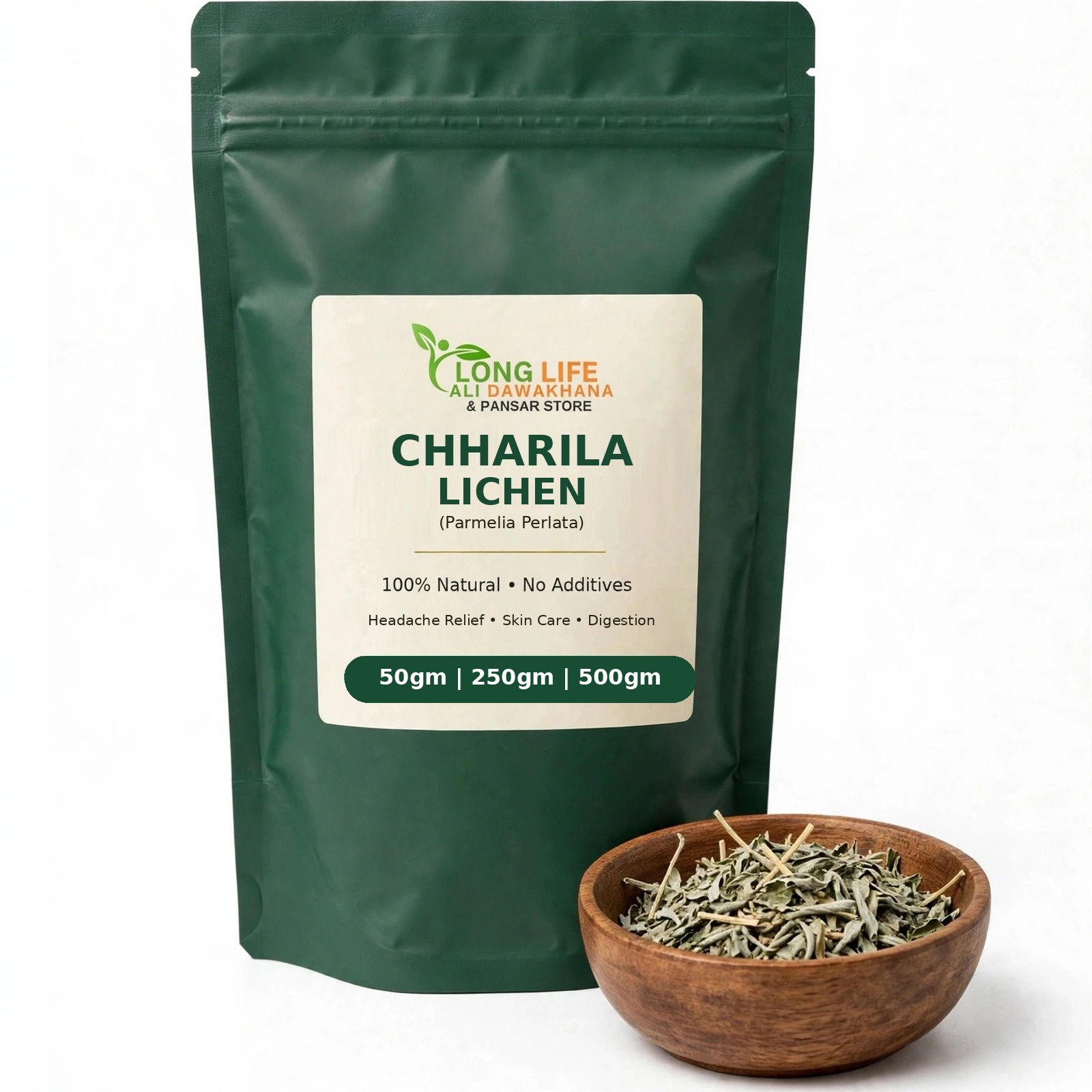
Chharila (Lichen, Stone Flower, Parmelia perlata) is a fragrant lichen used as a spice in garam masala and biryani, and in Ayurvedic and Unani medicine for headaches, skin problems, digestion and respiratory health. Its key compound usnic acid is a powerful natural antimicrobial — but concentrated usnic acid supplements have caused liver damage, so the whole lichen should be used only in traditional food and small medicinal doses. At Long.pk it is available in Whole and Powder forms (50 gm, 250 gm and 500 gm) from Rs 253, with Cash on Delivery across Pakistan.
چھڑیلہ (Chharila) — مکمل معلومات
چھڑیلہ، جسے انگریزی میں Lichen یا Stone Flower کہتے ہیں، ایک خاص قسم کی بوٹی ہے — یہ نہ پودا ہے نہ پھول، بلکہ پھپھوندی (fungus) اور کائی (algae) کا مجموعہ ہے جو چٹانوں اور درختوں پر اگتا ہے۔ اس کا رنگ سرمئی سبز ہوتا ہے اور یہ پھول کی شکل میں پھیلتا ہے، اسی لیے اسے “پتھر کا پھول” (Stone Flower) کہا جاتا ہے۔
چھڑیلہ پاکستان اور بھارت میں ایک مشہور مصالحہ بھی ہے — گرم مصالحہ، بریانی اور چٹنیوں میں اس کی خوشبو کھانے کو خاص ذائقہ دیتی ہے۔ جنوبی بھارت (تمل ناڈو) میں اسے کلپاسی (Kalpasi) کہتے ہیں اور چیٹیناڈ کھانوں میں استعمال کرتے ہیں۔
یونانی اور آیورویدک طب میں چھڑیلہ سر درد، جلد کے مسائل، ہاضمے، سانس کی بیماریوں اور پیشاب کی نالی کے مسائل کے لیے استعمال ہوتی ہے۔ اس کا اہم مرکب usnic acid ہے جو جراثیم کش (antimicrobial) ہے — لیکن زیادہ مقدار میں usnic acid جگر کو نقصان پہنچا سکتا ہے، اس لیے چھڑیلہ کو صرف روایتی مقدار میں استعمال کریں۔
چھڑیلہ کے فائدے (روایتی استعمال)
- سر درد: روایتی طور پر سر درد اور درد میں آرام کے لیے استعمال ہوتی ہے۔
- جلد: جلد کے مسائل، پھوڑوں، خارش اور فنگل انفیکشن کے لیے بیرونی طور پر استعمال ہوتی ہے۔
- ہاضمہ: بدہضمی، معدے کے مسائل اور بھوک کی کمی کے لیے استعمال ہوتی ہے۔
- سانس: کھانسی، برونکائٹس اور بلغم کے لیے روایتی طور پر استعمال ہوتی ہے۔
- پیشاب کی نالی: روایتی طور پر پیشاب کی نالی کو مضبوط کرنے اور پتھری بننے سے روکنے کے لیے استعمال ہوتی ہے۔
- مصالحہ: کھانے میں خوشبو اور ذائقہ کے لیے — گرم مصالحہ اور بریانی کا اہم جزو۔
استعمال کا طریقہ
- قہوہ: 3 سے 5 گرام خشک چھڑیلہ 200 ملی لیٹر پانی میں ابال کر آدھا رہ جانے پر کھانے کے بعد دن میں دو بار پیئیں۔
- مصالحہ کے طور پر: گرم مصالحہ یا بریانی میں تھوڑی مقدار میں ڈالیں۔
- بیرونی: پاؤڈر کو پانی یا تیل میں ملا کر جلد پر لگایا جا سکتا ہے۔
- لمبے عرصے تک زیادہ مقدار میں استعمال نہ کریں — usnic acid جگر کو نقصان پہنچا سکتا ہے۔
چھڑیلہ Long.pk سے Whole اور Powder فارم میں 50، 250 اور 500 گرام تک منگوایا جا سکتا ہے۔ قیمت صرف 253 روپے سے شروع ہوتی ہے اور پورے پاکستان میں کیش آن ڈیلیوری دستیاب ہے۔
Chharila (Lichen) – Price in Pakistan, Benefits, Uses & Safety
Direct answer: Chharila (Lichen, Stone Flower, Parmelia perlata) price in Pakistan starts from Rs 253 for 50 gm (Whole form) at Long.pk, going up to Rs 2,025 for 500 gm (Powder form). It is available in two forms — Whole and Powder — in 50 gm, 250 gm and 500 gm packs, with cash on delivery across Pakistan. Chharila is a fragrant lichen — a symbiotic organism of fungus and algae — used both as a spice in garam masala and biryani and as a traditional medicine for headaches, skin problems, digestion and respiratory health. Its key compound usnic acid is a powerful natural antimicrobial, but concentrated usnic acid supplements have caused severe liver damage, so the whole lichen should be used only in traditional food and small medicinal doses, never as a concentrated extract.
Table of Contents
- What Is Chharila?
- History of Chharila
- Active Compounds
- Chharila in Ayurveda, Unani & Folk Medicine
- What Does Modern Research Say?
- Detailed Benefits of Chharila
- Chharila as a Spice vs as a Medicine
- Who Is Chharila For?
- How to Use Chharila
- Traditional Combinations
- Dosage & Duration
- Side Effects & Who Should Avoid It
- How to Identify Original Chharila
- Storage & Shelf Life
- Chharila vs Usnea vs Iceland Moss
- Chharila Price in Pakistan
- Product Specifications
- Roman Urdu
- Frequently Asked Questions
What Is Chharila?
Chharila (Parmelia perlata, family Parmeliaceae) is a lichen — and a lichen is not a plant at all. It is a symbiotic organism: a fungus (the mycobiont) and an alga (the photobiont) living together so closely that they form a single body, called a thallus. The fungus provides structure and protection; the alga photosynthesises and provides food. Together they can survive on bare rock, tree bark and soil in places where neither could live alone. Lichens dominate about 8% of the Earth’s terrestrial ecosystems, and India alone has around 2,450 lichen species.
Parmelia perlata is a foliose (leafy) lichen that forms pale grey-green rosettes 3–8 cm across, with rounded lobes that spread over the surface like a flower — which is why it is called the Stone Flower. It grows on rocks and tree bark in the cool, moist forests of the Himalayas and the Western Ghats, and is widely distributed across the hilly areas of the Indian subcontinent. Its accepted modern synonym is Parmotrema chinense (also written Parmotrema perlatum, the “Blue Stoneflower”).
Names: In Urdu it is Chharila (چھڑیلہ), also Ushna (اشنہ), Dawali (دوالی / دواله), Chheel Chhabila, Shailaj and Pariyo. In Hindi: Chhadila, Charela, Pathar ka Phool. In Marathi: Dagad Phool. In Tamil: Kalpasi. In Sanskrit/Ayurveda: Shaileya, Shaila, Shailaka, Bhuricharilla, Shaileyam. In Persian: Davala. In Punjabi: Ausneh, Chhadila. In English: Stone Flower, Charila, Lichen.
The whole thallus is used — the dried lichen body, collected carefully from rocks and trees, cleaned of debris, and dried. It has a distinctive earthy, slightly musky aroma that is prized in cooking, and a bitter, astringent taste.
History of Chharila
Chharila is one of the oldest items in the South Asian spice box and medicine chest. References to Parmelia perlata appear in classical Ayurvedic texts dating to the 11th–12th centuries CE, notably the Vangasena Samhita and regional Tamil Siddha manuscripts, and the Goyal et al. (2016) review notes the lichen in the Rigvedic tradition. Traditional healers of Kerala valued it as a “forest musk” for its warming properties.
As a spice, Chharila has been used for centuries across India and Pakistan. In South India — especially in Tamil Nadu’s Chettinad cuisine — Kalpasi (stone flower) is an essential ingredient, giving biryanis, curries and garam masala a deep, earthy, almost smoky aroma that no other spice provides. In North India it goes into garam masala, kebabs and rich meat dishes. The Rai and Limbu communities of East Nepal have traditionally eaten it as food.
As a medicine, it appears in the Ayurvedic Pharmacopoeia of India, and in Unani texts as Ushna/Dawali. It has also been used as a light brown dye for wool, and as a bio-indicator of air pollution — lichens absorb heavy metals from the air, so their presence (or absence) tells scientists about air quality. This is also a practical warning: lichens collected near polluted roads or factories can carry heavy metals, which is why the source matters.
Usnic acid, the lichen’s signature compound, was first isolated in 1844 and has been studied ever since — first as an antibiotic (it was used in wound dressings and creams), then controversially as a weight-loss supplement in the early 2000s, when its liver toxicity came to light (see Side Effects).
Active Compounds
Chharila’s chemistry is unlike any flowering plant’s — lichens produce unique secondary metabolites called depsides and depsidones that plants do not make.
| Compound | Type | What researchers looked at |
|---|---|---|
| Usnic acid | Dibenzofuran derivative | The major active compound; potent antimicrobial and antifungal — intercalates microbial cell membranes and disrupts respiration; also antioxidant and anti-inflammatory in lab models; the compound behind both the benefits and the liver-toxicity risk |
| Salazinic acid | Depsidone | Anti-inflammatory — inhibits COX-1 and COX-2 enzymes in vitro; reduced edema and joint inflammation in rodent models |
| Atranorin | Depside | Antimicrobial and antioxidant activity; one of the characteristic Parmelia metabolites |
| Lecanoric acid | Depside | Antioxidant and antimicrobial activity in lab studies |
| Protolichesterinic acid | Aliphatic acid | Antimicrobial activity; studied alongside the depsides |
| Gyrophoric acid | Depside | Inhibits growth of human keratinocytes; antimitotic and antitumour activity in lab models |
| Stictic acid | Depsidone | Antioxidant and anti-inflammatory activity (reported in Parmotrema perlatum) |
| Flavonoids | Polyphenols | Contribute to the antioxidant profile |
| Tridecyl myristate, 3-ketooleanane, icosan-1-ol | Lipids/alcohols | Minor constituents identified in phytochemical analysis |
Usnic acid content is about 1–3% of the dry weight in Usnea lichens; Parmelia species contain it at lower but still significant levels. Usnic acid exists in two mirror-image forms, (+)-usnic acid and (−)-usnic acid, which differ in their effects — the (−) form shows stronger genotoxicity and allergic potential in lab tests.
Chharila in Ayurveda, Unani & Folk Medicine
In Ayurveda, Chharila is Shaileya (from shaila, “rock” — it grows on rocks). Its properties are described as astringent, bitter, acrid, cooling, anti-inflammatory and aphrodisiac. It is used for bronchitis, excessive salivation, vomiting, toothache, boils and inflammations, and is indicated in seminal weakness, nocturnal emission, amenorrhoea, leucorrhoea, dyspepsia, calculi (stones), blood and heart diseases, stomach disorders, enlarged spleen, bleeding piles, scabies, leprosy and general pains. It is said to tone up the urinary tract and suppress the formation of calculi. Its actions are listed as resolvent, emollient, laxative, sedative and diuretic.
In Unani medicine, Chharila (Ushna/Dawali) is used for headaches, skin diseases, digestive complaints, heart conditions and respiratory problems, and as a general tonic. It is valued for its warming, resolvent action on swellings and inflammations.
In folk medicine across Pakistan and India, Chharila is the spice that is also a medicine: it goes into food daily in small amounts, and in larger medicinal doses as a decoction for coughs, digestion and skin. In Nepal, the Rai and Limbu people eat it as a traditional food. In Tamil Nadu, Kalpasi is both a kitchen essential and a home remedy for indigestion and colds.
What Does Modern Research Say?
Chharila’s research base is real but almost entirely preclinical — laboratory and animal studies, with no large human trials. The honest summary is: strong lab evidence for antimicrobial action, promising animal evidence for inflammation, and no proven human efficacy for most uses.
Antimicrobial — the strongest evidence. Usnic acid-rich extracts of Parmelia perlata inhibit Staphylococcus aureus and Candida albicans in petri-dish studies. This is the basis for its traditional topical use on minor wounds and fungal skin problems, and for usnic acid’s historical use in wound dressings, creams, toothpastes and mouthwashes. Usnic acid also shows antimycobacterial activity (against tuberculosis-related bacteria) in the lab.
Anti-inflammatory — animal evidence. Salazinic acid reduced edema and joint inflammation in rodent models, and Parmotrema perlatum extracts inhibited NF-κB signalling and reduced pro-inflammatory cytokine production in cell studies. This supports the traditional use for arthritis, sprains and swellings — but no human trial has tested it.
Antioxidant — lab evidence. Extracts enhanced the activity of the body’s own antioxidant enzymes (catalase, superoxide dismutase, glutathione peroxidase) and scavenged free radicals directly in test-tube studies.
Respiratory — preliminary. Ex vivo assays suggest a mucolytic (phlegm-thinning) action, which fits the traditional use for cough and bronchitis, but human trials are lacking.
Skin — one small trial. In 2019, an Ayurvedic clinic near Bangalore ran a small open-label trial: 20 patients with mild eczema applied a Parmelia perlata ointment for 4 weeks, and 70% reported reduced itching and dryness, with no adverse reactions. This is encouraging but very weak evidence — small, open-label, no control group.
Kidney stones (antiurolithiatic) — traditional claim. The Goyal et al. (2016) review lists antiurolithiatic potential among the substantiated activities, and the traditional claim is that Chharila tones the urinary tract and suppresses calculi formation. The evidence is preclinical — do not rely on it as a treatment for kidney stones.
Anticancer and antidiabetic — lab only. The review lists anticancer and antidiabetic potentials as “substantiated” — but this means lab and animal studies (usnic acid is antimitotic and cytotoxic in cell lines; glycoside and alkaloid isolates showed antidiabetic activity in lab tests). There is no human evidence that Chharila treats cancer or diabetes, and it must never be presented as such.
The honest summary: Chharila is a well-studied lichen with genuine antimicrobial chemistry and a long, safe history as a food spice. Its medicinal claims beyond the antimicrobial action rest on animal and lab evidence, and robust human clinical trials are lacking (as the Hermetica review states plainly). Use it as a traditional spice and a gentle traditional remedy — not as a proven medicine.
Detailed Benefits of Chharila
Every benefit below is described as it appears in the traditional literature and research, with the evidence level stated honestly.
Headache Relief (Traditional)
In Unani and folk medicine, Chharila is a traditional remedy for headaches — taken as a decoction or applied as a paste. The traditional reasoning links it to its cooling, anti-inflammatory action. There are no clinical trials for headache, so this remains a traditional use.
Skin Health (Traditional + Lab Support)
Chharila is used for boils, sores, scabies, fungal skin infections and general skin inflammation — applied externally as a paste, or taken internally. The lab evidence supports this better than most uses: usnic acid inhibits Staphylococcus aureus and Candida albicans, the microbes behind many skin infections, and the small 2019 eczema trial (20 patients, 70% improved) is the only human data point. Himalaya’s herb monograph specifically notes its use in fungal infections in women, including vaginal candidiasis.
Digestive Support (Traditional)
Chharila is used for dyspepsia (indigestion), stomach disorders, loss of appetite and vomiting. Its bitter, astringent taste stimulates digestive secretions — the classic bitter-tonic action — and as a spice it is eaten daily in small amounts for exactly this purpose. No clinical trials exist for digestion.
Respiratory Health (Traditional + Preliminary Lab)
Traditional decoctions target cough, bronchitis, sinus congestion and phlegm. Preliminary lab assays suggest a mucolytic (phlegm-thinning) action. Human trials are lacking, but the traditional use is consistent across Ayurveda, Unani and folk medicine.
Urinary Tract & Kidney Stones (Traditional)
The Ayurvedic claim is that Chharila tones up the urinary tract and suppresses the formation of calculi (stones). The Goyal review lists antiurolithiatic potential among its substantiated activities. The evidence is preclinical — do not rely on it as a treatment for kidney stones.
Heart & Blood Health (Traditional)
Ayurveda lists Chharila for blood and heart diseases. This is a traditional indication with no modern clinical evidence, and should be understood as classical reasoning rather than a proven effect.
Seminal Weakness & Reproductive Health (Traditional)
Himalaya’s monograph calls Stone Flowers “an important ingredient in herbal compositions for the treatment of seminal weakness and male sexual debility”, and the Goyal review lists spermatorrhoea, nocturnal emission, amenorrhoea and leucorrhoea among its indications. These are classical Ayurvedic uses with no modern clinical evidence.
Antimicrobial Protection (Lab Evidence)
This is Chharila’s best-supported benefit. Usnic acid is a broad-spectrum natural antimicrobial — effective against bacteria (including S. aureus), fungi (including Candida), and mycobacteria in the lab. It is the reason usnic acid was historically used in wound dressings, creams and mouthwashes.
Chharila as a Spice vs as a Medicine
Chharila is unusual among the herbs in this series: it is both a daily food spice and a traditional medicine, and the two uses involve very different doses — which matters for safety.
| Aspect | As a spice (food) | As a medicine |
|---|---|---|
| Dose | A pinch to a few grams per dish, cooked into food | 3–5 g dried thallus as a decoction, twice daily |
| Frequency | Daily, as part of normal cooking | Short courses for a specific complaint |
| Usnic acid exposure | Very low — a fraction of a gram of lichen per serving, and cooking may reduce it | Higher — a full decoction of several grams |
| Safety record | Centuries of daily use across South India with no safety concerns | Traditional use is long, but concentrated extracts are a different matter |
| Purpose | Flavour and aroma (earthy, musky, smoky) | Headaches, skin, digestion, respiratory complaints |
| Who uses it | Home cooks (Chettinad, biryani, garam masala) | Ayurvedic and Unani practitioners, home remedy users |
The key point: the liver-toxicity cases from usnic acid all involved concentrated supplements (500–1,000 mg of pure usnic acid per day) — not the whole lichen eaten as a spice. A few grams of whole Chharila contains only a small fraction of that amount of usnic acid. The spice use is safe; the danger is in concentrated extracts and high-dose supplements. Use the whole lichen, in traditional amounts, and do not buy or take concentrated usnic acid products.
Who Is Chharila For?
Chharila is for home cooks who want the authentic stone-flower aroma in garam masala, biryani and curries — and for adults who want a traditional remedy for headaches, skin problems, digestion or respiratory complaints, used in small, traditional doses.
It is not for pregnant or breastfeeding women (no safety data), children (no safety data), or anyone with liver disease (usnic acid is hepatotoxic at high doses). It is not for anyone taking prescription medication without a doctor’s advice. And it is not a weight-loss product — usnic acid supplements marketed for weight loss have caused severe liver damage, and there is no evidence they work.
How to Use Chharila
As a spice. Add a small piece of dried Chharila (about 1–2 g) to garam masala, biryani, pulao, kebabs or curries — it goes in with the other whole spices at the start of cooking. Toast it lightly in a dry pan first to release the aroma. Remove before serving if you prefer (like a bay leaf), or grind it into the masala.
As a decoction (kwath). Simmer 3–5 g of dried thallus in 200 ml of water until reduced by half (about 100 ml). Strain and drink twice daily after meals, for digestive or respiratory complaints. Use for short courses (a few days to two weeks), not continuously.
As a powder. The powder can be taken in warm water or honey in small doses (1–3 g), or mixed into food. The dose is small and must be measured, not guessed.
Externally. Mix the powder with water, rose water or oil to make a paste, and apply to the skin for boils, fungal patches, itching or minor wounds. Do a patch test first — allergic reactions to usnic acid have been reported with topical use. Do not apply to large areas of broken skin.
What NOT to do. Do not take concentrated usnic acid extracts or supplements. Do not take large doses for long periods. Do not use it for weight loss. Do not give it to children. Do not use it during pregnancy.
Traditional Combinations
- Chharila + Black Cardamom (Badi Elaichi): the classic Chettinad combination — stone flower and black cardamom together give biryani its deep, smoky aroma.
- Chharila + Cinnamon + Cloves: the garam masala trio — Chharila adds the earthy base note that ties the sweet spices together.
- Chharila + Liquorice (Mulethi): for coughs and throat complaints — liquorice soothes while Chharila clears phlegm.
- Chharila + Ginger: for digestion — ginger’s warming carminative action complements Chharila’s bitter tonic effect.
- Chharila + Turmeric (external): for skin application — turmeric’s anti-inflammatory action complements usnic acid’s antimicrobial effect.
- Chharila + Neem (external): for fungal skin problems — two traditional antifungals together.
Dosage & Duration
The figures below come from the classical literature and the ask-ayurveda dosage guidance. They are given for information — your hakim’s instruction takes priority. There are no established modern dosages for Chharila; the doses below are traditional.
| Form | Dose | Notes |
|---|---|---|
| Decoction (kwath) | 3–5 g dried thallus in 200 ml water, reduced to half, twice daily after meals | For digestive or respiratory complaints; short courses only |
| Powder (internal) | 1–3 g, once or twice daily | With warm water or honey; measure the dose |
| As a spice | 1–2 g per dish | Cooked into food; safe for daily use at this level |
| External paste | As needed | Powder + water/rose water/oil; patch-test first |
| Dangerous dose (usnic acid supplements) | 500–1,000 mg/day of pure usnic acid | Documented to cause severe liver injury, including acute liver failure requiring transplant — never take usnic acid supplements |
Duration: as a spice, Chharila can be eaten daily in food amounts indefinitely. As a medicine, use it in short courses (a few days to two weeks) for a specific complaint. Do not take medicinal doses continuously for months.
Side Effects & Who Should Avoid It
The most important safety message in this article: usnic acid can damage the liver. The risk comes from concentrated usnic acid — not from the whole lichen eaten as a spice — but it must be understood clearly.
What happened with usnic acid supplements. In the early 2000s, usnic acid (crude extracts or pure usnic acid) was marketed in the United States as a dietary supplement for weight loss, sold as a “fat-burner” and popular in the bodybuilding community. The US FDA received more than 20 reports of liver toxicity associated with these supplements. The injuries ranged from mild liver enzyme elevation to hepatitis and acute liver failure requiring liver transplantation. In 2001 the FDA issued a warning letter on the product LipoKinetix and asked its manufacturer to withdraw it from the market. Memorial Sloan Kettering Cancer Center records a case of fulminant liver failure in a woman who used usnic acid for weight loss, which eventually required a liver transplant. The doses involved were 500–1,000 mg of usnic acid per day — far more than the amount in a few grams of whole lichen.
How it damages the liver. A 2024 review by FDA scientists (Chen et al., Journal of Environmental Science and Health, Part C, 2025; PMID 38904414) summarised the mechanisms: usnic acid uncouples oxidative phosphorylation in liver mitochondria, generates excess free radicals, decreases ATP synthesis, damages cell membranes, and triggers apoptosis (programmed cell death) and autophagy. Both (+)- and (−)-usnic acid are hepatotoxic in lab models; the (−) form also shows stronger genotoxicity and allergic potential.
Possible side effects of the whole lichen: at traditional food and medicinal doses, Chharila is well tolerated. Allergic reactions have been reported with topical use of usnic acid (skin rash, contact dermatitis) — patch-test before applying to the skin. Nausea or stomach upset is possible at higher oral doses.
Who must avoid it or consult first:
- Pregnant women — no safety data; avoid.
- Breastfeeding women — no safety data; avoid.
- Children — no safety data; do not give to children.
- People with liver disease — avoid; usnic acid is hepatotoxic.
- People taking prescription medication — consult a doctor first (no interaction studies exist).
- People with known lichen or usnic acid allergy — avoid, especially topical use.
- Anyone considering usnic acid supplements for weight loss — do not. There is no scientific evidence they work, and they have caused severe liver damage.
Regulatory status: no regulatory approval as a medicine in any major jurisdiction. Used as a traditional herb and food spice in Ayurvedic, Unani and Siddha practice, and listed in the Ayurvedic Pharmacopoeia of India. The FDA has warned against usnic acid supplements (2001, LipoKinetix). Usnic acid itself is not approved as a medicine or supplement ingredient.
How to Identify Original Chharila
- Shape: genuine Chharila is a foliose (leafy) lichen — flat, grey-green, leaf-like lobes that spread like a flower or rosette. It should look like dried, crinkly leaves, not powder or chunks.
- Colour: pale grey-green to brownish-grey. Very bright green means it is not Chharila (or is dyed); black or mouldy pieces are spoiled.
- Smell: a distinctive earthy, slightly musky, almost smoky aroma — the “forest musk” smell. This is the key identification test: real stone flower smells like nothing else in the spice box.
- Texture: dry, papery, slightly brittle lobes. It should feel light and dry, not damp or soft.
- No mould: reject any lichen with white or green mould spots, or a musty, fermented smell.
- Not moss: Chharila is a lichen, not a moss — moss is soft and feathery; lichen is flat, papery and crusty-leafy.
- Heavy metals: lichens absorb pollutants from the air, so buy from a trusted source that collects from clean hilly areas, not from roadsides or industrial areas. Long.pk sources its Chharila from established pansar suppliers.
- Powder: Chharila powder is greyish-brown and fine, with the same earthy smell. Very pale powder may be cut with filler.
Storage & Shelf Life
Store Chharila in an airtight container or its sealed pouch, away from light, heat and moisture. A cool, dry cupboard is ideal. The dried lichen keeps its aroma and potency for 18–24 months when stored properly. The powder loses strength faster (use within 9–12 months of grinding). Do not store it in the bathroom or near the stove, where steam and heat degrade it. Keep it away from strong-smelling spices — the lichen absorbs odours easily.
Chharila vs Usnea vs Iceland Moss
These three are the best-known medicinal lichens — all contain usnic acid or related compounds, but they are used differently.
| Feature | Chharila (Parmelia perlata) | Usnea (Usnea barbata) | Iceland Moss (Cetraria islandica) |
|---|---|---|---|
| Common names | Stone Flower, Dagad Phool, Kalpasi | Beard Lichen, Old Man’s Beard | Iceland Moss |
| Growth form | Foliose (leafy rosettes) | Fruticose (hanging beard-like strands) | Foliose (leafy, upright) |
| Key compound | Usnic acid, salazinic acid | Usnic acid (1–3% of dry weight) | Lichenin, isolichenin, usnic acid (low) |
| Main traditional use | Spice + medicine (headache, skin, digestion) | Wound care, respiratory infections | Coughs, sore throat, digestive tonic |
| Culinary use | Yes — major spice in Indian cooking | No | Yes — food in Iceland/Scandinavia (as flour) |
| Antimicrobial evidence | Lab (S. aureus, Candida) | Lab + historical (wound dressings) | Lab (mild) |
| Liver risk | From concentrated usnic acid only | From concentrated usnic acid only | Low (very little usnic acid) |
| Availability in Pakistan | Common in pansar shops | Rare | Rare |
| Price (Long.pk, from) | Rs 253 / 50 gm | — | — |
Which to choose: for cooking and general traditional use, Chharila. For wound care, Usnea (the historical wound lichen). For coughs and sore throats as a soothing demulcent, Iceland Moss. All three share the usnic acid liver warning for concentrated extracts — use the whole lichen, in traditional amounts.
Chharila Price in Pakistan
Prices checked 19 November 2026 (following pansaar.com, rounded to whole rupees). Cash on Delivery available across Pakistan.
| Form | 50 gm | 250 gm | 500 gm |
|---|---|---|---|
| Whole | Rs 253 | Rs 1,013 | Rs 1,839 |
| Powder | Rs 447 | Rs 1,122 | Rs 2,025 |
Best value: the 500 gm Whole pack at Rs 1,839 is the best value per gram (about Rs 368 per 100 gm, against Rs 506 for the 50 gm pack). At the usual spice use of 1–2 g per dish, the 50 gm pack lasts 25–50 dishes and the 500 gm pack lasts a year or more of regular cooking. The Powder form costs more than Whole (grinding adds cost), which is normal across the herb range.
Product Specifications
| Product Name | Chharila (Lichen) |
| Urdu Name | چھڑیلہ (Chharila) |
| Botanical Name | Parmelia perlata |
| Family | Parmeliaceae |
| Forms Available | Whole / Powder |
| Weights Available | 50 gm / 250 gm / 500 gm |
| Price Range | Rs 253 – Rs 2,025 |
| Purity | 100% Natural, No Additives |
| Origin | Himalayas / Western Ghats / South Asia |
| Shelf Life | 18–24 months (dried lichen); 9–12 months (powder) |
| Storage | Airtight container, cool & dry place, away from sunlight |
| Seller | Ali Dawakhana and Pansar Store |
| Delivery | Cash on Delivery across Pakistan |
Roman Urdu
Chharila (Lichen, Stone Flower, Parmelia perlata) aik khushbudar lichen hai — yeh na poda hai na phool, balkay fungus aur algae ka مجموعہ hai jo chatano aur darakhton par ugta hai. Pakistan aur Bharat mein yeh aik mashhoor masala bhi hai — garam masala, biryani aur kebabon mein is ki khushbu khane ko khaas zaiqa deti hai. Janubi Bharat mein isay Kalpasi kehte hain aur Chettinad khano mein istemal karte hain.
Unani aur Ayurvedic tib mein Chharila sar dard, jild ke masail, hazmay, saans ki bimariyon aur peshab ki nali ke liye istemal hoti hai. Is ka ahem markab usnic acid hai jo jaraseem kush hai — lekin zyada miqdar mein usnic acid jigar ko nuqsan pahuncha sakta hai. America mein usnic acid ke wazan kam karne wale supplements se jigar kharab hone ke waqiat darj huay hain, is liye Chharila ko sirf rawayati miqdar mein istemal karein — masalay ke tor par ya chhoti dawaai khurak mein.
Rawayati tor par is ka qehwa 3 se 5 gram khushk Chharila ko 200 ml pani mein ubaal kar aadha kar ke din mein do baar khane ke baad piya jata hai.
Long.pk se Chharila Whole aur Powder form mein 50, 250 aur 500 gm tak dastiyab hai — qeemat sirf Rs 253 se shuru. Pure Pakistan mein Cash on Delivery ki sahulat mojood hai.
Frequently Asked Questions
Q: Chharila kis kaam aati hai?
Chharila (Parmelia perlata) aik khushbudar lichen hai jo masalay ke tor par garam masala aur biryani mein istemal hoti hai, aur rawayati tib mein sar dard, jild ke masail, hazmay aur saans ki bimariyon ke liye istemal hoti hai.
Q: Chharila ki Pakistan mein qeemat kya hai?
Long.pk par Chharila ki qeemat Rs 253 se shuru hoti hai (50 gm Whole) aur Rs 2,025 tak jati hai (500 gm Powder). Whole aur Powder — dono forms 50, 250 aur 500 gm mein dastiyab hain.
Q: Chharila aur Dagad Phool mein kya farq hai?
Koi farq nahi — Dagad Phool (Marathi), Kalpasi (Tamil), Pathar ka Phool (Hindi) aur Chharila (Urdu) aik hi lichen (Parmelia perlata) ke alag alag naam hain.
Q: Kya Chharila jigar ke liye nuqsan-deh hai?
Poori Chharila ko masalay ya rawayati dawaai miqdar mein istemal karna mehfooz hai. Nuqsan concentrated usnic acid supplements se hota hai — America mein 500–1,000 mg rozana lene se jigar kharab hone ke waqiat darj huay hain. Kabhi usnic acid supplements na lein.
Q: Chharila khane mein kaisay istemal hoti hai?
Garam masala, biryani ya salan mein 1–2 gram khushk Chharila daal dein — isay pehle halka sa bhoon lein taake khushbu khul jaye. Yeh Chettinad aur biryani ka khaas masala hai.
Q: Chharila ka qehwa kaisay banayen?
3 se 5 gram khushk Chharila 200 ml pani mein ubaal kar aadha kar lein, chhaan kar khane ke baad din mein do baar peeyen. Sirf mukhtasar muddat ke liye istemal karein.
Q: Kya Chharila wazan kam karti hai?
Nahi — usnic acid ke wazan kam karne ka koi saboot nahi hai, aur wazan kam karne wale usnic acid supplements se jigar ko shadeed nuqsan pahuncha hai. Chharila ko wazan kam karne ke liye istemal na karein.
Q: Chharila jild par laga saktay hain?
Haan — is ka paste phoron, fungal daaghon aur kharish par lagaya jata hai. Pehle patch test karein — usnic acid se kuch logon ko allergy ho sakti hai.
Q: Asli Chharila ki pehchan kya hai?
Asli Chharila halki grey-green, patay jaisi, phool ki shakal mein pheli hui hoti hai aur is ki khushbu mitti jaisi, musk jaisi hoti hai — yeh khushbu hi is ki pehchan hai.
Q: Chharila aur Usnea mein kya farq hai?
Dono lichen hain aur dono mein usnic acid hota hai — lekin Chharila (Parmelia) patay jaisi hoti hai aur masala hai, jabke Usnea darhi jaisi latakti hui hoti hai aur zakhmon ke liye istemal hoti hai.
Ali Dawakhana and Pansar Store — Asli desi dawa aur khalis jadi bootiyan, ab ghar baithay Long.pk se mangwayen.
Reviews
There are no reviews yet