
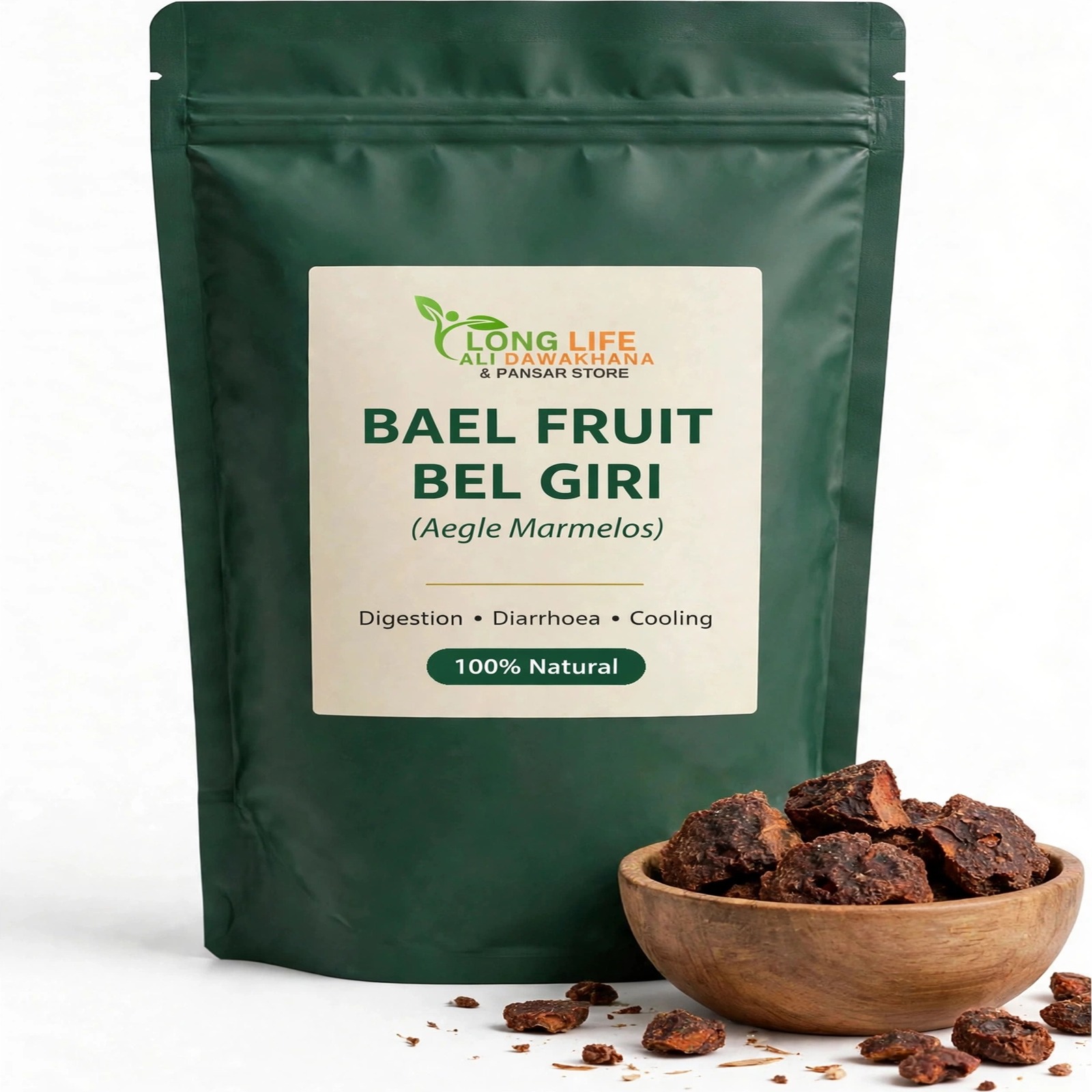
Bael Fruit (Bel Giri, Aegle marmelos), known in Ayurveda as Bilva, is the dried fruit of the sacred bael tree — Ayurveda’s foremost remedy for diarrhoea and dysentery, and one of the few medicines that works in both directions: the unripe fruit binds the bowel, the ripe fruit loosens it. At Long.pk it is available in Whole and Powder forms (50 gm and 250 gm) from Rs 186, with Cash on Delivery across Pakistan.
بیل گری (بیل فروٹ) — مکمل معلومات
بیل گری (Bael Fruit، Bilva) بیل کے درخت (Aegle marmelos) کا سوکھا پھل ہے۔
بیل آیوروید کی دست و پیچش کی مشہور دوا ہے — کچا پھل دست روکتا ہے، پکا پھل قبض کھولتا ہے۔
اہم انتباہ: بیل شکر کم کر سکتا ہے — ذیابیطس والے شکر ناپتے رہیں۔ زیادہ مقدار قبض کر سکتی ہے۔ حاملہ خواتین ڈاکٹر سے مشورہ کیے بغیر استعمال نہ کریں۔
Direct answer: Bael Fruit (Bel Giri, Aegle marmelos) costs Rs 186 for 50 gm (Whole) to Rs 1,063 for 250 gm at Long.pk. Bel Giri is Bilva, Ayurveda’s foremost remedy for diarrhoea and dysentery: the unripe fruit binds the bowel (tannins 9–20%), the ripe fruit is mildly laxative. This product is the dried unripe fruit. A 2009 study validated the antidiarrhoeal use against Giardia and rotavirus, but no human randomised controlled trials exist.
- What Is Bael Fruit?
- History of Bael Fruit
- Active Compounds
- Bael Fruit in Ayurveda, Unani & Folk Medicine
- What Does Modern Research Say?
- Detailed Benefits of Bael Fruit
- Unripe vs Ripe: Two Opposite Medicines
- Who Is Bael Fruit For?
- How to Use Bael Fruit
- Traditional Combinations
- Dosage & Duration
- Side Effects & Who Should Avoid It
- How to Identify Original Bael Fruit
- Storage & Shelf Life
- Bael Fruit vs Pomegranate Rind vs Isabgol
- Bael Fruit Price in Pakistan
- Product Specifications
- Roman Urdu
- Frequently Asked Questions
What Is Bael Fruit?
Bael Fruit (Bel Giri, Aegle marmelos) is the dried fruit of the bael tree (Rutaceae). In Urdu Bel Giri (بیل گری); in Sanskrit Bilva. The dried fruit comes as dark reddish-brown, craggy chunks.
History of Bael Fruit
Bael is mentioned in the Charaka Samhita and Sushruta Samhita as Bilva, a grahi (astringent) drug for diarrhoea and dysentery, and a core ingredient of Dashamoola and Bilvadi Lehyam.
Active Compounds
| Compound | Type | What researchers looked at |
|---|---|---|
| Marmelosin (imperatorin) | Furanocoumarin | Antidiarrhoeal, antimicrobial, antioxidant |
| Tannins (9–20% in unripe fruit) | Polyphenols | Astringent — reduces intestinal motility and secretions |
Bael Fruit in Ayurveda, Unani & Folk Medicine
In Ayurveda, Bilva is Kashaya (astringent), Tikta (bitter), Ushna (hot). Its action is Grahi (binding) — the classical drug for Atisara (diarrhoea), Pravahika (dysentery) and Grahani (irritable bowel). Unani uses it for diarrhoea; folk medicine roasts the unripe fruit for diarrhoea.
What Does Modern Research Say?
Antidiarrhoeal — laboratory, validated. Brijesh et al. 2009 (BMC Complementary and Alternative Medicine 9:47): a decoction of the dried unripe fruit reduced bacterial adherence and toxin binding, and showed activity against Giardia and rotavirus.
Antidiabetic — animal. A 2026 study found hypolipidemic and renoprotective effects in diabetic rats; small human studies reported glucose down by up to 20%.
Anticancer — cell lines ONLY. Activity against MCF-7 breast cancer cells; no human trial exists, and the anticancer claim must never be made for this product.
The honest summary: a well-supported traditional remedy, not a proven drug.
Detailed Benefits of Bael Fruit
1. Diarrhoea & Dysentery
The signature use: the unripe fruit is Grahi — binding — and the 2009 Brijesh study showed activity against Giardia and rotavirus. No human RCT; severe or bloody diarrhoea needs medical care. See also Plantain Seeds (Bartang).
2. IBS & Gut Health
Bilva is the classical drug for Grahani (irritable bowel); its polysaccharides act as a prebiotic. (No human trial.)
3. Constipation
The ripe fruit is the opposite medicine: mildly laxative, it softens and bulks the stools. (This product is the dried unripe fruit — the antidiarrhoeal form.)
4. Stomach Ulcers & Acidity
Bael extracts protect the gut lining in ulcer models. (Animal data only.)
5. Blood Sugar
Hypoglycaemic in animal models; small human studies reported glucose down by up to 20%. Do not use bael for diabetes without a doctor’s supervision.
6. Cholesterol & Kidney Health
The 2026 study found hypolipidemic and renoprotective effects in diabetic rats. (One animal study.)
7. Immunity & Infections
Antimicrobial against E. coli, Salmonella, Shigella and Candida. Supportive only — not a standalone antibiotic.
8. Skin & Wounds
Bael pulp is used in kushthaghni (skin disease) formulas in the classical texts. (Traditional use only.)
Unripe vs Ripe: Two Opposite Medicines
| Feature | Unripe fruit (this product) | Ripe fruit |
|---|---|---|
| What it is | Unripe fruit, dried — Bel Giri | Fully ripe fruit, fresh pulp |
| Tannins | 9–20% (high) | Low — tannins fall as the fruit ripens |
| Action | Grahi — binding, checks loose stools | Mildly laxative — softens and bulks the stools |
| Main use | Diarrhoea, dysentery, IBS, chronic loose stool | Constipation, cooling, summer heat |
| Who should NOT use it | People with constipation | People with diarrhoea |
Diarrhoea: the dried unripe fruit. Constipation: the ripe fruit.
Who Is Bael Fruit For?
- People with mild diarrhoea or dysentery.
- People with IBS or chronic loose stools (Grahani).
- People with diabetes — under a doctor’s supervision, with blood-sugar monitoring.
Not for anyone looking for a proven treatment — no human RCTs — or for pregnant women without a doctor’s advice.
How to Use Bael Fruit
Powder for diarrhoea. 3–6 g of powder with warm water after meals, once or twice daily.
Decoction. Boil 5–10 g in two cups of water down to one cup; strain and drink warm, once or twice daily.
Bael sharbat (ripe fruit). Ripe pulp, water, jaggery and spices, strained and chilled.
What NOT to do. Do not use it for constipation — it will make it worse. Do not take it with iron or other medicines, or substitute it for diabetes medication. Not in pregnancy without a doctor’s advice.
Traditional Combinations
| Combination | Purpose | How to use |
|---|---|---|
| Bael + honey (Shehed) | Dysentery — honey carries the powder | Powder mixed with honey, after meals |
| Bael + isabgol (Isabgol) | IBS — bael binds, isabgol bulks | Powder of both with warm water, practitioner-directed |
Dosage & Duration
- Powder 3–6 g/day with warm water after meals; decoction 5–10 g per cup, once or twice daily.
- Duration: for diarrhoea, until stools normalise (1–2 weeks). Do not take continuously for months.
- Take 2 hours away from iron and other medicines — tannins reduce absorption.
Side Effects & Who Should Avoid It
No human trials establish its safety profile. Side effects: constipation at high doses; cramps from ripe-fruit overdose.
Blood sugar. Bael may lower blood sugar and potentiate insulin, metformin and sulfonylureas. Diabetics must monitor closely.
Drug interactions (in vitro). Marmelosin may inhibit liver enzymes CYP3A4 and CYP1A2 — caution with warfarin and theophylline.
Who should avoid it or consult first:
- Pregnant women — may stimulate uterine activity; consult a doctor first.
- Breastfeeding women — no safety data; consult a doctor.
- People with diabetes on medication — may lower blood sugar further.
- People on warfarin or theophylline — in vitro data warrant caution.
- People with iron-deficiency anaemia — tannins block iron absorption.
- People with constipation — it will make it worse.
- Children — safety data insufficient; do not give without a practitioner’s direction.
How to Identify Original Bael Fruit
- Shape: irregular, craggy chunks — rough and rock-like.
- Colour: dark reddish-brown; black or mouldy pieces are spoiled.
- Taste: astringent and slightly bitter — if not astringent, it is not unripe bael.
- No mould: reject fruit or powder with mould spots or a musty smell.
- Buy from a trusted store. Bel Giri is sometimes confused with wood apple (Limonia acidissima).
Storage & Shelf Life
Store in an airtight jar, cool, dark and dry. Whole fruit 18–24 months; powder 9–12 months. Replace soft, damp or mouldy pieces.
Bael Fruit vs Pomegranate Rind vs Isabgol
| Feature | Bael Fruit (Bel Giri) | Pomegranate Rind (Anar Chilka) | Isabgol (Psyllium Husk) |
|---|---|---|---|
| Botanical name | Aegle marmelos | Punica granatum | Plantago ovata |
| Family | Rutaceae (citrus) | Lythraceae | Plantaginaceae |
| Part used | Dried unripe fruit | Dried fruit rind | Seed husk |
| Key compounds | Marmelosin, aegeline, tannins 9–20% | Punicalagins, ellagic acid, tannins 25–30% | Soluble fibre (mucilage) ~70% |
| Main traditional use | Diarrhoea, dysentery, IBS | Diarrhoea, dysentery, oral health | Constipation, IBS, cholesterol |
| Action on the bowel | Bidirectional — binds when unripe, loosens when ripe | Astringent — binds only | Bulk-forming — absorbs water, adds bulk |
| Effect on motility | Slows it (unripe) | Slows it | Normalises it (both directions) |
| Blood sugar | Lowers it (animal data) | Mild effect | Lowers postprandial glucose (human data) |
| Cholesterol | Lowers it (animal data) | Mild effect | Lowers LDL (human data) |
| Human trials | None (no RCTs) | A few small trials | Many RCTs — the best-studied of the three |
| Safety cautions | Hypoglycaemia, uterine stimulation (pregnancy) | Blocks iron; avoid in pregnancy (traditional) | Must take with plenty of water; can cause bloating |
| Price (Long.pk, from) | Rs 186 / 50 gm | — | — |
| Best for | Diarrhoea and dysentery | Diarrhoea, gums, oral health | Constipation, cholesterol, daily fibre |
Price in Pakistan
| Form | 50 gm | 250 gm |
|---|---|---|
| Whole | Rs 186 | Rs 894 |
| Powder | Rs 253 | Rs 1,063 |
Best value: Whole 250 gm, Rs 3.58 per gram.
Specifications
| Product name | Bael Fruit (Bel Giri) |
| Urdu name | بیل گری (Bel Giri) |
| Sanskrit name | Bilva |
| Botanical name | Aegle marmelos (L.) Corrêa |
| Family | Rutaceae (citrus family) |
| Part used | Dried unripe fruit |
| Forms | Whole / Powder |
| Weights | 50 gm, 250 gm |
| Price Range | Rs 186 – Rs 1,063 |
| Origin | India, Pakistan, Nepal, Bangladesh, Myanmar, Sri Lanka |
| Purity | 100% natural dried fruit, no additives |
| Key compounds | Marmelosin, aegeline, tannins (9–20%), rutin, beta-carotene |
| Shelf life | Whole fruit 18–24 months; powder 9–12 months |
| Storage | Airtight container, cool, dark, dry place |
| Seller | Ali Dawakhana and Pansar Store |
Roman Urdu Summary
Bael Fruit (Bel Giri) — Aegle marmelos — Ayurveda ki mashhoor dawa Bilva hai. Kacha phal dast rokta hai, pakka phal qabz kholta hai.
2009 ki tehqeeq mein qahway ne Giardia aur rotavirus ke khilaf asar dikhaya, lekin insani RCTs koi nahi hain. Qeemat Rs 186 se shuru hoti hai.
Frequently Asked Questions
Q: Bel Giri kis kaam aata hai?
Ayurveda ki dast o pechish ki pehli dawa hai.
Q: Kacha bél aur pakka bél mein kya farq hai?
Kacha bél dast rokta hai; pakka bél qabz kholta hai.
Q: Bel Giri dast ke liye kaisay istemal hota hai?
3–6 gram powder, garam pani ke saath.
Q: Kya Bel Giri diabetes ke liye kaam karta hai?
Janwaron mein shakar kam ki; insani trials nahi hain.
Q: Bel Giri ki khurak kya hai?
Powder 3–6 gram rozana.
Q: Kya Bel Giri ke koi side effects hain?
Ziyada miqdar qabz kar sakti hai. Hamila khawateen doctor se mashwara karein.
Q: Asli Bel Giri ki pehchan kya hai?
Gehray surkh bhooray, khurduray tukray — kasaila zaiqa.
Q: Bel Giri ki price kya hai?
Rs 186 se Rs 1,063 tak.
Q: Bael sharbat kya hai?
Pakkay bél se bana garmiyon ka mashroob.
Q: Bel Giri ko kaise store karein?
Airtight jar mein, thandi jagah par.
Related Products
- Plantain Seeds (Bartang) — a traditional gut remedy for diarrhoea and loose motions, pairing with Bael’s antidiarrhoeal action.
- Liquorice Root (Mulethi) — soothing for the stomach and gut, complementing Bael’s ulcer benefit.
- Golden Shower (Amaltas) — the gentle laxative side of gut care, for constipation — the opposite direction to unripe Bael.
- Sweet Chirata (Chiraita Shireen) — another traditional blood-sugar herb, sharing Bael’s hypoglycaemic use.
Ali Dawakhana and Pansar Store — Asli desi dawa aur khalis jadi bootiyan, ab ghar baithay Long.pk se mangwayen.
Reviews
There are no reviews yet