
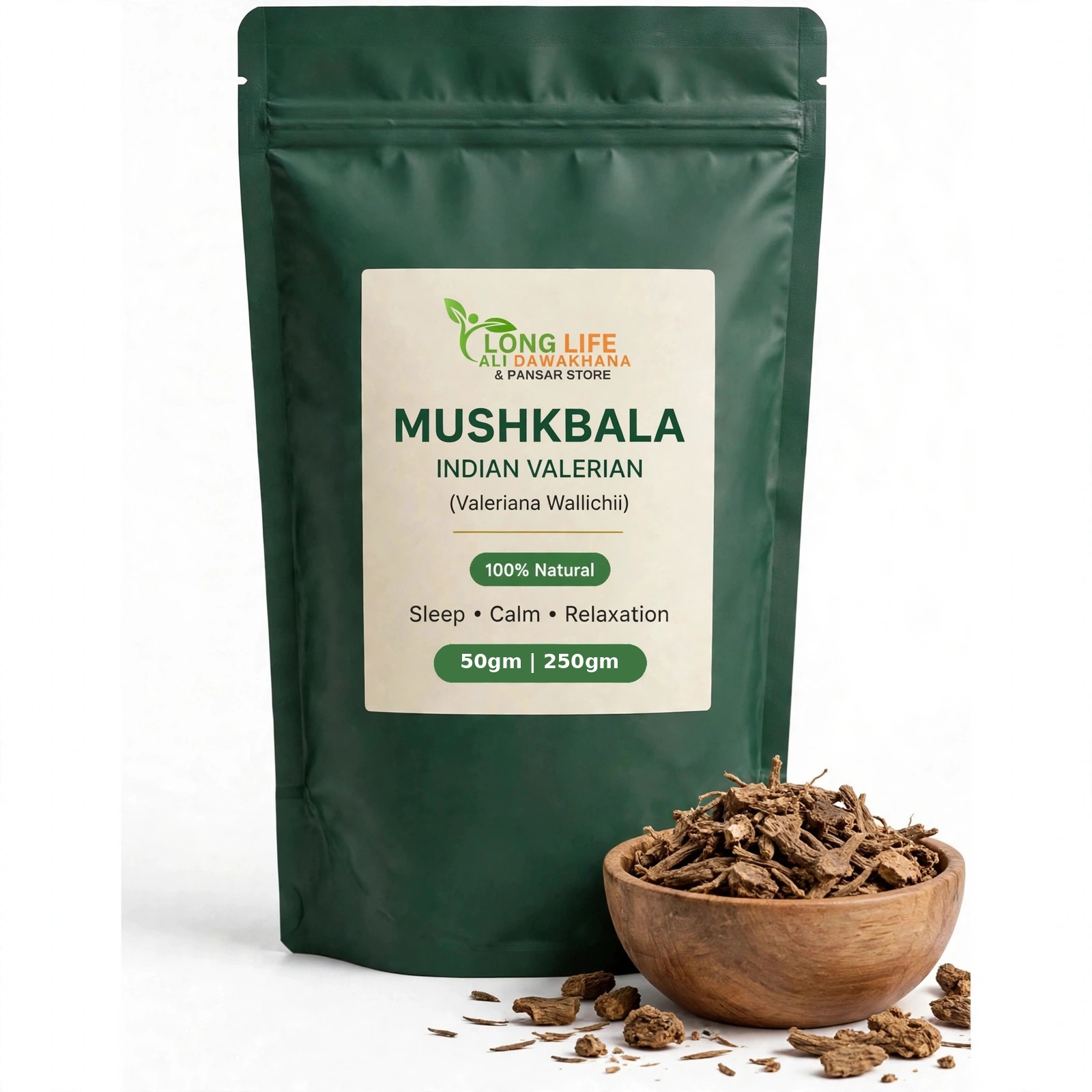
Mushkbala (Indian Valerian, Tagar, Valeriana wallichii) is the dried root of the Himalayan valerian, a classical Ayurvedic and Unani medicine traditionally used for sleep, calm and nervous tension. Indian valerian is rich in valepotriates — but nearly all trials tested the European species. Whole and Powder (50 gm and 250 gm) from Rs 397, Cash on Delivery across Pakistan.
مشک بالا (Mushkbala) — مکمل معلومات
مشک بالا ہمالیہ کی ایک مشہور جڑ ہے جو کشمیر سے بھوٹان تک اگتی ہے۔ آیوروید میں اسے تگر (Tagara) کہتے ہیں — صدیوں سے نیند، اعصابی تناؤ اور سر درد کے لیے استعمال ہوتی ہے۔
اہم انتباہ: مشک بالا نیند لانے والی بوٹی ہے — اسے لینے کے بعد گاڑی نہ چلائیں اور نیند کی دوا یا شراب کے ساتھ استعمال نہ کریں۔ حاملہ خواتین، دودھ پلانے والی مائیں اور 12 سال سے چھوٹے بچے استعمال نہ کریں۔
Mushkbala (Indian Valerian) – Price in Pakistan, Benefits, Uses & Safety
Direct answer: Mushkbala (Indian Valerian, Tagar, Valeriana wallichii) costs Rs 397 for 50 gm to Rs 1,814 for 250 gm at Long.pk, in Whole and Powder forms. In Ayurveda it is Tagara, the classical sleep root. Nearly all sleep trials tested European valerian (V. officinalis).
- What Is Mushkbala?
- History of Mushkbala
- Active Compounds
- Mushkbala in Ayurveda, Unani & Folk Medicine
- What Does Modern Research Say?
- Detailed Benefits of Mushkbala
- Mushkbala vs European Valerian — Different Chemistry, Different Herb
- Who Is Mushkbala For?
- How to Use Mushkbala
- Traditional Combinations
- Dosage & Duration
- Side Effects & Who Should Avoid It
- How to Identify Original Mushkbala
- Storage & Shelf Life
- Mushkbala vs Jatamansi vs Brahmi
- Mushkbala Price in Pakistan
- Product Specifications
- Roman Urdu
- Frequently Asked Questions
What Is Mushkbala?
Mushkbala — Urdu مشک بالا (Mushk Bala, “musk root”) — is the dried root of Valeriana wallichii DC, the Himalayan valerian (accepted name Valeriana jatamansi Jones). The product is the dried root — gnarled, woody and brown, with the strong musky smell that names the herb.
History of Mushkbala
Mushkbala has been a medicine for over two thousand years. In Ayurveda, Tagara is named in the Charaka Samhita and Sushruta Samhita, prescribed for sleep, epilepsy and neurosis. In Unani medicine it entered through the Greco-Arab tradition as a stimulant and hypnotic.
Active Compounds
Valepotriates are the main sedative compounds — 2.8–3.5% here vs 0.8–1.7% in European. Valerenic acid, the marker of European valerian, is essentially absent here. Valepotriates are unstable — they break down with heat, light and moisture.
Mushkbala in Ayurveda, Unani & Folk Medicine
Ayurveda — Tagara. Bitter and pungent, hot potency, pacifying Vata and Kapha. Classical actions: Nidrajanaka (sleep-inducing), Manas-shamak (mind-calming), Vedanasthapaka (pain-soothing). Unani — Mushkbala. A hot and dry drug — stimulant, carminative and hypnotic — used for epilepsy, hysteria and neurosis. Folk medicine: a household remedy for sleeplessness and cramps in Himalayan villages.
What Does Modern Research Say?
No controlled human trials of Valeriana wallichii (Indian valerian) were found. Everything clinical below tested European valerian (V. officinalis).
European trials (context, not proof). Fernández-San-Martín 2010: time to fall asleep differed from placebo by only 0.70 minutes. Valente 2024: no convincing evidence for clinical insomnia. AASM (2017) advises not to use valerian for chronic insomnia.
Animal work: Saeed & Muhammad (2018) report sedative and anticonvulsant effects in animals; no human trials.
Detailed Benefits of Mushkbala
1. Sleep & Insomnia
The defining use — Nidrajanaka (sleep-inducing), for a restless mind. The benefit takes 2–4 weeks of nightly use.
2. Calm & Nervous Tension
Manas-shamak (mind-calming) — for restlessness and palpitations from nerves. A mild calming effect — not for clinical anxiety.
3. Headaches
Vedanasthapaka (pain-soothing) — for tension headaches from worry and poor sleep.
4. Muscle Spasms
An antispasmodic in Unani medicine; the valepotriates relax smooth muscle in laboratory studies.
5. Digestion & Bloating
A carminative (Deepana in Ayurveda). Taken after meals for heaviness and gas.
6. Epilepsy
Classical texts list epilepsy (apasmara); animal studies report anticonvulsant activity. No human trials — NOT a treatment for epilepsy. Never stop prescribed anti-epileptic medicine.
7. Skin & Wounds
The classical texts include skin disease and ulcers among Tagara’s uses; applied externally as a paste. A minor, traditional use.
Mushkbala vs European Valerian — Different Chemistry, Different Herb
| Feature | Mushkbala (Indian valerian) | European valerian |
|---|---|---|
| Key chemistry | Valepotriates 2.8–3.5% | Valerenic acid 0.1–0.5% + valepotriates 0.8–1.7% |
| Valerenic acid | Essentially absent | The marker compound — extracts standardised to 0.8% |
| Human trials | None found | Dozens — mixed results, modest subjective benefit |
The practical point: if you buy Mushkbala expecting the exact trial results reported for European valerian, you are comparing two different medicines. Buy Mushkbala for its own tradition — Tagara in Ayurveda, two thousand years of use for sleep.
Who Is Mushkbala For?
- People with mild, stress-related sleeplessness — difficulty falling asleep because the mind will not quieten — who want a traditional herb rather than a sleeping pill.
- People with nervous tension — tight shoulders, a racing mind, palpitations from nerves.
Not for pregnancy, breastfeeding, children under 12, sleeping pills or sedatives without medical advice, liver disease, or epilepsy.
How to Use Mushkbala
Powder at bedtime (the classical preparation). Take 1–3 g of root powder with warm milk, 30–60 minutes before bed.
Tea. Steep 2–3 g of dried root in a cup of hot water, covered, for 10–15 minutes, then strain.
Patience is required: valerian needs 2–4 weeks of nightly use before its full effect appears. The smell: Mushkbala smells strongly of musk, earth and old socks — the sign of a genuine, potent root.
Traditional Combinations
| Combination | Purpose |
|---|---|
| Mushkbala + Brahmi | The classic nervine pair — Brahmi for mind, Tagara for sleep |
| Mushkbala + Shatavari | Calm plus rejuvenation — for people who are both wired and tired |
Dosage & Duration
| Preparation | Dose | Frequency |
|---|---|---|
| Root powder | 1–3 g | Once at bedtime |
| Tea (2–3 g root per cup) | 1 cup | Once at bedtime |
| Decoction (3–5 g root) | Half cup (100 ml) | Once at bedtime |
Duration: use nightly for 2–4 weeks, then reassess. Courses of up to 6 weeks, followed by a break of at least a week. Do not stop abruptly after long-term use — taper down.
Side Effects & Who Should Avoid It
Mushkbala is generally well tolerated at traditional doses, but it is a real sedative herb with real cautions.
- Drowsiness — the main effect. Morning grogginess, daytime sedation and mild stomach upset. Do not drive or operate machinery after taking valerian. Some people feel paradoxical excitation — wired instead of calm.
- Vivid dreams. Valerian causes unusually vivid dreams. Harmless but unsettling.
- Sedative medicines and alcohol — do NOT combine. Valerian adds to the sedation of benzodiazepines, Z-drugs, opioids and alcohol. If you take sleep or anxiety medicine, talk to your doctor first.
- Liver — rare but real. A small number of liver-injury cases have been reported worldwide; most resolved after withdrawal. People with liver disease should avoid it. Stop immediately if you develop dark urine, yellowing eyes or skin, or upper-right abdominal pain.
- Drug metabolism (CYP3A4). Valerian can affect how the liver processes some medicines. Tell your doctor if you take narrow-margin medicines.
- Pregnancy and breastfeeding — avoid. Safety in pregnancy is not established. Children under 12 — avoid.
- Withdrawal after long-term use. Abruptly stopping valerian after prolonged daily use has caused benzodiazepine-like withdrawal. After a long course, taper the dose down.
- Surgery. Stop medicinal doses two weeks before a planned operation. Epilepsy: never use Mushkbala as a substitute for prescribed anti-epileptic medicine.
How to Identify Original Mushkbala
- Appearance: gnarled, woody, brown root pieces — short rhizome chunks with thin rootlets.
- Smell — the best test: true valerian root smells strongly of musk, earth and old socks. If it smells of nothing, it is old or the wrong plant.
- Taste: bitter, earthy and warming.
- What to avoid: musty or mouldy roots, and anything sold as “Mushkbala” that is actually Jatamansi — darker, smelling of spikenard (woody-sweet), not musk.
Storage & Shelf Life
Whole root: 18–24 months; Powder: 6–9 months. Airtight container, cool and dry. Seal tightly after use.
Mushkbala vs Jatamansi vs Brahmi
| Feature | Mushkbala (Indian Valerian) | Jatamansi (Balchar) | Brahmi Booti (Centella) |
|---|---|---|---|
| Part used | Root | Rhizome / root | Whole herb / leaf |
| Key compound | Valepotriates | Jatamansone | Asiaticoside, madecassoside |
| Main traditional use | Sleep, calm, nervous tension | Sleep, anxiety, hair | Memory, mind, calm |
Which to choose? For falling asleep, Mushkbala — Tagara is Ayurveda’s sleep root. For anxiety or hair, Jatamansi. For memory and daytime calm, Brahmi.
Price in Pakistan
| Form | 50 gm | 250 gm |
|---|---|---|
| Whole | Rs 397 | Rs 1,645 |
| Powder | Rs 548 | Rs 1,814 |
Range: Rs 397–1,814. Best value: Whole 250 gm at Rs 6.58 per gram. Powder costs more per gram at every size.
Specifications
| Product name | Mushkbala (Indian Valerian) |
| Urdu name | مشک بالا (Mushk Bala / Mushkbala) |
| Botanical name | Valeriana wallichii DC (accepted name Valeriana jatamansi Jones) |
| Family | Caprifoliaceae |
| Part used | Root (dried) |
| Forms | Whole / Powder |
| Weights | 50 gm, 250 gm |
| Price Range | Rs 397 – Rs 1,814 |
| Key compound | Valepotriates |
| Temperament (Ayurveda) | Hot (ushna virya); pacifies Vata and Kapha |
| Additives | None — 100% natural |
| Shelf life | Whole root 18–24 months; Powder 6–9 months |
| Storage | Airtight container, cool and dry, away from sunlight |
| Seller | Ali Dawakhana and Pansar Store |
Roman Urdu Summary
Mushkbala (Indian Valerian) Himalaya ki mashhoor jarr hai. Ayurveda mein ise Tagara kehte hain — sadiyon se neend aur tanau ke liye istemal hoti hai. Indian valerian mein valepotriates, European mein valerenic acid hota hai. Trials European valerian par huay hain — Indian valerian par koi controlled human trial nahi hua. Powder 1–3 gram sonay se pehle lein; faida 2–4 haftay mein hota hai. Whole aur Powder — Rs 397 se shuru.
Frequently Asked Questions
Q: Mushkbala kis kaam aati hai?
Neend, aasabi tanau aur sar dard ke liye. Fawaid rawayati hain.
Q: Mushkbala ki Pakistan mein qeemat kya hai?
Rs 397 se Rs 1,814 tak. Cash on Delivery dastiyab hai.
Q: Mushkbala aur European valerian mein kya farq hai?
Mushkbala mein valepotriates; European mein valerenic acid. Trials European par huay hain.
Q: Kya Mushkbala neend ke liye waqai kaam karti hai?
Rawayati tor par haan — Tagara neend ki bunyadi booti hai. Halki be-khwabi ke liye naram madad hai.
Q: Mushkbala kaisay istemal karte hain?
Powder 1–3 gram sonay se pehle doodh ya pani ke saath; ya 2–3 gram ki chai.
Q: Kya Mushkbala neend ki dawa ke saath le sakte hain?
Nahi — baghair mashwaray ke nahi. Neend ki dawaon aur sharab ke saath neend barh sakti hai.
Q: Kya Mushkbala hamila khawateen le sakti hain?
Nahi — hamal aur doodh pilane mein parhez karein. Bachon ke liye bhi sifarish nahi hai.
Q: Mushkbala aur Jatamansi mein kya farq hai?
Mushkbala Valeriana wallichii hai; Jatamansi Nardostachys jatamansi hai. Aik doosray ki jagah nahi le sakteen.
Q: Mushkbala ka asar kitni dair mein hota hai?
2–4 haftay rozana istemal ke baad. Aik khurak se farq nahi parta.
Q: Asli Mushkbala ki pehchan kya hai?
Ghundhi hui, bhuri jarr; khushboo tez aur mushk jaisi. Pack kholtay hi khushboo aani chahiye.
Related Products
- Brahmi Booti (Centella) — the classical mind-calming partner for sleep.
- Jujube Berries (Unab) — the Unani sleep fruit.
- Shatavari Powder (Satawar) — a rejuvenative root for strength and calm.
- Organic Moringa Leaf Powder (Sohanjna Powder) — a daily tonic for general health.
Ali Dawakhana and Pansar Store — Asli desi dawa aur khalis jadi bootiyan, ab ghar baithay Long.pk se mangwayen.
Reviews
There are no reviews yet