
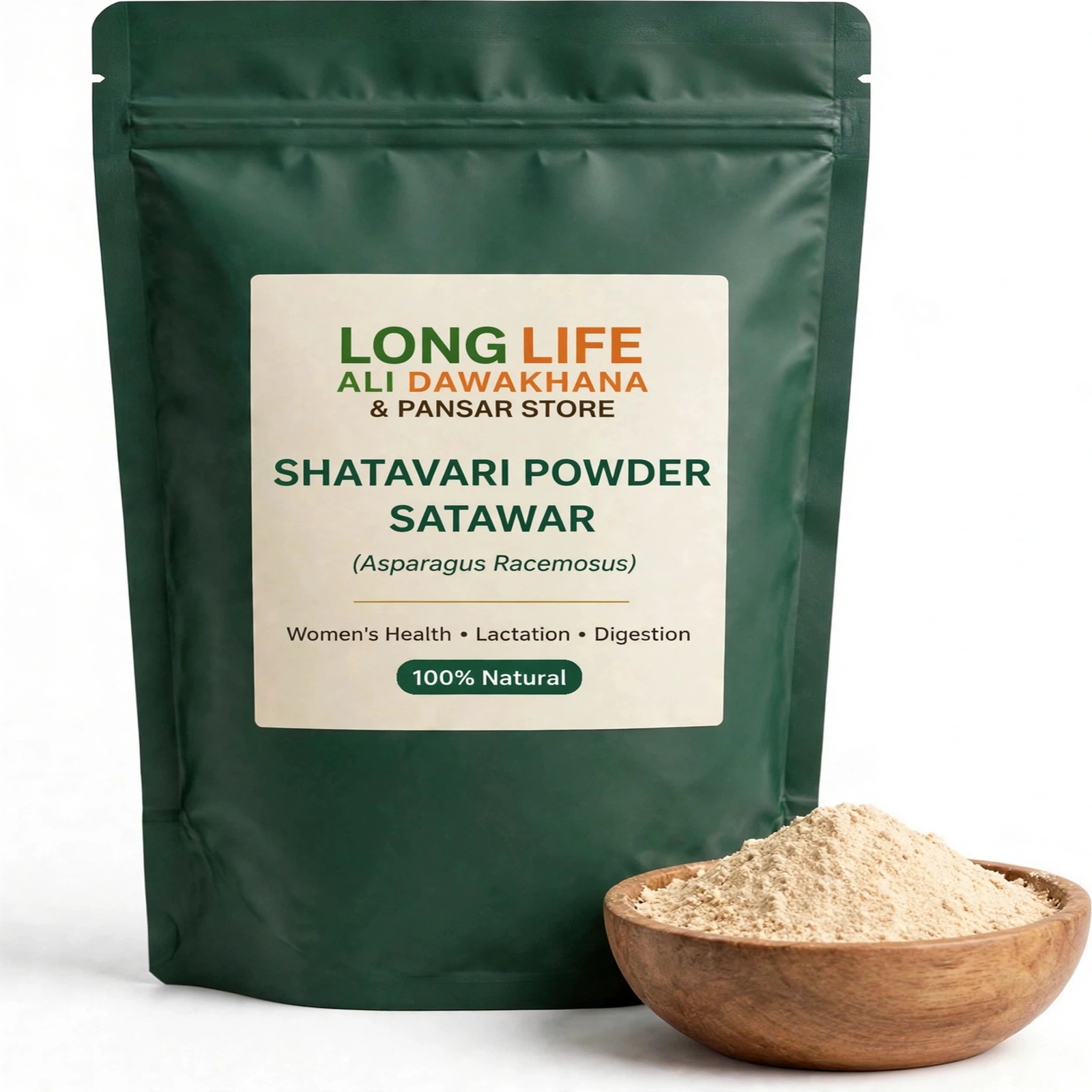
Shatavari Powder (Satawar, Asparagus racemosus) is the “queen of herbs” in Ayurveda — a cooling, nourishing root powder traditionally used for women’s reproductive health, breast milk production and digestion, and one of the few herbs in this series with genuine randomised trial support: three trials for lactation and two for menopausal symptoms. At Long.pk it is available as a pure root powder from Rs 500, with Cash on Delivery across Pakistan.
ستاور (Satawar) — شتاوری پاؤڈر کی مکمل معلومات
ستاور، جسے شتاوری بھی کہتے ہیں، آیوروید کی “جڑی بوٹیوں کی ملکہ” (Queen of Herbs) ہے۔ اس کا نباتاتی نام Asparagus racemosus ہے۔ یہ ایک چڑھنے والی بیل ہے جس کی جڑیں موٹی اور رس بھری ہوتی ہیں — اور یہی جڑیں دوا کے طور پر استعمال ہوتی ہیں۔ سنسکرت میں اس کا نام “شتاوری” اس لیے ہے کہ اس کے سو سے زیادہ فوائد مانے جاتے ہیں — “وہ جس کے سو شوہر ہوں” (she who possesses a hundred husbands) — ایک ایسی جڑی بوٹی جو عورتوں کی صحت کی ہر ضرورت کو پورا کرتی ہے۔
ستاور کی سب سے مشہور خصوصیت یہ ہے کہ یہ دودھ پلانے والی ماؤں کے دودھ کو بڑھاتی ہے۔ آیوروید میں اسے ستنیکارا (دودھ بڑھانے والی) کہا جاتا ہے، اور جدید تحقیق میں بھی تین randomised trials نے اس کی تصدیق کی ہے — ایک trial میں دودھ کی مقدار میں تقریباً 30 فیصد اضافہ دیکھا گیا۔ اس کے علاوہ یہ ماہواری کی بے قاعدگی، menopause کی علامات (گرمی کے دورے، رات کو پسینہ)، ہاضمے اور عام کمزوری کے لیے بھی استعمال ہوتی ہے۔
اس پاؤڈر میں شتاورین (shatavarins) نامی قدرتی مرکبات پائے جاتے ہیں جو ہلکا estrogen جیسا اثر رکھتے ہیں — اسی لیے یہ عورتوں کی صحت کے لیے اتنی اہم ہے، اور اسی لیے estrogen سے متعلق کینسر والی خواتین کو ڈاکٹر سے مشورہ کیے بغیر استعمال نہیں کرنا چاہیے۔
ستاور کا پاؤڈر عام طور پر نیم گرم دودھ میں ملا کر پیا جاتا ہے — دودھ اس کا روایتی طریقہ ہے، کیونکہ دودھ کی چربی اس کے فائدہ مند اجزا کو نکالنے میں مدد دیتی ہے۔ روزانہ ایک سے دو چائے کے چمچ (3 سے 5 گرام) کافی ہیں۔
ستاور Long.pk سے پاؤڈر کی شکل میں 50 گرام سے 500 گرام تک منگوایا جا سکتا ہے۔ قیمت صرف 500 روپے سے شروع ہوتی ہے اور پورے پاکستان میں کیش آن ڈیلیوری دستیاب ہے۔
Shatavari Powder (Satawar) – Price in Pakistan, Benefits, Uses & Safety
Direct answer: Shatavari Powder (Satawar, Asparagus racemosus) price in Pakistan starts from Rs 500 for 50 gm at Long.pk, going up to Rs 5,000 for 500 gm. It is available as a pure root powder in 50 gm, 100 gm, 250 gm and 500 gm packs, with Cash on Delivery across Pakistan. Shatavari is Ayurveda’s “queen of herbs” — a cooling, nourishing root powder traditionally used for women’s reproductive health, breast milk production, menopause and digestion. Three randomised trials support its use for lactation and two for menopausal symptoms — the strongest human evidence of any herb in this series — but most trials used standardised extracts, not the raw powder, so the results support the herb rather than this exact product.
- Shatavari Powder (Satawar) Kya Hai?
- History: 2,000+ Years as the “Queen of Herbs”
- Active Compounds: Shatavarins and More
- Shatavari in Ayurveda, Unani and Folk Medicine
- What Does Modern Research Say?
- Shatavari Powder Ke Fayde (Benefits)
- Shatavari for Women: What the Trials Actually Show
- Who Is It For?
- How to Use Shatavari Powder
- Traditional Combinations
- Dosage & Duration
- Side Effects & Who Should Avoid
- Quality Guide: How to Spot Pure Shatavari Powder
- Storage & Shelf Life
- Shatavari vs Fenugreek vs Fennel
- Shatavari Powder Price in Pakistan
- Product Specifications
- Roman Urdu Mein Tafseel
- Aksar Puche Jane Wale Sawalat (FAQ)
Shatavari Powder (Satawar) Kya Hai?
Shatavari (Asparagus racemosus Willd.) is a climbing plant of the asparagus family (Asparagaceae), native to India, Nepal and Sri Lanka. Its name comes from Sanskrit — shata (a hundred) and vari (husband or root) — traditionally explained as “she who possesses a hundred husbands”, a poetic reference to its reputation as a tonic for women’s reproductive health. The plant grows as a scrambling climber with fine needle-like cladodes (modified stems that look like leaves), small white flowers and red berries — but the medicine is underground: a cluster of tuberous, fleshy roots, each up to a metre long and as thick as a finger, which are dug up, washed, peeled, dried and milled into the pale cream powder sold here.
Three confusions are worth clearing up at the start. First, Shatavari is not the vegetable asparagus (Asparagus officinalis) sold in supermarkets — that is a different species, eaten for its young shoots, with no comparable medicinal reputation. Second, the powder is made from the root, not the stem or leaf — the root is the official drug in the Ayurvedic Pharmacopoeia of India. Third, the closely related species Asparagus adscendens (also called Satavar in some regions) is sometimes substituted in the market; genuine Shatavari should be A. racemosus, and the quality guide below explains how to tell them apart.
The powder itself is fine, light beige to cream in colour, with a mild, slightly sweet and earthy smell and a faintly bitter-sweet taste. It is mucilaginous — it forms a slightly slimy texture in water or milk, from the polysaccharides in the root — which is part of its soothing action on the gut. It dissolves easily into warm milk, which is the traditional way to take it.
History: 2,000+ Years as the “Queen of Herbs”
Shatavari is one of the oldest continuously used herbs in the world. It is named in the Charaka Samhita and the Sushruta Samhita, the foundational texts of Ayurveda, where it is listed among the Dhatri Rasayanas — the rejuvenating herbs — and prescribed for disorders of the reproductive system, for lactation and for general debility. Manuscripts describing its use date back to around 1000 BCE, and it appears in the Bhavaprakasha (16th century) combined with liquorice for women’s health, and in the Raja Nighantu as a cooling, nourishing tonic.
The classical preparations are still in use today: Shatavari ghrita (the root cooked into medicated ghee), Shatavari kalpa (sweetened granules) and Shatavari kshirpak (the root simmered in milk) — the last being the most famous home preparation, and the one most Pakistani and Indian households still know. The herb was standardised in the Ayurvedic Formulary of India in the early 20th century, and was among the first herbs registered with the Central Council for Research in Ayurvedic Sciences (CCRAS) when modern Indian herbal regulation began.
Unani medicine adopted Shatavari under the same name, using it as a cooling tonic for the reproductive system, a galactagogue (milk-promoting herb), a demulcent for the gut and a general strengthener. In folk practice across Pakistan, the root powder in warm milk is the standard remedy given to nursing mothers and to women recovering from childbirth — a use that has now been tested in randomised trials, as the research section below describes.
Active Compounds: Shatavarins and More
Shatavari root contains a complex mixture of compounds, dominated by steroidal saponins. No single molecule explains the herb — its effects come from the combination, and from how the gut processes them.
| Compound group | Key members | What they are linked to |
|---|---|---|
| Steroidal saponins | Shatavarins I–IV | The signature compounds; mild oestrogen-receptor activity (shatavarin I and IV bind oestrogen receptors α and β as partial agonists), prolactin stimulation, adaptogenic and immunomodulatory effects |
| Sterols | Beta-sitosterol, stigmasterol, diosgenin | Plant sterols with weak hormonal and anti-inflammatory activity; diosgenin is a known phytoestrogen precursor |
| Phenolics | Racemofuran, racemosol | Antioxidant compounds unique to the species |
| Flavonoids | Quercetin, rutin, kaempferol | Antioxidant and anti-inflammatory activity |
| Polysaccharides | Mucilaginous polysaccharides, starch | Demulcent (soothing, coating) action on the gut lining; immune modulation |
| Alkaloids | Asparagine and trace alkaloids | Traditionally linked to the herb’s nervine and diuretic actions |
| Minerals & vitamins | Folate, zinc, calcium, iron (trace) | Nutritional support; the root is a starchy, mildly nutritious food as well as a medicine |
The shatavarins deserve a closer look, because they are the reason Shatavari behaves differently from a simple food. Each shatavarin is a steroidal saponin: a fat-soluble steroidal backbone (a spirostanol or furostanol ring system) attached to a chain of sugars — glucose and rhamnose. The sugar chain makes the molecule water-soluble enough to be extracted into milk or water, but it also limits absorption: intact saponin glycosides are poorly absorbed from the gut, with oral bioavailability of the intact molecules likely below 5–15%. What reaches the bloodstream in larger amounts are the aglycones — the steroidal backbones freed when gut bacteria strip off the sugars. This is why traditional preparations boil the powder in milk (fat helps carry the steroidal compounds) and why the effects of Shatavari are gentle and gradual rather than immediate.
The second point that matters is the phytoestrogen activity. Shatavarin I and IV bind to oestrogen receptors α and β as partial agonists — they produce mild oestrogen-like effects at target tissues without the potency of the body’s own oestradiol. This is the pharmacological basis for the traditional use in menstrual regulation and menopausal symptoms — and it is also the reason for the herb’s most important safety caution, which is covered in the side effects section: anyone with a hormone-sensitive condition should discuss Shatavari with a qualified provider before using it.
Shatavari in Ayurveda, Unani and Folk Medicine
In Ayurveda, Shatavari is classified as a rasayana — a rejuvenator, one of the herbs given to rebuild strength and vitality over time rather than to suppress a symptom. Its specific actions, as recorded in the Ayurvedic Pharmacopoeia of India, are balya (strengthening), medhya (beneficial to the intellect and mind), rasayana (rejuvenating), vrishya (supporting reproductive function) and stanyakara (promoting breast milk). It is described as cooling and moistening in nature — a sheeta virya herb that pacifies excess heat (pitta) and dryness (vata) — which is why it is given in conditions of dryness, burning, debility and nervous exhaustion, and why its classic vehicle is milk, itself cooling and nourishing.
The classical texts list its therapeutic uses as amlapitta (acidity and gastritis), parinama shula (pain during digestion), puerperal disorders (problems after childbirth), disorders of breast milk and diminished lactation (stanya kshaya). These are Ayurvedic indications — descriptions of how the drug was applied within that system — and they are not equivalent to modern disease-treatment claims. But they explain why Shatavari sits at the centre of women’s Ayurvedic medicine: it is the herb given when a woman is depleted — after childbirth, during breastfeeding, through the menopause — and when the reproductive system needs nourishment rather than stimulation.
Unani medicine adopted Shatavari under the same name, using it as a cooling tonic for the reproductive system, a galactagogue, a demulcent for the gut and urinary tract, and a general strengthener. In folk practice across Pakistan and northern India, the root powder is taken in warm milk with a little sugar or honey, most famously by nursing mothers and by women recovering from childbirth, and it is also given to men as a vrishya (vitality) tonic. The kshirpak preparation — the powder simmered in milk until the milk thickens — is still the best-known home method, and it is also the preparation most consistent with the chemistry: the milk fat helps extract the steroidal saponins.
Siddha and Tibetan traditions use the root similarly, and in modern Indian practice Shatavari is one of the most widely sold single herbs in the country, available as churna (powder), capsules, ghrita (medicated ghee) and kalpa (sweet granules). The powder sold here is the simplest and oldest of these forms — the root, dried and milled, with nothing added.
What Does Modern Research Say?
Shatavari has more human clinical evidence than almost any other herb in this series — but it is concentrated in two areas, lactation and menopausal symptoms, and most of the trials used standardised extracts rather than the raw powder. Everything else rests on laboratory and animal work. Here is what the evidence actually shows, trial by trial.
Lactation — the best-documented domain. The Ayurvedic Pharmacopoeia lists Shatavari as stanyakara (milk-promoting), and this is the use with the most controlled human data:
- Sharma/Gupta 2011 (Iran Journal of Pharmaceutical Research): a double-blind randomised trial of 60 nursing mothers. One group received fresh Shatavari root (20 mg/kg three times daily, equivalent to about 500 mg root powder twice daily) and the other a rice-powder placebo, for 30 days. Prolactin — the hormone that drives milk production — rose by 33% from baseline in the Shatavari group versus 10% in the placebo group, and infant weight increased by 16% versus 6%. Prolactin rose more than threefold compared with the control group.
- Ajgaonkar 2025 (Journal of Obstetrics and Gynaecology): a randomised, double-blind, placebo-controlled trial of 120 postpartum women (113 completers). A standardised root extract (300 mg twice daily) used for 72 hours after delivery shortened the time to breast fullness (p=0.002) and increased expressed milk volume at 72 hours (p<0.001) compared with placebo. More mothers were satisfied with their lactation (52.6% versus 25.0%), and no adverse events were reported.
- Birla 2022 (Cureus): a double-blind trial of a food bar containing Shatavari and oats versus an identical bar without it, with 39 women in each group. Milk volume expressed at 72 hours was higher with the Shatavari bar (64.74 ml versus 49.69 ml, p=0.008 — about 30% more), and the time to breast fullness was shorter (30.49 hours, p=0.024) — mothers reached fullness about 7.6 hours sooner.
- The negative trial — 1996: a randomised trial of 64 women with lactational inadequacy tested a mixture containing Shatavari with several other ingredients, and the completed cases showed no advantage over placebo in prolactin change, infant weight gain or supplemental feeding. Not every trial has been positive, and this one is a reminder that the effect is not guaranteed.
- Mortel & Mehta 2013 (Breastfeeding Medicine): a systematic review of herbal galactagogues concluded that while Shatavari trials show a consistent positive direction for milk production, none meets the methodological standard of a well-powered, blinded randomised trial, and larger trials are needed.
The proposed mechanism is distinctive: Shatavari root extract appears to increase prolactin secretion through a corticosteroid-receptor-mediated pathway — different from the dopaminergic mechanism of most galactagogue drugs. That is a plausible explanation for the milk-volume results, and it is consistent across the positive trials.
Menopause — the second evidence base. Two 8-week placebo-controlled trials (70 and 135 women) tested Shatavari root extract at 300–500 mg a day. Both found that menopausal symptom scores fell more with Shatavari than with placebo: the first reported fewer hot flashes, night sweats and sleep problems and less vaginal dryness; in the second, rating-scale scores fell 13 points versus 3 on placebo. A multicentre trial of 70 women reported a 45% improvement in hot flashes, a 45% improvement in vaginal dryness, and a 50% reduction in anxiety and nervousness — with only 5.7% of women experiencing mild side effects (typically loose stools or dizziness) and no serious events. An older open-label study (Sabnis 1968, Indian Journal of Experimental Biology, 36 women, 6 weeks) also reported significant symptom reductions, but it had no placebo arm and pre-modern methodology, so it carries little weight on its own.
Menstrual health and PCOS — early evidence. A 2018 open-label controlled study (Pandey, Journal of Ethnopharmacology, 50 women with oligomenorrhoea — irregular, infrequent periods) found that Shatavari extract at 1,000 mg/day for 8 weeks improved menstrual cycle regularity and reduced the FSH:LH ratio — but there was no placebo arm, which limits interpretation. A 12-week randomised, double-blind trial of 70 women with PCOS found that perceived stress scores fell more with Shatavari root extract than with placebo, though stress was a secondary outcome and neither trial enrolled people specifically for stress, so this evidence is preliminary.
Everything else — laboratory and animal evidence only. Antioxidant, immunomodulatory, anti-inflammatory, gastroprotective and adaptogenic effects are all well documented in laboratory and animal studies, and the mechanisms are plausible (HPA-axis modulation, NF-κB inhibition, mucosal protection). But no good human trial has yet shown that Shatavari prevents infections, treats ulcers, or improves fertility in people. For general fertility support, the traditional use is promising but human clinical trials are lacking — and anyone selling Shatavari as a proven fertility treatment is going beyond the evidence.
The honest summary: lactation and short-term menopausal symptoms have real, replicated, randomised trial support — the strongest human evidence in this series. The trials are small, most used standardised extracts (300–500 mg/day) rather than the raw powder at 2–6 g/day, and results from one product do not automatically apply to every Shatavari product. The phrase “balances female hormones” is too broad: the trials measured defined symptom scales and selected laboratory outcomes, not a general hormonal rebalancing.
Shatavari Powder Ke Fayde (Benefits)
Breast Milk Production
This is Shatavari’s best-supported benefit, and the reason it is the first herb most Ayurvedic physicians reach for when a nursing mother is short of milk. Three randomised trials — Sharma 2011, Birla 2022 and Ajgaonkar 2025 — found that Shatavari increased prolactin, shortened the time to breast fullness and raised expressed milk volume compared with placebo, with the 2022 and 2025 trials measuring actual milk volume rather than just subjective reports. The effect appears within the first 72 hours, and the 2025 trial reported no adverse events. One older trial (1996) found no advantage over placebo, so the benefit is likely, not certain — but the direction of the evidence is consistent. Another traditional galactagogue worth knowing about is Organic Moringa Leaf Powder (Sohanjna Powder), which is also traditionally used to support lactation and nutrition in nursing mothers.
Menopause & Hot Flashes
Two 8-week placebo-controlled trials found that Shatavari root extract reduced menopausal symptom scores more than placebo, with fewer hot flashes, night sweats and sleep problems and less vaginal dryness. In one multicentre trial, hot flashes improved by 45% and vaginal dryness by 45%, and anxiety and nervousness fell by half — with only mild side effects in about 1 in 18 women. The mechanism is the mild phytoestrogen activity of the shatavarins, which act as partial agonists at oestrogen receptors. This is genuine trial evidence, but it is short-term (8 weeks) and it used standardised extracts — the raw powder has not been tested head-to-head for menopause, and long-term safety data do not exist.
Menstrual Health
Traditionally, Shatavari is given for irregular, scanty or painful periods, and for the premenstrual symptoms that come with hormonal fluctuation. The human evidence is thin: one open-label study (Pandey 2018, 50 women with oligomenorrhoea) found improved cycle regularity and a better FSH:LH ratio after 8 weeks of extract, but there was no placebo group. The traditional logic is that the herb nourishes the reproductive tissues and gently modulates oestrogen signalling — plausible, and consistent with the menopause trial results, but not yet proven for menstrual disorders specifically.
Fertility & Reproductive Health
In Ayurveda, Shatavari is a vrishya — a reproductive tonic — given to both women and men to support fertility, and it is one of the herbs most often recommended in traditional fertility practice. The traditional reasoning is sound: a nourishing, cooling tonic that supports the reproductive tissues, improves the uterine environment (laboratory work shows enhanced IGF-1 expression, which may promote the uterine lining) and reduces the stress that interferes with conception. But there are no good human trials showing that Shatavari improves fertility outcomes, and it should never be presented as a fertility treatment. Anyone trying to conceive should treat it as a general tonic, not a solution.
Digestion & Gut
Shatavari is a demulcent — its mucilaginous polysaccharides coat and soothe irritated mucous membranes. Traditionally it is used for acidity (amlapitta), gastritis, burning during digestion (parinama shula) and constipation, and its mild prebiotic polysaccharides are thought to support healthy gut flora. Laboratory studies show gastroprotective effects, and the cooling, moistening nature of the herb makes it a natural fit for hot, irritated digestive conditions. For a related soothing herb, Liquorice Root (Mulethi) is traditionally used for the same digestive complaints and is often combined with Shatavari in classical preparations.
Stress & Adaptogenic Support
Shatavari is classed as an adaptogen — a herb that helps the body cope with stress — and the mechanism is plausible: its saponins modulate the HPA axis (the body’s stress-response system) and cortisol pathways. The human evidence is preliminary: in the PCOS trial, perceived stress scores fell more with Shatavari than with placebo, and in a menopause trial, anxiety and nervousness improved more than on placebo — but neither trial enrolled people for stress, so these were secondary findings. Traditionally, the herb is given for nervous exhaustion and debility, and its medhya (mind-benefiting) action is recorded in the Ayurvedic Pharmacopoeia. For stress and mental calm, Brahmi Booti (Centella) is the classic companion herb.
Immunity & Antioxidant Protection
Laboratory studies show that Shatavari extracts have antioxidant activity (from the flavonoids, racemofuran and racemosol) and immunomodulatory effects (from the polysaccharides, which activate immune cells in the laboratory). Animal studies support these findings. But no human trial has shown that Shatavari prevents infections or measurably strengthens immunity in people, so this benefit should be described as traditional and laboratory-supported, not clinically proven. It is a reasonable part of a general wellness routine, not an immune treatment.
Male Reproductive Health
Although Shatavari is best known as a women’s herb, Ayurveda also prescribes it for men as a vrishya — a vitality and reproductive tonic — traditionally used to support sperm health, stamina and general strength. The evidence here is almost entirely traditional: there are no controlled human trials of Shatavari for male fertility or testosterone, and the animal studies are thin. Men using it should treat it as a general nourishing tonic in the Ayurvedic sense, not as a proven treatment for any male reproductive condition.
Shatavari for Women: What the Trials Actually Show
This is the section that matters most, because Shatavari is sold more on its women’s-health reputation than on anything else — and that reputation is partly earned by real trials and partly inflated by marketing. Here is the honest picture, use by use.
| Women’s health use | Best evidence | What the trials found | Honest verdict |
|---|---|---|---|
| Breast milk production | 3 RCTs (2011, 2022, 2025) + 1 negative RCT (1996) | Prolactin up 33% vs 10%; milk volume ~30% higher at 72 h; fullness ~7.6 h sooner; satisfaction 52.6% vs 25% | Supported — the strongest evidence for any use, but trials are small and one was negative |
| Menopausal symptoms | 2 RCTs (8 weeks, 70 + 135 women) | Symptom scores fell 13 points vs 3 on placebo; hot flashes −45%, vaginal dryness −45%, anxiety −50% | Supported short-term — real trial evidence, but only 8 weeks, and extracts, not powder |
| Menstrual regularity | 1 open-label study (2018, 50 women) | Improved cycle regularity, better FSH:LH ratio | Promising but unproven — no placebo group |
| Fertility | No human trials | Traditional use only; lab work on uterine lining (IGF-1) | Not proven — do not buy it as a fertility treatment |
| Stress and mood | Secondary outcomes in 2 trials | Stress scores and anxiety fell more than placebo | Preliminary — not the primary outcome in either trial |
Three cautions belong in any honest account. First, the extract gap: most of the positive trials used standardised root extracts at 300–500 mg a day. This product is the raw root powder, traditionally taken at 2–6 g a day. The powder contains the same compounds, but in unmeasured amounts, and no trial has tested the raw powder head-to-head against the extracts — so the trial results support the herb, not this exact product at this exact dose. Second, the size problem: the largest trial had 120 women and analysed 113; the menopause trials had 70 and 135. These are real trials, but they are small, mostly from one country, and they have not yet been confirmed by large multi-centre studies. Third, the “hormone balance” overclaim: the commercial phrase “balances female hormones” is too broad. The trials measured defined symptom scales and selected laboratory outcomes (prolactin, symptom scores). They did not show a general rebalancing of the hormonal system, and Shatavari should not be sold as a hormone therapy substitute.
None of this makes Shatavari a weak herb — on the contrary, it has more genuine human evidence than most herbs in this series. It makes it a herb whose real strengths (early postpartum lactation, short-term menopausal symptoms) are specific and proven, while its wider reputation (fertility, general hormone balance) runs ahead of the evidence.
Who Is It For?
Shatavari Powder is most suited to:
- Breastfeeding mothers who want traditional support for milk supply — ideally with guidance from their doctor or midwife, especially in the first days after delivery, when the trial evidence is strongest.
- Perimenopausal and menopausal women looking for a traditional option for hot flashes, night sweats, sleep disturbance and vaginal dryness — with the understanding that the trial evidence is short-term (8 weeks) and used extracts.
- Women with irregular cycles who want a traditional tonic — with realistic expectations, since the evidence here is open-label only.
- People with acidity, gastritis or a sensitive gut who want a gentle, demulcent, cooling herb.
- Anyone recovering from illness, overwork or debility who wants a nourishing rasayana tonic in the Ayurvedic sense.
- Men seeking a traditional vitality tonic — with the understanding that the male evidence is traditional, not clinical.
It is not for everyone. Avoid it — or use it only under medical supervision — if you have an oestrogen-sensitive condition (breast, uterine or ovarian cancer, endometriosis, uterine fibroids), if you are pregnant (modern safety data are limited), if you are allergic to asparagus, or if you take hormone therapy, diuretics, lithium or blood-sugar medication without first discussing it with your doctor. Children should not take it without a practitioner’s guidance. The full safety section below gives the details.
How to Use Shatavari Powder
The classic method is the simplest: 1 teaspoon (about 3–5 g) of Shatavari powder stirred into a cup of warm milk, once or twice a day. Milk is the traditional vehicle (anupana) — its fat helps extract the steroidal saponins, its cooling nature matches the herb, and the combination (known as kshirpak when the powder is simmered in the milk) is the preparation the classical texts describe. A little honey or sugar can be added for taste, and the milk can be taken warm in the morning and again in the evening.
Other traditional ways to take it:
- With warm water: stir half to one teaspoon into a cup of warm water and drink after meals. Simpler than milk, but the saponins extract less well without fat.
- With honey: mix the powder into a teaspoon of honey and take it directly, followed by warm water or milk. This is the traditional method for children and for people who dislike the taste in milk.
- In smoothies or porridge: the mild, slightly sweet taste blends easily into a morning smoothie, oatmeal or yoghurt.
- As a decoction (kshirpak): simmer 1–2 teaspoons of powder in a cup of milk for 5–10 minutes, strain and drink warm. This is the most traditional preparation and the one most consistent with the chemistry.
- In cooking: the powder can be stirred into soups, dals and stews, though heat and long cooking may reduce some of the saponin content.
Take it after food rather than on an empty stomach, especially if your digestion is sensitive — the powder can cause mild bloating or loose stools when taken without food. Consistency matters more than dose: Shatavari is a slow, nourishing tonic, and its traditional use is over weeks, not days. The lactation trials saw effects within 72 hours, but the menopause trials ran for 8 weeks, and traditional courses run for 2–3 months.
Traditional Combinations
Shatavari is rarely used alone in classical practice. These are the combinations recorded in Ayurvedic and folk tradition — not prescriptions, but the pairings a hakim would recognise:
- Shatavari + Ashwagandha: the classic male-and-female tonic pair — Shatavari as the cooling, nourishing women’s tonic and ashwagandha as the warming, strengthening adaptogen. Traditionally given together for general debility, stress and reproductive health in both sexes.
- Shatavari + Liquorice (Mulethi): a classical combination recorded in the Bhavaprakasha for women’s reproductive health and for soothing the gut and throat together. Liquorice Root (Mulethi) adds its own demulcent, sweet, cooling action.
- Shatavari + Moringa: two traditional galactagogues and nutritive tonics used together by nursing mothers — Shatavari for prolactin and milk production, moringa for iron, calcium and vitamins. Organic Moringa Leaf Powder (Sohanjna Powder) is the form sold on Long.pk.
- Shatavari + Cardamom + Saffron: the traditional kalpa flavouring — a pinch of cardamom and a few strands of saffron in the milk preparation, for taste and for their own warming, mood-lifting properties.
- Shatavari + Ghee (Shatavari ghrita): the classical medicated-ghee preparation, used in Ayurveda for reproductive and digestive conditions where a fat-based carrier is wanted.
- Shatavari + Brahmi: for stress, anxiety and mental exhaustion — Shatavari as the nourishing tonic and brahmi as the calming, mind-clearing herb. Brahmi Booti (Centella) is the form sold on Long.pk.
Dosage & Duration
There is no single standardised dose for Shatavari powder, because the traditional dose and the trial dose are different things. Here is both, clearly separated:
| Form | Dose | Source |
|---|---|---|
| Root powder (traditional) | 3–5 g (about 1 teaspoon) once or twice daily, in warm milk | Classical Ayurvedic practice |
| Root powder (marketed range) | 2–6 g per day | Typical marketed doses for powdered root |
| Standardised extract (trial dose, lactation) | 300 mg twice daily for 72 hours | Ajgaonkar 2025 (120 postpartum women) |
| Standardised extract (trial dose, menopause) | 300 mg once daily for 8 weeks | Menopause RCTs (70 + 135 women) |
| Standardised extract (trial dose, menstrual) | 1,000 mg/day for 8 weeks | Pandey 2018 (open-label, 50 women) |
| Root powder (trial dose, lactation) | 500 mg twice daily for 30 days | Sharma 2011 (60 nursing mothers) |
A few practical points. Start low: begin with half a teaspoon once a day for the first week, and increase to the full dose only if your digestion tolerates it. Take it with food or milk, not on an empty stomach. Use it in courses: traditional practice is 8–12 weeks at a time, then a break of 2–4 weeks, rather than indefinite daily use — this is good practice for any herb with hormonal activity. For lactation, the trial evidence supports short-term use in the first days after delivery; longer use should be guided by a doctor or midwife. Do not exceed 6 g a day of the powder without a practitioner’s guidance — above that level, digestive side effects become more common, and there is no evidence that more is better.
Side Effects & Who Should Avoid
Shatavari is generally well tolerated, with no established toxic dose at normal amounts, and the trials reported only mild side effects. But “well tolerated” does not mean “safe for everyone”, and this herb has one safety consideration that matters more than all the others: its phytoestrogen activity.
The most important caution — oestrogen-like activity. The shatavarins bind to oestrogen receptors as partial agonists. For most women this is the source of the benefit. But anyone with a history of an oestrogen-dependent cancer (breast, uterine or ovarian) should avoid Shatavari or use it only under strict medical supervision, because of the phytoestrogen content. The same caution applies to endometriosis and uterine fibroids, and to anyone taking hormone therapy or oestrogenic medication — Shatavari may potentiate the effects of oestrogenic drugs. If you have a hormone-sensitive condition, treat this as a herb to discuss with a qualified provider before use, not one to self-prescribe.
Common side effects are mild and mainly digestive: bloating, gas, loose stools, nausea or abdominal discomfort, especially at doses above 6 g a day or when taken on an empty stomach. In the menopause trials, about 5.7% of women reported mild side effects, typically loose stools or dizziness, with no serious events.
Who should avoid it or seek advice first:
- Pregnant women: traditionally used in pregnancy in Ayurveda, but modern safety data are limited and the hormonal effects are not fully characterised — avoid unless recommended by an obstetrician knowledgeable about herbal medicine.
- Breastfeeding mothers: the lactation trials found no adverse events in mothers or babies, but use should still be guided by a doctor or midwife, especially in the first days after delivery.
- People allergic to asparagus: do not use Shatavari — cross-reactivity is possible, and rare allergic reactions (skin rash, itching) have been reported.
- People on diuretics, lithium or blood-sugar medication: Shatavari has a mild diuretic effect and may lower blood sugar — it can shift fluid and electrolyte balance and may add to the effect of these drugs. Monitor and consult your doctor.
- People on immunosuppressive therapy: the immunomodulatory activity of the polysaccharides may interact with immunosuppressants — use with caution.
- People with severe hypothyroidism: one Ayurvedic source lists this as a contraindication, suggesting Shatavari may interact with thyroid hormone pathways — discuss with your doctor if you have thyroid disease.
- Children: there is no safety data for children, and no paediatric dose — do not give it to children without a practitioner’s guidance.
Other notes: weight gain has occasionally been reported anecdotally with long-term high use. A 2024 FDA recall documented elevated lead levels in a Shatavari product sold in the United States — a reminder that the quality of the source matters, and that heavy-metal contamination is a real risk with root powders bought from untested suppliers. Buy from a trusted seller who can vouch for the source (see the quality guide below).
Quality Guide: How to Spot Pure Shatavari Powder
Root powders are easy to adulterate — with starch, with cheaper roots, or with the wrong species — so knowing what genuine Shatavari powder looks like matters.
- Colour: light beige to cream, uniform throughout. A very white powder may be cut with starch; a dark brown or grey powder may be old, contaminated or a different root.
- Texture: fine and smooth, with a soft, slightly starchy feel. It should not be gritty or fibrous.
- Smell: mild, slightly sweet and earthy, with a faint root-like aroma. A strong chemical smell, a musty smell or no smell at all are all warning signs.
- Taste: faintly bitter-sweet, mildly mucilaginous (slightly slimy on the tongue from the polysaccharides). It should not be intensely bitter or tasteless.
- Botanical name on the label: the label should say Asparagus racemosus. If it says only “shatavari” or “asparagus”, or if it names Asparagus adscendens, it may not be the genuine article.
- Species substitution: Asparagus adscendens (also called Satavar in folk use) is the most common substitute. It is a related species with overlapping traditional use, but it is not the species the trials tested and not the species the Ayurvedic Pharmacopoeia specifies.
- Heavy metals: the 2024 FDA lead recall is a reminder to buy from a seller who sources from known growers and can answer questions about testing. Roots absorb metals from the soil, and untested material is a genuine risk.
- Freshness: the powder should be dry and free-flowing, not clumped. Clumping suggests moisture, which leads to mould.
At Ali Dawakhana and Pansar Store, the Shatavari powder is the pure dried root, milled with nothing added — no colour, flavour, preservative or filler.
Storage & Shelf Life
Store Shatavari Powder in an airtight jar or container, away from direct sunlight, heat and moisture. A cool, dry kitchen cupboard is ideal; do not store it above the stove or in a damp room. Keep the container tightly closed between uses — the fine powder absorbs moisture quickly, and damp powder clumps and can grow mould.
Kept dry and airtight, the powder holds its quality for 9–12 months. After that, it is not dangerous, but the saponin content and the flavour decline, and the traditional guidance is to replace it rather than use stale powder. If the powder smells musty, has changed colour, or shows any sign of mould or insects, discard it. Buy the size you will use within a few months — the 50gm or 100gm pack for a first trial, the 250gm or 500gm pack for a regular course.
Shatavari vs Fenugreek vs Fennel
Shatavari, fenugreek (Methi) and fennel (Saunf) are the three herbs most often recommended for breast milk production in South Asian households — but they work differently, and the evidence behind them is not equal.
| Shatavari (Satawar) | Fenugreek (Methi) | Fennel (Saunf) | |
|---|---|---|---|
| Botanical name | Asparagus racemosus | Trigonella foenum-graecum | Foeniculum vulgare |
| Part used | Tuberous root (powder) | Seed | Seed |
| Key compounds | Shatavarins I–IV (steroidal saponins) | Diosgenin, trigonelline, galactomannan fibre | Anethole, fenchone, estragole |
| How it is thought to work | Raises prolactin via a corticosteroid-receptor pathway | Phytoestrogen (diosgenin) + oxytocin-like effects; also a food | Mild phytoestrogen (anethole); mainly a digestive carminative |
| Lactation evidence | 3 positive RCTs + 1 negative RCT; milk volume measured | The most-studied galactagogue; several small trials, mixed quality | Weakest evidence; mostly traditional and anecdotal |
| Other strengths | Menopause (2 RCTs), digestion, stress | Blood sugar, appetite, hair | Digestion, gas, bloating, breath |
| Main cautions | Oestrogen-sensitive conditions; asparagus allergy | Blood sugar (adds to diabetes drugs); maple-syrup body odour; allergy (peanut/legume family) | Estragole safety questions at high doses; allergy (carrot family) |
| Taste | Mild, slightly sweet, earthy | Bitter, maple-like | Sweet, aniseed-like |
| Best for | A nursing mother who wants the best-trialled option, or a menopausal woman | A nursing mother who also wants blood-sugar support | Digestion and gas, with mild lactation support as a bonus |
The practical point: if the goal is milk production, Shatavari and fenugreek are the two with trial evidence, and Shatavari has the cleaner trial record for measured milk volume. Fennel is best thought of as a digestive herb that happens to have a mild traditional reputation for lactation — useful, but not in the same league. None of the three is a substitute for good breastfeeding technique, frequent feeding and adequate hydration, which matter more than any herb.
Shatavari Powder Price in Pakistan
Shatavari Powder (Satawar) at Ali Dawakhana and Pansar Store (Long.pk) is priced exactly as the source lists it — and the pricing has a feature found in no other herb in this series: it is perfectly flat. Every pack size costs exactly Rs 10.00 per gram, so there is no bulk discount at all.
| Form | 50 gm | 100 gm | 250 gm | 500 gm |
|---|---|---|---|---|
| Powder | Rs 500 | Rs 1,000 | Rs 2,500 | Rs 5,000 |
| Per gram | Rs 10.00/g | Rs 10.00/g | Rs 10.00/g | Rs 10.00/g |
That flat pricing is worth understanding. Most herbs in this series get cheaper per gram as the pack grows — Beleric Myrobalan, for example, falls from Rs 6.08/g at 50 gm to Rs 2.06/g at 500 gm, a 66% saving. Shatavari does not: the 500 gm pack costs exactly ten times the 50 gm pack. The reason is the source’s pricing — Arshad Bazaar, the reference supplier, lists every size at Rs 10/g, and Long.pk follows the source. The source also lists a 1 Kg pack at Rs 10,000; Long.pk stocks 50–500 gm.
What this means in practice: there is no financial reason to buy a bigger pack than you need. Buy the size you will use within the powder’s 9–12 month shelf life — the 50 gm pack for a first trial (about 2 weeks at 1 teaspoon a day), the 100 gm or 250 gm pack for a full 8–12 week course, and the 500 gm pack only if the whole household uses it. At Rs 10.00/g, Shatavari is the third most expensive herb per gram in this series at the 50 gm size, after Borage Flower (Rs 28.68/g) and Sweet Colchicum (Rs 10.54/g) — and the 500 gm pack at Rs 5,000 is the second most expensive 500 gm pack after Borage Flower (Rs 13,627). The price reflects the cost of the tuberous root and the demand for a herb with genuine trial evidence behind it.
All prices include Cash on Delivery across Pakistan. Prices checked 19 Nov 2026.
Product Specifications
| Product | Shatavari Powder (Satawar) |
| Botanical name | Asparagus racemosus Willd. |
| Other names | Satawar, Shatavari, Shatmuli, Satavar, Wild Asparagus |
| Part used | Tuberous root, dried and milled |
| Form | Powder only |
| Pack sizes | 50 gm, 100 gm, 250 gm, 500 gm |
| Ingredients | 100% shatavari root powder — no additives, colour or preservative |
| Storage | Keep in an airtight jar away from sunlight and moisture; use within 9–12 months |
| Seller | Ali Dawakhana and Pansar Store |
| Delivery | Cash on Delivery available all over Pakistan via Long.pk |
Roman Urdu Mein Tafseel
Satawar yani Shatavari (Asparagus racemosus) aik mashhoor Ayurvedic jadi booti hai jo do hazaar saal se zyada arsay se khawateen ki sehat ke liye istemal ho rahi hai. Isay “Queen of Herbs” (jadi bootiyon ki malka) kaha jata hai. Yeh poda asparagus khandan ka hai aur is ki jar (tuberous root) ko sukha kar pees kar powder banaya jata hai. Is powder mein shatavarin naam ke qudrati ajza paye jate hain jo doodh banane wale hormone prolactin ko barhate hain aur jism mein estrogen jaisa halka asar rakhte hain.
Satawar ki sab se mazboot daleel doodh pilane wali maaon ke liye hai — teen randomised trials mein is ne prolactin barhaya aur doodh ki miqdar mein taqreeban 30% izafa dikhaya. Menopause (mahwari band hone ke baad) ki alamat — jaise garmi ke dore (hot flashes), raat ko paseena aur neend ki kharabi — mein bhi do trials mein faida nazar aaya. Mahwari ki be-qaidgi aur baanjh-pan ke liye is ka riwayati istemal hai, lekin is ke liye mazboot insanon par trials maujood nahi hain, is liye isay ilaaj ke tor par nahi, aik riwayati tonic ke tor par lena chahiye.
Istemal ka tarika: aik chaye ka chamach (3 se 5 gram) powder neem garam doodh mein mila kar subah aur shaam piyen. Doodh is ka riwayati tareeqa hai, kyun ke doodh ki charbi is ke faida-mand ajza ko nikalne mein madad deti hai. Khane ke baad lena behtar hai — khaali pait lene se pait mein gas ya dast ho sakte hain. 8 se 12 hafte ka course lein, phir 2 se 4 hafte ka waqfa dein.
Ehtiyat: jin khawateen ko estrogen se mutalliq cancer (chhaati, bachay daani ya anday daani ka cancer) raha ho, woh Satawar doctor ki ijazat ke baghair istemal na karen. Hamla khawateen bhi pehle doctor se mashwara karen. Asparagus se allergy wale afraad is se parhez karen. Sugar, blood pressure ya hormone ki dawa lene wale afraad bhi pehle apne doctor se pooch len.
Qeemat: 50 gm Rs 500, 100 gm Rs 1,000, 250 gm Rs 2,500 aur 500 gm Rs 5,000 — har size mein Rs 10 per gram, is liye bara pack lene par koi riayat nahi milti. Ghar baithay Cash on Delivery par mangwayen.
Aksar Puche Jane Wale Sawalat (FAQ)
Q: Satawar (Shatavari) kis liye istemal hoti hai?
Satawar riwayati tor par khawateen ki sehat — doodh pilane wali maaon ke doodh mein izafa, mahwari ki be-qaidgi, menopause ki alamat — aur hazme, taqat aur sukoon ke liye istemal hoti hai. Is ki sab se mazboot daleel doodh (lactation) aur menopause ke liye hai, jahan randomised trials mein faida nazar aaya.
Q: Kya Shatavari doodh (breast milk) barhati hai?
Haan — is ke liye is ki sab se mazboot daleel hai. Teen randomised trials mein Shatavari ne prolactin (doodh banane wala hormone) barhaya aur doodh ki miqdar mein taqreeban 30% izafa dikhaya (2022 ke trial mein 64.74 ml vs 49.69 ml). Asar pehle 72 ghanton mein nazar aata hai. Lekin aik purana trial (1996) mein koi faida nazar nahi aaya, is liye faida yaqeeni nahi — mumkin hai. Doodh pilane wali maaen apne doctor ya dai se mashwara kar ke istemal karen.
Q: Kya Shatavari menopause mein madad karti hai?
Do 8-hafte ke placebo-controlled trials mein Shatavari extract ne menopause ki alamat — garmi ke dore (hot flashes), raat ko paseena, neend ki kharabi aur khushki — mein placebo se zyada behtri dikhayi. Aik trial mein hot flashes mein 45% behtri aur ghabrahat mein 50% kami nazar aayi. Lekin yeh daleel sirf 8 hafte ke liye aur extract ke liye hai — powder ke liye seedha trial nahi hua.
Q: Shatavari powder ki price Pakistan mein kya hai?
Ali Dawakhana and Pansar Store par Shatavari Powder 50 gm Rs 500, 100 gm Rs 1,000, 250 gm Rs 2,500 aur 500 gm Rs 5,000 mein dastiyab hai — har size mein Rs 10 per gram. Cash on Delivery ke sath.
Q: Shatavari powder istemal ka sahi tarika kya hai?
Riwayati tor par aik chaye ka chamach (3 se 5 gram) powder neem garam doodh mein mila kar subah aur shaam piya jata hai. Doodh is ka behtareen tareeqa hai. Neem garam pani ya shehad ke sath bhi le sakte hain. Khane ke baad lena behtar hai.
Q: Kya hamla khawateen Shatavari le sakti hain?
Riwayati Ayurved mein hamal mein is ka istemal milta hai, lekin jadeed safety data mehdood hain aur is ke hormone jaisay asraat ki wajah se hamla khawateen ko pehle apne obstetrician se mashwara karna chahiye. Doctor ki ijazat ke baghair istemal na karen.
Q: Shatavari ke koi nuqsan to nahi?
Aam tor par halke hote hain — pait mein gas, dast ya matli, khaas tor par 6 gram rozana se zyada lene par. Sab se ahem ehtiyat is ki estrogen jaisi sargarmi hai: jin khawateen ko estrogen se mutalliq cancer raha ho, woh doctor ki nigrani ke baghair istemal na karen. Asparagus se allergy, sugar ya blood pressure ki dawa lene wale afraad bhi pehle doctor se pooch len.
Q: Shatavari powder aur capsules mein kya farq hai?
Powder khalis sukhi hui jar ka pisa hua form hai — riwayati form, jis mein tamam ajza qudrati miqdar mein hote hain. Capsules mein aam tor par standardised extract hota hai, jis mein shatavarin ki muqarrar miqdar hoti hai. Zyada tar trials mein extract istemal hua (300–500 mg rozana), powder nahi — is liye trial ke nataij powder par seedhe laagu nahi hote.
Q: Shatavari kitne arse tak le sakte hain?
Riwayati tor par 8 se 12 hafte ka course liya jata hai, phir 2 se 4 hafte ka waqfa diya jata hai. Doodh ke liye trials mein pehle 72 ghanton mein asar nazar aaya; menopause ke trials 8 hafte chale. Lambi muddat ke liye baghair waqfe ke istemal ki safety par data maujood nahi.
Q: Original Shatavari powder kahan se milega?
Ali Dawakhana and Pansar Store, Faisalabad se Long.pk par online order karen — 100% khalis Shatavari Powder (Satawar), ghar baithay Cash on Delivery par mil jayega.
Related Products
- Organic Moringa Leaf Powder (Sohanjna Powder) — another traditional lactation and nutrition tonic, rich in iron and vitamins, often used alongside Shatavari by nursing mothers.
- Brahmi Booti (Centella) — the calming memory herb, pairs with Shatavari for stress, anxiety and mental wellbeing.
- Liquorice Root (Mulethi) — soothing for digestion and throat, classically combined with Shatavari in traditional preparations.
- Jujube Berries (Unab) — iron-rich tonic for sleep, blood health and energy.
Ali Dawakhana and Pansar Store — Asli desi dawa aur khalis jadi bootiyan, ab ghar baithay Long.pk se mangwayen.
Reviews
There are no reviews yet