
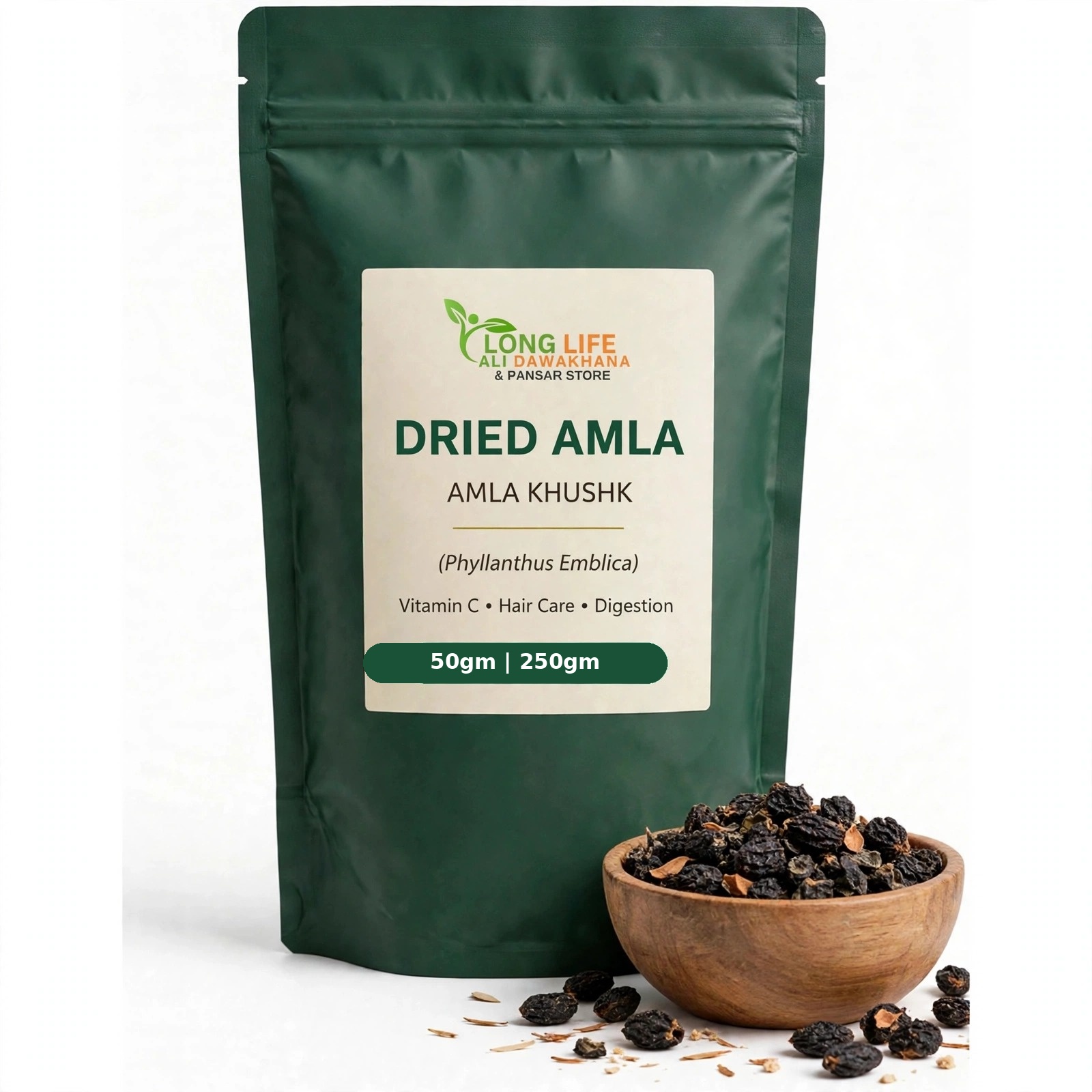
Dried Amla (Amla Khushk, Indian Gooseberry, Phyllanthus emblica) is the dried fruit of the amla tree — one of the three Triphala fruits and the base of Chyawanprash — traditionally used for hair health, digestion and immunity. It has the strongest human-trial record of any herb in this range, including a 2024 trial for women’s hair loss — but drying destroys most of its famous vitamin C, and this article says so plainly. At Long.pk it is available in Whole form (50 gm and 250 gm) from Rs 169, with Cash on Delivery across Pakistan.
خشک آملہ (Dried Amla) — مکمل معلومات
خشک آملہ، جسے انگریزی میں Indian Gooseberry کہتے ہیں، آملہ کے درخت کا خشک کیا ہوا پھل ہے۔
ایک ضروری وضاحت: آملہ کی وٹامن سی کی شہرت تازہ پھل کی ہے — خشک آملے میں وٹامن سی بہت کم رہ جاتا ہے، کیونکہ وٹامن سی گرمی اور ہوا سے جلدی ختم ہو جاتا ہے۔ اس مضمون میں یہ فرق صاف بتایا گیا ہے تاکہ آپ صحیح توقع رکھیں۔
احتیاط: خون پتلا کرنے والی دوا (warfarin, aspirin, clopidogrel) لینے والے افراد ڈاکٹر سے مشورہ کر کے استعمال کریں — آملہ خون کے جمنے کو سست کر سکتا ہے۔
Dried Amla (Amla Khushk) – Price in Pakistan, Benefits, Uses & Safety
Direct answer: Dried Amla (Amla Khushk, Indian Gooseberry, Phyllanthus emblica) price in Pakistan starts from Rs 169 for 50 gm at Long.pk, going up to Rs 371 for 250 gm. It is available in Whole form only — dried fruit pieces — in 50 gm and 250 gm packs, with cash on delivery across Pakistan.
- What Is Dried Amla (Amla Khushk)?
- History of Dried Amla
- Active Compounds
- Dried Amla in Ayurveda, Unani & Folk Medicine
- What Does Modern Research Say?
- Detailed Benefits of Dried Amla
- The Vitamin C Question — What Dried Amla Really Contains
- Who Is Dried Amla For?
- How to Use Dried Amla
- Traditional Combinations
- Dosage & Duration
- Side Effects & Who Should Avoid It
- How to Identify Original Dried Amla
- Storage & Shelf Life
- Dried Amla vs Beleric Myrobalan vs Chebulic Myrobalan
- Dried Amla Price in Pakistan
- Product Specifications
- Roman Urdu
- Frequently Asked Questions
What Is Dried Amla (Amla Khushk)?
Dried Amla — Urdu Amla Khushk (خشک آملہ, “dried amla”), also called Anola Khushk — is the dried fruit of Phyllanthus emblica L. (synonym Emblica officinalis Gaertn.), a deciduous tree of the Phyllanthaceae family native to India.
History of Dried Amla
Dried Amla has one of the richest histories in Ayurveda — it is named in the Charaka Samhita (c. 1st–2nd century CE) as a Rasayana (rejuvenative) and a Vayasthapana (anti-ageing) herb.
Active Compounds
The chemistry of Dried Amla is dominated by its hydrolysable tannins and polyphenols — not, as the marketing says, by vitamin C alone.
Dried Amla in Ayurveda, Unani & Folk Medicine
In Ayurveda, Dried Amla is one of the most versatile medicines in the entire materia medica — and one of the very few substances said to balance all three doshas.
What Does Modern Research Say?
Here is the honest summary first: amla has the strongest human-trial record of any herb in this series — randomised trials, two 2023 meta-analyses, and a triple-blind trial for hair loss — but the trials are still small.
Cholesterol and blood lipids — the best evidence. A 2023 meta-analysis by Brown et al. (PMID 37296402) pooled nine randomised trials with 535 people and found that amla fruit extracts lowered LDL cholesterol by about 15 mg/dL.
Detailed Benefits of Dried Amla
Every benefit below is labelled with its evidence level: traditional (classical Ayurvedic/Unani use), human (human trials — always small and short), animal/lab (rat or test-tube studies). Nothing here is a proven medical claim.
Hair Health & Hair Fall (Human Trial + Traditional)
This is amla’s most famous use — and the one with the best human evidence in this series.
Cholesterol & Heart Health (Meta-Analyses + RCTs)
The strongest evidence in this article: two 2023 meta-analyses of small randomised trials found amla extracts lowered LDL cholesterol by ~15 mg/dL and triglycerides by ~22 mg/dL.
Blood Sugar Support (RCTs — Adjunct Only)
The Usharani 2013 trial (80 people with type 2 diabetes on metformin) showed HbA1c falling from 7.56% to 7.09% over 12 weeks.
Digestion & Gut Health (Traditional + Triphala)
Amla is the cooling, nourishing third of Triphala.
Immunity & Antioxidant Protection (Traditional + Lab)
Amla is traditionally the winter immunity fruit — eaten fresh, as murabba or in Chyawanprash.
Skin Health (Traditional + Lab)
In Ayurveda, amla is used for skin brightness and for chronic skin complaints.
Eyesight (Traditional)
A classical Ayurvedic claim: amla is Chakshushya (beneficial for the eyes).
Liver Support (Traditional + Animal)
In Unani and Ayurvedic practice, amla is used for liver complaints and jaundice, and as a general liver tonic.
The Vitamin C Question — What Dried Amla Really Contains
This is the most important section of the article for a buyer, because amla’s vitamin C reputation is the most exaggerated claim in herbal medicine — and the dried fruit is where the exaggeration matters most.
The measured values. The ICMR-NIN Indian Food Composition Tables 2017 — the current Indian national reference — give 252 mg of vitamin C per 100 g of fresh amla: about six times an orange, not twenty. Sun-dried amla holds roughly 40–70 mg per 100 g.
Who Is Dried Amla For?
Dried Amla suits people who:
- Want a traditional hair tonic — for hair fall, thinning or premature greying — and are willing to use it for 12 weeks or more (the trial duration) before judging it.
- Have digestive complaints — sluggish digestion, acidity, irregular motions — and want the Triphala tradition’s cooling fruit.
How to Use Dried Amla
Decoction (the classical preparation): Add 5–10 g of the dried fruit pieces to 2 cups (about 400 ml) of water. Bring to the boil, then simmer until reduced to about 1 cup.
Traditional Combinations
- Amla + Haritaki + Bahera = Triphala — the most famous formula in Ayurveda.
- Amla + Henna — the classical hair pack.
- Amla + Honey — honey as the vehicle (anupana) for the powder, and the base of the murabba method.
Dosage & Duration
There is no modern dose-finding study for Dried Amla pieces, so all doses below are from the classical texts and traditional practice. The trial doses (for extracts) are given for reference — they are not interchangeable with dried fruit pieces.
Decoction: 5–10 g pieces in 400 ml water, reduced to 200 ml, once or twice daily. Powder: 3–5 g once or twice daily. Duration: 8–12 weeks, then a 2–4 week break.
Side Effects & Who Should Avoid It
Dried Amla is a food eaten daily by millions of households, and at food-level and traditional doses it is well tolerated — but it is not free of cautions, and the cautions below are real.
Blood thinners — the main caution. Amla slows blood clotting. In a small 2014 trial (Fatima et al., Phytomedicine), a 500 mg amla extract reduced platelet aggregation and prolonged bleeding time.
Blood-sugar medicines — monitor. Amla can lower blood sugar (see the research section). If you take insulin or oral diabetes medicines, it may push your blood sugar too low.
Kidney stones — consult a doctor first. Vitamin C is converted to oxalate in the body, and oxalate contributes to calcium-oxalate kidney stones.
Pregnancy and breastfeeding. Amla as food is common and generally considered safe in pregnancy at normal food amounts.
Allergy. Rare, but reported: itching, swelling or skin irritation in sensitive individuals.
Children. Amla as food (fresh fruit, murabba) is fine for children.
How to Identify Original Dried Amla
Appearance: Genuine dried Dried Amla is dark brown-black, shrivelled and wrinkled — hard, dry pieces, sometimes with the hard, pale seed still inside and lighter tan seed fragments among the dark pieces. The pieces should be dry and hard.
Storage & Shelf Life
- Whole dried pieces: keep 18–24 months in an airtight container in a cool, dry place away from direct sunlight.
- Powder (ground to order): keeps 6–9 months — ground amla oxidises faster and loses vitamin C and aroma, so grind only what you need for a few weeks at a time.
Dried Amla vs Beleric Myrobalan vs Chebulic Myrobalan
| Feature | Dried Amla (Amla Khushk) | Beleric Myrobalan (Bahera) | Chebulic Myrobalan (Haritaki) |
|---|---|---|---|
| Part used | Fruit (dried) | Fruit (dried) | Fruit (dried) |
| Key compounds | Gallic acid, β-glucogallin, vitamin C | Gallic acid, ellagic acid, chebulagic acid | Chebulic acid, chebulagic acid, tannins |
Dried Amla Price in Pakistan
| Form | 50 gm | 250 gm |
|---|---|---|
| Whole | Rs 169 | Rs 371 |
Best value: Whole 250 gm, Rs 1.48 per gram — less than half the price per gram of the 50 gm pack.
Product Specifications
| Product Name | Dried Amla (Amla Khushk) |
| Urdu Name | خشک آملہ (Amla Khushk) |
| Botanical Name | Phyllanthus emblica L. (syn. Emblica officinalis Gaertn.) |
| Family | Phyllanthaceae |
| English Names | Indian Gooseberry, Emblic Myrobalan, Amalaki |
| Sanskrit Name | Amalaki, Amalaka, Dhatri |
| Part Used | Fruit (dried) |
| Forms | Whole only |
| Weights | 50 gm, 250 gm |
| Price Range | Rs 169 – Rs 371 |
| Key Compounds | Gallic acid, ellagic acid, chebulagic acid, β-glucogallin, vitamin C |
| Temperament (Ayurveda) | Tridoshic; five tastes except salty, Sheeta (cooling) virya, Madhura vipaka |
| Additives | None — 100% natural |
| Shelf Life | Whole pieces 18–24 months; Powder (ground to order) 6–9 months |
| Storage | Airtight container, cool and dry, away from sunlight |
| Seller | Ali Dawakhana and Pansar Store |
| Delivery | Cash on Delivery across Pakistan |
Roman Urdu
Amla Khushk (Dried Amla) aamlay ke darakht ka khushk kiya hua phal hai.
Is ka sab se bara faida baalon ke liye hai.
Istemaal: qehwa — 5 se 10 gram tukray 2 cup pani mein ubaal kar 1 cup reh janay par chhaan kar pi lein.
Frequently Asked Questions
Q: Amla Khushk kis kaam aata hai?
Amla Khushk (Dried Amla) Ayurveda mein baalon (hair fall, growth), hazme (Triphala ka aik juz), quwwat-e-mudafiat, jild aur aankhon ke liye rawayati tor par istemal hota hai.
Q: Dried Amla ki Pakistan mein qeemat kya hai?
Rs 169 se Rs 371 tak — Whole form hi hai, 50 gm Rs 169, 250 gm Rs 371.
Q: Kya khushk aamlay mein vitamin C hota hai?
Bohat kam. Taaza aamlay mein vitamin C 252 mg/100g hota hai (ICMR-NIN 2017) — narangi se taqreeban 6 guna.
Q: Kya amla baal girne mein madad karta hai?
Is ka sab se achha saboot 2024 ka triple-blind trial hai — 60 khawateen (female pattern hair loss) ne 12 haftay tak amla syrup liya.
Q: Amla Khushk kaisay istemal karte hain?
Qehwa — 5 se 10 gram tukray 2 cup pani mein ubaal kar 1 cup reh janay par chhaan kar pi lein.
Q: Triphala kya hai aur amla is mein kya karta hai?
Triphala Ayurveda ki sab se mashhoor formula hai — teen phal barabar miqdar mein: Haritaki (Chebulic Myrobalan), Bahera (Beleric Myrobalan) aur Amla (Amalaki).
Q: Kya amla cholesterol kam karta hai?
Chhoti trials ke mutabiq haan — 2023 ke meta-analysis (9 trials, 535 log) mein amla extracts se LDL cholesterol taqreeban 15 mg/dL aur triglycerides taqreeban 22 mg/dL kam huay.
Q: Kya amla khoon patla karne wali dawa ke saath le sakte hain?
Doctor se pooch kar lein — aik chhoti study (Fatima 2014) mein amla extract ne platelet aggregation kam ki aur bleeding time barhaya.
Q: Kya Amla Khushk hamila khawateen le sakti hain?
Khane ki aam miqdar (taaza phal, murabba) aam tor par mehfooz samjhi jati hai.
Q: Asli Amla Khushk ki pehchan kya hai?
Asli khushk amla gehra bhoora-kaala, sikra hua aur sakht hota hai — kabhi kabhi andar sakht beej bhi hota hai.
Related Products
- Golden Shower (Amaltas) — digestion and gentle cleansing, the classical cleansing partner for amla.
- Organic Moringa Leaf Powder — a daily nutrition tonic.
- Jujube Berries (Unab) — blood nourishment and skin health.
- Plantain Seeds (Bartang) — gut comfort and digestion.
Ali Dawakhana and Pansar Store — Asli desi dawa aur khalis jadi bootiyan, ab ghar baithay Long.pk se mangwayen.
Reviews
There are no reviews yet