
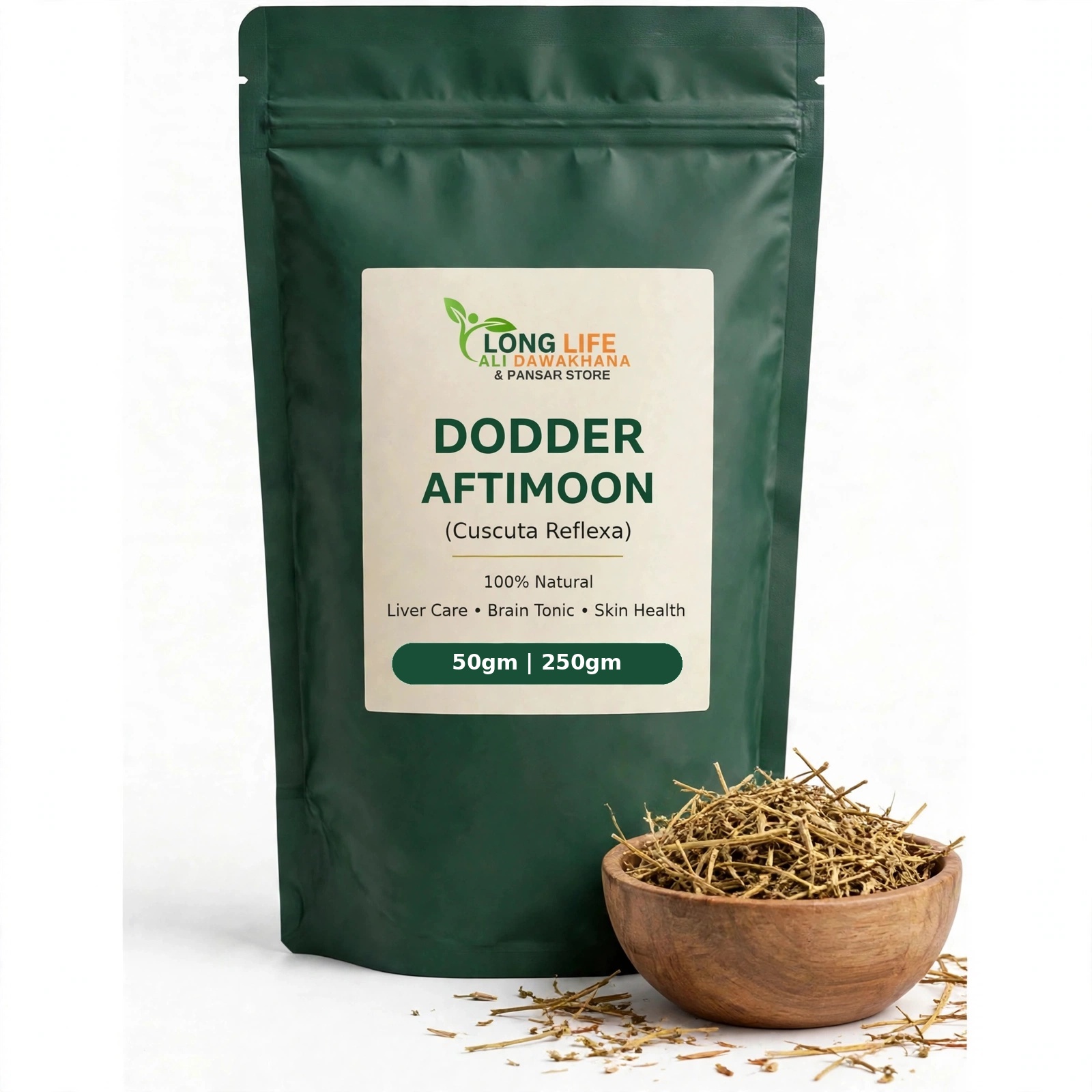
Dodder (Aftimoon, Cuscuta reflexa) is the dried stem of the golden parasitic vine, a classic Unani herb used for liver care, brain health and skin conditions. At Long.pk it is available as Whole or Powder in 50 and 250 gm packs from Rs 262, with Cash on Delivery across Pakistan.
افتیمون (Dodder) — جگر، دماغ اور جلد کی روایتی جڑی بوٹی
افتیمون، جسے انگریزی میں ڈوڈر (Dodder) کہتے ہیں، ایک سنہری رنگ کی پتوں اور جڑوں سے محروم بیل ہے جو دوسرے پودوں پر چڑھ کر ان سے خوراک حاصل کرتی ہے۔
اہم انتباہ: حاملہ خواتین افتیمون استعمال نہ کریں، اور دودھ پلانے والی مائیں بھی اس سے پرہیز کریں کیونکہ اس کی حفاظت پر کوئی تحقیق موجود نہیں۔ بلڈ پریشر یا دل کی دوا لینے والے افراد افتیمون استعمال کرنے سے پہلے اپنے معالج سے مشورہ کریں، کیونکہ اس کا عرق دل کی دھڑکن اور بلڈ پریشر کم کر سکتا ہے۔
Dodder (Aftimoon) — The Golden Parasitic Vine of Unani Medicine
Direct answer: Dodder (Aftimoon, Cuscuta reflexa) is the dried stem of a golden, leafless parasitic vine that has been a classical Unani medicine for liver care, brain health and skin conditions for centuries. Its most famous preparation is Itrifal-e-Aftimoon, a compound still sold in every dawakhana in Pakistan.
- Dodder (Aftimoon) Kya Hai?
- Tareekh aur Riwayat
- Dodder ke Active Compounds
- Ayurveda aur Unani Mein Aftimoon
- Jadeed Tehqiq: Science Kya Kehti Hai
- Dodder (Aftimoon) ke Faide
- A Parasite’s Medicine: Why the Host Matters
- Dodder Kis ke Liye Hai?
- Dodder Istemal Karne ka Tareeqa
- Dodder ke Behtareen Combinations
- Dodder ki Miqdar (Dosage)
- Side Effects aur Ehtiyat
- Asli Dodder Pehchanne ka Tareeqa
- Dodder Store Karne ka Tareeqa
- Dodder vs Doosri Jadi Bootiyan
- Dodder (Aftimoon) ki Qeemat Pakistan Mein
- Product Specifications
- Roman Urdu Mein Dodder (Aftimoon)
- Frequently Asked Questions
Dodder (Aftimoon) Kya Hai?
Dodder is not a normal plant. It has no leaves and no roots of its own. It is a parasitic vine that wraps itself around shrubs, hedges and trees, pushes tiny suckers called haustoria into the host plant, and feeds on its sap.
Tareekh aur Riwayat
Aftimoon has been a medicine in the Greco-Arab (Unani) tradition for well over a thousand years.
Its most famous preparation is Itrifal-e-Aftimoon, a classical compound (Itrifal is the Unani name for a triphala-style electuary) in which Aftimoon is the lead ingredient.
Dodder ke Active Compounds
Modern phytochemical studies have found a wide range of compounds in Cuscuta reflexa, including:
- Cuscutin and cuscutalin — the signature compounds of the genus, found in the stems
- Bergenin — a phenolic compound with antioxidant and anti-inflammatory activity in lab studies
- Flavonoids — luteolin, kaempferol, quercetin and myricetin, all well-known antioxidant plant pigments
- Sterols — beta-sitosterol and stigmasterol, plus sterol glycosides
Ayurveda aur Unani Mein Aftimoon
In the Unani system, Aftimoon is classed as hot and dry in temperament (mizaj). Its classical actions are described with a set of precise terms that are worth knowing, because they explain why it was prescribed.
Jadeed Tehqiq: Science Kya Kehti Hai
Here is the honest picture. There are no robust human clinical trials of Cuscuta reflexa stem for any condition. What exists is a growing body of laboratory and animal research, plus several reviews of the traditional and pharmacological literature. The best-studied area is liver protection.
Liver protection (animal studies). Several independent research groups have tested Dodder extracts against chemically induced liver damage in rats and mice, and the results are consistent.
The pattern is real: in animals, Dodder extracts protect the liver from chemical damage.
Dodder (Aftimoon) ke Faide
The benefits below are organised by how strong the evidence is. Traditional use is stated as traditional use; animal evidence is stated as animal evidence.
1. Liver care (traditional + animal evidence). This is the strongest area. Aftimoon has been used for liver disorders and jaundice for centuries, and the animal studies above consistently show liver protection against chemical damage.
2. Brain and nerve tonic (traditional). In Unani medicine, Dodder is a muqawwi-dimagh — a brain tonic — used for melancholia, low mood and nervous weakness.
3. Skin conditions (traditional). Aftimoon has a long traditional use for vitiligo, pityriasis and other scaly skin conditions, both taken internally and applied as a paste.
4. Digestion and bowel cleansing (traditional). As a purgative (mushil), Dodder is used for constipation and as a “cleanser” in the Unani sense.
5. Blood purification (traditional). In the Unani framework, purging black bile and phlegm “purifies the blood”, and Aftimoon is classed as a blood purifier.
6. Heart and blood pressure (animal evidence). The alcoholic extract has been shown to slow the heart rate and lower blood pressure in animals, which matches the traditional use for palpitations.
7. Fever and inflammation (lab/animal). Antipyretic and anti-inflammatory effects have been reported in animal studies.
A Parasite’s Medicine: Why the Host Matters
This is the one thing about Dodder that is genuinely different from almost every other herb, and it matters for quality.
Dodder is a parasite. It has no roots and no leaves; it lives entirely on the sap of its host plant.
This has three practical consequences: the chemistry varies between batches, so the source matters more than usual — and the name itself is loose, since “Dodder” covers around 200 species (this product is Cuscuta reflexa, the large golden dodder of South Asia).
Dodder Kis ke Liye Hai?
Dodder may suit people who:
- Follow Unani medicine and want the classical herb for liver support, as part of a practitioner-guided regimen
- Use Itrifal-e-Aftimoon or other classical compounds and want the raw herb for their own preparations
- Are looking for a traditional brain tonic and skin herb alongside a broader herbal routine
Dodder Istemal Karne ka Tareeqa
Dodder is used in three main ways. The Whole stems are for decoctions; the Powder is for direct use or for mixing into compounds.
1. Decoction (joshanda / kwath) — the standard method. Take 10 gm of Whole Aftimoon stems and add to 400 ml of water.
Dodder ke Behtareen Combinations
In Unani practice, Aftimoon is rarely used alone. Its classical home is in compounds, and these are the combinations that make sense by product use:
- Dodder + Brahmi (Centella) — the brain-tonic pairing.
- Dodder + Dried Aloe (Elwa) — the liver-and-skin pairing.
- Dodder + Golden Shower (Amaltas) — the gentle bowel-cleansing pairing.
Dodder ki Miqdar (Dosage)
There is no dose of Dodder established by human clinical trials. The doses below are the traditional ones used in Unani and Ayurvedic practice.
- Dried powder (churna): 3–6 gm, twice daily, with warm water or milk
- Decoction (kwath): 10 gm coarse stems in 400 ml water, reduced to 100 ml; 50 ml twice daily before meals
- In classical compounds: as directed by the formula and the practitioner
Side Effects aur Ehtiyat
Dodder at traditional doses is generally well tolerated, and animal toxicity studies found the extracts practically non-toxic (LD50 over 2,000 mg/kg in rats). But “generally safe” is not the same as “safe for everyone”, and the following cautions are important.
Do not use in pregnancy. The effects of Aftimoon on the uterus are unknown, and there is no safety data.
Blood pressure and heart. The alcoholic extract of Dodder slows the heart rate and lowers blood pressure in animals.
Purgative effect. Dodder loosens the bowels. This is a wanted effect at the right dose, but it means people with diarrhoea, inflammatory bowel conditions or a sensitive stomach should avoid it or use it only under guidance.
Drug interactions. No formal interaction studies exist in humans. On the basis of the animal evidence, caution is sensible with blood-pressure drugs, heart drugs and sedatives.
Allergy. Allergy to Dodder is not well documented, but anyone with a known allergy to plants of the morning-glory family should be cautious.
Asli Dodder Pehchanne ka Tareeqa
Good-quality Aftimoon is easy to recognise once you know what to look for:
- Appearance: a tangle of thin, wiry, golden-yellow to yellowish-brown stems, with small thread-like strands and tiny fruit bits.
- Colour: golden-yellow to light brown.
- Smell: almost odourless when dry, with a faint grassy note.
- Cleanliness: free from soil, stones, sand and other plant material.
Dodder Store Karne ka Tareeqa
- Keep Dodder in an airtight container — a glass jar or a sealed food-grade pouch — away from light, heat and moisture.
- Store in a cool, dry cupboard.
- The Whole stems keep well for 12–18 months if stored dry.
Dodder vs Doosri Jadi Bootiyan
| Feature | Dodder (Aftimoon) | Dried Aloe (Elwa) | Brahmi Booti (Centella) |
|---|---|---|---|
| Botanical name | Cuscuta reflexa | Aloe barbadensis (dried juice) | Centella asiatica |
| Part used | Dried stems | Dried leaf juice | Whole herb (leaves) |
| Main traditional use | Liver, brain, skin | Liver, skin, digestion | Brain, nerves, memory |
Dodder (Aftimoon) ki Qeemat Pakistan Mein
| Form | 50 gm | 250 gm |
|---|---|---|
| Whole | Rs 262 | Rs 1,612 |
| Powder | Rs 430 | Rs 1,747 |
Best value: unusually, the smallest pack — Whole 50 gm at Rs 262, just Rs 5.24 per gram, cheaper per gram than any other pack.
Product Specifications
| Attribute | Detail |
|---|---|
| Product name | Dodder (Aftimoon) |
| Urdu name | افتیمون (Aftimoon) |
| Botanical name | Cuscuta reflexa Roxb. |
| Family | Convolvulaceae |
| Part used | Dried stems (and fruits) |
| Forms | Whole, Powder |
| Weights | 50 gm, 250 gm |
| Price range | Rs 262 – Rs 1,747 |
| Origin | Pakistan / South Asia (wild-harvested) |
| Purity | 100% natural, no additives, no preservatives |
| Shelf life | Whole 12–18 months; Powder 6–12 months after opening |
| Seller | Ali Dawakhana and Pansar Store |
| Delivery | Cash on delivery across Pakistan |
Roman Urdu Mein Dodder (Aftimoon)
Dodder (Aftimoon) ek sunhari rang ki patton aur jarron se mehroom bail hai jo doosre podon par charh kar un se khurak leti hai.
Aftimoon ka mizaj garam o khushk mana jata hai. Ye mufattih (jigar ke sudde kholne wali), mushil (sauda o balgham kharij karne wali).
Frequently Asked Questions
Q: Dodder (Aftimoon) kya hai?
Dodder (Aftimoon, Cuscuta reflexa) ek sunhari, patton aur jarron se mehroom taifli (parasitic) bail hai jo doosre podon par charh kar un se khurak leti hai.
Q: Aftimoon jigar ke liye kaisa hai?
Aftimoon ka sab se mazboot rawayati istemal jigar ki dekh bhal hai.
Q: Dodder ki qeemat kya hai?
Rs 262 se Rs 1,747 tak — Whole 50 gm Rs 262, 250 gm Rs 1,612; Powder 50 gm Rs 430, 250 gm Rs 1,747.
Q: Dodder ka behtareen faida kya hai — Whole ya Powder?
Dono aik hi jadi booti hain.
Q: Aftimoon ka istemal kaise karein?
Safoof 3–6 gram din mein do baar neem garam pani ya doodh ke saath.
Q: Kya Dodder (Aftimoon) hamal mein mehfooz hai?
Nahi — hamila khawateen Aftimoon istemal na karein, kyun ke is ke bachay-dani par asrat maloom nahi aur is par koi safety data mojood nahi.
Q: Kya Dodder blood pressure ki dawa ke saath le sakte hain?
Pehle apne doctor se mashwara karein.
Q: Aftimoon aur Akash Bel mein kya farq hai?
Koi farq nahi — Akash Bel aur Amar Bel isi poday (Cuscuta reflexa) ke Hindi naam hain, jab ke Aftimoon is ka Unani/Arabi naam hai.
Q: Dodder ka host plant kyun ahem hai?
Kyun ke Dodder taifli poda hai — ye apne host poday se sirf pani aur cheeni nahi, balkay us ke alkaloids aur doosre chemicals bhi jazb karta hai.
Q: Dodder kitne arse tak istemal kar sakte hain?
Rawayati course aam tor par 2–4 hafte ka hota hai, phir waqfa diya jata hai.
Related Products
- Brahmi Booti (Centella) — the classical Ayurvedic brain tonic; pairs with Aftimoon for nerves, calm and memory.
- Dried Aloe (Elwa) — a classical liver and skin herb with a purgative action; the liver-focused partner to Dodder.
- Golden Shower (Amaltas) — a gentle laxative fruit for digestion and liver sluggishness; pairs well in bowel-cleansing regimens.
- Henna Leaves (Mehndi Patti) — the traditional skin and hair herb; the external partner to Dodder’s internal skin use.
Ali Dawakhana and Pansar Store — Asli desi dawa aur khalis jadi bootiyan, ab ghar baithay Long.pk se mangwayen.
Reviews
There are no reviews yet