
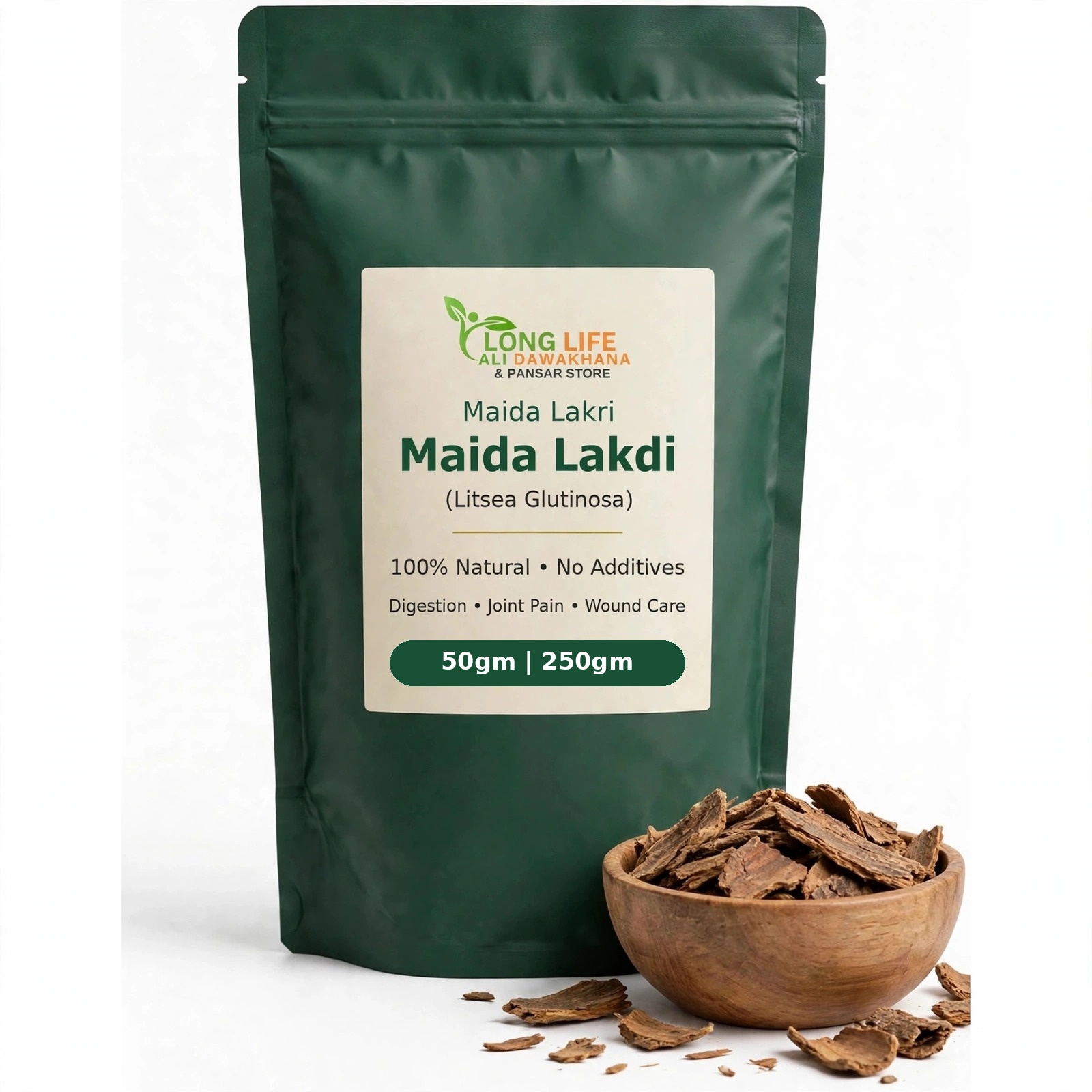
Maida Lakri (Maida Lakdi, Common Tallow Laurel, Litsea glutinosa) is the mucilage-rich bark of a laurel-family tree, a classical Unani and Ayurvedic drug traditionally used as a demulcent for diarrhoea and dysentery, for joint pain and swelling, and as a sticky plaster for sprains and fractures. Its bark powder forms a thick gel with water — the property behind both its gut-soothing use and its centuries-old role as a binder. At Long.pk it is available in Whole and Powder forms (50 gm and 250 gm) from Rs 152, with Cash on Delivery across Pakistan.
میدہ لکڑی (Maida Lakri) — مکمل معلومات
میدہ لکڑی، جسے انگریزی میں Common Tallow Laurel اور سائنسی نام سے Litsea glutinosa کہتے ہیں، ایک درخت کی چھال ہے جو ہندوستان، چین اور جنوب مشرقی ایشیا کے جنگلات میں اگتا ہے۔
اہم انتباہ: میدہ لکڑی کا زیادہ استعمال قبض کر سکتا ہے — یہ آنتوں کو باندھنے والی (قابض) بوٹی ہے۔ حاملہ خواتین دوائی کی مقدار میں استعمال نہ کریں، کیونکہ اس کی حفاظت کا کوئی ڈیٹا نہیں ہے۔
Maida Lakri (Maida Lakdi) – Price in Pakistan, Benefits, Uses & Safety
Direct answer: Maida Lakri (Maida Lakdi, Common Tallow Laurel, Litsea glutinosa) price in Pakistan starts from Rs 152 for 50 gm (Whole form) at Long.pk, going up to Rs 709 for 250 gm (Whole form). It is available in two forms — Whole and Powder — in 50 gm and 250 gm packs, with cash on delivery across Pakistan.
- What Is Maida Lakri?
- History of Maida Lakri
- Active Compounds
- Maida Lakri in Unani, Ayurveda & Folk Medicine
- What Does Modern Research Say?
- Detailed Benefits of Maida Lakri
- The Mucilage — Why This Bark Sticks
- Who Is Maida Lakri For?
- How to Use Maida Lakri
- Traditional Combinations
- Dosage & Duration
- Side Effects & Who Should Avoid It
- How to Identify Original Maida Lakri
- Storage & Shelf Life
- Maida Lakri vs Plantain Seeds vs Arjuna Bark
- Maida Lakri Price in Pakistan
- Product Specifications
- Roman Urdu
- Frequently Asked Questions
What Is Maida Lakri?
Maida Lakri — Urdu Maida Lakdi (میدہ لکڑی) — is the dried bark of Litsea glutinosa (Lour.) C.B. Rob., a small to medium-sized tree of the Lauraceae (laurel family), the same family as cinnamon, bay leaf and camphor.
History of Maida Lakri
Maida Lakri has been a working drug of South Asian medicine for centuries, but unlike the great Unani herbs of the Arabic canon it does not arrive with a famous name attached — no Ibn Sina chapter, no Hadith mention.
Active Compounds
The chemistry of Maida Lakri has two halves that barely overlap: the mucilage, which does the physical work (soothing, binding, plastering), and the alkaloids and phenolics, which do the pharmacological work (pain, fever, blood sugar, microbes).
Maida Lakri in Unani, Ayurveda & Folk Medicine
In Unani medicine, Maida Lakri is a demulcent and emollient drug — a mulayyin (softening, soothing) medicine whose mucilage coats irritated tissue.
Ayurveda knows the plant as Medasaka. Its classical profile is Shita Virya (cooling potency) with an astringent taste.
What Does Modern Research Say?
Here is the honest summary first: there are no published human clinical trials of Maida Lakri (or of Litsea glutinosa as a whole) for any condition.
Most of the modern studies tested the leaves, not the bark — the product sold here is the bark, and leaf results do not automatically transfer.
Antibacterial activity — the bark itself (laboratory). Mandal et al. (2000) tested the methanolic bark extract against a panel of bacteria and found it inhibited both gram-positive and gram-negative organisms — including Staphylococcus aureus, Shigella dysenteriae.
Detailed Benefits of Maida Lakri
Every benefit below is labelled with its evidence level: traditional (classical Unani/Ayurvedic/folk use), animal/lab (rat, mouse or test-tube studies), or both. Nothing here is a proven human-treatment claim.
Diarrhoea & Dysentery (Traditional + Lab)
This is the herb’s defining internal use. In Unani medicine the bark decoction is prescribed for diarrhoea and dysentery.
Joint Pain, Swelling & Sprains (Traditional + Animal)
The bark paste is the traditional application for joint pain.
Fractures & Bone Support (Traditional + Lab Hint)
The most distinctive use in this series: the bark paste is a traditional plaster for fractured limbs.
Digestion, Acidity & Gut Soothing (Traditional)
As a demulcent, the bark soothes an irritated digestive tract.
Wounds, Boils & Skin (Traditional)
The bark paste is applied to wounds, skin boils, bruises and skin infections.
Fever, Blood Sugar & Vitality (Animal + Traditional)
Three secondary benefits, grouped because each rests on thinner evidence.
The Mucilage — Why This Bark Sticks
Every herb in this series has one property that explains it.
What it is. The bark mucilage is made of heteropolysaccharide polyuronides — long, branching chains of sugar and uronic-acid units, laid down in layers on the bark’s cell walls.
What it does. Swallowed as a decoction or powder, the gel coats the mucous membranes of the gut — a physical, soothing film over irritated tissue.
Who Is Maida Lakri For?
Maida Lakri suits people who:
- Have loose bowels or a sensitive gut and want a traditional demulcent.
- Have swollen, painful joints — especially hot, inflamed joints — and want a traditional external paste.
- Have had a sprain, bruise or minor soft-tissue injury and want a traditional supportive plaster or poultice.
How to Use Maida Lakri
Decoction (the classical internal preparation): Add 5–10 g of the whole bark to 2 cups (about 400 ml) of water. Bring to the boil, then simmer until reduced to about 1 cup.
Powder (the simplest internal preparation): Take 1–3 g of the powder with warm water or honey once or twice daily.
Traditional Combinations
- Maida Lakri + Liquorice (Mulethi) — the classical demulcent pairing.
- Maida Lakri + Cumin (Jeera) — the Ayurvedic cooling digestive tonic.
- Maida Lakri + Castor Oil — the joint paste.
Dosage & Duration
There is no modern dose-finding study for Maida Lakri, so all doses below are from traditional practice. Start at the lower end and stop if you feel unwell.
| Preparation | Dose | Frequency |
|---|---|---|
| Bark powder | 1–3 g | Once or twice daily |
| Decoction (5–10 g bark in 400 ml water, reduced to 200 ml) | 30–40 ml | Twice daily |
| Cold infusion (5 g bark in 1 cup water, overnight) | 1 cup | Once daily |
Side Effects & Who Should Avoid It
Maida Lakri has a long traditional record and a reassuring acute-toxicity signal in rats (no lethality up to 3,000 mg/kg), and side effects at traditional doses are uncommon — but it is a real medicine with real cautions, and the long-term safety data do not exist.
Constipation. The most likely side effect: the bark binds. Overuse can cause hard stools, bloating and abdominal discomfort.
Medicines may be absorbed more slowly. The mucilage gel can coat the gut and slow the absorption of other drugs.
Blood thinners and surgery. Leaf extracts disrupted blood clots in a laboratory test (Bhowmick et al.) — a thrombolytic effect.
Diabetes medicines. The bark extract lowered blood sugar in diabetic mice (Zhang 2018).
Pregnancy, breastfeeding and children — avoid medicinal doses. There are no teratogenicity or reproductive-safety studies at all — the 2022 review lists them among the missing data — and the bark contains aporphine alkaloids, a class with no established safety record in pregnancy.
Allergies. People allergic to laurel-family plants (Lauraceae) — cinnamon, bay, camphor — should be cautious.
How to Identify Original Maida Lakri
Appearance: Genuine dried Maida Lakri bark comes as thick, rough, curled pieces — the bark is 2–2.5 cm thick on the tree, so the dried pieces are substantial and rigid, not thin or papery.
Storage & Shelf Life
- Whole bark: keeps 18–24 months in an airtight container in a cool, dry place away from direct sunlight.
- Powder: keeps 9–12 months — ground bark absorbs moisture faster, and damp powder gels into clumps and loses its mucilage strength, so buy powder in smaller quantities and use it up.
Maida Lakri vs Plantain Seeds vs Arjuna Bark
| Feature | Maida Lakri (Maida Lakdi) | Plantain Seeds (Bartang) | Arjuna Bark (Arjun Ki Chaal) |
|---|---|---|---|
| Botanical name | Litsea glutinosa | Plantago major (seed) | Terminalia arjuna |
| Part used | Bark | Seeds | Bark |
| Key property | Mucilage gel + aporphine alkaloids | Mucilage gel (psyllium-type fibre) | Tannins, triterpenoids, flavonoids |
Maida Lakri Price in Pakistan
| Form | 50 gm | 250 gm |
|---|---|---|
| Whole | Rs 152 | Rs 709 |
| Powder | Rs 295 | Rs 597 |
Best value: Powder 250 gm at Rs 2.39 per gram — unusually, the Powder is cheaper per gram than the Whole at 250 gm (Rs 597 vs Rs 709).
Product Specifications
| Attribute | Detail |
|---|---|
| Product Name | Maida Lakri (Maida Lakdi) |
| Urdu Name | میدہ لکڑی (Maida Lakri / Maida Lakdi) |
| Botanical Name | Litsea glutinosa (Lour.) C.B. Rob. |
| Family | Lauraceae (laurel family) |
| English Names | Common Tallow Laurel, Indian Laurel, Bolly Beech, Brown Bollygum |
| Ayurvedic Name | Medasaka |
| Part Used | Bark (dried) |
| Forms | Whole / Powder |
| Weights | 50 gm, 250 gm |
| Price Range | Rs 152 – Rs 709 |
| Key Property | Mucilage (heteropolysaccharide polyuronides); aporphine alkaloids (boldine, laurolitsine) |
| Temperament (Ayurveda) | Cooling (Shita Virya); binding (Grahi) |
| Additives | None — 100% natural |
| Shelf Life | Whole bark 18–24 months; Powder 9–12 months |
| Storage | Airtight container, cool and dry, away from sunlight and moisture |
| Seller | Ali Dawakhana and Pansar Store |
| Delivery | Cash on Delivery across Pakistan |
Roman Urdu
Maida Lakri (Maida Lakdi) aik darakht ki chhaal hai jo Hindustan, China aur janub mashriqi Asia ke janglaat mein ugta hai.
Is ka sab se bara faida is ki demulcent (narm karne wali) khasiyat hai — is ki gel aanton ki jalan wali jhilli par teh bana deti hai aur dast roknay mein madad karti hai. Whole aur Powder, 50 gm aur 250 gm — Rs 152 se shuru.
Frequently Asked Questions
Q: Maida Lakri kis kaam aati hai?
Maida Lakri (Maida Lakdi, Litsea glutinosa) Yunani aur Ayurvedic tib mein aik mashhoor demulcent booti hai.
Q: Maida Lakri ki Pakistan mein qeemat kya hai?
Rs 152 se Rs 709 tak — Whole 50 gm Rs 152, 250 gm Rs 709; Powder 50 gm Rs 295, 250 gm Rs 597.
Q: Maida Lakri ka naam “Maida” kyun hai?
Is liye ke is ki chhaal ka powder pani mein milanay se aatay (maida) jaisi chipchipi lai ban jati hai.
Q: Kya Maida Lakri dast mein madad karti hai?
Rawayati tor par haan — Yunani tib mein is ka qehwa dast aur pechish ke liye diya jata hai.
Q: Maida Lakri ka paste kaisay banatay hain?
Chhaal ka powder neem garam pani ya arandi ke tail mein mila kar gaarha paste bana lein.
Q: Kya Maida Lakri tooti haddi jor sakti hai?
Rawayati tor par is ki lai se tooti haddiyon par plaster bandha jata hai.
Q: Maida Lakri kaisay istemal karte hain?
Teen tareeqay: (1) qehwa — 5 se 10 gram chhaal 2 cup pani mein ubaal kar 1 cup kar lein, din mein 2 baar 30 se 40 ml; (2) powder — 1 se 3 gram din mein aik ya do baar; (3) paste — powder ko pani ya tail mein mila kar bahar se lagayen.
Q: Kya Maida Lakri hamila khawateen le sakti hain?
Nahi — hamal mein dawaai ki miqdaar mein istemal na karein.
Q: Maida Lakri ke nuqsanaat kya hain?
Sab se aam nuqsan qabz hai — yeh aanton ko bandhnay wali booti hai.
Q: Asli Maida Lakri ki pehchan kya hai?
Asli chhaal moti (2 se 2.5 cm), khurdari aur murrhi hui bhoori lakri hoti hai.
Related Products
- Plantain Seeds (Bartang) — gut soothing with a different mucilage herb, the seed-gel remedy for constipation and gut comfort.
- Liquorice Root (Mulethi) — digestion and throat comfort, the classical demulcent partner for Maida.
- Peepal Bark (Peepal ki Chaal) — wounds and skin complaints from another traditional bark.
- Jujube Berries (Unab) — cooling digestion and general wellness.
Ali Dawakhana and Pansar Store — Asli desi dawa aur khalis jadi bootiyan, ab ghar baithay Long.pk se mangwayen.
Reviews
There are no reviews yet