
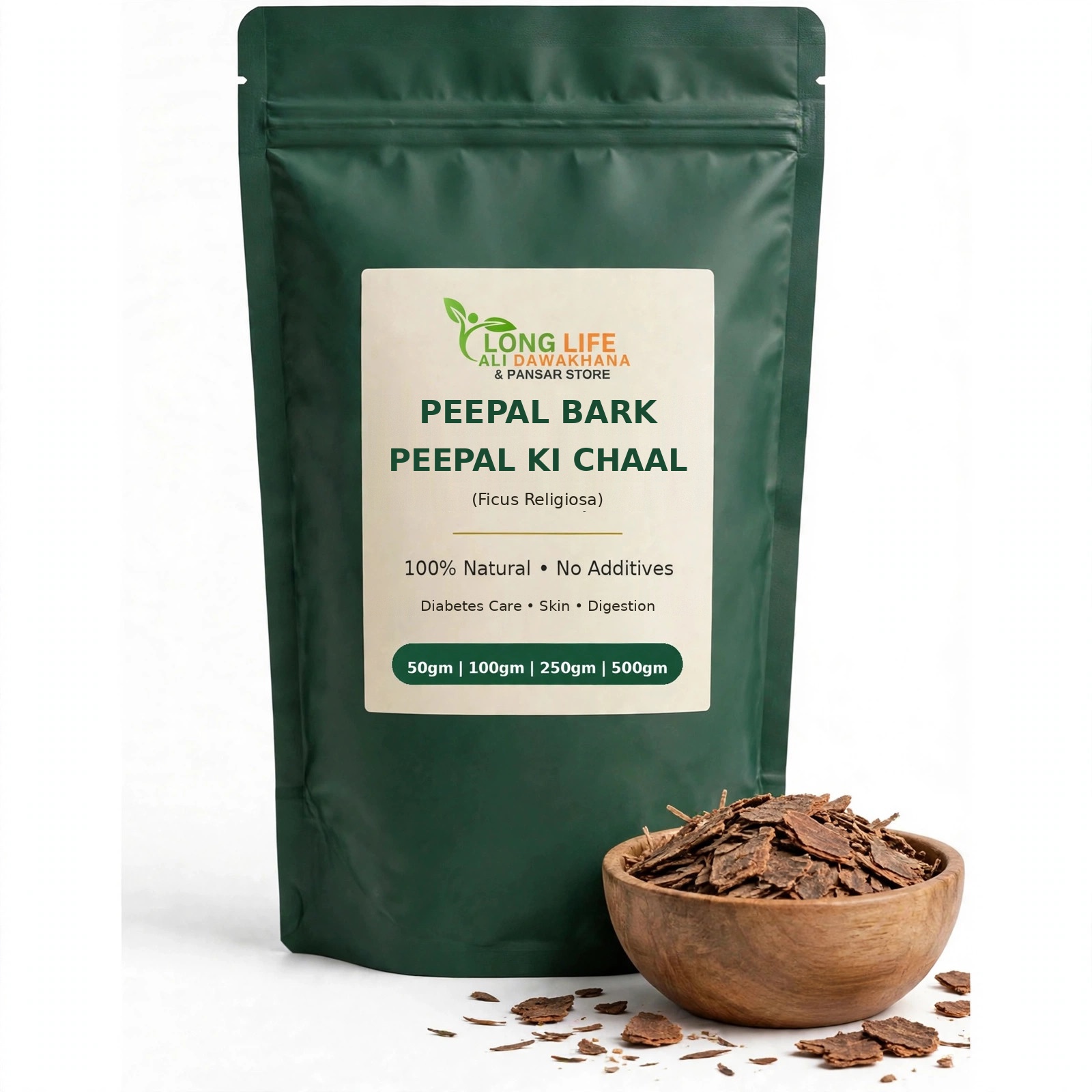
پیپل کی چھال (Peepal Bark) — مکمل معلومات
پیپل کا درخت برصغیر کے سب سے مقدس اور مشہور درختوں میں سے ایک ہے۔ اسے اردو میں پیپل، سنسکرت میں اشوتھا اور انگریزی میں Sacred Fig یا Bodhi Tree کہا جاتا ہے۔ اس کا نباتاتی نام فیکس ریلیجیوسا (Ficus religiosa) ہے۔ بدھ مت کی روایت کے مطابق گوتم بدھ نے اسی درخت کے نیچے نروان حاصل کیا تھا، اسی لیے اسے بودھی درخت بھی کہتے ہیں۔ ہندو مت اور جین مت میں بھی پیپل کو مقدس مانا جاتا ہے۔
آیوروید میں پیپل کی چھال کو دل کی دوا (ہریدیا)، خون صاف کرنے والی، زخم بھرنے والی اور ذیابیطس (شوگر) میں مفید مانا جاتا ہے۔ چرک سنہتا اور سشرت سنہتا جیسی قدیم کتابوں میں پیپل کا ذکر موجود ہے۔ اس کی چھال قابض (astringent) ہوتی ہے، یعنی یہ جسم کے ٹشوز کو سکیڑتی ہے اور خون بہنا روکنے میں مدد دیتی ہے۔
پیپل کی چھال کے روایتی استعمال میں شوگر کنٹرول، جلد کے مسائل، زخموں کا علاج، دانتوں اور مسوڑھوں کی مضبوطی، اور ہاضمے کے مسائل شامل ہیں۔ جدید تحقیق میں بھی اس کے خون میں شکر کم کرنے والے اثرات جانوروں پر کیے گئے تجربات میں دیکھے گئے ہیں۔
پیپل کی چھال کے فائدے (روایتی استعمال)
- شوگر (ذیابیطس): پیپل کی چھال کا جوشاندہ روایتی طور پر خون میں شکر کم کرنے کے لیے استعمال ہوتا ہے۔ بھاوپرکاش نگھنٹو میں شوگر کے لیے چھال کا سفوف شہد کے ساتھ تجویز کیا گیا ہے۔
- دل کی صحت: چرک سنہتا میں پیپل کی چھال کو ہریدیا (دل کی ٹانک) کہا گیا ہے۔
- زخم اور جلد: چھال کا جوشاندہ زخم دھونے اور جلد کے مسائل جیسے خارش اور ایگزیما میں استعمال ہوتا ہے۔
- دانت اور مسوڑھے: چھال کا باریک سفوف دانتوں اور مسوڑھوں پر ملنے سے وہ مضبوط ہوتے ہیں۔
- دست اور پیچش: اپنی قابض خصوصیات کی وجہ سے یہ دست روکنے میں مدد دیتی ہے۔
استعمال کا طریقہ
- جوشاندہ: 10 گرام خشک چھال 400 ملی لیٹر پانی میں ابالیں، جب پانی 100 ملی لیٹر رہ جائے تو چھان کر دن میں دو بار پیئیں۔
- سفوف: 2 سے 5 گرام سفوف شہد یا نیم گرم پانی کے ساتھ دن میں ایک یا دو بار لیا جا سکتا ہے۔
- زخم دھونا: 50 گرام چھال آدھا لیٹر پانی میں ابال کر نیم گرم پانی سے زخم دھوئیں۔
- جلد پر لیپ: 4 گرام سفوف شہد میں ملا کر چہرے یا متاثرہ جلد پر لگائیں۔
پیپل کی چھال Long.pk سے Whole، Powder یا Grounded فارم میں 50 گرام سے 500 گرام تک منگوائی جا سکتی ہے۔ قیمت صرف 132 روپے سے شروع ہوتی ہے اور پورے پاکستان میں کیش آن ڈیلیوری دستیاب ہے۔
Peepal Bark (Peepal ki Chaal) – Price in Pakistan, Benefits & How to Use
Direct answer: Peepal Bark (Peepal ki Chaal, Ficus religiosa) price in Pakistan starts from Rs 132 for 50 gm (Whole form) at Long.pk, going up to Rs 1,384 for 500 gm (Powder or Grounded form). It is available in three forms — Whole, Powder and Grounded — in 50 gm, 100 gm, 250 gm and 500 gm packs, with cash on delivery across Pakistan. Peepal bark is one of Ayurveda’s classical herbs: Charaka Samhita calls it a cardiac tonic (Hridya), and it is traditionally used for blood-sugar support, wound healing, skin problems, teeth and gums, and digestive complaints. Animal studies support its blood-sugar-lowering effect, but it is a traditional support herb — not a replacement for diabetes medication.
Table of Contents
- What Is Peepal Bark?
- History of the Peepal Tree
- Active Compounds
- Peepal in Ayurveda, Unani & Folk Medicine
- What Does Modern Research Say?
- Detailed Benefits of Peepal Bark
- Bark, Leaves, Latex or Fruit?
- Who Is Peepal Bark For?
- How to Use Peepal Bark
- Traditional Combinations
- Dosage & Duration
- Side Effects & Who Should Avoid It
- How to Identify Original Peepal Bark
- Storage & Shelf Life
- Peepal Bark vs Arjuna Bark vs Banyan Bark
- Peepal Bark Price in Pakistan
- Product Specifications
- Roman Urdu
- Frequently Asked Questions
What Is Peepal Bark?
Peepal (Ficus religiosa L.) is a large, long-lived fig tree of the family Moraceae, native to the Indian subcontinent and now grown across South and Southeast Asia. In Urdu it is Peepal (پیپل), in Sanskrit Ashvattha, and in English the Sacred Fig or Bodhi Tree. The tree is famous for its heart-shaped leaves with long, tapering tips that tremble in the slightest breeze, and for its grey, slightly cracked bark — the part sold here as Peepal ki Chaal (پیپل کی چھال).
The bark is harvested from mature branches and the trunk, dried, and cut or ground. Good-quality dried peepal bark is greyish-brown on the outside, reddish-brown on the inside, rough and fibrous, with a distinctly astringent taste — that puckering, drying sensation is the tannins at work, and it is the key to most of the bark’s traditional uses. The bark is rich in tannins, flavonoids and phytosterols, which is why it is classed as an astringent, wound-healing and blood-sugar-supporting herb in the classical texts.
Every part of the peepal tree is used in traditional medicine — bark, leaves, fruit, roots and the milky latex — but the bark is the most widely used part, and the one with the strongest classical backing for diabetes and heart support. The dried bark sold by pansar stores is usually the stem bark, cut into rough chips; the powder and grounded forms are made by grinding those chips.
Peepal is also remarkable as a tree: it is one of the few trees that releases oxygen at night as well as during the day (through a form of photosynthesis called CAM in its leaves), which is one reason it is planted around temples, shrines and village meeting places across Pakistan and India. A peepal tree can live for many centuries — the famous Bodhi tree at Anuradhapura in Sri Lanka, grown from a cutting of the original tree under which the Buddha sat, is over 2,300 years old.
History of the Peepal Tree
Few trees carry as much history as the peepal. In Buddhism, the tree is sacred above all others: Siddhartha Gautama is said to have attained enlightenment while meditating beneath a peepal at Bodh Gaya in India, around the 5th century BCE, and that tree became known as the Bodhi Tree — the tree of awakening. Cuttings from it were carried across Asia, and Bodhi trees are now planted at Buddhist temples from Sri Lanka to Japan.
In Hindu tradition, the peepal is associated with the Trimurti — Brahma, Vishnu and Shiva are all said to dwell in it — and the Bhagavad Gita calls it the king of trees (“Among trees, I am Ashvattha”). In Jainism too the tree is revered. For ordinary village life across the subcontinent, the peepal has always been the meeting tree: the big shady tree at the edge of the village where the panchayat sits, where travellers rest, and where shrines are built.
Medicinally, the peepal enters the written record with the classical Ayurvedic texts. Charaka Samhita (circa 400 CE) includes Ashvattha in the Nyagrodhadi Gana — a group of astringent bark herbs used for Pitta disorders, diarrhoea and bleeding conditions — and classifies the bark as Hridya, a cardiac tonic. Sushruta Samhita, the great surgical text, places peepal in the same group and recommends its latex and bark for wound healing and skin disorders. Bhavaprakasha Nighantu (16th century, Vatadi Varga) gives the full pharmacological profile: astringent taste, heavy and drying qualities, Pitta- and Kapha-pacifying, wound-healing, blood-purifying, and useful for diabetes (Madhumeha), skin disease and disorders of the female reproductive system.
In Unani medicine, peepal bark came to be used for asthma, diarrhoea, skin disease, fever and wounds, and the tree is a standard entry in the Unani materia medica. Folk use across Punjab, Sindh and the wider region has always been practical: bark decoction for sugar and diarrhoea, bark powder for teeth, leaf poultices for bruises, and the shade of the tree itself as a place to recover from the summer heat.
Active Compounds
The bark and other parts of Ficus religiosa contain a wide range of bioactive compounds. The most studied are the flavonoids (antioxidant and blood-sugar activity), the tannins (astringent and wound-healing activity), and the sterols and triterpenoids.
| Compound | Type | What researchers looked at |
|---|---|---|
| Bergenin | C-glycoside | Identified in a 2025 AI-driven study as a strong DPP-4 inhibitor (a diabetes drug target); needs experimental validation |
| Caffeic acid | Phenolic acid | Also flagged as a DPP-4 inhibitor in the same study, with good predicted bioavailability (21.48%) |
| Quercetin | Flavonoid | Strong antioxidant; reduces inflammation and protects cells from damage |
| Kaempferol | Flavonoid | Anti-inflammatory, cardioprotective; studied for anti-cancer activity |
| Myricetin | Flavonoid | Supports antidiabetic and antioxidant activity |
| Leucocyanidin glycosides | Flavonoid glycosides | Leucocyandin 3-O-beta-d-galactosyl cellobioside — a dimethoxy derivative lowered blood sugar in normal and diabetic rats |
| Leucopelargonidin glycosides | Flavonoid glycosides | Leucopelargonidin-3-O-alpha-L-rhamnoside; a derivative remarkably lowered blood sugar in animal studies |
| β-Sitosterol & Stigmasterol | Phytosterols | Plant sterols; β-sitosteryl-D-glucoside isolated from the bark; phytosterolin from bark lowered blood glucose in rabbits comparably to tolbutamide |
| Lupeol | Triterpenoid | Anti-inflammatory triterpenoid found in the bark |
| Tannins | Polyphenols | Responsible for the bark’s astringent taste and its wound-healing, anti-diarrhoeal and skin-tightening effects |
| Bergapten & Bergaptol | Coumarins (furanocoumarins) | Reported in the bark; coumarins contribute to antimicrobial activity |
| Vitamin E | Vitamin | Present in Ficus species; antioxidant |
The 2025 AI-powered screening study is worth noting for what it is and is not: it used computer modelling to screen 12 phytochemicals from F. religiosa against DPP-4, the enzyme targeted by a major class of diabetes drugs, and found bergenin and caffeic acid bound strongly. That is a promising lead for drug discovery — not proof that drinking peepal bark tea works like a DPP-4 inhibitor. The study’s own authors call for enzyme assays, cell tests and animal testing to confirm it.
Peepal in Ayurveda, Unani & Folk Medicine
In Ayurveda, peepal is Ashvattha, and its profile is well documented. Bhavaprakasha Nighantu describes it as astringent (kashaya) in taste, heavy (guru) and drying (ruksha) in quality, with a cooling effect that pacifies Pitta and Kapha. Its classical actions include Raktaprasadana (blood purifying), Shothahara (anti-inflammatory), Vranaropana (wound healing) and Pittashamaka (Pitta pacifying). It is classed as Hridya (cardiac tonic), Grahi (stool-binding, useful in diarrhoea) and Shukrala (reproductive tonic). The bark is the part most used for diabetes (Prameha/Madhumeha) and heart support; the leaves are used for wounds and inflammation; the latex is applied externally for skin lesions and wounds. Some sources describe peepal as tridoshic — balancing all three doshas — with a lean toward pacifying Vata and Kapha.
In Unani medicine, peepal bark is used as an astringent and cooling herb for diarrhoea, bleeding disorders, asthma, fever, skin disease and wounds. The temperament is generally given as cold and dry, which fits its astringent, tissue-tightening action. Unani practitioners use the bark decoction for diabetes and for excessive menstrual bleeding, and the powdered bark for teeth and gums.
In folk medicine across Pakistan and India, peepal is the village pharmacy tree: bark decoction for sugar, bark powder rubbed on teeth and gums, bark paste with honey for the face, leaf poultices for bruises and swollen joints, and latex dabbed on cracked heels and warts. In Nepal, high-altitude communities traditionally use peepal preparations to manage post-meal blood sugar. The tree’s shade is itself considered medicinal — a place to sit and cool down in the summer heat.
What Does Modern Research Say?
Peepal bark has better animal evidence for blood-sugar control than most traditional diabetes herbs — but, as with all the herbs in this series, the honest picture is that human evidence is still thin.
Blood sugar — the best-studied effect. The landmark study is Pandit et al. (2010), published in the Journal of Ethnopharmacology: an aqueous extract of Ficus religiosa bark was given to streptozotocin-induced diabetic rats at 25, 50 and 100 mg/kg for 21 days. Blood glucose fell by 28.56%, 49.65% and 48.58% respectively — the 50 and 100 mg/kg doses working best. The extract also raised serum insulin, body weight and glycogen stores in the liver and muscles, while lowering triglycerides and total cholesterol, and it protected the pancreas against lipid damage. The effect was compared with glibenclamide, a standard diabetes drug. Earlier work by Ambika and Rao (1967) isolated phytosterolin from the bark and found it lowered blood glucose in rabbits at doses comparable to tolbutamide. A review of Ficus species confirms that F. religiosa extracts and isolated compounds enhance insulin secretion and reduce blood glucose in multiple animal models.
Human evidence — small but real. A pilot trial in 2021 gave 3 g of peepal leaf powder daily to people with type 2 diabetes and noted moderate blood sugar reductions. That is encouraging, but it is one small pilot — not the large controlled trial that would be needed to call peepal a proven diabetes treatment. No large human trial of the bark exists yet.
Wound healing. A 2015 peer-reviewed study found that ethanol extracts of peepal bark, applied topically, accelerated wound contraction in Wistar rats — supporting the classical Vranaropana (wound-healing) claim and the folk practice of washing wounds with bark decoction.
Other activities. Reviews list antioxidant, anti-inflammatory, antimicrobial, anticonvulsant, anti-ulcer, anti-asthmatic and immunomodulatory activities for F. religiosa extracts, mostly from animal and laboratory studies. The 2025 AI screening study flagged bergenin and caffeic acid as potential DPP-4 inhibitors, which may explain part of the antidiabetic effect — but that finding is computational and awaits lab confirmation.
The honest summary: peepal bark’s blood-sugar effect is supported by solid animal studies, including one well-conducted trial with a drug comparison, plus a small human pilot. That makes it one of the more evidence-backed traditional diabetes herbs — but it is still a support herb. Nobody should stop diabetes medication in favour of peepal bark, and anyone using it alongside medication must monitor their blood sugar, because the effects can add up.
Detailed Benefits of Peepal Bark
Blood Sugar Support (Diabetes)
This is peepal bark’s headline benefit. In Ayurveda it is a classical herb for Prameha and Madhumeha (diabetes), and Bhavaprakasha recommends the bark powder with honey for the purpose. The animal evidence — significant glucose reductions, improved insulin levels, better lipid profiles — gives the tradition real weight. Used as a decoction or powder alongside a proper diet, it is a reasonable traditional support for blood-sugar management. It is not a cure for diabetes and not a substitute for prescribed medication.
Heart Health (Cardiac Tonic)
Charaka Samhita classifies peepal bark as Hridya — a cardiac tonic. In traditional terms it strengthens the heart and calms palpitations; in modern terms, its flavonoids (quercetin, kaempferol) are cardioprotective antioxidants, and the bark extract’s lipid-lowering effect in diabetic rats (lower triglycerides and cholesterol) points in the same direction. It is a gentle, traditional heart support, not a treatment for heart disease.
Wound Healing & Skin Health
The bark’s tannins make it a natural astringent: they tighten tissues, reduce oozing, and help wounds close. Traditional practice washes wounds with bark decoction and applies bark paste (with honey or ghee) to eczema, itching, ulcers and burns. The 2015 rat study confirmed faster wound contraction with topical bark extract. For the face, a paste of bark powder and honey is a traditional remedy for blemishes and uneven skin.
Teeth & Gums
One of the most practical traditional uses: rubbing 5 g of fine bark powder on the teeth and gums strengthens them and kills bacteria, thanks to the bark’s antibacterial and astringent tannins. In the days before toothpaste, peepal twigs were used as miswak-style tooth sticks across the subcontinent. The powder is still used this way in rural areas.
Digestive Support (Diarrhoea & Dysentery)
As a Grahi (stool-binding) herb, peepal bark is traditionally used for diarrhoea and dysentery: the tannins reduce intestinal secretions and tighten the gut lining. The bark decoction is also used for general digestive sluggishness and for vomiting in the classical texts.
Bleeding Disorders
The astringent action extends to bleeding: traditional practice uses peepal bark for bleeding gums, nosebleeds, excessive menstrual bleeding and blood in the urine (haematuria). The bark is one of the Nyagrodhadi Gana herbs specifically grouped for Pitta disorders and bleeding conditions.
Respiratory Support
The bark decoction is described as Vatahara (Vata-pacifying) and a mild tonic for the respiratory channels in Charaka Samhita, and traditional practice uses it for chronic cough and mild asthma. The leaves are also used in steam preparations for congestion. This is a secondary use — peepal is not a first-choice respiratory herb — but it is part of the classical picture.
Anti-Inflammatory & Antioxidant Support
The flavonoid content (quercetin, kaempferol, myricetin) gives the bark measurable antioxidant and anti-inflammatory activity in laboratory models. In traditional terms this shows up as its use for swollen joints (leaf poultice), inflammatory skin conditions, and general “heat” in the body.
Bark, Leaves, Latex or Fruit?
All parts of the peepal tree are used, but they are not interchangeable. The bark is the most versatile and the most studied part.
| Part | Traditional use | Notes |
|---|---|---|
| Bark | Diabetes, heart tonic, wounds, teeth, diarrhoea, bleeding | The main medicinal part; richest in tannins and sterols; the product sold here |
| Leaves | Wound poultices, bruises, inflammation, blood sugar (pilot trial used leaf powder) | Used fresh as poultice or dried as powder; tender leaves also used for diabetes |
| Latex (milky sap) | Wounds, cracked heels, warts, eczema — external only | Can irritate skin; never ingest raw latex; classical use is in controlled poultices |
| Fruit (figs) | Diabetes (fruit extract active in one rat study), laxative, cooling | Small figs; the fruit extract at 250 mg/kg showed antidiabetic activity in alloxan-diabetic rats |
| Roots / root bark | Skin lesions (powder applied externally), traditional formulas | Root bark powder is applied to oozing skin lesions to dry them |
| Seeds | Diabetes in classical texts | Mentioned alongside bark and leaves for Prameha |
For home use, the bark is the safest and most practical part: it stores well, makes a straightforward decoction, and has the strongest classical and research backing.
Who Is Peepal Bark For?
Peepal bark suits adults interested in traditional diabetes support — particularly people who already follow Ayurvedic or Unani practice and want a classical bark herb for blood-sugar management alongside diet and (where prescribed) medication. It also suits people looking for a traditional wound wash, a natural teeth-and-gums powder, or a skin-care ingredient from the classical tradition.
It is a gentle herb as traditional herbs go, but it is not for everyone: pregnant women should avoid large oral doses, people on diabetes medication need to monitor their blood sugar closely, and anyone on blood thinners or blood-pressure medication should check with their doctor first. Children over 5 can use half the adult dose under guidance; younger children should not take it internally.
How to Use Peepal Bark
Decoction (Kwatha / Joshanda) — the classic method. Boil 10 g of dried bark in 400 ml of water until it reduces to about 100 ml. Strain and drink warm, twice a day. For diabetes support, the traditional dose is 40–50 ml of decoction per day, or 50–100 ml in divided doses — follow your practitioner’s advice.
Powder (Churna). Take 2–5 g of bark powder (the classical range is 1–3 g with honey for diabetes, up to 3–6 g in some sources) mixed with honey or warm water, once or twice a day. Honey is the traditional vehicle (anupan) for diabetes use.
Wound wash. Boil about 50 g of bark in 500 ml of water until it reduces by half. Let it cool to lukewarm and use the liquid to wash wounds — this is the standard traditional preparation for both infected and non-infected wounds.
Teeth and gums. Take about 5 g of fine bark powder and gently rub it on the teeth and gums with a fingertip or soft brush, then rinse. Used regularly, it strengthens the gums and freshens the mouth.
Skin paste. Mix 4 g of bark powder with honey to make a paste and apply to the face or to affected skin (eczema patches, itchy areas). Leave for 15–20 minutes, then wash off. For burns, the traditional base is ghee rather than honey.
Leaf poultice (if you have fresh leaves). Warm fresh peepal leaves and apply them over swollen joints, bruises or wounds as a poultice. For bruises, a traditional preparation grinds a few leaves with 25 g of jaggery, rolls the mixture into 8 pills, and takes one pill daily with milk.
Traditional Combinations
- Peepal Bark + Jamun (Java Plum): two classical diabetes herbs combined — jamun seeds are the other great Ayurvedic antidiabetic, and the pair is a standard traditional combination for blood-sugar support.
- Peepal Bark + Giloy: for fever with blood-sugar concerns, and for general immune support. Giloy’s milder profile complements the bark.
- Peepal Bark + Arjuna Bark: two Hridya (cardiac tonic) barks together for heart support — arjuna is the stronger heart herb, peepal adds the blood-sugar and astringent dimensions.
- Peepal Bark + Honey: the classical vehicle for diabetes use (Bhavaprakasha recommends bark powder 1–3 g with honey for Madhumeha).
- Peepal Bark + Neem: for skin conditions — neem’s antimicrobial action plus peepal’s astringent, wound-healing action, used as a wash or paste.
- Peepal Bark + Turmeric: for wounds and inflammation — turmeric’s curcumin plus peepal’s tannins, applied as a paste or taken in milk.
Dosage & Duration
The figures below are traditional Ayurvedic and Unani doses from the classical texts and modern Ayurvedic sources. They are given for information — your practitioner’s instruction takes priority, and diabetics must monitor blood sugar when using peepal bark.
| Form | Traditional dose | Notes |
|---|---|---|
| Bark powder | 2–5 g per day (classical: 1–3 g with honey for diabetes; some sources up to 3–6 g) | With honey or warm water, once or twice daily |
| Bark decoction | 50–100 ml per day (from 10 g bark in 400 ml water, reduced to 100 ml) | Twice daily; for diabetes, 40–50 ml per day is the common traditional dose |
| Bark for wound wash | ~50 g bark in 500 ml water, reduced by half | External use; lukewarm |
| Bark powder for teeth | ~5 g, rubbed on teeth and gums | External; rinse after |
| Bark powder for skin | ~4 g mixed with honey | External paste |
Duration: for blood-sugar support, traditional courses run 4–8 weeks with regular blood-sugar monitoring, then review with your practitioner. For wounds and skin, use until healed. Peepal bark is gentle enough for longer courses than many herbs, but any diabetes-related use should be reviewed regularly — and never replace prescribed medication without your doctor’s agreement.
Side Effects & Who Should Avoid It
Peepal bark is generally safe in traditional doses, and it is one of the gentler herbs in this series. But “gentle” does not mean “no cautions”.
Possible side effects: the bark’s drying (ruksha) quality means excessive use can aggravate Vata — leading to constipation, dry skin or joint discomfort in Vata-dominant people. Large doses may cause stomach discomfort or nausea. Allergic reactions are possible, particularly in people sensitive to fig trees or latex (peepal is in the fig family, and its latex contains similar proteins).
Who should be careful:
- Pregnant women — avoid large oral doses; traditional sources note uterine-stimulating potential at high concentrations, and safety data is limited. Topical use is generally considered acceptable.
- Breastfeeding women — limited safety data; use only on professional advice.
- People on diabetes medication — peepal bark lowers blood sugar, so it can add to the effect of your medication and push blood sugar too low. Monitor closely and tell your doctor you are using it.
- People on blood thinners (anticoagulants) — use cautiously; the bark affects blood and bleeding in traditional theory, and interactions are possible.
- People on blood-pressure medication — use cautiously for the same reason.
- Children under 5 — no established safe dose for internal use; older children use half the adult dose under guidance.
Latex warning: the milky latex of the peepal tree can irritate the skin and must never be swallowed raw. Classical use is external only, in controlled poultices. The bark product sold here contains no latex.
How to Identify Original Peepal Bark
- Colour: dried peepal bark is greyish-brown on the outer surface and reddish-brown on the inner surface. Very pale or very dark bark may be old or from the wrong tree.
- Texture: rough, fibrous and slightly cracked, in flat chips or curled pieces. It should snap with a fibrous break, not crumble to dust.
- Taste: distinctly astringent — it puckers the mouth. If the bark has no astringent taste, it is old or poor quality.
- Smell: a mild, woody, earthy smell. A musty or mouldy smell means damp storage — reject it.
- No confusion with banyan: peepal bark (Ficus religiosa) and banyan bark (Ficus benghalensis) look similar and are sometimes mixed. True peepal bark is thinner and greyer; banyan bark is thicker and more deeply cracked. Buy from a trusted store.
- Buy from a trusted store: Long.pk sources its Peepal ki Chaal from established pansar suppliers, and the bark is packed in sealed pouches that protect it from moisture and contamination.
Storage & Shelf Life
Store peepal bark in an airtight container or its sealed pouch, away from light, heat and moisture. A cool, dry kitchen cupboard is ideal. The dried bark keeps its potency for 18–24 months when stored properly — bark is one of the longest-keeping herb forms. The powder loses strength faster (use within 9–12 months of grinding). Keep the pouch sealed between uses. Do not store it in the bathroom or near the stove, where steam and heat degrade it.
Peepal Bark vs Arjuna Bark vs Banyan Bark
These three are the great astringent barks of South Asian medicine, and they are often confused. All three are used for the heart, bleeding and wounds — but each has its own strength.
| Feature | Peepal Bark | Arjuna Bark | Banyan Bark |
|---|---|---|---|
| Botanical name | Ficus religiosa | Terminalia arjuna | Ficus benghalensis |
| Tree | Sacred Fig / Bodhi | Arjuna | Banyan / Bargad |
| Main tradition | Ayurveda & Unani | Ayurveda | Ayurveda & folk |
| Signature use | Blood sugar + heart | Heart (cardiac tonic) | Diabetes + wounds |
| Temperament | Cooling, drying | Cooling | Cooling, astringent |
| Key compounds | Bergenin, quercetin, tannins | Arjunolic acid, tannins, flavonoids | Leucocyanidin glycosides, tannins |
| Best for | Diabetes support, skin, teeth | Heart health, blood pressure | Diabetes, diarrhoea, wounds |
| Safety | Gentle; caution in pregnancy | Generally safe | Generally safe |
| Price (Long.pk, from) | Rs 132 / 50 gm | (16 original herbs) | — |
Which to choose: for blood-sugar support with heart benefits, peepal bark. For the heart specifically, arjuna bark is the classical first choice. For a traditional diabetes combination, peepal + jamun is the standard pairing.
Peepal Bark Price in Pakistan
Prices checked 18 November 2026 (following pansaar.com, rounded to whole rupees). Cash on Delivery available across Pakistan.
| Form | 50 gm | 100 gm | 250 gm | 500 gm |
|---|---|---|---|---|
| Whole | Rs 132 | Rs 253 | Rs 641 | Rs 1,316 |
| Powder | Rs 199 | Rs 405 | Rs 996 | Rs 1,384 |
| Grounded | Rs 199 | Rs 405 | Rs 996 | Rs 1,384 |
Best value: the 500 gm Whole pack at Rs 1,316 works out to about Rs 263 per 100 gm, against Rs 264 per 100 gm for the 50 gm pack — the price scales almost evenly, so buy the size you will actually use. The Powder and Grounded forms cost more than Whole at small sizes (grinding and sieving add cost), which is normal across the herb range.
Product Specifications
| Product Name | Peepal Bark (Peepal ki Chaal) |
| Urdu Name | پیپل کی چھال |
| Botanical Name | Ficus religiosa L. |
| Family | Moraceae |
| Forms Available | Whole / Powder / Grounded |
| Weights Available | 50 gm / 100 gm / 250 gm / 500 gm |
| Price Range | Rs 132 – Rs 1,384 |
| Purity | 100% Natural, No Additives |
| Origin | Pakistan / South Asia |
| Shelf Life | 18–24 months (dried bark); 9–12 months (powder) |
| Storage | Airtight container, cool & dry place, away from sunlight |
| Seller | Ali Dawakhana and Pansar Store |
| Delivery | Cash on Delivery across Pakistan |
Roman Urdu
Peepal Bark (Peepal ki Chaal, Ficus religiosa) bar-e-sagheer ke sab se muqaddas darakht ki chhaal hai — isi darakht ko Bodhi Tree bhi kehte hain, jis ke neechay Gautam Buddha ne nirwan hasil kiya tha. Ayurveda mein is ki chhaal ko dil ki dawa (Hridya) aur sugar ke liye mufeed mana jata hai. Charaka Samhita aur Bhavaprakasha jaisi qadeem kitabon mein is ka zikr maujood hai.
Peepal ki chhaal ke fawaid mein blood sugar ko control karne mein madad, zakhmon ka jaldi bharna, jild ke masail mein behtri, daanton aur masooron ki mazbooti, aur dast mein aaram shamil hain. Is mein bergenin, quercetin aur tannins jaise murakkabat paaye jate hain. Janwaron par ki gayi tehqeeq mein is ke khoon mein shakar kam karne wale asraat dekhe gaye hain — lekin yeh sugar ki dawa ka badal nahi hai.
Peepal ki chhaal ka joshanda banane ke liye 10 gram chhaal 400 ml pani mein ubaalain aur 100 ml reh jane par chhaan kar din mein do baar piyen. Safoof 2 se 5 gram tak shehed ya neem garam pani ke saath liya ja sakta hai. Zakham dhone ke liye 50 gram chhaal aadha litre pani mein ubaal kar neem garam pani istemal karein. Sugar ki dawa lene walay afraad apna blood sugar check karte rahen aur doctor ko zaroor batayen.
Long.pk se Peepal ki Chaal Whole, Powder aur Grounded form mein 50 gm se 500 gm tak dastiyab hai — qeemat sirf Rs 132 se shuru. Pure Pakistan mein Cash on Delivery ki sahulat mojood hai.
Frequently Asked Questions
Q: Peepal ki chhaal kis kaam aati hai?
Peepal ki chhaal (Ficus religiosa) rawayati Ayurvedic aur Unani tib mein khaas tor par sugar (diabetes), dil ki sehat, zakhmon, jild ke masail, daanton aur masooron, aur dast ke liye istemal hoti hai.
Q: Peepal Bark ki Pakistan mein qeemat kya hai?
Long.pk par Peepal Bark ki qeemat Rs 132 se shuru hoti hai (50 gm Whole) aur Rs 1,384 tak jati hai (500 gm Powder/Grounded). Whole, Powder aur Grounded — teeno forms 50, 100, 250 aur 500 gm mein dastiyab hain.
Q: Kya peepal ki chhaal sugar kam karti hai?
Janwaron par ki gayi tehqeeq (Pandit et al. 2010) mein peepal ki chhaal ke arq ne khoon mein shakar 28% se 49% tak kam ki. Aik chhoti insani pilot study mein bhi mamooli kami dekhi gayi. Lekin yeh sugar ki dawa ka badal nahi hai — dawa ke saath istemal karne par blood sugar check karte rahen.
Q: Peepal ki chhaal ka joshanda kaise banayen?
10 gram khushk chhaal 400 ml pani mein daal kar halki aanch par ubaalain, jab pani 100 ml reh jaye to chhaan lein aur neem garam piyen. Aam tor par din mein do baar liya jata hai.
Q: Peepal ki chhaal daanton ke liye kaisi hai?
Taqreeban 5 gram bareek safoof daanton aur masooron par halke se malne se masooray mazboot hotay hain aur munh ke jaraseem kam hotay hain. Yeh chhaal ke qabiz (astringent) aur antibacterial asraat ki wajah se hai.
Q: Peepal ki chhaal aur Arjun ki chhaal mein kya farq hai?
Dono dil ki bootiyan hain, lekin Arjun ki chhaal dil ke liye pehla intikhab hai, jab ke peepal ki chhaal sugar aur zakhmon mein zyada mashhoor hai. Dono ko aik saath bhi istemal kiya jata hai.
Q: Kya peepal ki chhaal se koi nuqsan ho sakta hai?
Munasib miqdar mein yeh aam tor par mehfooz hai. Zyada miqdar se qabz, khushk jild ya pait mein takleef ho sakti hai. Haamla khawateen bari miqdar se parhaiz karein aur sugar ki dawa lene walay blood sugar monitor karein.
Q: Peepal ki chhaal zakhmon par kaise istemal karein?
50 gram chhaal aadha litre pani mein ubaal kar jab aadha reh jaye to neem garam pani se zakham dhoyen. Yeh rawayati tareeqa zakham jaldi bharne mein madad deta hai.
Q: Asli peepal ki chhaal ki pehchan kya hai?
Asli chhaal bahar se greyish-brown aur andar se reddish-brown hoti hai, khurdari aur reshaydar hoti hai, aur is ka zaiqa qabiz (munh sukhane wala) hota hai. Bargad ki chhaal is se moti aur zyada phati hui hoti hai.
Q: Peepal ki chhaal ko kitni dair tak rakh saktay hain?
Hawa-band dabbe mein, thandi aur khushk jagah par, khushk chhaal 18 se 24 mahine tak theek rehti hai. Safoof (powder) 9 se 12 mahine mein istemal kar lena behtar hai.
Ali Dawakhana and Pansar Store — Asli desi dawa aur khalis jadi bootiyan, ab ghar baithay Long.pk se mangwayen.
Reviews
There are no reviews yet