
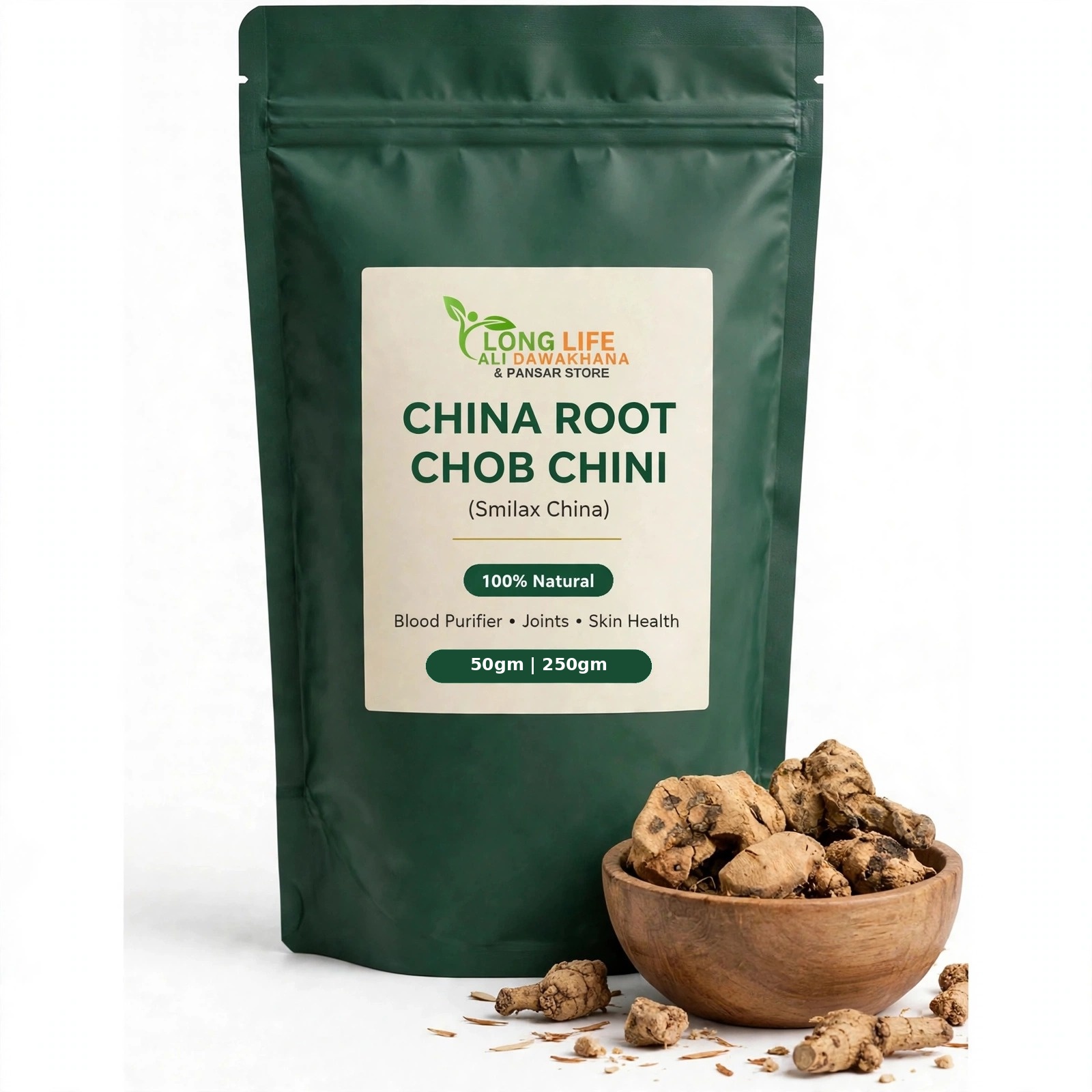
China Root (Chob Chini, Smilax china) is the dried rhizome of a climbing Smilax vine, a traditional blood purifier in Ayurveda and Unani medicine used for chronic skin conditions, joint pain and urinary complaints. Its main compound is astilbin, and the honest position is that there are no human clinical trials of this species itself — the well-known gout trials belong to its cousin Smilax glabra, not to this root. At Long.pk it is available in Whole and Powder forms (50 gm and 250 gm) from Rs 599, with Cash on Delivery across Pakistan.
چوب چینی (China Root) — مکمل معلومات
چوب چینی، جسے انگریزی میں China Root کہتے ہیں، ایک بیل دار پودے (Smilax china) کی جڑ (rhizome) ہے جو چین، کوریا، جاپان اور ہندوستان میں اگتی ہے۔
اہم انتباہ: چوب چینی کی زیادہ مقدار (دن میں 10 گرام سے زیادہ) متلی اور قے کا باعث بن سکتی ہے۔ حاملہ خواتین اور دودھ پلانے والی مائیں اسے استعمال نہ کریں۔
China Root (Chob Chini) – Price in Pakistan, Benefits, Uses & Safety
Direct answer: China Root (Chob Chini, Smilax china) price in Pakistan starts from Rs 599 for 50 gm (Whole form) at Long.pk, going up to Rs 2,712 for 250 gm (Powder form). It is available in two forms — Whole and Powder — in 50 gm and 250 gm packs, with cash on delivery across Pakistan.
- What Is China Root?
- History of China Root
- Active Compounds
- China Root in Ayurveda, Unani & Chinese Medicine
- What Does Modern Research Say?
- Detailed Benefits of China Root
- China Root vs Sarsaparilla vs Tu Fu Ling — Three Smilax, Three Medicines
- Who Is China Root For?
- How to Use China Root
- Traditional Combinations
- Dosage & Duration
- Side Effects & Who Should Avoid It
- How to Identify Original China Root
- Storage & Shelf Life
- China Root vs Sarsaparilla vs Liquorice
- China Root Price in Pakistan
- Product Specifications
- Roman Urdu
- Frequently Asked Questions
What Is China Root?
China Root — Urdu Chob Chini (چوب چینی, “Chinese wood”) — is the dried rhizome of Smilax china L., a climbing vine of the Smilacaceae (greenbrier family).
Names: In Urdu it is Chob Chini and Chobchini; in Sanskrit Chopchini and Chopachini.
History of China Root
China Root has one of the most dramatic histories of any herb in the Long.pk range — it was once the most expensive and most talked-about medicine in Europe.
Active Compounds
The chemistry of China Root is dominated by one compound — astilbin — and understanding it explains both the root’s reputation and the limits of its evidence.
China Root in Ayurveda, Unani & Chinese Medicine
In Ayurveda, Chopchini is classed as a Raktashodhaka — a blood purifier — and a Vatanashaka, a pacifier of Vata.
In Unani medicine, Chob Chini holds the same place. The Makhzanul Advia describes it as the root of a climbing plant brought from China.
What Does Modern Research Say?
Here is the honest summary first: there are no published human clinical trials of Smilax china itself for any condition.
The gout meta-analysis that is NOT about this plant. In 2026, a meta-analysis in Frontiers in Endocrinology (PMID 42460320) pooled 56 randomised controlled trials with 4,605 participants and found that formulae containing Smilax improved gout outcomes.
Uric acid and the kidneys — the strongest animal study. A 2011 study in Planta Medica gave astilbin (1.25–5 mg/kg) to rats with fructose-induced high uric acid and found that it lowered serum uric acid by increasing urinary excretion.
Detailed Benefits of China Root
Every benefit below is labelled with its evidence level: traditional, animal/lab, or other species (evidence that belongs to S. glabra, not claimed for this root).
Blood Purification & Skin Health (Traditional + Lab)
This is the herb’s defining use. In Ayurveda China Root is a Raktashodhaka.
Joints, Gout & Arthritis (Traditional + Animal; Human Trials Belong to Another Species)
The root’s second great traditional use is for painful, swollen joints — Vatarakta in Ayurveda.
Uric Acid & Urinary Health (Animal)
The 2011 rat study is the strongest single piece of evidence for this product.
Women’s Health — Pelvic Inflammation (Chinese Clinical Use + Animal)
In Chinese hospitals, Jin Gang Teng preparations are used for chronic pelvic inflammatory disease.
Digestion & Appetite (Traditional)
The Chinese Pharmacopoeia lists Ba Qia as a carminative.
Wounds & Ulcers (Traditional)
The Ayurvedic texts list Vrana (wounds and ulcers) among the root’s indications.
China Root vs Sarsaparilla vs Tu Fu Ling — Three Smilax, Three Medicines
This is the most important section of the article for a buyer, because the name “China root” has been applied to several different plants — and even modern sellers confuse them.
Smilax china — this product. The Chinese Ba Qia / Jin Gang Teng and the Indian Chopchini.
Who Is China Root For?
China Root suits people who:
- Want a traditional blood purifier for chronic skin complaints.
- Have joint pain or gout and want a traditional supportive remedy alongside their doctor’s treatment.
- Have urinary complaints of the mild, recurrent kind.
How to Use China Root
Decoction (the classical preparation): Add 5–10 g of the whole root to 2 cups (about 400 ml) of water. Bring to the boil, then simmer until reduced to about half a cup (100 ml).
Powder: Take 3–6 g of the powder with water, milk or honey once or twice daily.
Traditional Combinations
- China Root + Liquorice (Mulethi) — the classical blood-purifier pairing for skin complaints.
- China Root + Manjistha — two blood purifiers together, a standard Ayurvedic combination for chronic skin disease (manjistha, Rubia cordifolia, is the red root of the Ayurvedic skin tradition).
Dosage & Duration
There is no modern dose-finding study for China Root, so all doses below are from the classical texts and traditional practice. Start at the lower end and stop if you feel unwell.
| Preparation | Dose | Frequency |
|---|---|---|
| Root powder | 3–6 g | Once or twice daily |
| Decoction (5–10 g root in 400 ml water, reduced to 100 ml) | 100 ml | Twice daily |
| Paste (external) | As needed | 20–30 minutes per application |
Side Effects & Who Should Avoid It
China Root has a long traditional record and side effects at traditional doses are uncommon — but it is a real medicine with real cautions, and one of them is a matter of life and health.
Sexually transmitted infections — this root is NOT a treatment. The most important safety point in this article. China Root was famous in the 16th century as a syphilis cure, and it did not work — patients improved briefly and relapsed.
Nausea and vomiting at high doses. The classical sources are clear: daily intake should not exceed 10 g, and heavy doses cause nausea and vomiting.
Pregnancy — avoid. There is no safety data for China Root in pregnancy, and the classical use for venereal disorders does not make it safe for a pregnant woman.
Breastfeeding — avoid medicinal doses. There is no safety data for nursing mothers. Wait until after weaning for concentrated decoctions and powders.
Children under 12 — avoid. No safety data, and the active compounds are pharmacologically real.
Kidney disease — consult a doctor first. The root affects uric acid handling and urine flow, which is exactly why it interests researchers — and exactly why it is not a self-treatment decision for someone with impaired kidney function.
Allergies. Allergy to Smilax is rare, but anyone with a known allergy to the greenbrier family or to sarsaparilla should be cautious.
Surgery. As a general precaution, stop using medicinal doses two weeks before planned surgery, because of the possible effects on blood clotting and blood sugar.
How to Identify Original China Root
Appearance: Genuine dried China Root is a bundle of thick, gnarled, knobby rhizome chunks — light tan to medium brown, hard and woody, with a rough bark-like surface and darker patches where the bark has flaked.
Storage & Shelf Life
- Whole root: keeps 18–24 months in an airtight container in a cool, dry place away from direct sunlight.
- Powder: keeps 9–12 months — ground herbs lose their active compounds faster, so buy powder in smaller quantities and use it up.
- Seal tightly after every use.
China Root vs Sarsaparilla vs Liquorice
| Feature | China Root (Chob Chini) | Sarsaparilla (S. officinalis) | Liquorice Root (Mulethi) |
|---|---|---|---|
| Botanical name | Smilax china | Smilax officinalis / reglii | Glycyrrhiza glabra |
| Part used | Rhizome (thick chunks) | Root (thin, fibrous) | Root and stolon |
| Key compound | Astilbin (flavonoid) | Sarsasapogenin (saponin) | Glycyrrhizin (saponin) |
China Root Price in Pakistan
| Form | 50 gm | 250 gm |
|---|---|---|
| Whole | Rs 599 | Rs 2,624 |
| Powder | Rs 768 | Rs 2,712 |
Best value: Whole 250 gm at Rs 10.50 per gram — the Powder costs more per gram at every size.
Product Specifications
| Product Name | China Root (Chob Chini) |
| Urdu Name | چوب چینی (Chob Chini) |
| Botanical Name | Smilax china L. |
| Family | Smilacaceae (greenbrier family) |
| English Names | China Root, China Smilax, Chinese Smilax |
| Sanskrit Name | Chopchini, Chopachini |
| Chinese Names | Ba Qia, Jin Gang Teng |
| Part Used | Rhizome (dried) |
| Forms | Whole / Powder |
| Weights | 50 gm, 250 gm |
| Price Range | Rs 599 – Rs 2,712 |
| Key Compound | Astilbin (flavonoid) |
| Temperament (Unani) | Hot and dry (traditional assessment) |
| Additives | None — 100% natural |
| Shelf Life | Whole root 18–24 months; Powder 9–12 months |
| Storage | Airtight container, cool and dry, away from sunlight |
| Seller | Ali Dawakhana and Pansar Store |
| Delivery | Cash on Delivery across Pakistan |
Roman Urdu
Chob Chini (China Root) aik bail daar pauday (Smilax china) ki jarr (rhizome) hai jo China, Korea, Japan aur Hindustan mein ugti hai.
Istemaal: qehwa — 5 se 10 gram jarr 2 cup pani mein ubaal kar aadha cup reh janay par chhaan kar din mein 2 baar piyein.
Frequently Asked Questions
Q: Chob Chini kis kaam aati hai?
Chob Chini (China Root, Smilax china) Ayurveda aur Yunani tib mein aik mashhoor khoon saaf karne wali (blood purifier) booti hai.
Q: China Root ki Pakistan mein qeemat kya hai?
Rs 599 se Rs 2,712 tak — Whole 50 gm Rs 599, 250 gm Rs 2,624; Powder 50 gm Rs 768, 250 gm Rs 2,712.
Q: Kya Chob Chini gout mein madad karti hai?
Rawayati tor par haan — yeh sadiyon se gout aur joron ke dard ke liye istemal hoti aa rahi hai.
Q: China Root aur sarsaparilla mein kya farq hai?
Dono aik hi genus (Smilax) ki mukhtalif species hain.
Q: Chob Chini kaisay istemal karte hain?
Teen tareeqay hain: (1) qehwa — 5 se 10 gram jarr 2 cup pani mein ubaal kar aadha cup reh janay par chhaan kar din mein 2 baar piyein; (2) powder — 3 se 6 gram din mein aik ya do baar; (3) leep — zakhm ya soojan par paste 20 se 30 minute laga kar dho lein.
Q: Kya Chob Chini se syphilis (aatishk) ka ilaaj hota hai?
Nahi — bilkul nahi.
Q: Kya Chob Chini hamila khawateen le sakti hain?
Nahi. Hamal mein Chob Chini ki safety ka koi data nahi hai, is liye hamila khawateen is se parhez karein.
Q: Chob Chini ki rozana miqdar kitni hai?
Powder 3 se 6 gram din mein aik ya do baar, ya qehwa (5 se 10 gram jarr se bana hua) din mein 2 baar.
Q: Asli Chob Chini ki pehchan kya hai?
Asli jarr moti, ganth daar, halki bhoori rhizome ke tukray hoti hai — sakht, lakri jaisi, khurdari satah wali, wazan mein bhari.
Q: Kya Chob Chini ke koi nuqsanat hain?
Rawayati miqdar (din mein 10 gram tak) mein nuqsanat kaam hain.
Related Products
- Liquorice Root (Mulethi) — blood purification and skin health, the classical partner herb for China Root.
- Golden Shower (Amaltas) — gentle cleansing and digestion.
- Jujube Berries (Unab) — skin and blood support.
- Organic Moringa Leaf Powder — a general daily tonic.
Ali Dawakhana and Pansar Store — Asli desi dawa aur khalis jadi bootiyan, ab ghar baithay Long.pk se mangwayen.

Reviews
There are no reviews yet