
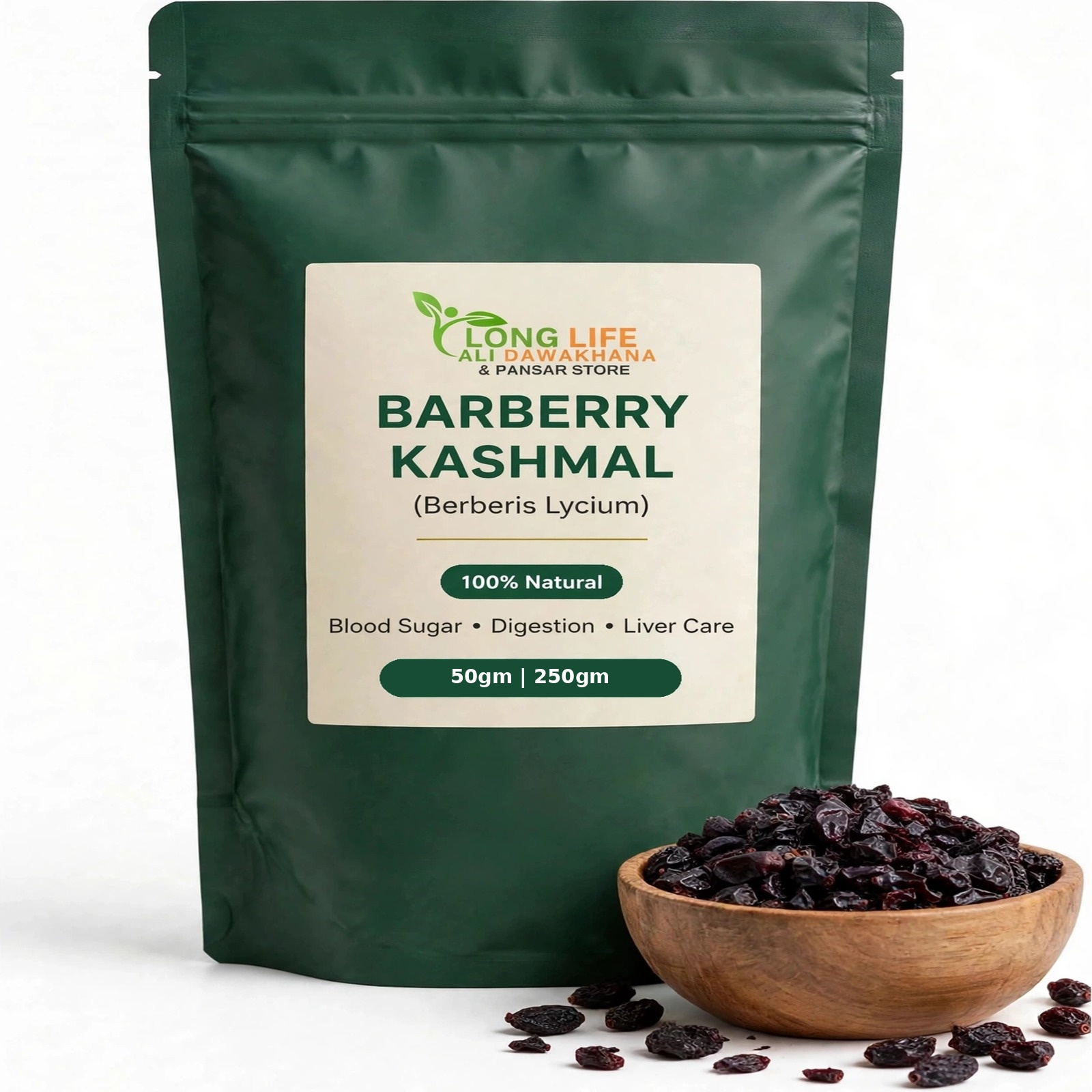
Barberry (Kashmal, Berberis lycium) is the dried fruit of the Himalayan barberry — dark purple-black berries used in Unani medicine for digestion, liver health and blood sugar. Its colour comes from anthocyanins — but do not buy it for berberine: the fruit contains very little, and the berberine trials used root and bark extracts instead. At Long.pk it is available in Whole and Powder forms (50 gm and 250 gm) at a flat Rs 483 for every pack, with Cash on Delivery across Pakistan.
کشمل (Barberry / Kashmal) — مکمل معلومات
کشمل، جسے انگریزی میں Barberry کہتے ہیں، ہمالیہ کی پہاڑیوں میں اگنے والی جھاڑی کا خشک پھل ہے — گہری جامنی سیاہ رنگ کی کھٹی بیریاں۔ یونانی طب میں اسے زرشک کہتے ہیں اور یہ ہاضمے، جگر اور خون میں شکر کے لیے استعمال ہوتی ہے۔
اہم انتباہ: کشمل کا پھل کھانے کی چیز ہے، لیکن دوا کی مقدار میں حاملہ خواتین استعمال نہ کریں۔ شوگر یا بلڈ پریشر کی دوا لینے والے ڈاکٹر سے مشورہ کریں۔ یہ رسوت نہیں ہے — رسوت جڑ کا عرق ہے، کشمل پھل ہے۔
Barberry (Kashmal) – Price in Pakistan, Benefits, Uses & Safety
Direct answer: Barberry (Kashmal, Berberis lycium) price in Pakistan is a flat Rs 483 for every pack at Long.pk — Whole or Powder, 50 gm or 250 gm, all Rs 483, with cash on delivery across Pakistan. The fruit contains very little berberine — the famous berberine trials used root and bark extracts, not the fruit.
- What Is Barberry?
- History of Barberry
- Active Compounds
- Barberry in Unani, Ayurveda & Folk Medicine
- What Does Modern Research Say?
- Detailed Benefits of Barberry
- Berries vs Bark vs Extract — Three Barberry Products
- Who Is Barberry For?
- How to Use Barberry
- Traditional Combinations
- Dosage & Duration
- Side Effects & Who Should Avoid It
- How to Identify Original Barberry
- Storage & Shelf Life
- Barberry vs Amla vs Jujube
- Barberry Price in Pakistan
- Product Specifications
- Roman Urdu
- Frequently Asked Questions
What Is Barberry?
Barberry — Urdu Kashmal (کشمل) — is the dried fruit of Berberis lycium Royle, the Indian barberry, a thorny western-Himalayan shrub of the Berberidaceae family. The plant is Ishkeen (اشکین); the fruit, Kashmal. The berries ripen dark purple-black — not Rasaut, not Persian zereshk, not a berberine supplement.
History of Barberry
Barberry has been gathered in the Himalayas since before written medicine. Ibn Sina recorded the fruit as Zereshk in the Canon of Medicine, a cold, dry, astringent fruit for the liver, stomach and fevers.
Active Compounds
The chemistry of Barberry fruit is the chemistry of a tart berry — fruit acids, colour pigments and tannins. Its anthocyanins (82.47 mg per 100 g) give the dark colour; its fruit acids give the sharp tartness. Berberine is the wrong test for this fruit: the alkaloid lives in the root and bark, and the fruit holds only a trace.
Barberry in Unani, Ayurveda & Folk Medicine
Barberry fruit — Zereshk — is a classical Unani drug: cold and dry (sard o khushk), used for the liver, the stomach and digestion, fevers and thirst. In Ayurveda it is Darhald; in Himalayan folk medicine the berries are brewed as a tea for stomach complaints and fevers.
What Does Modern Research Say?
Here is the honest summary first: there are no human trials of Berberis lycium — the species sold here. The trials were all done on the Iranian species, B. vulgaris, whose chemistry is similar — so the Iranian results are the best available evidence, but not evidence for this exact species.
The 2025 metabolic-syndrome meta-analysis (11 trials, 718 people) found fasting blood sugar down 16.69 mg/dL and cholesterol down 17.90 mg/dL; a 2025 diabetes meta-analysis (8 trials, 451 people) found HbA1c down 0.65 points. Both pools were all-Iranian, small and short.
The Emamat trial (2022) gave 10 g a day of milled dried fruit for 8 weeks to 84 hypertensive patients: lipids fell, and flow-mediated dilation improved 6.54%.
Detailed Benefits of Barberry
Benefits are labelled: trial (human trials — Iranian species), traditional (Unani and folk use), lab (test-tube or animal studies).
Blood Sugar (Trial — Iranian Species)
Fasting blood sugar fell about 15 mg/dL and HbA1c 0.65 points in two 2025 meta-analyses — an adjunct to prescribed treatment, never a replacement. Sweet Chirata (Chiraita Shireen) is another bitter Unani herb used alongside barberry.
Cholesterol (Trial — Iranian Species)
Cholesterol fell 18–29 mg/dL, LDL 11–17 mg/dL, triglycerides 19–24 mg/dL; HDL did not change.
Blood Pressure (Trial — Needs Replication)
Systolic down 9.84 mmHg and diastolic down 11.31 mmHg in the metabolic-syndrome meta-analysis — a large effect needing replication.
Liver Health (Traditional + Lab)
The classical Unani use — weak liver, jaundice — is supported by lab and animal studies; no human trials exist for liver disease.
Digestion & Gut Health (Traditional)
The fruit’s acids stimulate digestion, and its tannins firm the bowels — the classical use for diarrhoea.
Berries vs Bark vs Extract — Three Barberry Products
The berries (this product) are a tart, anthocyanin-rich food-medicine; the bark and root are a bitter, berberine-rich drug; and rasaut is the concentrated root-bark extract. For a gentle tonic, you want the berries; for berberine, rasaut or the bark.
Who Is Barberry For?
Barberry suits people who:
- Want a gentle, food-like tonic for digestion, liver and blood sugar.
- Have type 2 diabetes or high cholesterol and want a natural adjunct.
- Cook Iranian or Himalayan food and want the real tart berries.
How to Use Barberry
Tea: Put 5–10 g of berries in a cup, pour over boiled water, steep 10 minutes, strain and drink — once or twice a day.
Powder: Take 3–5 g once or twice a day with water or honey.
As food: Soak the berries 30 minutes, then add to rice, pilau or yoghurt — the Iranian way.
Traditional Combinations
- Barberry + Liquorice (Mulethi) — the classical liver and digestion pairing.
- Barberry + Moringa — barberry for blood sugar, moringa as the general tonic.
- Barberry + Amla — the two tart fruits together: amla for hair, barberry for liver and blood sugar.
Dosage & Duration
No modern dose-finding study exists, so these doses combine the trial dose (10 g a day, Emamat 2022) with classical Unani doses.
| Preparation | Dose | Frequency |
|---|---|---|
| Dried berries (tea) | 5–10 g | Once or twice daily |
| Powder | 3–5 g | Once or twice daily |
Use in 8-week courses, then take a two-week break.
Side Effects & Who Should Avoid It
Barberry fruit is a food; side effects at food amounts are rare. Medicinal doses (10 g a day and above) deserve respect.
Pregnancy — avoid medicinal doses. Berberine crosses the placenta, can stimulate the uterus, and can displace bilirubin in a newborn’s blood (kernicterus risk). That risk is established for berberine-rich preparations; the fruit contains very little — but “very little” is not “none,” and there is no safety trial in pregnancy. Food amounts are not a concern; the same caution applies to breastfeeding and young children.
Diabetes and blood-pressure medication — monitor closely. The fruit lowers blood sugar and blood pressure, adding to metformin, sulfonylureas, insulin and antihypertensives. Tell your prescriber; never cut your prescribed dose alone.
Drug interactions — low for the fruit, but tell your doctor. Berberine inhibits CYP3A4, CYP2D6 and CYP2C9 and P-glycoprotein, which clear drugs such as cyclosporine, tacrolimus, some statins and warfarin. The fruit’s berberine is far lower — but not zero. Large amounts can cause stomach cramps; take after meals. Stop medicinal doses two weeks before surgery.
How to Identify Original Barberry
Genuine dried Barberry is a small, deeply wrinkled berry, dark purple-black. It should smell faintly fruity and taste sharply sour. Avoid musty berries, and “barberry” that is yellow wood chips or a dark lump (rasaut).
Storage & Shelf Life
- Whole berries: keep 18–24 months in an airtight container, cool and dry, away from sunlight.
- Powder: keep 9–12 months — buy powder in smaller quantities and use it up.
Barberry vs Amla vs Jujube
| Feature | Barberry (Kashmal) | Amla | Jujube Berries (Unab) |
|---|---|---|---|
| Botanical name | Berberis lycium | Phyllanthus emblica | Ziziphus jujuba |
| Main traditional use | Digestion, liver, blood sugar | Digestion, hair, immunity | Sleep, calming, blood |
| Human evidence | Fruit trials (Iranian species) | Strong — hair, lipids, diabetes | Some — sleep and anxiety |
Barberry Price in Pakistan
| Form | 50 gm | 250 gm |
|---|---|---|
| Whole | Rs 483 | Rs 483 |
| Powder | Rs 483 | Rs 483 |
Price: Rs 483 for every pack — the source lists the same price for all variants (Rs 482.62), almost certainly a listing error; no graduated prices have been invented. Best value: the 250 gm pack — five times the berries for the same Rs 483 (Rs 1.93/g vs Rs 9.66/g).
Product Specifications
| Attribute | Detail |
|---|---|
| Product Name | Barberry (Kashmal) |
| Urdu Name | کشمل (Kashmal — the fruit); اشکین (Ishkeen — the plant) |
| Botanical Name | Berberis lycium Royle |
| Part Used | Dried fruit (berries) |
| Forms | Whole / Powder |
| Weights | 50 gm, 250 gm |
| Price Range | Rs 483 (all packs — flat pricing) |
| Key Compounds | Anthocyanins (82.47 mg/100g), fruit acids, β-carotene |
| Berberine Content | Very low in the fruit (concentrated in root/bark) |
| Temperament (Unani) | Cold and dry |
| Additives | None — 100% natural |
| Shelf Life | Whole berries 18–24 months; Powder 9–12 months |
| Storage | Airtight container, cool and dry, away from sunlight |
| Seller | Ali Dawakhana and Pansar Store |
| Delivery | Cash on Delivery across Pakistan |
Roman Urdu
Kashmal (Barberry) Himalaya ki jhaari ka khushk phal hai — gehray jamni siyah khatti beriyan, hazme, jigar aur khoon mein shakar ke liye. Is ka faida anthocyanins aur phalon ke tezab hain — yeh berberine ki dawa nahi hai.
Irani trials mein sugar aur LDL kam hua — Pakistani qism par koi trial nahi hua. Istemaal: 5–10 gram chai mein ya 3–5 gram powder, din mein aik ya do baar. Qeemat: Rs 483 har pack; 250 gm sab se behtareen qeemat hai.
Frequently Asked Questions
Q: Kashmal kis kaam aati hai?
Kashmal Yunani tib mein hazme, jigar aur khoon mein shakar ke liye istemal hoti hai.
Q: Barberry ki Pakistan mein qeemat kya hai?
Rs 483 — har pack aik hi qeemat. 250 gm ka pack sab se behtareen qeemat hai — 5 guna zyada beriyan.
Q: Kashmal aur Rasaut mein kya farq hai?
Kashmal phal hai — berberine bohat kam. Rasaut jarr ka arq hai — berberine se bharpoor.
Q: Kya Kashmal mein berberine hoti hai?
Bohat kam — berberine jarr aur chhaal mein hoti hai, phal mein sirf trace.
Q: Kashmal kaisay istemal karte hain?
Teen tareeqay: (1) chai — 5–10 gram beriyan 10 minute bhigo kar din mein aik ya do baar; (2) powder — 3–5 gram din mein aik ya do baar; (3) khane mein — beriyan chawal ya salad mein daalein.
Q: Kya Kashmal sugar ke mareez le sakte hain?
Irani trials mein sugar 15 mg/dL aur HbA1c 0.65 points kam hui — lekin yeh dawa ka badal nahi hai.
Q: Kya Kashmal hamila khawateen le sakti hain?
Dawa ki miqdaar mein nahi. Khane mein chand beriyan koi masla nahi.
Q: Kashmal ki pehchan kya hai?
Asli Kashmal gehri jamni siyah, jhurriyon wali beriyan hoti hain; zaiqa tez khatta hota hai.
Q: Kashmal kitni der chalti hai?
10 gram rozana par 50 gm 5 din, 250 gm 25 din chalta hai. 5 gram rozana par 10 din aur 50 din.
Q: Kashmal dawaiyon ke saath le sakte hain?
Sugar aur BP ki dawaiyon ke saath ehtiyaat zaroori hai — asar jur sakta hai.
Related Products
- Sweet Chirata (Chiraita Shireen) — blood-sugar support, the classical bitter tonic often used alongside barberry.
- Golden Shower (Amaltas) — digestion and gentle cleansing, the classical Unani fruit for gut comfort.
- Jujube Berries (Unab) — a sweet Unani fruit for sleep and blood building.
- Organic Moringa Leaf Powder — a general daily tonic alongside targeted herbs.
Ali Dawakhana and Pansar Store — Asli desi dawa aur khalis jadi bootiyan, ab ghar baithay Long.pk se mangwayen.
Reviews
There are no reviews yet