
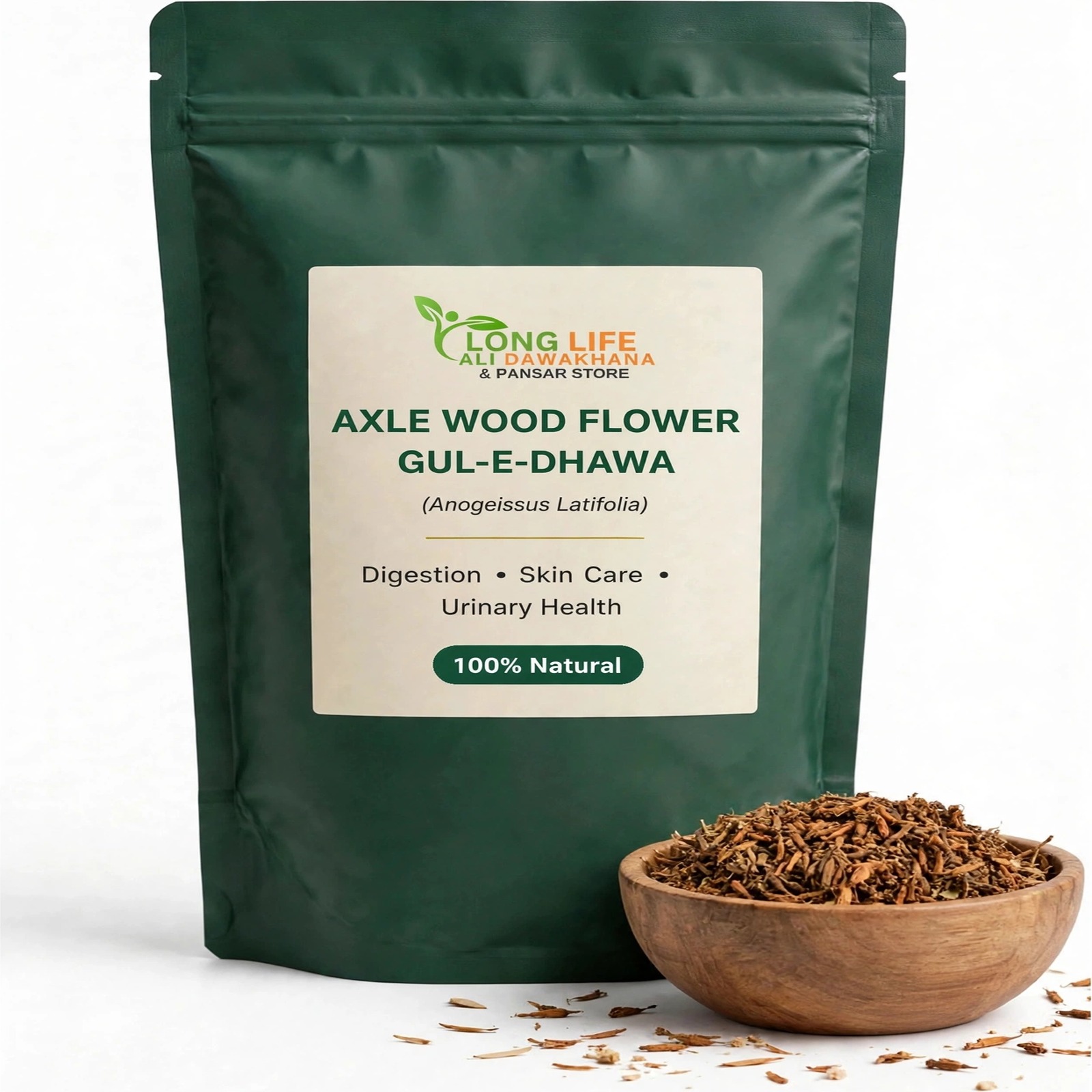
Axle Wood Flower (Gul-e-Dhawa, Anogeissus latifolia), known in Ayurveda as Dhava, is the dried flower of the axlewood tree — a large tree of India’s dry forests and the source of gum ghatti — used traditionally as a cooling astringent for diarrhoea, diabetes and urinary disorders, wounds and skin diseases. At Long.pk it is available in Whole and Powder forms (50 gm and 250 gm) from Rs 304, with Cash on Delivery across Pakistan.
گل دھاوا (ایکسل ووڈ فلاور) — مکمل معلومات
گل دھاوا، جسے آیوروید میں دھوا (Dhava) کہا جاتا ہے، ایک بڑے درخت (Anogeissus latifolia) کے سوکھے پھول ہیں۔
روایتی فائدے: دست و پیچش، ذیابیطس، پیشاب کے امراض، زخم، جلد کے امراض، بواسیر، خون کی کمی۔
اہم انتباہ: ٹینن زیادہ ہے — کھانے یا آئرن کی دوا سے دور رکھیں۔ زیادہ مقدار قبض پیدا کر سکتی ہے۔ حاملہ خواتین ڈاکٹر سے مشورہ کیے بغیر استعمال نہ کریں۔
Axle Wood Flower (Gul-e-Dhawa) – Price in Pakistan, Benefits, Uses & Safety
Direct answer: Axle Wood Flower (Gul-e-Dhawa, Anogeissus latifolia) starts from Rs 304 for 50 gm (Whole), up to Rs 1,180 for 250 gm (Powder). Gul-e-Dhawa is Dhava — the dried flower of the axlewood tree — used in Ayurveda for diarrhoea, diabetes, urinary disorders, wounds, skin and piles. No human trials exist.
- What Is Axle Wood Flower?
- History of Axle Wood Flower
- Active Compounds
- Axle Wood Flower in Ayurveda, Unani & Folk Medicine
- What Does Modern Research Say?
- Detailed Benefits of Axle Wood Flower
- Flower vs Bark vs Gum: Three Medicines from One Tree
- Who Is Axle Wood Flower For?
- How to Use Axle Wood Flower
- Traditional Combinations
- Dosage & Duration
- Side Effects & Who Should Avoid It
- How to Identify Original Axle Wood Flower
- Storage & Shelf Life
- Axle Wood Flower vs Myrobalan vs Beleric
- Axle Wood Flower Price in Pakistan
- Product Specifications
- Roman Urdu
- Frequently Asked Questions
What Is Axle Wood Flower?
Axle Wood Flower (Gul-e-Dhawa, Anogeissus latifolia) is the dried flower of the axlewood tree, a large Combretaceae tree. In Urdu Gul-e-Dhawa (گل دھاوا); in Sanskrit Dhava; in English Axlewood. Botanists have reclassified it as Terminalia anogeissiana. Its flowers dry to small rusty-brown buds, 1–2 cm long.
History of Axle Wood Flower
Sushruta, Charaka and Vagbhata all placed Dhava in classical groups for Prameha (diabetes and urinary disorders).
Active Compounds
| Compound | Type |
|---|---|
| Tannins (12–18% in bark) | Polyphenols |
| Gallic acid (0.95% w/w) | Phenolic acid |
| Ellagic acid (0.25% w/w) | Phenolic acid |
| Quercetin | Flavonoid |
| Myricetin | Flavonoid |
| Luteolin | Flavonoid |
Axle Wood Flower in Ayurveda, Unani & Folk Medicine
In Ayurveda, Dhava is Kashaya (astringent), Laghu (light), Ruksha (dry), Sheeta (cold), Katu post-digestive; it reduces Kapha and Pitta. Ruchya and Deepana, absorbent in the gut — for dysentery, diarrhoea, bleeding piles, Meha (diabetes), Pandu (anaemia), Arsha (piles), wounds, skin diseases; bark is in Ayaskriti. In Unani: diarrhoea, dysentery, ulcers, piles, urinary disorders, epilepsy. Siddha/folk: wounds, diarrhoea, diabetes, fever; bark paste for wounds, snake bites.
What Does Modern Research Say?
Reviews in 2023–2025 agree: lab and animal evidence is consistent — and there are no human trials.
Anti-ulcer (animal): bark extract (200 mg/kg) achieved 84.16% curation of stress-induced ulcers in rats (Journal of Ethnopharmacology 2006). Pain, inflammation, fever (animal): stem bark extract reduced pain, paw oedema (44–46%) and fever in rats (Clinical Phytoscience 2020). Antidiabetic (animal): a 2025 review calls Dhava’s activity “the best”. Anticancer — cell lines ONLY; never claim it. CNS (animal): leaf extract (750 mg/kg) sedated mice.
Detailed Benefits of Axle Wood Flower
1. Diarrhoea & Dysentery
Tannins (12–18% in bark) tighten the gut lining, reducing fluid loss. Traditional use; no human trial. Plantain Seeds (Bartang): another traditional gut remedy.
2. Diabetes & Urinary Disorders
Indicated for Meha; reduces urine output. Traditional use; no human trial. Use only under a doctor’s supervision. Sweet Chirata (Chiraita Shireen): another blood-sugar herb.
3. Wounds & Swelling
Bark powder paste for wounds and swelling; wound-healing reported in reviews. Traditional use; no human trial.
4. Skin Diseases
For blisters, boils, itching, eczema, psoriasis; bark is in Ayaskriti. Traditional use; no human trial.
5. Piles & Bleeding
For Arsha (haemorrhoids) and bleeding disorders — astringency tightens tissue, seals vessels. Traditional use.
6. Stomach Ulcers
Best-studied — bark extract (200 mg/kg) achieved 84.16% curation of stress-induced ulcers in rats. Animal data; no human trial.
7. Pain, Inflammation & Fever
Stem bark extract reduced pain, paw swelling (44–46%) and fever in rats. Animal data; no human trial.
8. Anaemia
For Pandu (anaemia); bark is in Ayaskriti. Traditional use; no human trial. Tannins block iron — take away from meals and iron.
Flower vs Bark vs Gum: Three Medicines from One Tree
Flower (this product): dried rusty-brown buds — tannins, flavonoids — for diarrhoea, diabetes, urinary disorders; decoction or powder. Bark: rough grey-brown pieces — tannins 12–18% — for wounds, diarrhoea, ulcers, piles; decoction (50–60 ml) or paste. Gum (gum ghatti): pale translucent tears — ghattic acid, fibre — postpartum tonic and gut problems; eaten as laddu or dissolved in water.
Who Is Axle Wood Flower For?
- Diarrhoea or dysentery — mild cases; medical care for severe or bloody cases.
- Diabetes or urinary disorders — for Prameha, under a practitioner’s guidance.
- Wounds or swelling — the traditional bark paste.
- Skin conditions — blisters, boils, itching, eczema.
- Traditional medicine users — Ayurvedic/Unani practice, e.g. Ayaskriti.
How to Use Axle Wood Flower
Decoction: boil 5–10 g flowers in two cups of water down to one cup; strain, drink warm, once or twice daily. Powder: 3–5 g with water or honey, once or twice daily, before meals. Paste (external): powder + water on wounds or swelling, 20–30 minutes, then wash off. Wash: cool a decoction and wash affected skin.
What NOT to do: no large doses; no continuous use for months; not with meals or iron; not a substitute for diabetes medication; not on large broken-skin areas.
Traditional Combinations
- With myrobalan (Harar) — diarrhoea; decoction, practitioner-directed.
- With bael fruit (Bel Giri) — diarrhoea and dysentery; decoction, practitioner-directed.
- With pomegranate rind (Anar Chilka) — diarrhoea, oral health; decoction, practitioner-directed.
- With turmeric (Haldi) — wounds and skin; paste, external.
- With honey (Shehed) — powder with honey, before meals.
- With neem (Neem) — skin diseases; powder, practitioner-directed.
Dosage & Duration
- Decoction (bark/heartwood): 50–60 ml for diarrhoea and bleeding piles.
- Decoction (diabetes): 40–50 ml daily, divided doses.
- Flower decoction: 5–10 g per cup, once or twice daily.
- Powder: 3–5 g once or twice daily, with water or honey.
- Duration: 1–2 weeks for diarrhoea; longer only under a practitioner.
- Take 2 hours from meals and iron — tannins block iron absorption.
Side Effects & Who Should Avoid It
Safe at traditional doses; all safety data are preclinical — no human safety studies.
Side effects: stomach irritation, nausea, constipation — especially at higher doses or empty stomach. Patch-test before external use.
Sedation (animal, high dose). Leaf extract (750 mg/kg) caused significant sedation in mice — reduced activity, longer sleep, impaired balance and coordination. Do not take large doses; caution with sedatives or alcohol.
Leaf extract may lower blood pressure (consult a doctor if on blood-pressure medication); tannins block iron; toxicity is dose-dependent — do not exceed the dose.
Avoid or consult first: pregnant and breastfeeding women (no safety data); iron-deficiency anaemia (take well away from meals and iron); low blood pressure; sedative medication; kidney disease (no safety data); children (adult dose only).
Interactions: take 2 hours from other medicines; caution with blood-pressure medication and sedatives.
How to Identify Original Axle Wood Flower
- Shape: small, slender buds, 1–2 cm, tapered at one end.
- Colour: rusty-brown to orange-brown; very pale is immature, black or mouldy is spoiled.
- Texture: dry, light, papery, brittle.
- Smell: mild, woody, slightly astringent; musty means damp storage — reject.
- Taste: astringent — puckers the tongue; if not astringent, it is not Dhava.
- Twig fragments: a few are normal; mostly twigs is poor.
- Powder: reddish-brown, fine, astringent; very pale may be cut with filler.
Storage & Shelf Life
Store airtight, cool, dark and dry. Whole flowers keep 18–24 months; powder 9–12 months. Replace if soft, damp or mouldy.
Axle Wood Flower vs Myrobalan vs Beleric
| Feature | Axle Wood Flower (Gul-e-Dhawa) | Myrobalan (Harar) | Beleric (Bahera) |
|---|---|---|---|
| Botanical name | Anogeissus latifolia | Terminalia chebula | Terminalia bellirica |
| Part used | Dried flowers | Dried fruit | Dried fruit |
| Tannin content | 12–18% (bark) | 30–40% | 20–30% |
| Main traditional use | Diarrhoea, diabetes, urinary disorders, wounds | Digestion, constipation, detox (Triphala) | Cough, respiratory, hair, digestion (Triphala) |
| Laxative effect | No — constipating | Mild laxative | Mild laxative |
| Internal use | Short courses | Daily tonic | Daily tonic |
| Human trials | None | Some small trials | Some small trials |
| Safety cautions | Blocks iron; sedative (animal); hypotensive | Avoid in pregnancy | Avoid in pregnancy |
Diarrhoea and ulcers: Axle Wood Flower. Daily digestion: myrobalan. Cough and hair: beleric.
Price in Pakistan
| Form | 50 gm | 250 gm |
|---|---|---|
| Whole | Rs 304 | Rs 928 |
| Powder | Rs 402 | Rs 1,180 |
Range: Rs 304–1,180. Best value: Whole 250 gm at Rs 3.71/g. Cash on delivery across Pakistan.
Specifications
| Product name | Axle Wood Flower (Gul-e-Dhawa) |
| Urdu name | گل دھاوا (Gul-e-Dhawa) |
| Sanskrit name | Dhava, Dhavada |
| Botanical name | Anogeissus latifolia (Roxb. ex DC.) Wall. — now Terminalia anogeissiana |
| Family | Combretaceae (Haritaki kula) |
| Part used | Dried flowers |
| Forms | Whole / Powder |
| Weights | 50 gm, 250 gm |
| Price Range | Rs 304 – Rs 1,180 |
| Origin | India, Nepal, Myanmar, Sri Lanka |
| Purity | 100% natural dried flowers, no additives |
| Key compounds | Tannins, gallic acid, ellagic acid, quercetin, myricetin |
| Shelf life | Whole flowers 18–24 months; powder 9–12 months |
| Storage | Airtight container, cool, dark, dry place |
| Seller | Ali Dawakhana and Pansar Store |
Roman Urdu Summary
Axle Wood Flower (Gul-e-Dhawa) — Anogeissus latifolia — Ayurveda ki mashhoor dawa Dhava hai. Charaka, Sushruta aur Vagbhata — teeno ne Dhava ko Prameha (diabetes aur peshaab ke amraz) ke liye bataya hai.
Dast o pechish, zakhmon, jild aur bawaseer ke liye istemal hoti hai. Janwaron ki tehqeeq mein chhaal ke extract ne ulcer mein 84% tak shifa dikhayi, lekin insani trials koi nahi hain. Tannin ziyada hai — khanay ya iron ki dawa se door rakhen.
Frequently Asked Questions
Q: Gul-e-Dhawa kis kaam aata hai?
Dast, diabetes, peshaab, zakhmon, jild aur bawaseer ke liye.
Q: Gul-e-Dhawa aur gum ghatti mein kya farq hai?
Gul-e-Dhawa sookhay phool hain; gum ghatti chhaal ka gond hai.
Q: Gul-e-Dhawa dast ke liye kaisay istemal hota hai?
5–10 gram phool ka qahwa, din mein aik ya do baar. Shadeed dast mein doctor se ruju karein.
Q: Kya Gul-e-Dhawa diabetes ke liye kaam karta hai?
Ji — teeno hakeemon ne Dhava ko Prameha ke liye bataya hai. Insani trial koi nahi.
Q: Gul-e-Dhawa ki khurak kya hai?
Qahwa: 5–10 gram. Powder: 3–5 gram.
Q: Kya Gul-e-Dhawa ke koi side effects hain?
Aam khurak mein mehfooz. Ziyada miqdar mein jalan, mutli, qabz. Khanay se 2 ghantay door rakhen.
Q: Asli Gul-e-Dhawa ki pehchan kya hai?
Chhotay, patlay, 1–2 cm ke zang aalood bhooray phool. Zabaan par kasailapan.
Q: Gul-e-Dhawa ki price kya hai?
Rs 304 (50 gm Whole) se Rs 1,180 (250 gm Powder) tak.
Q: Gul-e-Dhawa Harar aur Bahera se kaisay mukhtalif hai?
Dhava dast aur ulcer ke liye; Harar hazmay ke liye; Bahera khaansi, baalon ke liye.
Q: Gul-e-Dhawa ko kaise store karein?
Airtight jar mein, thandi aur khushk jagah par. Whole phool 18–24 mahinay, powder 9–12 mahinay.
Related Products
- Sweet Chirata (Chiraita Shireen) — another traditional blood-sugar herb, sharing Gul-e-Dhawa’s Prameha (diabetes) use.
- Plantain Seeds (Bartang) — a traditional gut remedy for diarrhoea and loose motions, pairing with Gul-e-Dhawa’s astringent action.
- Liquorice Root (Mulethi) — soothing for the stomach and gut, complementing Gul-e-Dhawa’s anti-ulcer benefit.
- Organic Moringa Leaf Powder (Sohanjna Powder) — a daily nutrition tonic, also traditionally used for blood-sugar support.
Ali Dawakhana and Pansar Store — Asli desi dawa aur khalis jadi bootiyan, ab ghar baithay Long.pk se mangwayen.
Reviews
There are no reviews yet