
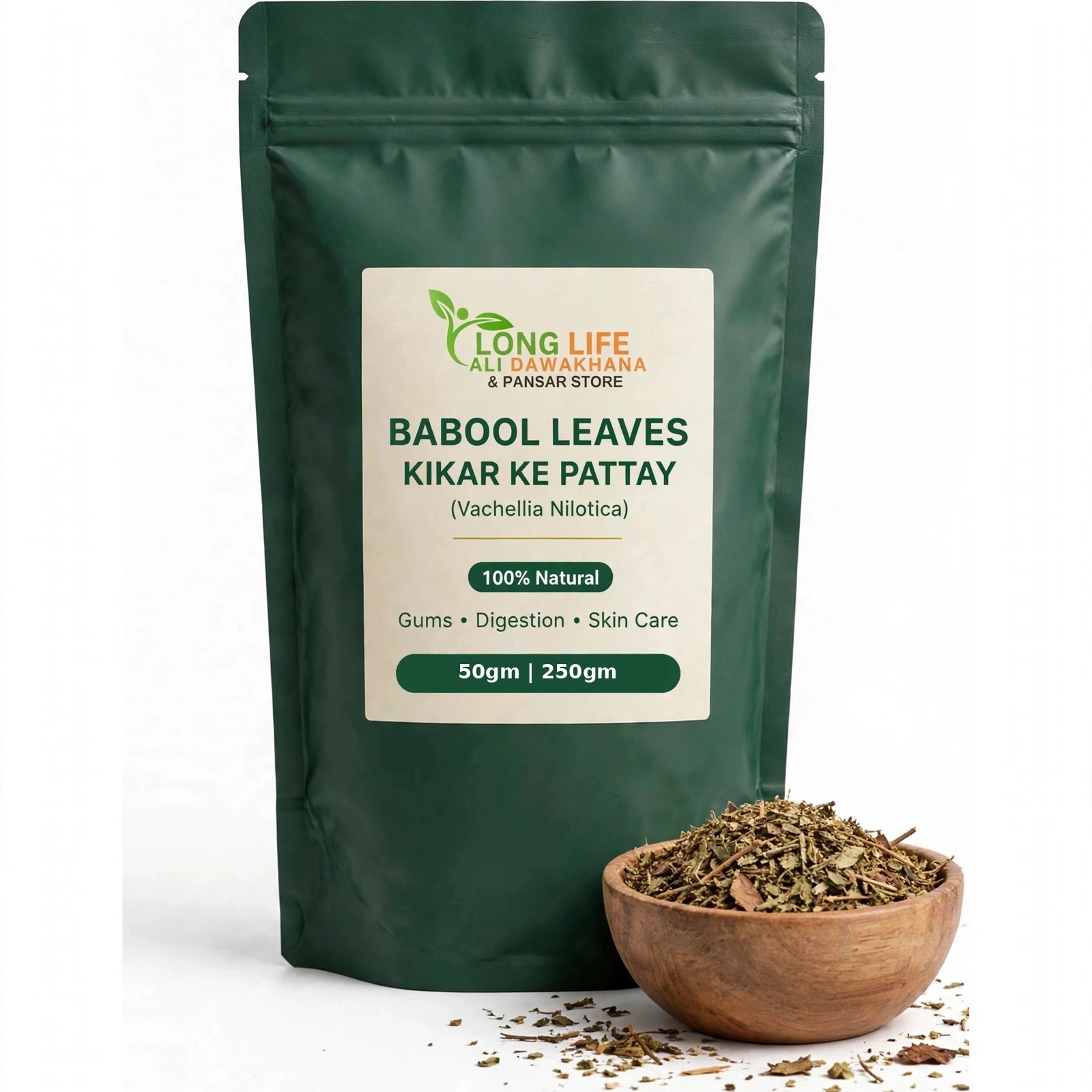
Babool Leaves (Kikar ke Pattay, Vachellia nilotica) are the dried leaves of the babool (kikar) tree — Pakistan’s most familiar roadside tree. In traditional medicine they are used as a gargle for spongy gums and sore throat, for diarrhoea and dysentery, and as a wash for skin complaints and wounds. The leaves carry the strongest diabetes evidence of any part of the tree — in animal studies, leaf extracts lowered blood sugar as effectively as glibenclamide — but there are no human trials of the leaves, and this article says so plainly. At Long.pk they are available in Whole and Powder forms (50 gm and 250 gm) from Rs 152, with Cash on Delivery across Pakistan.
کیکر کے پتے (Babool Leaves) — مکمل معلومات
کیکر کے پتے، جنہیں اردو میں برگ ببول بھی کہتے ہیں، ببول (کیکر) کے درخت کے خشک پتے ہیں۔
اہم انتباہ: کیکر کے پتوں پر انسانوں کے کوئی کلینیکل ٹرائل نہیں ہوئے — ذیابیطس کے فوائد جانوروں کی تحقیق پر مبنی ہیں، اور دانتوں کا ٹرائل چھال (bark) کا ہے، پتوں کا نہیں۔ شوگر کی دوا لینے والے مریض ڈاکٹر سے مشورہ کیے بغیر استعمال نہ کریں۔
Babool Leaves (Kikar ke Pattay) – Price in Pakistan, Benefits, Uses & Safety
Direct answer: Babool Leaves (Kikar ke Pattay, Vachellia nilotica) price in Pakistan starts from Rs 152 for 50 gm (Whole form) at Long.pk, going up to Rs 1,288 for 250 gm (Powder form). They are available in two forms — Whole and Powder — in 50 gm and 250 gm packs, with cash on delivery across Pakistan.
- What Are Babool Leaves?
- History of Babool Leaves
- Active Compounds
- Babool Leaves in Ayurveda, Unani & Folk Medicine
- What Does Modern Research Say?
- Detailed Benefits of Babool Leaves
- Leaves vs Bark — Two Medicines from One Tree
- Who Are Babool Leaves For?
- How to Use Babool Leaves
- Traditional Combinations
- Dosage & Duration
- Side Effects & Who Should Avoid Them
- How to Identify Original Babool Leaves
- Storage & Shelf Life
- Babool Leaves vs Neem Leaves vs Moringa Leaves
- Babool Leaves Price in Pakistan
- Product Specifications
- Roman Urdu
- Frequently Asked Questions
What Are Babool Leaves?
Babool Leaves — Urdu Kikar ke Pattay (کیکر کے پتے) and Barg-e-Babool (برگ ببول) — are the dried leaves of Vachellia nilotica, a thorny, flat-topped tree of the Fabaceae (legume family).
History of Babool Leaves
Unlike the Australian pine, babool is a classical medicine — one of the oldest in the South Asian record.
In the Unani tradition, babool arrived with the Arabic physicians as Babool (ببول) — the same name it carries today.
Active Compounds
The leaves of Vachellia nilotica carry a broader chemistry than the bark — tannins plus flavonoids, alkaloids and sterols.
| Compound | Type | What researchers looked at |
|---|---|---|
| Condensed tannins | Tannins | The astringent action — gargle, diarrhoea, wound wash; milder than the bark’s tannins |
| Gallic acid | Phenolic acid | Antioxidant, antimicrobial, anti-inflammatory; the signature phenolic of the tree |
| Catechin | Flavan-3-ol | Antioxidant and antimicrobial activity |
Babool Leaves in Ayurveda, Unani & Folk Medicine
In Ayurveda, Babbula (Acacia nilotica) is a classical drug. Its predominant taste is Kashaya (astringent), with Tikta (bitter) as a secondary taste, and it is described as cooling in nature.
What Does Modern Research Say?
Here is the honest summary first: there are no published human clinical trials of Babool Leaves for any condition. The diabetes evidence — the strongest in the babool family — is entirely animal work.
The diabetes studies — the strongest evidence in the series. The most important study is from Pakistan itself: JPMA 2015 (65:1266), from Shifa International Hospital and the National Institute of Health, Islamabad.
The 2026 laboratory study. Alqalam Journal (9(5):1392-1398) tested the ethanolic leaf extract in the laboratory: total phenolics 169.62 mg gallic-acid equivalents per gram.
Detailed Benefits of Babool Leaves
Mouth & Gum Care — the Gargle (Traditional)
This is the leaves’ defining use, and it is classical: Sushruta recommends babool for mouth diseases.
Blood Sugar — the Diabetes Evidence (Animal)
The leaves carry the strongest diabetes evidence of any part of the babool tree.
Diarrhoea & Dysentery (Traditional)
The tender leaves are a traditional remedy for diarrhoea and dysentery.
Skin & Wounds (Traditional + Lab)
The leaf paste is applied in folk practice to boils, ulcers and wounds.
Fever, Inflammation & Antioxidant Protection (Traditional + Lab)
The leaf decoction is taken in folk practice for fever.
Leaves vs Bark — Two Medicines from One Tree
The babool tree gives two medicines that are easy to confuse and important to tell apart: the leaves (this product) and the bark (Acacia Bark / Kikar ki Chaal, a separate product).
| Feature | Babool Leaves (Kikar ke Pattay) | Acacia Bark (Kikar ki Chaal) |
|---|---|---|
| Part used | Dried leaves (small leaflets + thin stems) | Dried inner bark (hard, woody strips) |
| Tannin level | Moderate (63.85 mg TAE/100g in the ethanolic extract) | High — 12–20% tannins, a tannin powerhouse |
Who Are Babool Leaves For?
Babool Leaves suit people who:
- Want a traditional gargle for spongy, bleeding gums, mouth ulcers or sore throat — the leaves’ defining use.
- Have short-term diarrhoea or loose motions and want a traditional astringent remedy.
- Follow Ayurvedic or Unani practice and want the classical Babbula leaf, not just the bark.
How to Use Babool Leaves
Gargle (the main preparation): Add 5 g of the whole leaves (about a tablespoon) to 2 cups (about 400 ml) of water, bring to the boil, then simmer for 10 minutes. Strain and let it cool to warm.
Tea (the mildest internal preparation): Put 1 teaspoon of the powder (or a small handful of the whole leaves) in a cup.
Traditional Combinations
- Babool Leaves + Liquorice (Mulethi) — the classical throat pairing.
- Babool Leaves + Plantain Seeds (Bartang) — the gut pairing.
- Babool Leaves + Henna Leaves (Mehndi) — the skin pairing.
Dosage & Duration
There is no modern dose-finding study for Babool Leaves, so all doses below are from folk practice and general tannin-herb usage. Start at the lower end and stop if you feel unwell.
| Preparation | Dose | Frequency |
|---|---|---|
| Leaf powder | 3–5 g | Once or twice daily, after meals |
| Decoction (5–10 g leaves in 400 ml water, reduced to 200 ml) | 30–50 ml | Twice daily, after meals |
Side Effects & Who Should Avoid Them
Babool Leaves are a tannin herb, and their side effects are the side effects of tannins — plus two leaf-specific cautions (blood sugar and platelets) that come from the animal research.
Stomach upset and constipation. Tannins are astringent — they tighten tissues, including the stomach lining.
Iron and medicine absorption. Tannins bind iron in food and reduce its absorption — this is the most important practical caution for any tannin herb.
Blood sugar. The animal studies show the leaf extract lowers blood sugar.
Blood clotting — an apparent paradox, explained. The traditional record says two things that sound contradictory: the leaves are used to stop bleeding (as a wash on wounds and a gargle for bleeding gums), and the leaf extract inhibits platelet aggregation (Jame 2018).
Liver — high doses. Sub-acute toxicity testing in rats found that doses above 250 mg/kg elevated liver enzymes.
Pregnancy and breastfeeding — avoid medicinal doses. There is no safety data for Babool Leaves in pregnancy, and tannin-rich herbs are traditionally avoided in pregnancy in medicinal doses.
Children under 12 — avoid. No safety data, and children’s dosing for a tannin herb is unpredictable.
Allergies and broken skin. Stop if you develop a rash, itching or breathing difficulty.
How to Identify Original Babool Leaves
Appearance: Genuine dried Babool Leaves are a mass of small, chopped, greenish-brown leaflets — each leaflet only a few millimetres long — mixed with thin, light-brown stems.
Storage & Shelf Life
- Whole leaves: keep 12–18 months in an airtight container in a cool, dry place away from direct sunlight.
- Powder: keeps 9–12 months — ground herbs lose strength faster, so buy powder in smaller quantities and use it up.
- Seal tightly after every use.
Babool Leaves vs Neem Leaves vs Moringa Leaves
| Feature | Babool Leaves (Kikar ke Pattay) | Neem Leaves (Neem ke Pattay) | Moringa Leaves (Sohanjna) |
|---|---|---|---|
| Botanical name | Vachellia nilotica | Azadirachta indica | Moringa oleifera |
| Family | Fabaceae (legume) | Meliaceae (mahogany) | Moringaceae |
| Key compound | Tannins + flavonoids | Azadirachtin + nimbin | Vitamins, minerals, isothiocyanates |
Babool Leaves Price in Pakistan
| Form | 50 gm | 250 gm |
|---|---|---|
| Whole | Rs 152 | Rs 759 |
| Powder | Rs 287 | Rs 1,288 |
Best value: Whole 250 gm at Rs 3.04 per gram — the same per-gram price as the 50 gm pack, so there is no bulk saving on Whole; the Powder costs more per gram at every size.
Product Specifications
| Product Name | Babool Leaves (Kikar ke Pattay) |
| Urdu Name | کیکر کے پتے (Kikar ke Pattay) / برگ ببول (Barg-e-Babool) |
| Botanical Name | Vachellia nilotica (syn. Acacia nilotica) |
| Family | Fabaceae (legume family) |
| English Names | Babool, Babul, Indian Gum Arabic Tree, Egyptian Thorn |
| Other Names | Babbula (Sanskrit), Kikar (Punjabi/Urdu), Babool (Hindi/Urdu) |
| Part Used | Leaves — dried and chopped |
| Forms | Whole / Powder |
| Weights | 50 gm, 250 gm |
| Price Range | Rs 152 – Rs 1,288 |
| Key Compound | Tannins + flavonoids (gallic acid, catechin, quercetin) |
| Temperament (Unani) | Cold and dry (qabiz, mujaffif) |
| Additives | None — 100% natural |
| Shelf Life | Whole leaves 12–18 months; Powder 9–12 months |
| Storage | Airtight container, cool and dry, away from sunlight |
| Seller | Ali Dawakhana and Pansar Store |
| Delivery | Cash on Delivery across Pakistan |
Roman Urdu
Kikar ke Pattay (Babool Leaves) babool (kikar) ke darakht ke khushk pattay hain — wohi darakht jo Pakistan ki sarakon, kheton aur nehron ke kinaron par har jagah nazar aata hai.
Rawayati tib mein Kikar ke pattay kaseela (astringent) dawa hain. Whole aur Powder, 50 gm aur 250 gm — Rs 152 se shuru.
Frequently Asked Questions
Q: Kikar ke pattay kis kaam aate hain?
Kikar ke pattay (Babool Leaves) rawayati tib mein aik kaseela (astringent) booti hain — masoorhon ki sozish aur galay ki kharabi ke liye gharaara.
Q: Babool Leaves ki Pakistan mein qeemat kya hai?
Rs 152 se Rs 1,288 tak — Whole 50 gm Rs 152, 250 gm Rs 759; Powder 50 gm Rs 287, 250 gm Rs 1,288.
Q: Kikar ke pattay aur Kikar ki chaal mein kya farq hai?
Dono aik hi darakht (Vachellia nilotica) ke hissay hain lekin alag dawaein hain.
Q: Kya Babool Leaves diabetes mein madad karte hain?
Janwaron ki tehqeeq mein haan — JPMA 2015 ki Pakistani tehqeeq mein pattay ka arq choohon mein khoon ki sugar glibenclamide jitni kam karta hai.
Q: Kya Babool Leaves gonorrhoea ka ilaaj hain?
Bilkul nahi. Gonorrhoea aik bacterial infection hai jis ka ilaaj sirf antibiotics se hota hai. Pansaar ki purani fehrist mein yeh daawa rawayati hai aur is ka koi saboot nahi hai.
Q: Masoorhon ke liye gharaara kaisay karein?
5 gram pattay 2 cup pani mein ubaal kar 10 minute paka kar chhaan lein.
Q: Kya Babool Leaves hamila khawateen le sakti hain?
Nahi — hamal mein is ki safety ka koi data nahi hai, aur tannin wali bootiyan hamal mein dawai ki miqdar mein istemal nahi ki jati hain.
Q: Kya Babool Leaves khoon patla karte hain?
Janwaron ki tehqeeq (Jame 2018) mein pattay ka arq platelet aggregation kam karta hai — yaani khoon ke jamnay ko kam karta hai.
Q: Kya Babool Leaves iron ki kami walon ke liye theek hain?
Ehtiyaat zaroori hai — tannin khanay mein mojood iron ke jazb honay mein rukawat daalta hai.
Q: Asli Kikar ke pattay ki pehchan kya hai?
Asli pattay chhotay chhotay katay huay hote hain — zaitooni-sabz se sabz-bhoora rang, halki ghass jaisi khushboo, aur zaiqa sakht kaseela (munh khushk kar deta hai).
Related Products
- Liquorice Root (Mulethi) — throat comfort, the classical partner herb for babool’s gargle.
- Plantain Seeds (Bartang) — gut and diarrhoea support.
- Henna Leaves (Mehndi) — skin and wound care.
- Organic Moringa Leaf Powder — a general daily tonic.
Ali Dawakhana and Pansar Store — Asli desi dawa aur khalis jadi bootiyan, ab ghar baithay Long.pk se mangwayen.
Reviews
There are no reviews yet