
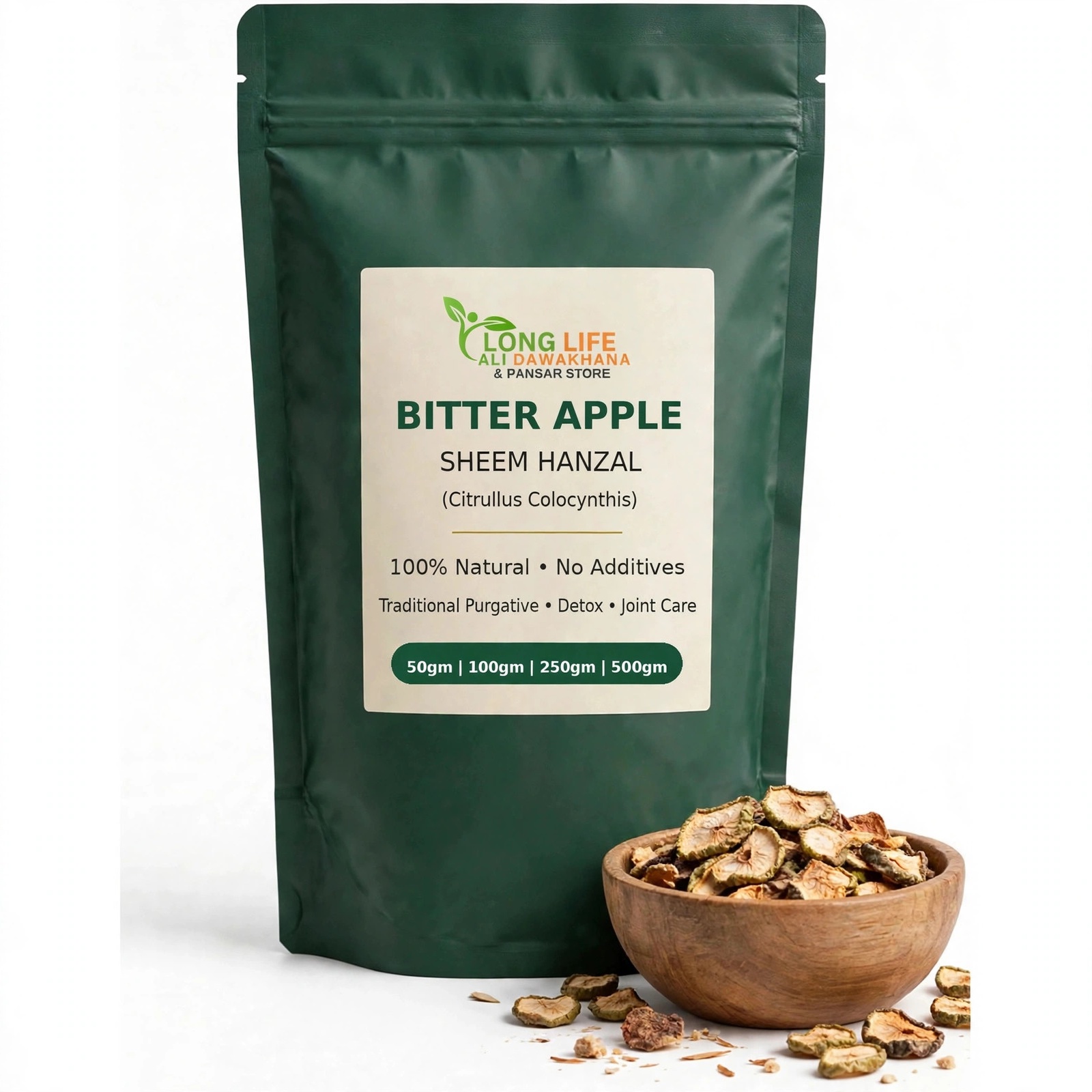
شیم حنظل (Bitter Apple) — مکمل معلومات
اہم انتباہ: شیم حنظل (کولو سنتھ) ایک طاقتور اور زہریلی بوٹی ہے۔ اسے بغیر کسی ماہر حکیم یا ڈاکٹر کے مشورے کے اندر سے استعمال نہ کریں۔ زیادہ مقدار سے خونی دست، گردے اور جگر کو نقصان، اور جان کا خطرہ ہو سکتا ہے۔
شیم حنظل، جسے حنظل یا اندرائن بھی کہتے ہیں، ایک صحرائی بیل کا پھل ہے جو Citrullus colocynthis کہلاتا ہے۔ یہ تربوز اور کھیرے کے خاندان (Cucurbitaceae) سے ہے اور بحیرہ روم، مشرقِ وسطیٰ اور جنوبی ایشیا کے صحراؤں میں پایا جاتا ہے۔ اس کا پھل چھوٹا، گول اور انتہائی کڑوا ہوتا ہے — اس کی کڑواہٹ اس کے طاقتور مرکبات (cucurbitacins) کی وجہ سے ہے۔
آیوروید میں اسے اندراورونی (Indravaruni) کہا جاتا ہے اور یہ ایک طاقتور جلاب (virechana) کے طور پر استعمال ہوتا ہے — لیکن صرف شدھنا (purification) کے بعد اور صرف ماہر کی نگرانی میں۔ یونانی طب میں بھی حنظل کو جگر، پیٹ کے درد اور جلد کے امراض کے لیے استعمال کیا جاتا ہے۔ قدیم مصر میں بھی اسے جلاب کے طور پر استعمال کیا جاتا تھا۔
شیم حنظل کے روایتی استعمال میں شدید قبض، جوڑوں کا درد، جلد کے مسائل اور شوگر شامل ہیں۔ جدید تحقیق میں اس کے شوگر کم کرنے والے اثرات انسانوں پر چھوٹے ٹرائلز میں دیکھے گئے ہیں — لیکن یہ ایک زہریلی بوٹی ہے، عام جڑی بوٹی نہیں۔
شیم حنظل کے فائدے (روایتی استعمال — صرف ماہر کی نگرانی میں)
- طاقتور جلاب: یہ آیوروید کے سب سے طاقتور جلابوں میں سے ایک ہے — شدید قبض اور ڈیٹاکس کے لیے استعمال ہوتا ہے۔
- شوگر: چھوٹے انسانی ٹرائلز میں اس کے کیپسولز نے HbA1c اور فاسٹنگ بلڈ شوگر کم کی۔
- جوڑوں کا درد: اس کے سوزش کم کرنے والے اثرات گٹھیا اور جوڑوں کے درد میں روایتی طور پر استعمال ہوتے ہیں۔
- جلد: پھنسیاں، دانے اور جلد کے مسائل میں اس کا بیرونی استعمال روایتی ہے۔
- جگر: یونانی طب میں جگر کے امراض کے لیے استعمال ہوتا ہے۔
استعمال کا طریقہ (صرف ماہر کی ہدایت پر)
- سفوف: آیورویدک فارماکوپیا کے مطابق 125 سے 500 ملی گرام — یہ بہت چھوٹی مقدار ہے، عام چمچ سے نہیں ناپی جا سکتی۔
- تیل (بیرونی): حنظل کا تیل جوڑوں اور جلد پر بیرونی طور پر لگایا جاتا ہے۔
- کبھی خود سے استعمال نہ کریں: کچا پھل یا زیادہ مقدار جان لیوا ہو سکتی ہے۔
شیم حنظل Long.pk سے Whole، Powder یا Grounded فارم میں 50 گرام سے 500 گرام تک منگوایا جا سکتا ہے۔ قیمت صرف 167 روپے سے شروع ہوتی ہے اور پورے پاکستان میں کیش آن ڈیلیوری دستیاب ہے۔
Bitter Apple (Sheem Hanzal) – Price in Pakistan, Benefits, Uses & Safety
Direct answer: Bitter Apple (Sheem Hanzal, Colocynth, Citrullus colocynthis) price in Pakistan starts from Rs 167 for 50 gm (Whole form) at Long.pk, going up to Rs 2,413 for 500 gm (Grounded form). It is available in three forms — Whole, Powder and Grounded — in 50 gm, 100 gm, 250 gm and 500 gm packs, with cash on delivery across Pakistan. Important safety note: colocynth is a genuinely toxic herb. It is one of Ayurveda’s most powerful purgatives, and small human trials show it can lower blood sugar — but the toxic dose starts at just 600 mg, and doses of 2 g or more can be lethal. The US FDA banned it for over-the-counter laxative use in 1991. Never use bitter apple internally without a qualified practitioner’s direction. This page gives the full, honest picture — benefits, research and dangers together.
Table of Contents
- What Is Bitter Apple?
- History of Colocynth
- Active Compounds
- Bitter Apple in Ayurveda, Unani & Folk Medicine
- What Does Modern Research Say?
- Detailed Benefits of Bitter Apple
- Pulp, Seeds or Oil?
- Who Is Bitter Apple For?
- How to Use Bitter Apple
- Traditional Combinations
- Dosage & Duration
- Side Effects & Who Should Avoid It
- How to Identify Original Bitter Apple
- Storage & Shelf Life
- Bitter Apple vs Senna vs Castor Oil
- Bitter Apple Price in Pakistan
- Product Specifications
- Roman Urdu
- Frequently Asked Questions
What Is Bitter Apple?
Bitter apple (Citrullus colocynthis (L.) Schrad.) is a poisonous desert vine of the gourd family (Cucurbitaceae) — the same family as watermelons and cucumbers. In Urdu it is Sheem Hanzal (شیم حنظل) or Hanzal (حنظل), in Hindi Indrayan, in Sanskrit Indravaruni, in Arabic Handal (al-Ḥanẓal), and in English Colocynth, Bitter Apple, Bitter Cucumber, Desert Gourd, Egusi or Vine of Sodom. It is native to the Mediterranean Basin and West Asia — especially the Levant, Turkey and Nubia — and grows wild across the deserts of Pakistan, India, North Africa and the Middle East.
The plant produces round fruits, 5–12 cm in diameter, mottled green when immature and yellow when ripe, enclosing a bitter, toxic pulp rich in cucurbitacins and numerous dark brown seeds 6–10 mm long. The dried fruit pulp — pale, light and intensely bitter — is the part sold by pansar stores as Sheem Hanzal. The seeds are less toxic than the pulp and are used in some traditional preparations and as a food (egusi) in parts of Africa, after processing.
What makes bitter apple different from every other herb in this series is its potency: the active compounds (cucurbitacins) are cytotoxic — they kill cells — which is why the fruit is both a powerful medicine in tiny, controlled doses and a genuine poison in larger ones. The Ayurvedic and Unani pharmacopoeias recognise it only with mandatory purification (Shodhana) requirements, and there is no WHO monograph endorsing its safety. It is not approved by the US FDA for over-the-counter use, and was banned as an OTC laxative in 1991.
History of Colocynth
Colocynth is one of the oldest purgatives in recorded medicine. In ancient Egypt, castor oil, senna and colocynth were consumed as part of regular purging practices, and colocynth appears in the Ebers Papyrus tradition for its purgative and anti-rheumatic applications. In ancient Greece and Rome, it was a standard drastic purgative — Hippocrates and Dioscorides both describe it, with warnings about its violence.
In Ayurveda, colocynth is Indravaruni, and the Ayurvedic Pharmacopoeia of India (Part I, Vol. III, monograph 30) gives it a formal monograph — with a standard dose of just 125–500 mg of fruit powder and a mandatory Shodhana (purification) process described as reducing toxicity. Classical practice uses it as a purgative (Virechana) in detoxification protocols, for constipation, abdominal disorders, ascites (dropsy), jaundice, rheumatism and intestinal worms — always in carefully processed, low-dose formulations, and never as raw fruit.
In Unani medicine, Hanzal is used for liver disorders, abdominal pain, skin diseases and diabetes — and in traditional Persian medicine it has long been used to treat diabetes. In Morocco it serves as a laxative; in the Thar Desert of India it is a traditional laxative; and in Arab and Islamic medicine, lozenges of colocynth (Alhandal, from Arabic al-Ḥanẓal) were a standard preparation.
The modern history of colocynth is a cautionary one: it was once sold in the West as a laxative, but the US FDA banned it from over-the-counter laxative products in 1991 because of its toxicity. In 2025, a case report in the Journal of Medical Case Reports documented multiorgan toxicity in a 64-year-old man who ate colocynth fruit for constipation — the first reported case from Eastern Africa, and a reminder of why this herb demands respect.
Active Compounds
The fruit pulp of Citrullus colocynthis contains cucurbitacins (the toxic, bitter, active compounds), their glycosides, flavonoids, saponins and sterols. The seeds contain fixed oils and are less toxic than the pulp.
| Compound | Type | What researchers looked at |
|---|---|---|
| Cucurbitacin E | Tetracyclic triterpenoid | The most studied cucurbitacin; potently cytotoxic — inhibits STAT3 signalling, induces cell-cycle arrest and apoptosis in cancer cells (lab only); strongly irritates the gut lining |
| Cucurbitacin B | Tetracyclic triterpenoid | Cytotoxic; inhibits JAK2/STAT3 signalling in laboratory cancer models; anti-inflammatory activity |
| Cucurbitacin I | Tetracyclic triterpenoid | Directly irritates the intestinal mucosa, stimulating peristalsis and secretion — part of the purgative action |
| Colocynthin | Cucurbitacin glycoside | The main purgative glycoside; stimulates colonic motility through irritation of the intestinal mucosa |
| Colocynthetin | Cucurbitacin aglycone | The breakdown product of colocynthin; contributes to the purgative and toxic effects |
| Citrullol | Triterpenoid alcohol | Identified in the fruit; part of the cucurbitacin family |
| Flavonoids | Flavonoids | Antioxidant activity; contribute to the antidiabetic effect (stimulate insulin secretion, enhance glucose uptake) |
| Saponins | Glycosides | Contribute to the fruit’s broad pharmacological profile |
| Alkaloids | Alkaloids | Present in the fruit; part of the complex phytochemistry |
| Sterols | Phytosterols | Plant sterols in the fruit and seeds |
| Seed fixed oils | Lipids | The seeds contain fixed oils and are less toxic than the pulp |
The mechanism of the purgative action is direct irritation: cucurbitacins E and I have membranolytic activity — they damage cell membranes — which irritates the intestinal mucosa, stimulates peristalsis and increases secretion into the bowel. That is why the purgation is so violent, and why overdose causes bloody diarrhoea: the same action that clears the bowel at 125 mg destroys the gut lining at 1,000 mg. The antidiabetic action works differently: cucurbitacins and flavonoids stimulate insulin secretion, enhance glucose uptake in peripheral tissues, inhibit alpha-glucosidase, and inhibit glucose-6-phosphatase (the enzyme behind the liver’s final step of glucose production).
Bitter Apple in Ayurveda, Unani & Folk Medicine
In Ayurveda, bitter apple is Indravaruni, and it is classified as a plant with strong purgative (virechana) properties. Classical texts reference it primarily for its potent action on the digestive system, and it appears in compound formulations for constipation, abdominal disorders, ascites, jaundice, rheumatism and intestinal worms. Its traditional action is described as addressing Pitta and Kapha disorders. Because the active compounds are so potent, traditional Ayurvedic practice uses the plant only in carefully processed, low-dose formulations — the Shodhana (purification) process is described as reducing toxicity, and self-administration of raw fruit is strongly discouraged. Sri Lanka’s Department of Ayurveda lists it as a regulated herb, and qualified Ayurvedic physicians oversee any therapeutic use.
In Unani medicine, Hanzal is used for liver disorders, abdominal pain, skin diseases and diabetes. In traditional Persian medicine, C. colocynthis has been used to treat diabetes for centuries. The Unani approach, like the Ayurvedic one, uses small, controlled doses in compound preparations — never raw fruit eaten directly.
In folk medicine across Pakistan, India and the Middle East, bitter apple is the strong purgative of last resort: used for severe constipation, for rheumatism and joint pain (often as an oil applied externally), for skin conditions (pimples, acne, boils), and for scorpion and snake bite (as a traditional first-aid measure — seek proper medical care for any bite). In Morocco it is a traditional laxative; in the Thar Desert it is used the same way. The seeds, which are less toxic, are used in some regions as a food after processing.
What Does Modern Research Say?
Bitter apple has more human trial evidence than most herbs in this series — but also the most serious safety evidence. Both sides matter.
Diabetes — the best human evidence. A randomised, double-blind, placebo-controlled clinical trial in Iran (50 type 2 diabetic patients, 2 months) gave 100 mg C. colocynthis fruit capsules three times a day (on top of standard antidiabetic therapy) versus placebo. The colocynth group showed a significant decrease in HbA1c and fasting blood glucose, “without severe adverse effects” at that dose. A separate trial used 125 mg once daily for 2 months, and another found that 125 mg capsules added to lipid-lowering therapy significantly reduced LDL cholesterol in type 2 diabetic patients with dyslipidemia compared with placebo. Reviews (Li et al. 2021, Frontiers in Pharmacology; Cheng et al. 2023, Molecules) conclude there are “multiple small randomized double-blind controlled trials in humans” providing preliminary-to-moderate evidence for diabetes.
Topical blood-sugar trial — promising but weak. A clinical trial with 36 type 2 diabetic patients found that topical application of colocynth extract to the feet reduced blood glucose by 46–65 mg/dL per application (from 157 mg/dL to 99.67 mg/dL at minimum). However, the authors themselves acknowledged a critical limitation: this was an open-label, single-arm exploratory trial with no placebo control group, so placebo effects cannot be excluded. Well-designed, randomised, double-blind, placebo-controlled trials are still needed.
Cancer — laboratory evidence ONLY. Cucurbitacins B and E inhibit STAT3 and JAK2/STAT3 signalling, induce G2/M cell-cycle arrest, and activate caspase-mediated apoptosis in cancer cells — in laboratory dishes. This is real science, and it is why researchers are interested in cucurbitacins as drug leads. It is not evidence that eating bitter apple treats cancer in people. The same cytotoxicity that kills cancer cells in a dish also damages healthy gut, liver and kidney cells in the body. There are no human trials of colocynth for cancer, and it must never be used for that purpose outside of research.
Toxicity — the other side of the evidence. The 2025 case report (Alemseged et al., Journal of Medical Case Reports, PMID 41088384) documents a 64-year-old man who ate colocynth fruit for constipation and within 2 hours developed profuse bloody diarrhoea, vomiting of blood, and altered consciousness, with acute kidney injury, liver damage, low blood pressure and a fast heart rate. A case series found the main feature of colocynth poisoning was acute rectal bleeding, preceded by mucosal diarrhoea, progressing to bloody diarrhoea within 3–4 hours. In rats, the methanolic fruit extract had an LD50 of 1,311.45 mg/kg and caused liver, kidney and bone-marrow damage.
The honest summary: bitter apple is a herb with genuine pharmacological power — including real human trial evidence for blood sugar — and genuine, documented lethality. Both are true at the same time. That is why it belongs in a practitioner’s hands, in standardised, low-dose preparations, and never as a home remedy.
Detailed Benefits of Bitter Apple
Every benefit below is described as it appears in the traditional literature and research. Internal use requires a qualified practitioner’s direction.
Powerful Purgative & Constipation Relief
This is bitter apple’s defining use: it is one of the strongest purgatives in Ayurvedic medicine, used for severe constipation and in detoxification (Virechana) protocols. The colocynthin glycoside and cucurbitacins stimulate the bowel violently — far more strongly than senna or castor oil. That power is exactly why it is dangerous: the line between a therapeutic purge and a toxic one is narrow, and the dose is measured in milligrams, not grams.
Blood Sugar Support (Diabetes)
The best-researched benefit after purgation. Small randomised trials (100 mg three times daily, and 125 mg once daily) found significant reductions in HbA1c and fasting blood glucose in type 2 diabetic patients, and one trial found reduced LDL cholesterol. The mechanism — insulin stimulation, glucose-uptake enhancement, alpha-glucosidase and glucose-6-phosphatase inhibition — is well described. But the trials used standardised capsules under medical supervision, and the herb can cause hypoglycaemia (dangerously low blood sugar) when combined with diabetes medication.
Joint Pain & Rheumatism
Colocynth has been used for rheumatism and arthritic joint pain across cultures — often as an oil applied externally to the painful joint, which avoids the gut toxicity entirely. The anti-inflammatory activity of the cucurbitacins supports this traditional use, and external application is the safest way to use bitter apple.
Skin Conditions (Pimples, Acne, Boils)
Traditional practice uses bitter apple preparations for pimples, acne and boils — usually externally, as a paste or oil. The antimicrobial and anti-inflammatory properties give this some support, but the evidence is traditional and laboratory-based, not clinical.
Liver Support
In Unani medicine, bitter apple is used for liver disorders. The irony is sharp: the same plant that is traditionally used for the liver can also damage it in overdose (the 2025 case report showed elevated liver enzymes). Any liver-related use must be practitioner-directed.
Urinary Tract & Kidney Stimulation
Traditional sources describe bitter apple as stimulating the kidney and maintaining a healthy urinary tract. This, too, cuts both ways: the kidney is one of the organs damaged by colocynth poisoning (acute kidney injury was a central feature of the 2025 case). Do not use it for kidney complaints without medical supervision.
Blood Purification
In traditional terms, bitter apple is described as a blood purifier — largely because a violent purge was historically understood as cleansing the blood. Modern medicine does not recognise this mechanism, and the claim should be understood as traditional reasoning, not a proven effect.
Pulp, Seeds or Oil?
The parts of the bitter apple fruit are not equally toxic — and that matters for safety.
| Part | Traditional use | Notes |
|---|---|---|
| Fruit pulp (dried) | Strong purgative, diabetes, detox | The main medicinal part — and the most toxic. Contains the highest concentration of cucurbitacins. Practitioner use only, in milligram doses. The product sold here. |
| Seeds | Less toxic; used in some preparations; food (egusi) in parts of Africa after processing | Contain fixed oils; significantly less toxic than the pulp, but still to be used with care |
| Fruit oil (external) | Joint pain, skin conditions | Applied to the skin — avoids gut toxicity entirely. The safest way to use bitter apple. |
| Whole fruit (raw) | Never eaten raw | Eating raw colocynth fruit has caused multiorgan toxicity and death. Never eat the raw fruit. |
| Root | Traditional formulas | Used in some classical preparations; not a home-use part |
| Leaves | Traditional formulas | Used in some folk preparations; not a home-use part |
For home use, the only safe application is external: the oil, or a paste applied to the skin. Internal use belongs to a qualified practitioner.
Who Is Bitter Apple For?
Bitter apple is for qualified Ayurvedic and Unani practitioners who use it in standardised, low-dose, purified (Shodhita) preparations — and for the patients they prescribe it to, under their supervision. It is also for people who want to use the oil externally for joint pain or skin conditions.
It is not for self-medication. It is not for pregnant or nursing women, children, elderly people, or anyone with kidney disease, liver disease, heart disease, inflammatory bowel disease, or low blood pressure. It is not for anyone taking diabetes medication (risk of hypoglycaemia), diuretics, or heart medication — unless their doctor explicitly approves it. And it is not a cancer treatment.
If you are buying bitter apple, buy it because a practitioner has told you to — not because you read about it online.
How to Use Bitter Apple
Internal use — practitioner only. The Ayurvedic Pharmacopoeia dose is 125–500 mg of fruit powder — a quantity so small it cannot be measured with a household spoon (a level teaspoon of powder is roughly 2,000–2,500 mg, which is already in the lethal range). It is used in purified (Shodhita) form, in capsules or compound preparations, under a practitioner’s direction. Do not attempt to measure or take this yourself.
External oil (the safe home use). Bitter apple oil is applied to painful joints, rheumatic areas, or skin affected by pimples and boils. Massage a small amount into the affected area once or twice a day. Do not apply to broken skin, and stop if irritation develops.
External paste. The powder can be mixed with water or oil to make a paste for external application to the skin. As with the oil, do not apply to broken skin.
What NOT to do. Do not eat the raw fruit. Do not make a tea or decoction from the fruit and drink it. Do not take a teaspoon of the powder. Do not give it to children. Do not use it to “detox” at home.
Traditional Combinations
- Bitter Apple + Ginger: ginger is traditionally added to colocynth preparations to moderate its harshness on the gut — a standard Ayurvedic corrective (anupan logic: warming, carminative herbs buffer drastic purgatives).
- Bitter Apple + Liquorice (Mulethi): liquorice’s soothing, demulcent root is used to protect the gut lining when a strong purgative is given.
- Bitter Apple + Haritaki: two purgatives together in classical detox formulas — haritaki’s gentler action complements colocynth’s drastic one. Practitioner use only.
- Bitter Apple + Castor Oil: both are drastic purgatives; the combination appears in classical Virechana (purgation) protocols. Practitioner use only.
- Bitter Apple Oil + Sesame Oil: the external preparation — colocynth infused in sesame oil for massage on painful joints.
- Bitter Apple + Honey: honey is a traditional vehicle for small-dose powders, masking the extreme bitterness.
Dosage & Duration
The figures below are from the Ayurvedic Pharmacopoeia of India and published clinical trials. They are given for information — your practitioner’s instruction takes priority, and you should never measure these doses yourself.
| Form | Dose | Notes |
|---|---|---|
| Fruit powder (Ayurvedic Pharmacopoeia) | 125–500 mg | Purified (Shodhita) form only; practitioner-directed |
| Fruit extract | 250–500 mg | Standardised extract; practitioner-directed |
| Clinical trial capsules (diabetes) | 100 mg, three times daily | Standardised capsules, 2-month trial, under medical supervision |
| Clinical trial capsules (diabetes/lipids) | 125 mg, once daily | Standardised capsules, 2-month trial, under medical supervision |
| External oil | As directed | Massage into joints or skin; the safe home use |
| Toxic dose | 600–1,000 mg | Causes colic, bloody diarrhoea, kidney damage, vomiting |
| Lethal dose | ≥ 2 g | Can cause convulsions, paralysis, death from circulatory collapse |
Duration: internal use is always short-term and practitioner-directed — days, not weeks. There is no safe long-term home dose. External oil can be used for as long as needed for the joint or skin complaint, with breaks if irritation develops.
Side Effects & Who Should Avoid It
This is the most important section on this page. Read it fully before considering bitter apple.
Toxicity — the facts. In modern phytotherapy, the toxic dose of C. colocynthis is 600–1,000 mg, causing colic, diarrhoea, bloody stools (hematochezia), kidney damage (nephrosis) and vomiting. Lethal doses (≥ 2 g) can cause convulsions, paralysis and death from circulatory collapse. A 2025 case report documented multiorgan toxicity — gastrointestinal haemorrhage, liver damage, acute kidney injury and low blood pressure — in a man who ate colocynth fruit for constipation. In rats, the fruit extract damaged the liver, kidneys and bone marrow.
Possible side effects (even at low doses): severe abdominal cramps, violent diarrhoea, vomiting, dehydration, electrolyte loss (especially potassium), low blood sugar (hypoglycaemia), and kidney irritation. As a stimulant laxative, it can lower potassium levels, which affects the heart.
Who must avoid it:
- Pregnant women — absolutely contraindicated; colocynth is an abortifacient risk and a violent purgative.
- Breastfeeding women — avoid; active compounds can pass into breast milk.
- Children — never give colocynth to children, in any dose.
- Elderly people — avoid; the dehydration and electrolyte risks are much higher.
- People with kidney disease — avoid; the kidney is a primary target of colocynth toxicity.
- People with liver disease — avoid; colocynth can damage the liver.
- People with heart disease or low blood pressure — avoid; electrolyte loss and low blood pressure can be fatal.
- People with inflammatory bowel disease, ulcers or haemorrhoids — avoid; the mucosal irritation will worsen the condition.
- People on diabetes medication — risk of hypoglycaemia; only under a doctor’s supervision.
- People on diuretics or heart medication — risk of dangerous potassium loss.
Regulatory status: banned by the US FDA for over-the-counter laxative use (1991). Not approved for OTC use. Recognised in Ayurvedic and Unani pharmacopoeias only with mandatory purification (Shodhana). No WHO monograph endorses its safety.
If someone has taken too much: seek emergency medical care immediately. Do not wait for symptoms. Bring the product packaging. Colocynth poisoning is a medical emergency.
How to Identify Original Bitter Apple
- Fruits: the dried fruit is round, pale yellow-white to light brown, light and spongy, with a hard rind. It should feel dry and light — heavy, damp fruit is poor quality.
- Taste: intensely, unbearably bitter — the bitterness is the cucurbitacins. If it is not bitter, it is not colocynth (do not taste more than a tiny fragment, and do not swallow it).
- Powder: bitter apple powder is pale cream to light brown, fine and very bitter. Very dark powder may be old or adulterated.
- Seeds: dark brown, ovate, 6–10 mm long, inside the fruit. The seeds are less toxic than the pulp.
- No mould: reject any fruit or powder with white or green mould spots, or a musty smell.
- Buy from a trusted store: Long.pk sources its Sheem Hanzal from established pansar suppliers, and the fruit is packed in sealed pouches that protect it from moisture and contamination.
Storage & Shelf Life
Store bitter apple in an airtight container or its sealed pouch, away from light, heat and moisture — and out of reach of children, clearly labelled. A cool, dry cupboard is ideal. The dried fruit keeps its potency for 18–24 months when stored properly. The powder loses strength faster (use within 9–12 months of grinding). Do not store it in the bathroom or near the stove, where steam and heat degrade it. Keep it separate from food herbs — its bitterness and toxicity mean it should never be mistaken for an ordinary herb.
Bitter Apple vs Senna vs Castor Oil
These three are the great purgatives of traditional medicine, and they are often confused. All three clear the bowel — but they differ enormously in strength and safety.
| Feature | Bitter Apple (Colocynth) | Senna (Sana Makki) | Castor Oil (Arandi) |
|---|---|---|---|
| Botanical name | Citrullus colocynthis | Senna alexandrina | Ricinus communis (oil) |
| Main action | Drastic purgative (cucurbitacins) | Stimulant laxative (sennosides) | Stimulant laxative (ricinoleic acid) |
| Strength | Extremely strong — violent purgation | Strong | Moderate to strong |
| Dose | 125–500 mg (milligrams!) | 10–30 mg sennosides | 15–60 ml oil |
| Toxicity | Toxic at 600 mg; lethal at 2 g | Safe at recommended doses | Safe at recommended doses (oil is not toxic; the seeds are) |
| FDA status | Banned OTC (1991) | FDA-approved OTC laxative | FDA-approved OTC laxative |
| Best for | Practitioner-directed detox only | Short-term constipation | Constipation, bowel prep |
| Human trials | Small diabetes RCTs | Multiple RCTs | Well established |
| Pregnancy | Absolutely contraindicated | Avoid | Avoid (stimulates uterus) |
| Price (Long.pk, from) | Rs 167 / 50 gm | Rs 351 / 50 gm | — |
Which to choose: for ordinary constipation, senna or castor oil — never bitter apple. Bitter apple is a practitioner’s tool for specific, supervised purposes, not a home laxative.
Bitter Apple Price in Pakistan
Prices checked 19 November 2026 (following pansaar.com, rounded to whole rupees). Cash on Delivery available across Pakistan.
| Form | 50 gm | 100 gm | 250 gm | 500 gm |
|---|---|---|---|---|
| Whole | Rs 167 | Rs 321 | Rs 388 | Rs 1,046 |
| Powder | Rs 336 | Rs 574 | Rs 692 | Rs 1,097 |
| Grounded | Rs 380 | Rs 673 | Rs 1,181 | Rs 2,413 |
Best value: the 250 gm Whole pack at Rs 388 is remarkable value — only Rs 67 more than the 100 gm pack (Rs 321), for two and a half times the quantity. Given that the therapeutic dose is measured in milligrams, even the 50 gm pack (Rs 167) contains many, many doses — buy the smallest size your practitioner recommends. The Powder and Grounded forms cost more than Whole (grinding and sieving add cost), which is normal across the herb range.
Product Specifications
| Product Name | Bitter Apple (Sheem Hanzal) |
| Urdu Name | شیم حنظل (also حنظل / Hanzal) |
| Botanical Name | Citrullus colocynthis (L.) Schrad. |
| Family | Cucurbitaceae |
| Forms Available | Whole / Powder / Grounded |
| Weights Available | 50 gm / 100 gm / 250 gm / 500 gm |
| Price Range | Rs 167 – Rs 2,413 |
| Purity | 100% Natural, No Additives |
| Origin | Pakistan / South Asia / Middle East |
| Shelf Life | 18–24 months (dried fruit); 9–12 months (powder) |
| Storage | Airtight container, cool & dry place, away from sunlight; keep out of reach of children |
| Seller | Ali Dawakhana and Pansar Store |
| Delivery | Cash on Delivery across Pakistan |
Roman Urdu
Bitter Apple (Sheem Hanzal, Citrullus colocynthis) aik taqatwar aur zehreeli booti hai — isay kabhi baghair mahir hakeem ya doctor ke mashwaray ke andar se istemal na karein. Yeh Ayurveda ka sab se taqatwar julaab hai aur chhoti insani trials mein is ne sugar bhi kam ki hai — lekin is ki zehreeli miqdar sirf 600 mg se shuru hoti hai aur 2 gram jaan-lewa ho sakti hai. America mein isay 1991 se aam julaab ke tor par bechna mana hai.
Shim Hanzal ke rawayati istemal mein shadeed qabz, joron ka dard, jild ke masail aur sugar shamil hain. Is mein cucurbitacins jaise murakkabat paaye jate hain jo aant ko tehreek detay hain aur insulin ko barhatay hain. Is ka tail joron par bahar se lagana sab se mehfooz istemal hai.
Is ki khurak Ayurvedic Pharmacopoeia ke mutabiq sirf 125 se 500 mg hai — yeh itni chhoti miqdar hai ke aam chammach se nahi naapi ja sakti. Kachha phal khana, chai bana kar peena, ya chammach bhar safoof lena jaan-lewa ho sakta hai. Haamla khawateen, bachay, buzurg, aur gurday ya jigar ke mareez isay bilkul istemal na karein.
Long.pk se Sheem Hanzal Whole, Powder aur Grounded form mein 50 gm se 500 gm tak dastiyab hai — qeemat sirf Rs 167 se shuru. Pure Pakistan mein Cash on Delivery ki sahulat mojood hai.
Frequently Asked Questions
Q: Sheem Hanzal kis kaam aata hai?
Sheem Hanzal (Citrullus colocynthis) Ayurveda ka sab se taqatwar julaab hai — shadeed qabz aur detox ke liye istemal hota hai. Is ke ilawa yeh joron ke dard, jild ke masail aur sugar mein bhi rawayati tor par istemal hota hai. Lekin yeh zehreeli booti hai — sirf mahir ki nigrani mein istemal karein.
Q: Sheem Hanzal ki Pakistan mein qeemat kya hai?
Long.pk par Sheem Hanzal ki qeemat Rs 167 se shuru hoti hai (50 gm Whole) aur Rs 2,413 tak jati hai (500 gm Grounded). Whole, Powder aur Grounded — teeno forms 50, 100, 250 aur 500 gm mein dastiyab hain.
Q: Kya sheem hanzal khud se le saktay hain?
Nahi — bilkul nahi. Sheem Hanzal ki zehreeli miqdar sirf 600 mg se shuru hoti hai aur 2 gram jaan-lewa ho sakti hai. Andar se istemal sirf kisi qualified hakeem ya doctor ki hidayat par karein. Bahar se tail lagana mehfooz hai.
Q: Sheem hanzal ki khurak kitni hai?
Ayurvedic Pharmacopoeia ke mutabiq 125 se 500 mg safoof — yeh itni chhoti miqdar hai ke ghar ke chammach se nahi naapi ja sakti. Aik chammach safoof (taqreeban 2,000 mg) pehlay hi jaan-lewa miqdar mein hai.
Q: Kya sheem hanzal sugar mein madad karta hai?
Chhoti insani trials (100 mg din mein teen baar, ya 125 mg rozana) mein is ne HbA1c aur fasting blood sugar kam ki. Lekin yeh standardised capsules theen jo doctor ki nigrani mein di gayeen — aur sugar ki dawa ke saath yeh khatarnak hadd tak sugar gira sakta hai.
Q: Kya sheem hanzal cancer ka ilaaj hai?
Nahi. Lab mein cucurbitacins cancer cells ko maartay hain, lekin yeh is liye hai ke woh zehreelay hain — woh sehat-mand cells ko bhi nuqsan pohanchatay hain. Cancer ke liye koi insani trial nahi hai. Isay cancer ke liye kabhi istemal na karein.
Q: Sheem hanzal se kya nuqsan ho sakta hai?
Zyada miqdar se shadeed pait dard, khooni dast, ulti, gurday aur jigar ko nuqsan, aur jaan ka khatra ho sakta hai. 2025 mein aik case report mein aik aadmi ko sirf qabz ke liye phal khanay par multiorgan toxicity hui.
Q: Sheem hanzal ka tail kis kaam aata hai?
Tail joron ke dard aur jild ke masail par bahar se lagaya jata hai — yeh sab se mehfooz istemal hai, kyun ke is se pait ki zehreeli asraat nahi hotay. Tooti hui jild par na lagayen.
Q: Sheem hanzal kon istemal na karay?
Haamla khawateen, doodh pilane wali maaen, bachay, buzurg, gurday ya jigar ke mareez, dil ke mareez, aur sugar ki dawa lene walay (doctor ki ijazat ke baghair) isay bilkul istemal na karein.
Q: Asli sheem hanzal ki pehchan kya hai?
Asli khushk phal gol, halka peela-safaid aur halka hota hai. Is ka zaiqa shadeed karwa hota hai — agar karwahat na ho to yeh colocynth nahi hai. (Zaiqa check karne ke liye sirf chhota sa tukra chakhain aur niglein nahi.)
Ali Dawakhana and Pansar Store — Asli desi dawa aur khalis jadi bootiyan, ab ghar baithay Long.pk se mangwayen.
Reviews
There are no reviews yet