
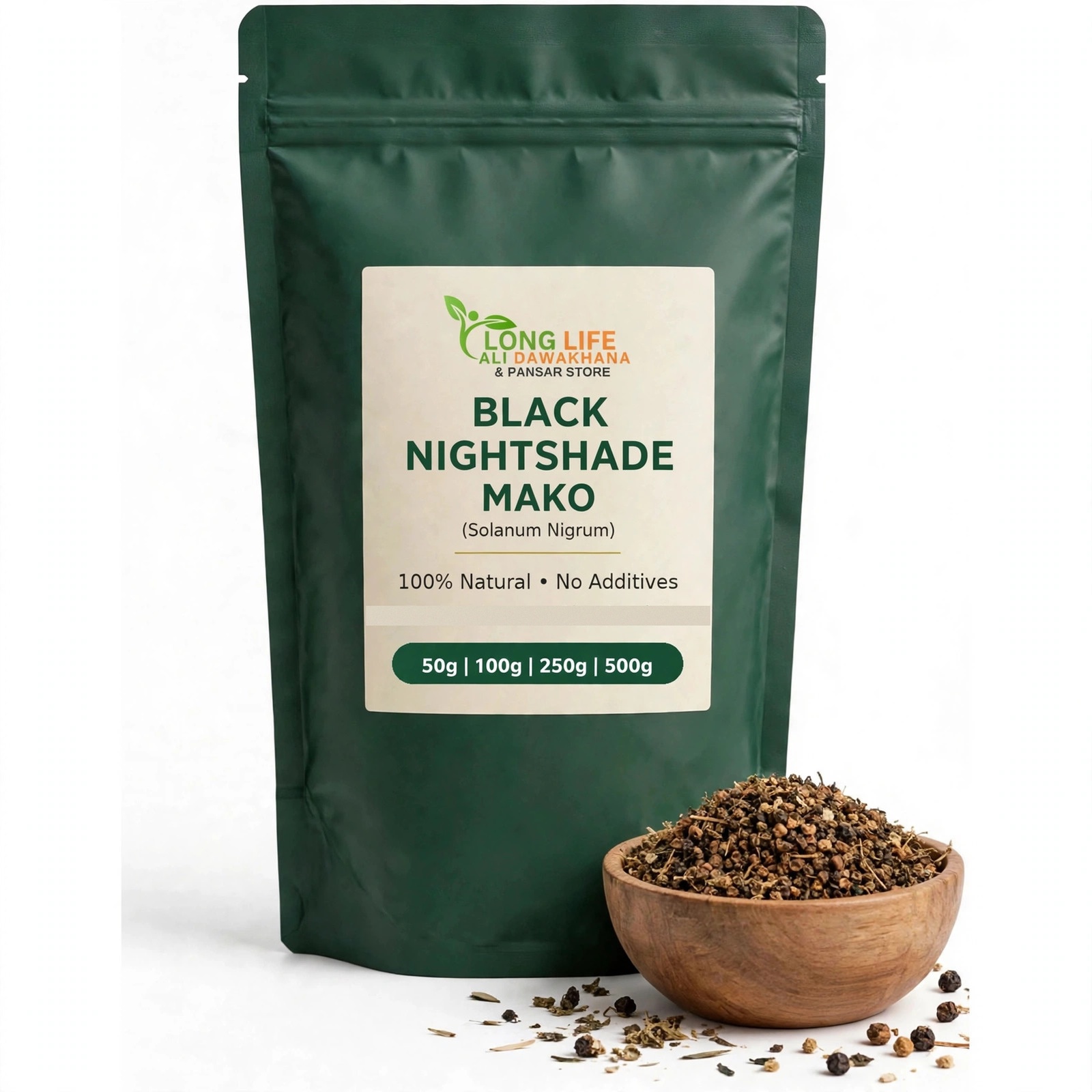
مکو خشک (Black Nightshade) — مکمل معلومات
مکو ایک مشہور دیسی جڑی بوٹی ہے جسے اردو میں مکو یا مکو خشک، ہندی میں مکوئے اور سنسکرت میں کاکاماچی کہا جاتا ہے۔ اس کا نباتاتی نام سولینم نائگرم (Solanum nigrum) ہے اور یہ اسی خاندان (Solanaceae) سے تعلق رکھتی ہے جس میں ٹماٹر، آلو اور بینگن شامل ہیں۔ پاکستان اور ہندوستان کے کھیتوں، باغوں اور ویران زمینوں میں یہ خودرو پودا عام پایا جاتا ہے۔ اس کے چھوٹے سفید ستارہ نما پھول اور گچھوں میں لگے گہرے جامنی یا کالے بیر اس کی پہچان ہیں۔
یونانی طب میں مکو کو سرد و خشک مزاج کی بوٹی مانا جاتا ہے اور صدیوں سے اسے جگر، جلد اور ہاضمے کے مسائل میں استعمال کیا جا رہا ہے۔ مکو کا عرق (عرق مکو) پاکستان میں جگر کے ٹانک کے طور پر بہت مشہور ہے۔ آیوروید میں اسے کاکاماچی کہا جاتا ہے اور اسے رسائن (جسمانی طاقت بڑھانے والی) بوٹیوں میں شمار کیا جاتا ہے۔
اہم احتیاط: مکو میں سولانین نامی مرکب پایا جاتا ہے جو زیادہ مقدار میں زہریلا ہو سکتا ہے، خاص طور پر کچے سبز بیر۔ اس لیے مکو ہمیشہ مناسب مقدار میں اور کسی مستند حکیم یا معالج کے مشورے سے استعمال کریں۔ حاملہ خواتین، دودھ پلانے والی مائیں اور بچے اس سے پرہیز کریں۔
مکو کے فائدے (روایتی استعمال)
- جگر کی صحت: روایتی طب میں مکو کو جگر کی صفائی اور یرقان جیسے مسائل میں استعمال کیا جاتا ہے۔ جدید لیبارٹری تحقیق میں بھی اس کے جگر کی حفاظت والے اثرات دیکھے گئے ہیں۔
- جلد کے مسائل: مکو کے پتوں کا لیپ جلد کی سوزش، خارش اور پھوڑوں پر روایتی طور پر لگایا جاتا ہے۔
- ہاضمہ: یہ ہلکی جلاب اور پیشاب آور خصوصیات رکھتی ہے اور بدہضمی میں مددگار مانی جاتی ہے۔
- سوزش میں کمی: اس میں موجود فلیوونائڈز اور پولی فینولز سوزش کم کرنے میں مدد دیتے ہیں۔
- بخار: روایتی طور پر مکو کا جوشاندہ بخار میں استعمال ہوتا رہا ہے۔
استعمال کا طریقہ
- جوشاندہ (قہوہ): خشک مکو کے پتے یا پوری بوٹی (تقریباً 3 تولہ) پانی میں ابال کر چھان لیں اور نیم گرم پیئیں۔
- سفوف: مکو کا سفوف 1 سے 3 گرام تک نیم گرم پانی یا شہد کے ساتھ لیا جا سکتا ہے — مقدار کے لیے حکیم سے مشورہ ضروری ہے۔
- عرق مکو: تیار شدہ عرق مکو بوتل پر درج مقدار کے مطابق پانی میں ملا کر دن میں ایک یا دو بار لیا جاتا ہے۔
- لیپ: تازہ یا خشک پتوں کو پیس کر متاثرہ جلد پر لیپ کی صورت میں لگایا جاتا ہے۔
مکو آن لائن خریدنے کے لیے Long.pk سے Whole، Powder یا Grounded فارم میں 50 گرام سے 500 گرام تک منگوایا جا سکتا ہے۔ قیمت صرف 219 روپے سے شروع ہوتی ہے اور پورے پاکستان میں کیش آن ڈیلیوری دستیاب ہے۔
Black Nightshade (Mako) – Price in Pakistan, Benefits & How to Use
Direct answer: Black Nightshade (Mako Khushk, Solanum nigrum) price in Pakistan starts from Rs 219 for 50 gm (Whole form) at Long.pk, going up to Rs 2,236 for 500 gm (Grounded form). It is available in three forms — Whole, Powder and Grounded — in 50 gm, 100 gm, 250 gm and 500 gm packs, with cash on delivery across Pakistan. Mako is one of the most famous liver herbs of Unani medicine: its distillate, Arq Makoh, has been sold in Pakistan for generations as a liver tonic, and the dried herb is traditionally used for liver support, skin problems, digestion and inflammation. It must be used in the right dose, because it contains solanine, a compound that is toxic in large amounts — especially in unripe green berries.
Table of Contents
- What Is Black Nightshade (Mako)?
- History of Mako
- Active Compounds
- Mako in Ayurveda, Unani & Folk Medicine
- What Does Modern Research Say?
- Detailed Benefits of Black Nightshade
- Leaves, Berries or Whole Herb?
- Who Is Mako For?
- How to Use Black Nightshade
- Traditional Combinations
- Dosage & Duration
- Side Effects & Who Should Avoid It
- How to Identify Original Mako
- Storage & Shelf Life
- Mako vs Kutki vs Kasni
- Black Nightshade Price in Pakistan
- Product Specifications
- Roman Urdu
- Frequently Asked Questions
What Is Black Nightshade (Mako)?
Black Nightshade (Solanum nigrum L.) is an annual or short-lived perennial herb in the nightshade family, Solanaceae — the same family that gives us the tomato, potato, eggplant and chilli. It grows wild across Pakistan, India, and much of Asia, Europe and Africa, usually as a weed in fields, gardens, roadsides and waste ground. In Urdu it is called Mako or Makoh, and the dried herb sold by pansar stores is Makoh Khushk (مکو خشک).
The plant grows 25–100 cm tall, with soft oval leaves, small white star-shaped flowers, and clusters of round berries about 8–10 mm across. The berries start green, then ripen to a dull purple-black — the colour that gives the plant its English name. The fruit is many-seeded and pea-sized. Every part of the plant — leaves, berries, stems and roots — has been used in traditional medicine, but the leaves and the ripe berries are the parts most commonly used, and the dried whole herb is what pansar stores sell.
Mako is one of those herbs that sits exactly on the line between food and medicine. In parts of Africa and Asia the cooked leaves are eaten as a vegetable, and ripe berries are used in preserves, jams and pies after boiling — heat is traditionally believed to break down the toxic compounds. At the same time, the plant is well known to be poisonous if misused: the unripe green berries and large doses of the raw plant contain enough solanine-type glycoalkaloids to cause serious poisoning. That double nature is why Mako has always been a hakim’s herb rather than a kitchen herb — powerful, useful, and demanding respect for the dose.
Nutritionally, the herb is valued for its mineral content: pansaar’s product notes list phosphorus, iron and calcium, along with vitamins A, C and B. The leaves are also a source of protein and fibre when cooked as a green vegetable in the regions where that is the custom.
History of Mako
Mako is one of the oldest documented medicinal plants in the world. It appears in De Materia Medica, the great herbal written by the Greek physician Dioscorides in the 1st century CE, where nightshade was described as a cooling herb for inflammation and skin complaints. From Greek medicine it passed into the Unani tradition, where Arab physicians such as Ibn Sina (Avicenna) and Al-Razi recorded its use for liver disorders, dropsy (oedema) and hot swellings.
In India, Mako — Kakamachi in Sanskrit — has been part of Ayurvedic practice for well over a thousand years. The classical texts describe it as a bitter, light herb used for liver and spleen enlargement, skin disease, piles and fever, and its distilled water (ark) is still prepared by Ayurvedic pharmacies today. In Chinese medicine the same plant is known as Long Kui (龙葵) and is used for clearing heat, reducing swelling and easing sore throats and skin abscesses.
In Pakistan, Mako’s fame rests above all on Arq Makoh — the steam-distilled water of the leaves, sold in every dawakhana as a liver tonic. Generations of families have kept a bottle of Arq Makoh at home for “jigar ki garmi” (liver heat), sluggish digestion and the yellowish complexion that traditional diagnosis links to liver sluggishness. It is one of the handful of Unani preparations that crossed over from the hakim’s clinic into everyday household use.
European folk medicine used the plant too — poultices of the bruised leaves for bruises, ringworm and skin ulcers — though by the 19th century doctors there had grown cautious about it, after several recorded poisonings from children eating the berries. That caution is still the right attitude: Mako’s long history is a history of careful, measured use.
Active Compounds
Modern phytochemistry has identified a rich mixture of compounds in Solanum nigrum. The most important groups are the steroidal glycoalkaloids — the compounds behind both the herb’s medicinal activity and its toxicity — and the flavonoids and polyphenols behind its antioxidant effects.
| Compound | Type | What researchers looked at |
|---|---|---|
| α-Solanine | Steroidal glycoalkaloid | The main “active and toxic” compound; studied for anti-tumour activity in lab cells (apoptosis, blocking invasion) and for liver protection at low doses |
| Solamargine | Steroidal glycoalkaloid | Studied alongside solasonine for cytotoxic and hepatoprotective effects; one of the two main alkaloids of the plant |
| Solasonine | Steroidal glycoalkaloid | Partner compound to solamargine; breaks down to the aglycone solasodine in the body |
| Solasodine | Steroidal alkaloid (aglycone) | The bioactive backbone of the glycoalkaloids; in demand by the pharmaceutical industry as a starting material |
| Quercetin & Rutin | Flavonoids | Antioxidant and anti-inflammatory activity; among the most studied plant flavonoids |
| Kaempferol & Luteolin | Flavonoids | Antioxidant, anti-inflammatory; tested in silico against skin fungi |
| Apigenin, Catechin, Epicatechin | Flavonoids / flavanols | Antioxidant polyphenols; part of the plant’s free-radical scavenging activity |
| Gallic acid, Caffeic acid, Protocatechuic acid | Phenolic acids | Antioxidant; phenolic content correlates with the plant’s hepatoprotective effect |
| Glycoproteins & Polysaccharides | Proteins / complex sugars | A 150 kDa glycoprotein from S. nigrum has shown antioxidant and immunomodulatory activity in lab studies |
| Saponins | Glycosides | Contribute to the herb’s traditional expectorant and skin uses |
A validated laboratory study (published on PubMed, 2017) quantified these compounds precisely: the n-butanol fraction of S. nigrum berries contained more than 20% steroidal glycosides and aglycones (solasonine, solamargine and solasodine), and that fraction was the most potent liver-protective fraction in HepG2 liver-cell tests. This is the kind of standardisation work that turns a folk herb into a measurable medicine — and it also explains why dose matters so much with this plant.
Mako in Ayurveda, Unani & Folk Medicine
In Unani medicine, Mako is a classic “Sard Khushk” (cold and dry) herb — temperament rated cold and dry in the second to third degree, depending on the part used and the authority cited. A 2026 review in the International Journal of Unani and Integrative Medicine summarises its traditional actions (afa’al) as anti-inflammatory, analgesic, diuretic, sedative, expectorant, laxative and antispasmodic. It is prescribed for liver and spleen disorders, dropsy, jaundice, chronic skin disease, and as a cooling agent in fevers and hot swellings. The same review discusses its emerging role as a nephroprotective (kidney-protecting) agent in preclinical research. Traditional Unani dosage forms include the decoction (joshanda), the fresh juice (5–10 ml), and the distillate Arq Makoh.
In Ayurveda, Mako is Kakamachi (also spelled Kakmachi), described as bitter (tikta) in taste, light (laghu) in quality, and slightly heating in effect — a combination that pacifies Pitta and Kapha while needing care in Vata-dominant people. It is classed among the herbs for liver and spleen enlargement (yakrit-pliha), skin disease (kushtha), piles, and chronic fever. Makoy Ark — the distilled water — is recommended as a rasayana (rejuvenative) with anti-allergic properties, and a paste of the ground leaves is applied to allergic skin and facial complaints.
In folk medicine across Pakistan, the uses are practical and household-level: Arq Makoh for the liver, leaf poultice for boils and bruises, and a decoction for fever and urinary complaints. In rural Sindh and Punjab, older women still know Mako as the plant to pick for a child’s skin rash — crushed leaves applied directly — and as the first herb to reach for when someone’s eyes look yellow.
In Chinese medicine (Long Kui), the herb is used to clear heat and toxins, reduce swelling, and treat sores, carbuncles and sore throats. In parts of Africa, the cooked leaves are a regular green vegetable — a reminder that preparation (cooking) changes this plant’s safety profile completely.
What Does Modern Research Say?
Mako is one of the most studied herbs of the nightshade family — but almost all the evidence comes from laboratories and animal studies, not from large human trials. Here is what the research actually shows, stated honestly.
Liver protection — the strongest evidence. Multiple studies confirm hepatoprotective effects. A study in the Journal of the Chinese Medical Association tested an aqueous extract of S. nigrum against alcohol-induced liver injury in primary liver cells and in animals: at 100 µg/mL the extract prevented liver-cell damage, raised the protective enzymes SOD and glutathione (GSH), and lowered MDA, a marker of lipid damage. The researchers linked the effect to GSTA1, a key liver detox enzyme. The 2017 PubMed study on HepG2 liver cells found the steroidal-glycoside-rich n-butanol fraction of the berries protected cells against D-galactosamine and hydrogen-peroxide toxicity. A 2022 review (Mani et al., International Journal of Indigenous Herbs and Drugs) and a 2023 comprehensive review (Journal of the Asiatic Society of Bangladesh, Science) both list hepatoprotection among the best-supported activities.
Anti-tumour activity — laboratory only. This is the most extensively studied area, and also the most easily exaggerated. Aqueous extracts inhibited the growth of cervical carcinoma (U14) in animals by modulating the immune response and triggering tumour-cell death (apoptosis), with little toxicity to the animals. Methanolic extract showed strong cytotoxicity against HeLa cells in the laboratory. Alpha-solanine inhibited the proliferation and invasion of PC-3 pancreatic cancer cells by blocking the epithelial–mesenchymal transition and the ERK and PI3K/Akt signalling pathways. Total alkaloids from the plant disturbed tumour-cell membrane function and DNA/RNA synthesis. None of this makes Mako a cancer treatment — these are laboratory and animal findings, a long way from a proven human therapy, and anyone claiming otherwise is misleading you.
Antioxidant and anti-inflammatory effects. The plant’s polyphenol content correlates directly with its antioxidant power: a glycoprotein isolated from S. nigrum shows strong free-radical scavenging activity, and the flavonoid fraction (quercetin, rutin, kaempferol) contributes to the anti-inflammatory effects seen in animal models.
Blood sugar and metabolism. Animal studies report anti-diabetic (hypoglycaemic) effects for leaf extracts, and the 2023 review lists anti-diabetic activity among the confirmed pharmacological actions. Human evidence is absent, so diabetics should treat Mako as a herb to discuss with their doctor, not a home remedy for blood sugar.
Kidney protection. The 2026 Unani review highlights preclinical evidence for nephroprotective activity — protection of kidney tissue in laboratory models — which fits with the herb’s traditional use in dropsy and urinary complaints.
Antimicrobial and antifungal activity. A recent in-silico (computer modelling) study tested ten compounds from S. nigrum berries — solanine, solasodine, apigenin, catechin, p-coumaric acid, epicatechin, kaempferol, quercetin, rutin and luteolin — against the fungi that cause dermatophytosis (ringworm-type infections). Solanine and solasodine showed the strongest binding to the fungal protein targets, but the authors stress this needs experimental validation. Traditional leaf poultices for skin fungi have a long history; the lab work is only beginning to catch up.
Anti-seizure activity. Ruby et al. (2012) tested an aqueous leaf extract for anti-epileptic activity in animal models and reported positive results, consistent with the herb’s traditional sedative reputation.
The honest summary: Mako’s liver-protective reputation has real laboratory support, its anti-tumour findings are genuine but preclinical, and its antioxidant and anti-inflammatory effects are well documented in the lab. What does not exist is a large, high-quality human clinical trial proving that taking Mako treats liver disease, cancer, or diabetes. Use it as traditional medicine uses it — in small, measured doses, for general liver and skin support, alongside (never instead of) proper medical care.
Detailed Benefits of Black Nightshade
Liver Support
This is Mako’s signature benefit and the reason Arq Makoh is a household name in Pakistan. Traditional Unani and Ayurvedic practice uses the herb for liver sluggishness, jaundice, and the digestive heaviness blamed on “jigar ki garmi”. The laboratory evidence — protection of liver cells against alcohol, galactosamine and peroxide damage, plus support for the liver’s own detox enzymes — gives this tradition a plausible mechanism. It is best understood as a gentle liver support herb for general wellness, not a treatment for hepatitis or liver failure.
Skin Health
Mako leaves have been applied to the skin for centuries: poultices for boils, bruises, ringworm, eczema-type rashes and allergic skin reactions. The combination of anti-inflammatory flavonoids and antimicrobial glycoalkaloids makes the traditional poultice a reasonable one, and the recent in-silico work on skin fungi points the same way. For internal use, traditional practice links skin clarity to liver function — clear the liver, clear the skin — which is why Mako appears in so many traditional skin formulas.
Digestion & Mild Laxative Action
In Unani terms Mako is a mild laxative and carminative: it is used for sluggish digestion, bloating and constipation, usually as part of a formula rather than alone. Its bitter taste stimulates digestive secretions the way bitter herbs generally do, and its gentle diuretic action helps relieve the water retention that sometimes accompanies digestive sluggishness.
Anti-Inflammatory Support
The flavonoid and polyphenol content — quercetin, rutin, kaempferol, gallic acid and caffeic acid — gives Mako measurable anti-inflammatory and antioxidant activity in laboratory models. Traditionally this is expressed as its use for hot, painful swellings, joint discomfort and inflammatory skin conditions, taken internally or applied as a poultice.
Fever (Traditional Febrifuge)
Mako decoction has a long folk history as a fever remedy: the herb is classed as febrifuge (fever-reducing) in the old herbals, and its cooling temperament in Unani theory fits the same use. It is a supportive traditional measure for mild fevers, not a substitute for medical treatment of a serious or persistent fever.
Urinary & Kidney Support
As a mild diuretic, Mako has been used for urinary complaints and dropsy (fluid retention) since antiquity. The 2026 Unani review’s discussion of nephroprotective activity in preclinical models adds modern interest to this old use, though — as with everything about this herb — human evidence is still missing.
Antioxidant Protection
The plant is rich in polyphenols and flavonoids, and its extracts show strong free-radical scavenging in laboratory tests. Antioxidant activity is the common thread running through most of Mako’s claimed benefits: it is the mechanism proposed for its liver protection, its skin effects, and its general reputation as a health-supporting herb.
Respiratory Comfort (Traditional Expectorant)
Unani sources list Mako among the mild expectorants, used in coughs and chest congestion where a cooling, soothing herb is wanted. This is a minor traditional use today, and the herb is rarely chosen first for respiratory problems — but it is part of the classical picture.
Leaves, Berries or Whole Herb?
This distinction matters more for Mako than for almost any other herb on Long.pk, because the different parts have different safety profiles.
| Part | Traditional use | Safety notes |
|---|---|---|
| Leaves | The main medicinal part: decoctions, Arq Makoh distillate, poultices, cooked as a vegetable in some regions | The safest part when cooked or properly prepared; the part used in most traditional preparations |
| Ripe berries (black/purple) | Used in preserves and jams after boiling; used in some traditional formulas | Ripe berries are much lower in glycoalkaloids than green ones, but should still be cooked, never eaten raw in quantity |
| Unripe berries (green) | Not used | Highest in solanine and other glycoalkaloids; genuinely poisonous — never eat green berries |
| Whole dried herb | What pansar stores sell as Makoh Khushk: leaves, stems and berries together, dried | The standard commercial form; used for decoctions and powders under guidance |
| Roots | Occasionally used in folk medicine | Rarely sold; not part of the standard product |
The dried herb sold on Long.pk is the whole dried herb (Makoh Khushk) — the standard pansar-store form. When you make a decoction from it, the boiling step is part of the traditional safety of the preparation, not just a way to extract the actives.
Who Is Mako For?
Mako suits adults who use traditional Unani or Ayurvedic medicine and want a classical liver-support herb — particularly people who already know Arq Makoh and want the raw herb for decoctions, or practitioners preparing traditional formulas. It is also relevant for people interested in traditional skin care from the inside out, since Mako’s skin reputation is tied to its liver action.
It is not a casual everyday herb for everyone. Because of the solanine content, Mako is for informed users who respect the dose, or for use under a hakim’s guidance. If you are new to herbal medicine, start with gentler liver herbs (such as Kasni/chicory) and graduate to Mako only when you understand it. Pregnant or breastfeeding women, children, and anyone with kidney or liver disease should not use it without medical advice.
How to Use Black Nightshade
Decoction (Joshanda / Qehwa) — the classic method. Take about 3 tola (roughly 35 g) of the dried herb, add to 2 cups of water, and boil gently until the water reduces to about half. Strain and drink warm, once a day, or as your hakim directs. Boiling is an important part of the traditional preparation.
Powder (Safoof). The powdered herb can be taken in small doses — traditionally 1–3 g — mixed with water or honey, once or twice a day. Because the powder is concentrated, dose accuracy matters more than with the decoction: use a measuring spoon or a small kitchen scale, and do not exceed the amount your practitioner advises.
Arq Makoh (distillate). If you have the prepared distillate, the usual traditional dose is a small measured quantity (follow the bottle’s directions) diluted in water, once or twice a day. Arq Makoh is the gentlest way to take Mako, because distillation leaves most of the heavy alkaloids behind.
Poultice (Lep) for skin. Grind fresh or soaked dried leaves into a paste and apply to boils, bruises, itchy patches or ringworm-type rashes. Leave for 20–30 minutes, then wash off. Patch-test on a small area first: some people react to nightshade plants on the skin.
Cooked leaves (as a vegetable). In the regions where Mako leaves are eaten, they are always boiled — often in two changes of water — which is the traditional way of making them safe. This is not a common use in Pakistan, and we do not recommend experimenting with it unless you know the preparation properly.
What not to do: never eat raw berries (especially green ones), never take large doses “for faster results”, and never give Mako preparations to children.
Traditional Combinations
Mako is rarely used alone in classical practice. The traditional combinations pair it with herbs that support the same organs or balance its temperament:
- Mako + Kasni (Chicory): the classic liver pair. Arq Makoh and Arq Kasni are often taken together, and the two herbs appear side by side in many Unani liver formulas. Kasni is the gentler of the two and rounds out Mako’s stronger action.
- Mako + Kutki: two bitter liver herbs combined in Ayurvedic practice for jaundice and liver congestion. Both are strong bitters; the combination is a practitioner’s formula, not a home experiment.
- Mako + Giloy: for fever with liver involvement, and for general immune support in traditional practice. Giloy’s milder profile balances Mako.
- Mako + Honey: the usual vehicle (anupan) for the powder — honey carries the bitter herb and is itself considered beneficial for the liver in Unani medicine.
- Mako + Saunf (Fennel): fennel is sometimes added to Mako decoctions to make them gentler on the stomach and to improve the taste.
- Mako + Turmeric: a modern traditional pairing for inflammation and liver support, combining Mako’s alkaloids with turmeric’s curcumin.
Dosage & Duration
There is no officially approved modern dose for Solanum nigrum, because no regulatory body has evaluated it in clinical trials. The figures below are traditional Unani and Ayurvedic doses, given for information — your hakim’s instruction takes priority.
| Form | Traditional dose | Notes |
|---|---|---|
| Dried herb decoction | ~3 tola (35 g) herb boiled in water, once daily | The classical Unani dose; the decoction, not the raw herb, is the dose form |
| Fresh plant juice | 5–10 ml | From Unani sources; rarely used today |
| Powder | 1–3 g per dose | Small doses only; measure, don’t guess |
| Arq Makoh (distillate) | As directed on the bottle | The gentlest form; usually a small measure diluted in water, once or twice daily |
Duration: traditional courses run 2–4 weeks for a liver-support course, followed by a break. Mako is not a herb to take continuously for months without supervision. If you are taking it for a specific complaint, review with your practitioner after 2 weeks. Stop immediately and seek medical advice if you develop nausea, vomiting, diarrhoea, headache or dizziness — these are the early signs of glycoalkaloid excess.
Side Effects & Who Should Avoid It
Mako demands more caution than most herbs on this site, and we say so plainly. The same glycoalkaloids that make it medicinal make it toxic in excess.
Possible side effects (usually from too large a dose): nausea, vomiting, stomach cramps, diarrhoea, headache, dizziness, drowsiness, and a dry mouth. These are the classic signs of solanine-type poisoning. They resolve when the herb is stopped, but a large overdose — especially of raw green berries — can cause serious poisoning with confusion, slowed breathing and heart rhythm changes. That is a medical emergency, not a home-treatment situation.
Who should avoid Mako:
- Pregnant and breastfeeding women — no safety data, and traditional sources advise against it.
- Children — the poisoning risk is highest in children, and there is no established safe paediatric dose.
- People with kidney disease — the herb is a diuretic and the 2026 review’s nephroprotective findings are preclinical, not a licence for use in kidney patients.
- People with serious liver disease — paradoxically, the liver herb is not for damaged livers without medical supervision; a struggling liver may not handle the alkaloids well.
- People on blood pressure, diuretic or diabetes medication — Mako can add to diuretic and blood-sugar-lowering effects; discuss it with your doctor first.
- People with nightshade sensitivity — if tomato, potato or eggplant bothers you, be cautious with this herb too.
Drug interactions: the diuretic action may add to prescription diuretics (“water tablets”) and blood-pressure medicines; the hypoglycaemic effect seen in animal studies could add to diabetes medication. Tell your doctor you are using it.
The one-line rule: small doses, short courses, proper preparation (boiled), and stop if you feel unwell. Used that way, Mako has been used safely for centuries. Used carelessly, it is one of the few herbs that can genuinely harm you.
How to Identify Original Mako
- Leaves: dried leaves should be dark green to brownish-green, with a characteristic slightly bitter smell. Very pale or yellowed leaves suggest old stock.
- Berries: look for small, round, dark purple-black dried berries mixed through the herb. Green berries in the mix are a bad sign — they should not be there.
- Stems: thin, wiry stems are normal in the whole herb, but the mix should not be mostly woody stem with few leaves.
- Smell: a mild, earthy, slightly bitter herbal smell. A musty or mouldy smell means damp storage — reject it.
- No dust and grit: shake a pinch — clean herb has no sand or soil. Pansar-store herb is sometimes dusty; rinse before making a decoction if it looks dusty.
- Buy from a trusted store: Long.pk sources its Makoh Khushk from established pansar suppliers, and the herb is packed in sealed pouches that protect it from moisture and contamination.
Storage & Shelf Life
Store Mako in an airtight container or its sealed pouch, away from light, heat and moisture. A cool, dry kitchen cupboard is ideal. The dried herb keeps its potency for 12–18 months when stored properly; the powder loses strength faster (use within 6–9 months of grinding). Keep the pouch sealed between uses, and keep it out of children’s reach — remember this is a herb that should never be in small hands. Do not store it in the bathroom or near the stove, where steam and heat degrade it.
Mako vs Kutki vs Kasni
These three are the classic liver herbs of South Asian medicine, and customers often ask which one to choose. They are complementary more than competitive — but they differ in strength and temperament.
| Feature | Mako (Black Nightshade) | Kutki (Picrorhiza kurroa) | Kasni (Chicory) |
|---|---|---|---|
| Botanical name | Solanum nigrum | Picrorhiza kurroa | Cichorium intybus |
| Main tradition | Unani & Ayurveda | Ayurveda | Unani & folk |
| Temperament | Cold & dry | Cold (bitter) | Cold & moist |
| Strength | Strong — needs care with dose | Strong bitter — small doses | Gentle — everyday use |
| Best for | Liver support, skin, fever | Jaundice, liver congestion, fever | Gentle liver tonic, digestion |
| Safety | Caution: solanine; not for children/pregnancy | Generally safe in small doses | Very safe; also a food plant |
| Typical form | Decoction, Arq Makoh, powder | Powder, decoction | Seeds/leaves, Arq Kasni |
| Price (Long.pk, from) | Rs 219 / 50 gm | — | — |
Which to choose: for gentle daily liver support, start with Kasni. For a stronger classical liver course under guidance, Mako or Kutki — or the traditional Mako + Kasni combination, which is the most widely used pairing in Pakistan.
Black Nightshade Price in Pakistan
Prices checked 18 November 2026 (following pansaar.com, rounded to whole rupees). Cash on Delivery available across Pakistan.
| Form | 50 gm | 100 gm | 250 gm | 500 gm |
|---|---|---|---|---|
| Whole | Rs 219 | Rs 422 | Rs 1,080 | Rs 1,772 |
| Powder | Rs 371 | Rs 692 | Rs 1,350 | Rs 1,873 |
| Grounded | Rs 422 | Rs 692 | Rs 1,519 | Rs 2,236 |
Best value: the 500 gm Whole pack at Rs 1,772 works out to about Rs 354 per 100 gm, against Rs 438 per 100 gm for the 50 gm pack — a saving of roughly 19% for regular users. The Powder form costs more than Whole at the small sizes (grinding and sieving add cost), which is normal across the herb range.
Product Specifications
| Product Name | Black Nightshade (Mako) |
| Urdu Name | مکو خشک (Makoh Khushk) |
| Botanical Name | Solanum nigrum L. |
| Family | Solanaceae |
| Forms Available | Whole / Powder / Grounded |
| Weights Available | 50 gm / 100 gm / 250 gm / 500 gm |
| Price Range | Rs 219 – Rs 2,236 |
| Purity | 100% Natural, No Additives |
| Origin | Pakistan / South Asia |
| Shelf Life | 12–18 months (dried herb); 6–9 months (powder) |
| Storage | Airtight container, cool & dry place, away from sunlight |
| Seller | Ali Dawakhana and Pansar Store |
| Delivery | Cash on Delivery across Pakistan |
Roman Urdu
Mako (Black Nightshade, Solanum nigrum) aik mashhoor desi jadi booti hai jo khaas tor par jigar ki sehat ke liye istemal hoti hai. Isay Urdu mein Mako ya Makoh Khushk kehte hain. Is ka mashhoor Arq Makoh Pakistan ke har dawakhane mein milta hai aur nasal dar nasal jigar ke tonic ke tor par istemal ho raha hai.
Mako ke fawaid mein jigar ki safai, jild ke masail mein behtri, hazma aur sozish mein kami shamil hain. Is mein solanine, solamargine aur solasonine jaise taqatwar murakkabat paaye jate hain, jin ki wajah se yeh booti asar rakhti hai — aur isi wajah se is ki miqdar ka khayal rakhna bohat zaroori hai. Kachay sabz bair zehreelay hotay hain; pakay hue kaalay bair aur pattay hi istemal hotay hain, aur woh bhi ubaal kar.
Mako ka joshanda (qehwa) banane ke liye taqreeban 3 tola khushk booti 2 cup pani mein ubaalain aur aadha reh jane par chhaan kar neem garam piyen. Safoof 1 se 3 gram tak pani ya shehed ke saath liya ja sakta hai. Hamesha kisi mustanad hakeem ke mashwaray se istemal karein, khaas tor par agar aap ko jigar ya gurday ki koi beemari hai ya aap dawa le rahe hain. Haamla khawateen, doodh pilane wali maaen aur bachay is se parhaiz karein.
Long.pk se Mako Whole, Powder aur Grounded form mein 50 gm se 500 gm tak dastiyab hai — qeemat sirf Rs 219 se shuru. Pure Pakistan mein Cash on Delivery ki sahulat mojood hai.
Frequently Asked Questions
Q: Mako kis kaam aata hai?
Mako (Black Nightshade) rawayati Unani aur Ayurvedic tib mein khaas tor par jigar ki sehat, jild ke masail, hazma aur sozish ke liye istemal hota hai. Is ka Arq Makoh Pakistan mein jigar ke tonic ke tor par bohat mashhoor hai.
Q: Black Nightshade (Mako) ki Pakistan mein qeemat kya hai?
Long.pk par Mako ki qeemat Rs 219 se shuru hoti hai (50 gm Whole) aur Rs 2,236 tak jati hai (500 gm Grounded). Whole, Powder aur Grounded — teeno forms 50, 100, 250 aur 500 gm mein dastiyab hain.
Q: Kya Mako khana mehfooz hai?
Munasib miqdar mein aur sahi tareeqay se (ubaal kar) istemal karne par Mako sadiyon se mehfooz tareeqay se istemal ho raha hai. Lekin is mein solanine hota hai jo zyada miqdar mein zehreela ho sakta hai — khaas tor par kachay sabz bair. Hamesha munasib miqdar istemal karein aur bachon ko na dein.
Q: Mako ka joshanda kaise banayen?
Taqreeban 3 tola khushk Mako 2 cup pani mein daal kar halki aanch par ubaalain, jab pani aadha reh jaye to chhaan lein aur neem garam piyen. Joshanda din mein aik baar, ya hakeem ki hidayat ke mutabiq lein.
Q: Arq Makoh kya hai aur Mako se kya farq hai?
Arq Makoh Mako ke patton se banaya gaya arq (distillate) hai — yeh Mako lene ka sab se narm tareeqa hai, kyun ke is mein bhaari alkaloids kam hotay hain. Khushk Mako (Makoh Khushk) poori booti hai jis se joshanda ya safoof banaya jata hai.
Q: Kya Mako wazan kam karta hai?
Mako ke wazan kam karne ka koi mazboot saboot nahi hai. Yeh halka peshab-aawar (diuretic) hai, is liye shuru mein wazan mein kami aaye to woh zyada tar pani ki kami hoti hai, charbi ki nahi. Ise wazan kam karne ki dawa samajh kar istemal na karein.
Q: Mako kin logon ko istemal nahi karna chahiye?
Haamla aur doodh pilane wali khawateen, bachay, gurday ya shadeed jigar ki beemari wale afraad, aur blood pressure, peshab-aawar ya diabetes ki dawa lene walay afraad ko Mako istemal karne se pehle doctor ya hakeem se mashwara karna chahiye.
Q: Mako aur Kasni mein kya farq hai?
Dono jigar ki bootiyan hain, lekin Kasni narm aur rozana istemal ke liye mehfooz hai, jab ke Mako zyada taqatwar hai aur is ki miqdar ka khayal rakhna parta hai. Rawayati tib mein dono ko aksar aik saath (Arq Makoh + Arq Kasni) istemal kiya jata hai.
Q: Asli Mako ki pehchan kya hai?
Asli khushk Mako mein gehray sabz pattay aur chhote kaalay/jamni bair hotay hain, halki karwi khushbu aati hai aur is mein mitti ya ret nahi hoti. Sabz bair ya seelan ki boo achi nishani nahi hai.
Q: Mako ko kitni dair tak rakh saktay hain?
Hawa-band dabbe mein, thandi aur khushk jagah par, khushk Mako 12 se 18 mahine tak theek rehta hai. Safoof (powder) 6 se 9 mahine mein istemal kar lena behtar hai. Bachon ki pohanch se door rakhein.
Ali Dawakhana and Pansar Store — Asli desi dawa aur khalis jadi bootiyan, ab ghar baithay Long.pk se mangwayen.
Reviews
There are no reviews yet