
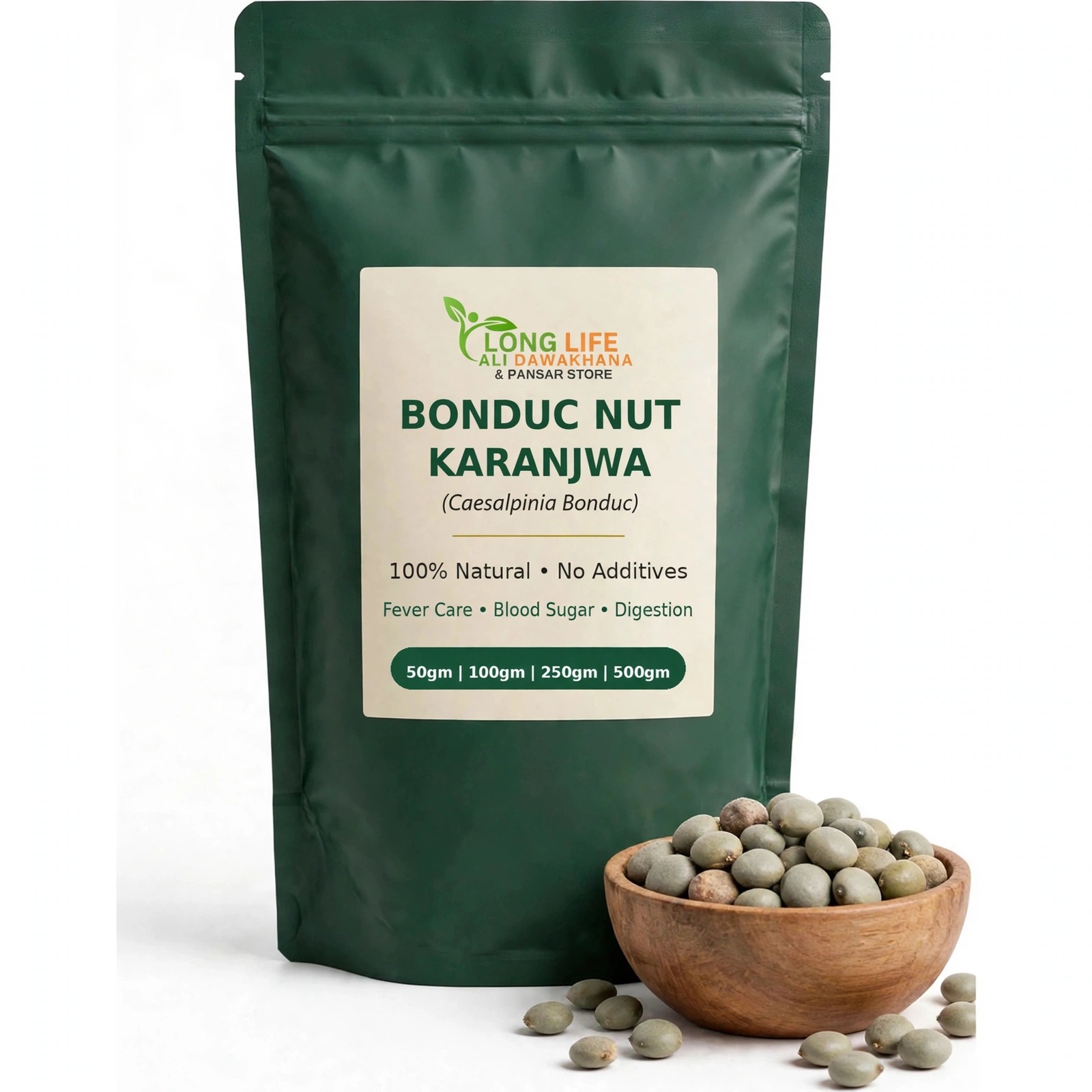
Bonduc Nut (Karanjwa, Caesalpinia bonduc), known as the Fever Nut, is a traditional Ayurvedic and Unani remedy used for intermittent fevers, blood-sugar support and digestion. Its intensely bitter kernel contains bonducin, and animal studies have shown it lowers blood sugar — diabetics must use it only under a doctor’s supervision. At Long.pk it is available in Whole, Powder and Grounded forms (50 gm to 500 gm) from Rs 203, with Cash on Delivery across Pakistan.
کرنجوہ (بونڈک نٹ) — مکمل معلومات
کرنجوہ، جسے انگریزی میں بونڈک نٹ (Bonduc Nut) یا فیور نٹ (Fever Nut) کہا جاتا ہے، ایک کانٹے دار جھاڑی (Caesalpinia bonduc) کے بیج ہیں جو بھارت، سری لنکا اور برما کے گرم علاقوں میں پائے جاتے ہیں۔ یہ بیج صدیوں سے آیوروید، یونانی اور سدھا طب میں بخار، ملیریا، ذیابیطس اور ہاضمے کے لیے استعمال ہو رہے ہیں۔
کرنجوہ کا بیج بہت کڑوا ہوتا ہے — اسی لیے اسے ہندی میں “کڑوا بادام” بھی کہا جاتا ہے۔ اس کا ایک عجیب وصف یہ ہے کہ اگر بیج کو کسی کھردری سطح پر رگڑا جائے تو وہ فوراً گرم ہو جاتا ہے۔ آیوروید میں اسے “کانٹکی کرنج” کہا جاتا ہے اور اس کا مزاج گرم، ذائقہ کڑوا اور کسیلا مانا جاتا ہے۔
اہم انتباہ: کرنجوہ خون میں شکر کم کرتا ہے — ذیابیطس کی دوا لینے والے افراد اسے ڈاکٹر کی نگرانی کے بغیر استعمال نہ کریں، کیونکہ شکر اچانک کم ہو سکتی ہے۔
کرنجوہ کے فائدے (روایتی استعمال)
- بخار: ملیریا اور وقفے وقفے سے آنے والے بخار (intermittent fever) کے لیے سب سے مشہور استعمال — اسی لیے اسے “Fever Nut” کہا جاتا ہے۔
- ذیابیطس: جانوروں کی تحقیق میں کرنجوہ نے خون کی شکر نمایاں طور پر کم کی ہے۔
- ہاضمہ: بھوک بڑھانے، بدہضمی اور پیٹ کے درد کے لیے روایتی استعمال۔
- پیٹ کے کیڑے: کرم کش (anthelmintic) — پیٹ کے کیڑوں کے لیے۔
- سوزش: جوڑوں اور جسم کی سوزش میں روایتی استعمال۔
- جلد: پھوڑے پھنسیوں اور جلد کے امراض کے لیے لیپ کے طور پر۔
استعمال کا طریقہ
- بخار کے لیے: کرنجوہ کے بیج کی گری کا پاؤڈر برابر مقدار میں کالی مرچ کے ساتھ ملا کر دن میں تین بار لیں (بالغ: 15 سے 30 گرین، بچے: 3 سے 4 گرین) — ہندوستانی فارماکوپیا (Indian Pharmaceutical Codex) کی مقدار 15 سے 18 گرین ہے۔
- ذیابیطس کے لیے (لوک طریقہ): ایک بیج توڑ کر گری نکالیں، رات بھر پانی میں بھگوئیں، صبح کھائیں اور پانی بھی پی لیں — 15 دن تک، شکر چیک کرتے رہیں۔
- دمہ کے لیے: بھنی ہوئی گری کا قہوہ روایتی طور پر استعمال ہوتا ہے۔
- بیرونی: گری کا لیپ پھوڑے پھنسیوں اور سوجن پر لگایا جاتا ہے۔
کرنجوہ Long.pk سے Whole، Powder یا Grounded فارم میں 50 گرام سے 500 گرام تک منگوایا جا سکتا ہے۔ قیمت صرف 203 روپے سے شروع ہوتی ہے اور پورے پاکستان میں کیش آن ڈیلیوری دستیاب ہے۔
Bonduc Nut (Karanjwa) – Price in Pakistan, Benefits, Uses & Safety
Direct answer: Bonduc Nut (Karanjwa, Caesalpinia bonduc) price in Pakistan starts from Rs 203 for 50 gm (Whole form) at Long.pk, going up to Rs 1,482 for 500 gm (Powder or Grounded form). It is available in three forms — Whole, Powder and Grounded — in 50 gm, 100 gm, 250 gm and 500 gm packs, with cash on delivery across Pakistan. Karanjwa is the traditional Fever Nut of Ayurvedic and Unani medicine — used for centuries for intermittent and malarial fevers, and one of the most-studied traditional antidiabetic seeds, with consistent blood-sugar-lowering results in animal models. Its kernel is intensely bitter (Hindi: Karwa Badam, “bitter almond”) and contains the bitter glycoside bonducin. Blood sugar can fall suddenly — anyone on diabetes medication must use it only under a doctor’s supervision. This article reports the traditional uses honestly and marks the evidence level for each claim.
Table of Contents
- What Is Bonduc Nut?
- History of Bonduc Nut
- Active Compounds
- Bonduc Nut in Ayurveda, Unani & Folk Medicine
- What Does Modern Research Say?
- Detailed Benefits of Bonduc Nut
- Seeds vs Leaves vs Roots
- Who Is Bonduc Nut For?
- How to Use Bonduc Nut
- Traditional Combinations
- Dosage & Duration
- Side Effects & Who Should Avoid It
- How to Identify Original Bonduc Nut
- Storage & Shelf Life
- Bonduc Nut vs Karela vs Jamun
- Bonduc Nut Price in Pakistan
- Product Specifications
- Roman Urdu
- Frequently Asked Questions
What Is Bonduc Nut?
Bonduc Nut (Karanjwa, Caesalpinia bonduc (L.) Roxb., syn. Caesalpinia bonducella (L.) Fleming, Caesalpinia crista Linn.) is the seed of a flowering, straggling, very thorny perennial shrub in the Caesalpiniaceae family (Fabaceae). In Urdu it is Karanjwa (کرنجوہ), also Karanjwaa, Akitmakit and Bunduk; in Hindi Karanja, Kanthekaranja, Karanjuvu, Karanju, Lata Karanju, Nata Karanja, Katkaranj and Ghotakaranja; in Marathi Gajaga, Sagargota, Kanchaki and Karbath; in Sanskrit Kakachika, Valli, Kantakikaranja, Karanja Tirini, Kantakini, Prakiriya, Vitapakaranja, Putikaranjah and Lataakaranja; in English Bonduc Nut, Fever Nut, Nicker Seed, Nicker Nut, Gray Nicker, Yellow Nicker, Indian Filbert and Nickar.
The shrub is pantropical — found in the hotter regions of India, Sri Lanka, Burma (Myanmar) and across the tropics — growing on waste grounds and in coastal areas. The seeds are smooth, round, grey-brown nuts, roughly the size of a marble, with a hard shell enclosing a bitter kernel. The seed has a peculiar property: when rubbed over a rough surface, it instantly becomes hot — a party trick that has made it famous in South Asia.
The kernel is the main part used, though the leaves, roots and seed coat also have traditional uses. The kernel is intensely bitter — in Hindi it is colloquially called Karwa Badam (“bitter almond”). That bitterness comes from bonducin, a bitter glycoside that is the plant’s signature compound and the source of its antipyretic (fever-reducing) and digestive actions.
History of Bonduc Nut
Caesalpinia bonduc has been used in the Indian systems of medicine since antiquity. In Ayurveda, it is Kantaki Karanj or Latakaranja — described in the Bhavaprakasha Nighantu (Guduchyadi Varga, verses 119–120) as a bitter, astringent, hot-potency herb for fever, worms and Vata-Kapha disorders. Its most famous classical use is for Vishama Jwara — intermittent and malarial fever — which is why it is called the Fever Nut in English.
The seed powder mixed with black pepper was the standard traditional fever remedy, and it was formalised in the Indian Pharmaceutical Codex (dose 15–18 grains) — one of the few traditional fever remedies to be given an official codex dose. The kernel powder with pepper was given to malaria patients and found to have weak antiperiodic properties — it helped break the fever cycle, though it was not as strong as quinine.
In the modern era, C. bonduc became one of the ingredients of Ayush 64, the Ayurvedic anti-malarial medicine developed by the Department of AYUSH, Government of India. And in 2020, the Ministry of AYUSH listed Karanjwa among the single drugs recommended as a prophylactic for respiratory tract infection (antipyretic, antimicrobial, anti-inflammatory and immunomodulatory) — a recognition of its broad traditional profile.
In Unani medicine, Karanjwa has been used for ages for seasonal fevers, bronchial asthma, bronchitis, ascites, hydrocele and pleurisy. In Siddha and Homoeopathy, it is also a recognised remedy. In Madagascar and La Réunion, the roots are regarded as febrifuge and anthelmintic, and used as an astringent for leucorrhoea. In Guinea, a root decoction is recommended for fever. In Himachal Pradesh, the roots are eaten for hernia and used for diabetes and intermittent fever.
Active Compounds
| Compound | Type | What researchers looked at |
|---|---|---|
| Bonducin | Bitter glycoside | The signature compound — antipyretic, anti-inflammatory, digestive stimulant, supports glucose regulation |
| Bonducellin | Cassane diterpenoid | Part of the bitter principle; contributes to the antipyretic and anti-inflammatory activity |
| α-, β-, γ-, δ-, ε-Caesalpin | Furanoditerpenes | The furanoditerpene series isolated from the seeds (Peter et al. 1997; Keith et al. 1986) |
| Caesalpinia-F | Furanoditerpene | Isolated from the seeds alongside the caesalpins |
| Caesalpin | Diterpenoid | The parent compound of the caesalpin series |
| Phytosterinin | Sterol glycoside | Plant sterol; contributes to the lipid-lowering activity |
| β-Sitosterol | Phytosterol | Plant sterol with cholesterol-lowering activity |
| Citrulline | Amino acid | Found in the seeds |
| Fatty acids (palmitic, stearic, oleic, linoleic, lignocenic, octadeca-4-enoic, octadeco-2,4-dienoic) | Fatty acids | The seed oil fraction |
| Flavonoids | Flavonoids | Antioxidant activity; credited with the pancreatic-protective and insulin-enhancing effects in the 2025 leaf-extract study |
| Triterpenoids & steroids | Triterpenoids | Found in the hydroalcoholic seed extract; contribute to the antidiabetic activity |
| Tannins & saponins | Polyphenols / saponins | Found in the leaf and seed extracts; contribute to the antidiabetic and astringent actions |
Mechanism. The bitter glycoside bonducin and the furanoditerpenes (caesalpins) are the signature chemistry — they drive the antipyretic action (the seed powder with pepper “produces a lot of sweat, prompting the decrease of fever”) and the anti-inflammatory action. The flavonoids provide the antioxidant and pancreatic-protective activity that underlies the antidiabetic effect: the seed extracts appear to stimulate insulin secretion by the pancreatic beta cells, which lowers blood glucose, while also improving the lipid profile (HDL up, LDL down).
Bonduc Nut in Ayurveda, Unani & Folk Medicine
In Ayurveda, Kantaki Karanj is described as Tikta–Kashaya Rasa (bitter, astringent taste), Ushna Virya (hot potency) and Katu Vipaka (pungent post-digestion effect). It pacifies Vata and Kapha Dosha. Its properties are Jwaraghna (antipyretic), Deepana–Pachana (digestive stimulant), Krimighna (anthelmintic) and Shothahara (anti-inflammatory). The classical indications are Jwara (fever), Vishama Jwara (intermittent / malarial fever), Krimi Roga (worm infestation), tumours, cysts, skin diseases, hydrocele, leprosy, spasms, orchitis, paralysis and nervous complaints. It is also described as Stambhani (useful in diarrhoea and bleeding disorders), Vamihara (a natural anti-emetic — relieves vomiting) and Pitta Arshahara (useful in piles of Pitta origin). The leaves alleviate Kapha and Vata and are emmenagogue.
In Unani medicine, Karanjwa is described as anti-inflammatory (Muha’lil-e-waram), anti-pyretic, analgesic (Musakkin-e-alam), blood purifier (Musaffi-i-Dam), anticonvulsant (Dafi’-i-Tashannuj) and antiseptic (Dafi’-i-Ta’affun). It is used for seasonal fevers (Humma), bronchial asthma (Diq al-Nafas), bronchitis (Su’al-o-Surfa), ascites (Istisqa’ Ziqqi), hydrocele (Qarw Ma’i) and pleurisy (Dhat al-Janb). The seeds are claimed to be styptic, purgative and anthelmintic, and useful in colic, malaria, hydrocele, skin diseases and leprosy.
In folk medicine, the seeds are used as a tonic, anthelmintic, febrifuge and antiblennorrhagic, and are considered specific for hydrocele. A decoction of roasted kernels is used for asthma; a paste of the kernel gives relief from boils and other swellings; the powdered seeds are mixed with an equal part of pepper powder for malaria and fever. The roots are eaten for hernia in Himachal Pradesh.
What Does Modern Research Say?
Caesalpinia bonduc has a substantial research base — strongest for diabetes, with multiple animal studies across different extracts, doses and models, and consistent results.
Antidiabetic — the strongest evidence (animal studies).
- Seed extract, 500 mg/kg (STZ-nicotinamide diabetic rats, 24 rats, 14 days): the ethanolic seed extract reduced post-prandial blood glucose from 232.63 ± 10.31 to 185.50 ± 16.00 mg/dl (P<0.001), while the untreated group’s glucose rose from 223.75 to 267.25 mg/dl. The extract also prevented the reduction of fasting insulin levels.
- Leaf extract, 150/200/400 mg/kg (STZ diabetic rats, 2025, PMID 41693189): the extract significantly reduced blood glucose at 6 hours — from 237.40 to 103.00 mg/dl (150 mg/kg), 324.00 to 199.40 mg/dl (200 mg/kg), and 336.00 to 116.20 mg/dl (400 mg/kg). Histological assessment showed reduced necrosis and inflammation and improved pancreatic morphology. The authors attribute the effect to a dual mechanism — antioxidant protection and insulin-secretion enhancement, likely driven by flavonoids.
- Seed kernel + Gymnema sylvestre (alloxan diabetic rats, 2025, PMID 40354793, Chemistry & Biodiversity): the combined extract (400 mg/kg total, 200 mg/kg each) for 28 days gave superior outcomes to either herb alone — improved fasting blood glucose, insulin, HbA1c, and oxidative-stress markers (SOD and CAT), modulated insulin secretion and stress-gene expression, and downregulated the JNK/MAPK pathway.
- Hydroalcoholic seed extract, 250/500 mg/kg (alloxan diabetic rats): both doses significantly lowered fasting blood glucose; the pancreas, kidney and liver histology showed significant recovery; the efficacy compared favourably with the reference drug glibenclamide.
- Kernel ethanolic extract (KEE): stimulated insulin secretion by the beta cells, increased HDL and suppressed LDL compared with the standard drug.
Antimalarial — weak but real (traditional + laboratory). The powdered seeds blended with an equal part of pepper powder were given to malaria patients and found to have weak antiperiodic properties. Cold ethanol and aqueous extracts have been tested in the laboratory. The herb is an ingredient of Ayush 64, the AYUSH anti-malarial formulation. It is not a substitute for modern antimalarial drugs.
Antimicrobial — laboratory and animal evidence. The seed has demonstrated in vitro as well as in vivo antimicrobial activity. The plant possesses antimalarial, antimicrobial, antitumor, hepatoprotective, hypoglycaemic and antioxidant activities.
Toxicity. Toxicity studies demonstrated the LD50 of C. bonduc to be 3,000 mg/kg, indicating the use of this plant to be quite safe in acute toxicity terms. That does not mean large doses are safe — the blood-sugar effect is the real risk, not acute poisoning.
The honest summary: the antidiabetic evidence is consistent across five animal studies (seed extract, leaf extract, kernel extract, and a combination with Gymnema) — but there are no human clinical trials for diabetes. The antimalarial evidence is weak (the traditional combination was found to have “weak antiperiodic properties”). The 2025 studies explicitly call for “further clinical evaluations and mechanistic studies to substantiate clinical applicability”.
Detailed Benefits of Bonduc Nut
Every benefit below is described as it appears in the traditional literature and research, with the evidence level stated.
Fever (Traditional + Weak Clinical Evidence)
This is Karanjwa’s signature use — the reason it is called the Fever Nut. The kernel powder mixed with an equal part of black pepper, taken thrice daily, was the standard traditional remedy for simple, continued and intermittent fevers. The Indian Pharmaceutical Codex gave it an official dose (15–18 grains). It is said to produce a lot of sweat, prompting the decrease of fever. The antipyretic activity is supported by the bonducin and furanoditerpene chemistry. For malaria specifically, the traditional combination was found to have weak antiperiodic properties — it helps, but it is not a substitute for modern antimalarial treatment.
Blood Sugar (Animal Evidence — Consistent)
The antidiabetic evidence is the strongest in the research literature — five animal studies, across seed, leaf and kernel extracts, all showing significant blood-glucose reduction, with pancreatic protection and insulin-secretion enhancement. The folk method (one kernel soaked overnight, eaten in the morning, for 15 days) is widely used in India. The risk is real: blood sugar can fall suddenly, so anyone on diabetes medication must monitor closely and work with their doctor.
Digestion (Traditional)
Ayurveda classes Karanjwa as Deepana–Pachana — a digestive stimulant. It is traditionally used for loss of appetite, indigestion, colic and abdominal pain. The bitter taste stimulates digestive secretions — the same principle as other bitter herbs (chirata, kutki). It is also used as a stomachic and digestive in the traditional literature.
Intestinal Worms (Traditional)
The seeds are traditionally used as an anthelmintic — to expel intestinal worms. The anthelmintic activity is reported in the review literature, and the roots are also used as an anthelmintic in Madagascar and La Réunion. Do not self-prescribe for children — consult a hakim first.
Inflammation (Traditional + Laboratory Evidence)
The anti-inflammatory activity is demonstrated in the laboratory (bonducin and the furanoditerpenes), and the seeds are traditionally used for inflammations, swellings and joint pain. A paste of the kernel gives relief from boils and other swellings. The leaves are bandaged over inflamed areas in folk practice.
Skin (Traditional)
The seeds are traditionally used for skin diseases and leprosy, and the kernel paste is applied to boils and swellings. The antimicrobial activity of the seed (in vitro and in vivo) gives this traditional use laboratory support.
Hydrocele (Traditional)
The seeds are considered specific for hydrocele in the traditional literature — one of the most specific traditional indications for this herb. This is a traditional claim with no modern clinical evidence, and hydrocele requires medical assessment.
Respiratory (Traditional)
A decoction of roasted kernels is traditionally used for asthma, and the herb is used in Unani medicine for bronchial asthma, bronchitis and pleurisy. The AYUSH 2020 guidelines listed Karanjwa as a prophylactic single drug for respiratory tract infection. It is not a substitute for asthma medication.
Diarrhoea and Bleeding (Traditional)
Ayurveda describes Karanjwa as Stambhani — useful in diarrhoea and bleeding disorders — and the antidiarrhoeal activity is reported in the review literature. The astringent (Kashaya) taste is the traditional explanation.
Liver and Lipids (Animal Evidence)
The hepatoprotective activity is reported in the reviews, and the kernel ethanolic extract increased HDL and suppressed LDL in the antidiabetic studies. The antihyperlipidemic activity is part of the same metabolic profile as the blood-sugar effect.
Seeds vs Leaves vs Roots
Different parts of the plant have different traditional uses — and the research has tested them separately.
| Feature | Seeds (kernel) — this product | Leaves | Roots |
|---|---|---|---|
| Main traditional use | Fever, diabetes, worms, inflammation | Asthma, fever, inflammation (external) | Febrifuge, anthelmintic, hernia |
| Key compounds | Bonducin, caesalpins, phytosterinin | Flavonoids, tannins, saponins | Not well characterised |
| Research tested | Yes — multiple antidiabetic studies (seed/kernel extracts) | Yes — 2025 hypoglycaemic study (leaf extract, PMID 41693189) | Limited |
| Traditional dose | 15–30 grains kernel powder + pepper, thrice daily | 3 g fried leaves in ghee, thrice daily | Decoction (folk use) |
| External use | Kernel paste for boils and swellings | Leaves bandaged over inflamed areas | — |
| Emmenagogue | — | Yes (leaves are emmenagogue in Ayurveda) | — |
| What Long.pk sells | The whole seeds (Whole / Powder / Grounded) | Not sold separately | Not sold |
The rule: the kernel is the fever and diabetes part. The leaves are the asthma and external-inflammation part. The roots are a folk remedy for hernia and fever in specific regions. Buy the seeds — that is what this product is.
Who Is Bonduc Nut For?
Bonduc Nut is for adults who want a traditional Ayurvedic and Unani remedy for fever and digestion — used in small, measured doses, under a hakim’s guidance. It is also for practitioners of Ayurvedic, Unani and Siddha medicine who use Karanjwa in compound preparations (including Ayush 64), and for people following the traditional diabetes-support routine — only with their doctor’s knowledge and blood-sugar monitoring.
It is not for pregnant women (the leaves are emmenagogue in Ayurveda, and the seeds have not been tested in pregnancy). It is not for children except in the small traditional doses (3–4 grains) under a hakim’s direction. It is not for anyone on diabetes medication without their doctor’s approval — the blood-sugar effect is strong enough to cause hypoglycaemia. And it is not a treatment for malaria, diabetes or any serious illness — it is a traditional herb whose human evidence has not yet been established.
How to Use Bonduc Nut
For fever (the classic method). Crack the seed, extract the kernel, and grind it to a fine powder. Mix the kernel powder with an equal quantity of black pepper powder. Take 15–30 grains (about 1–2 g) thrice daily — the Indian Pharmaceutical Codex dose is 15–18 grains (about 1–1.2 g). It is said to produce sweating, which helps bring the fever down. Take with warm water.
For blood-sugar support (folk method — doctor supervision mandatory). Crack one seed, extract the kernel, and soak it in water overnight. Eat the kernel in the morning and drink the water. Repeat for 15 days, then get your blood sugar checked. Blood sugar may fall suddenly — if you feel unwell, check immediately and take glucose if needed. Reduce your orthodox medicine only as your doctor advises. If blood sugar falls below normal despite stopping the orthodox medicine, stop the Bonduc nut and restart after a few days. Consultation with and monitoring by a doctor is mandatory.
As a decoction (roasted kernels). Roast the kernels lightly, then boil in water for 10 minutes and strain. Traditionally used for asthma and as a general tonic decoction.
For skin (external). Grind the kernel to a fine paste with water and apply to boils, swellings and inflamed areas. Leave for 20–30 minutes before washing off. Always test on a small area first.
As a powder. The Powder and Grounded forms can be used directly — mix with an equal quantity of black pepper powder for the fever remedy, or take with warm water or honey as your hakim advises.
What NOT to do. Do not take large doses. Do not use it as a substitute for diabetes medication or antimalarial drugs. Do not give it to infants. Do not use it in pregnancy.
Traditional Combinations
- Bonduc Nut + Black Pepper (Kali Mirch): the classic combination — equal quantities, ground together, for fever and malaria. The pepper is believed to enhance absorption and add its own antipyretic action. This is the combination formalised in the Indian Pharmaceutical Codex.
- Bonduc Nut + Gymnema (Gurmar): the combination tested in the 2025 rat study (PMID 40354793) — together they gave superior blood-sugar and HbA1c outcomes to either herb alone. A modern research combination, not a classical one.
- Bonduc Nut + Honey: honey is a traditional vehicle for the bitter powder — it masks the bitterness and adds its own soothing action.
- Bonduc Nut + Warm Water: the simplest vehicle — the kernel powder stirred into warm water for the fever remedy.
- Bonduc Nut + Ghee (leaves): the leaves are traditionally fried in ghee (3 g thrice daily) for the leaf-based remedy.
Dosage & Duration
The figures below come from the classical literature and the animal studies. They are given for information — your hakim’s instruction takes priority. Animal doses (mg/kg) cannot be converted directly to human doses. One grain ≈ 65 mg.
| Form | Dose | Notes |
|---|---|---|
| Kernel powder + pepper (Indian Pharmaceutical Codex) | 15–18 grains (≈1–1.2 g), thrice daily | The official codex dose for fever |
| Kernel powder + pepper (traditional) | 15–30 grains (≈1–2 g), thrice daily (adults); 3–4 grains (children) | Traditional range — the higher end is for severe fevers |
| Kernel powder + pepper (Herbpathy) | 5 g adults, 2 g children | A higher traditional dose — use the Codex dose unless your hakim advises otherwise |
| Diabetes folk method | 1 kernel soaked overnight, eaten each morning, 15 days | Check blood sugar regularly; doctor supervision mandatory |
| Leaves fried in ghee | 3 g, thrice daily | The leaf remedy (not this product — this product is the seeds) |
| Seed extract (diabetic rats) | 500 mg/kg ethanolic extract, 14 days | Animal dose — not a human dose |
| Leaf extract (diabetic rats, 2025) | 150–400 mg/kg, 2 weeks | Animal dose — not a human dose |
| Seed kernel + Gymnema (diabetic rats, 2025) | 400 mg/kg combined, 28 days | Animal dose — not a human dose |
Duration: the traditional fever course is a few days, until the fever breaks. The diabetes folk method is 15 days, followed by a blood-sugar check. Do not take it continuously for months without a hakim’s guidance.
Side Effects & Who Should Avoid It
Bonduc Nut has a long traditional use and a reassuring acute-toxicity profile (LD50 3,000 mg/kg), but no published human safety trials — and the blood-sugar effect is a real, documented risk.
The main risk — hypoglycaemia. The most important safety message in this article: blood sugar may fall suddenly. The folk diabetes method carries an explicit warning in the traditional literature — if the patient feels unwell, check blood sugar immediately and administer glucose if required. Anyone on diabetes medication (metformin, sulfonylureas, insulin) must use Bonduc Nut only under a doctor’s supervision, with regular blood-sugar monitoring.
Possible side effects: the intense bitterness can cause nausea and stomach upset, especially on an empty stomach. The purgative action (the seeds are described as purgative in the traditional literature) can cause loose motions at higher doses. Skin irritation from the external paste — always patch-test first.
Interactions to be aware of:
- Diabetes medication: the hypoglycaemic activity (demonstrated in five animal studies) means Bonduc Nut could lower blood sugar further alongside diabetes drugs. Monitor blood sugar and consult a doctor. This is the most important interaction.
- Antimalarial drugs: no known interaction, but do not use Bonduc Nut as a substitute for prescribed antimalarials.
- Hormone-sensitive conditions: antiestrogenic activity is reported in the review literature (laboratory evidence) — consult a doctor if you have a hormone-sensitive condition.
- Blood-pressure medication: no specific interaction reported, but the hypotensive activity is not well characterised — consult a doctor if you are on BP medication.
Who must avoid it or consult first:
- Pregnant women — the leaves are emmenagogue in Ayurveda; the seeds have not been tested in pregnancy. Avoid.
- Breastfeeding women — no safety data; consult a doctor.
- Children — only in the small traditional doses (3–4 grains) under a hakim’s direction; never give to infants.
- People on diabetes medication — doctor supervision and blood-sugar monitoring are mandatory.
- People with low blood sugar (hypoglycaemia) — avoid, or use only under medical supervision.
- People scheduled for surgery — stop use at least 2 weeks before, as a precaution (blood-sugar and bleeding effects are not well characterised).
Regulatory status: no regulatory approval as a medicine in any major jurisdiction. Used as a traditional herb in Ayurvedic, Unani, Siddha and Homoeopathic practice. An ingredient of Ayush 64 (the AYUSH anti-malarial formulation). Not FDA-approved for any medical use.
How to Identify Original Bonduc Nut
- Shape: genuine Bonduc nuts are smooth, round, grey-brown seeds, roughly the size of a marble (1.5–2 cm). They should be whole and intact, not broken or crushed.
- The heat test: rub a seed briskly over a rough surface — a genuine bonduc nut becomes hot almost instantly. This is the traditional identification test.
- Colour: grey-brown to dark grey. Very pale seeds are immature; black or mouldy seeds are spoiled.
- The kernel: crack a seed open — the kernel inside should be pale and intensely bitter. If it is not bitter, it is not Bonduc Nut.
- Smell: a mild, nutty, slightly bitter smell. A musty or fermented smell means damp storage — reject it.
- Powder: Bonduc Nut powder is greyish-brown, fine and intensely bitter. Very pale powder may be cut with filler.
- No mould: reject any seeds or powder with white or green mould spots.
- Not Karanja (Pongamia): Bonduc Nut (Caesalpinia bonduc) is sometimes confused with Karanja (Pongamia pinnata) — a different tree with different seeds. Bonduc nuts are round and grey-brown; Karanja seeds are flat and brown.
- Buy from a trusted store: Long.pk sources its Bonduc Nut from established pansar suppliers, and the seeds are packed in sealed pouches that protect them from moisture and contamination.
Storage & Shelf Life
Store Bonduc Nut in an airtight container or its sealed pouch, away from light, heat and moisture. A cool, dry cupboard is ideal. The whole seeds keep their potency for 24 months or more when stored properly — the hard shell protects the kernel. The powder loses strength faster (use within 9–12 months of grinding). Do not store it in the bathroom or near the stove, where steam and heat degrade it.
Bonduc Nut vs Karela vs Jamun
These three are the classic traditional antidiabetic herbs of South Asia — all three lower blood sugar in animal studies, but they work differently and have different safety profiles.
| Feature | Bonduc Nut (Karanjwa) | Karela (Bitter Gourd) | Jamun (Java Plum) |
|---|---|---|---|
| Botanical name | Caesalpinia bonduc | Momordica charantia | Syzygium cumini |
| Part used | Seed kernel | Fruit | Fruit / seed |
| Active compounds | Bonducin, caesalpins (furanoditerpenes) | Charantin, momordicin, polypeptide-p | Jamboline, jambosine, ellagic acid |
| Mechanism | Stimulates insulin secretion by beta cells | Insulin-like action + glucose uptake | Slows starch-to-sugar conversion |
| Antidiabetic evidence | 5 animal studies (seed, leaf, kernel) | Multiple animal studies + small human trials | Animal studies + small human trials |
| Human trials | None | Some small trials | Some small trials |
| Fever use | Yes — the Fever Nut (signature use) | Limited | No |
| Taste | Intensely bitter (“Karwa Badam”) | Very bitter | Astringent, sweet-sour |
| Hypoglycaemia risk | High — blood sugar can fall suddenly | Moderate | Low–moderate |
| Other uses | Worms, inflammation, hydrocele, skin | Digestion, skin, liver | Digestion, diarrhoea, oral health |
| Price (Long.pk, from) | Rs 203 / 50 gm | — | — |
Which to choose: for fever, Bonduc Nut (the Fever Nut). For blood-sugar support with the best human evidence, Karela. For a gentler, food-based approach, Jamun. All three require doctor supervision if you are on diabetes medication — and none of them replaces prescribed treatment.
Bonduc Nut Price in Pakistan
Prices checked 19 November 2026 (following pansaar.com, rounded to whole rupees). Cash on Delivery available across Pakistan.
| Form | 50 gm | 100 gm | 250 gm | 500 gm |
|---|---|---|---|---|
| Whole | Rs 203 | Rs 397 | Rs 979 | Rs 1,384 |
| Powder | Rs 380 | Rs 574 | Rs 878 | Rs 1,482 |
| Grounded | Rs 380 | Rs 574 | Rs 878 | Rs 1,482 |
Best value: the 500 gm Whole pack at Rs 1,384 is the best value per gram (about Rs 277 per 100 gm, against Rs 406 for the 50 gm pack). At the usual dose of 1–2 g a day, the 50 gm pack lasts 25–50 days and the 500 gm pack lasts 8–16 months. The Powder and Grounded forms cost more than Whole (grinding the hard seeds adds cost), which is normal across the herb range.
Product Specifications
| Product Name | Bonduc Nut (Karanjwa) |
| Urdu Name | کرنجوہ (Karanjwa) |
| Botanical Name | Caesalpinia bonduc |
| Family | Caesalpiniaceae (Fabaceae) |
| Forms Available | Whole / Powder / Grounded |
| Weights Available | 50 gm / 100 gm / 250 gm / 500 gm |
| Price Range | Rs 203 – Rs 1,482 |
| Purity | 100% Natural, No Additives |
| Origin | Pakistan / South Asia / Sri Lanka / Burma |
| Shelf Life | 24+ months (whole seeds); 9–12 months (powder) |
| Storage | Airtight container, cool & dry place, away from sunlight |
| Seller | Ali Dawakhana and Pansar Store |
| Delivery | Cash on Delivery across Pakistan |
Roman Urdu
Bonduc Nut yani Karanjwa (Caesalpinia bonduc) aik kantay daar jhaari ke beej hain, jo Bharat, Sri Lanka aur Burma ke garam ilaqon mein paye jatay hain. Ayurveda aur Unani tib mein yeh sadiyon se bukhar, malaria, sugar aur hazmay ke liye istemal ho rahay hain — isi liye isay “Fever Nut” kaha jata hai. Is ki giri bohat karwi hoti hai (Hindi mein “Karwa Badam”) aur is mein bonducin naam ka karwa glycoside hota hai.
Ahem intebah: Karanjwa khoon mein shakar kam karta hai — sugar ki dawa lene walay isay doctor ki nigrani ke baghair istemal na karein, kyun ke shakar achanak kam ho sakti hai.
Tehqeeq ki haqeeqat: is ke sugar kam karne ke asraat paanch janwaron ki tehqeeq mein sabit huay hain — insaanon par clinical trials abhi nahi huay. Is liye isay rawayati tonic ke tor par istemal karein, dawa ke tor par nahi.
Rawayati tor par is ki giri ka powder barabar miqdar mein kali mirch ke sath mila kar din mein teen baar liya jata hai (baligh: 15 se 30 grain). Sugar ke liye aik giri raat bhar pani mein bhigo kar subah khayi jati hai — 15 din tak, shakar check karte rahen.
Long.pk se Karanjwa Whole, Powder aur Grounded form mein 50 gm se 500 gm tak dastiyab hai — qeemat sirf Rs 203 se shuru. Pure Pakistan mein Cash on Delivery ki sahulat mojood hai.
Frequently Asked Questions
Q: Karanjwa kis kaam aata hai?
Karanjwa (Caesalpinia bonduc) rawayati tor par bukhar (khaas tor par malaria aur waqfay waqfay se aanay wala bukhar), sugar, hazma, pait ke keeron, sozish aur jild ke amraz ke liye istemal hota hai — Ayurveda mein isay Jwaraghna (bukhar khatam karne wala) mana jata hai.
Q: Karanjwa ki Pakistan mein qeemat kya hai?
Long.pk par Karanjwa ki qeemat Rs 203 se shuru hoti hai (50 gm Whole) aur Rs 1,482 tak jati hai (500 gm Powder/Grounded). Whole, Powder aur Grounded — teeno forms 50, 100, 250 aur 500 gm mein dastiyab hain.
Q: Karanjwa bukhar ke liye kaisay istemal hota hai?
Giri ka powder barabar miqdar mein kali mirch ke sath mila kar din mein teen baar lein — baligh: 15 se 30 grain (taqreeban 1 se 2 gram). Indian Pharmaceutical Codex ki miqdar 15 se 18 grain hai.
Q: Kya Karanjwa sugar ke liye mufeed hai?
Janwaron ki paanch tehqeeq mein Karanjwa ne blood sugar numayan tor par kam kiya hai — lekin insaanon par trials nahi huay. Sugar ki dawa lene walay doctor ki nigrani mein istemal karein, kyun ke shakar achanak kam ho sakti hai.
Q: Karanjwa ka beej garam kyun hota hai?
Karanjwa ke beej ki aik khaas khasoosiyat hai — agar isay khurdari satah par ragrain to woh foran garam ho jata hai. Yeh asli Karanjwa ki pehchan ka rawayati test hai.
Q: Karanjwa aur Karanja mein kya farq hai?
Karanjwa (Caesalpinia bonduc) aur Karanja (Pongamia pinnata) do alag darakht hain — Karanjwa ke beej gol aur grey-brown hotay hain, jabke Karanja ke beej chaptay aur bhooray hotay hain. Dono ke apne alag fawaid hain.
Q: Karanjwa kitne arse tak istemal kar sakte hain?
Bukhar ke liye chand din, jab tak bukhar na utar jaye. Sugar ke liye rawayati tareeqa 15 din ka hai, phir shakar check karen. Lambi muddat ke istemal se pehle apne hakim se mashwara karen.
Q: Karanjwa ke koi side effects hain?
Sab se bara khatra shakar ka achanak kam hona hai — sugar ki dawa lene walay doctor se mashwara karein. Karwahat ki wajah se mutli aur pait ki kharabi bhi ho sakti hai. Haamla khawateen istemal na karein.
Q: Asli Karanjwa ki pehchan kya hai?
Asli Karanjwa gol, grey-brown, hamwaar beej hotay hain — taqreeban 1.5–2 cm. Ragarnay par garam ho jatay hain, aur andar ki giri bohat karwi hoti hai. Agar giri karwi na ho to woh Karanjwa nahi hai.
Q: Karanjwa ka powder aur whole beej mein kya farq hai?
Teeno forms mein wohi khalis Karanjwa hota hai. Powder bukhar ke nuskhe ke liye sab se aasan hai (kali mirch ke sath milana), Whole beej raat bhar bhigone ya khud peesne ke liye behtareen hain.
Ali Dawakhana and Pansar Store — Asli desi dawa aur khalis jadi bootiyan, ab ghar baithay Long.pk se mangwayen.
Reviews
There are no reviews yet