
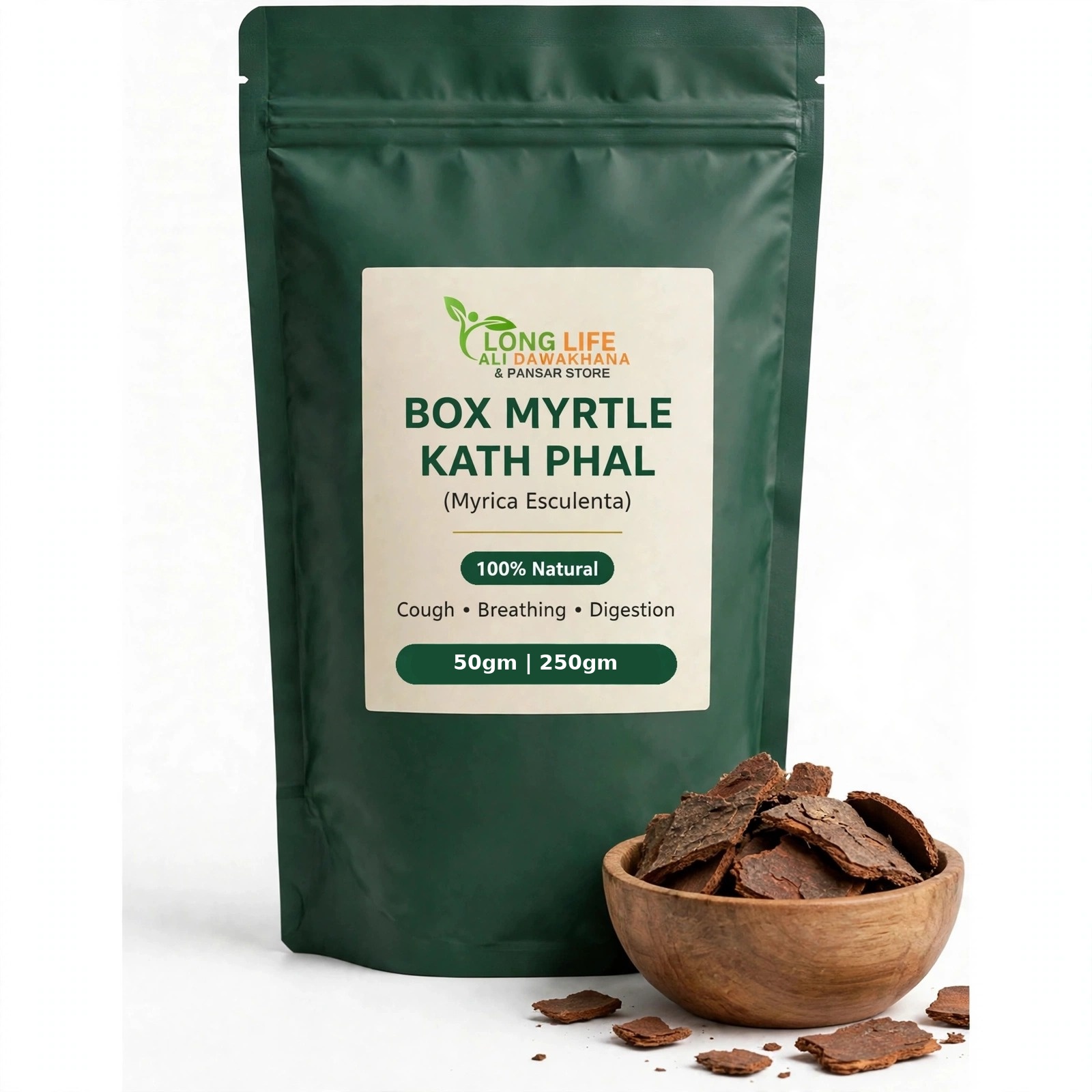
Box Myrtle (Kath Phal, Myrica esculenta) is the dried bark of the Himalayan bayberry tree, the Ayurvedic drug Katphala — a classical remedy for cough, asthma, blocked nose and throat complaints, listed in the Ayurvedic Pharmacopoeia of India. Its main compound is myricetin, and there are no human trials of the bark. Two things a buyer should know first: the product is the bark, not the edible Kaphal fruit, and the one published paper on its use in diabetes has been retracted. At Long.pk it is available in Whole and Powder forms (50 gm and 250 gm) from Rs 211, with Cash on Delivery across Pakistan.
کاٹھپل (Box Myrtle) — مکمل معلومات
کاٹھپل، جسے انگریزی میں Box Myrtle کہتے ہیں، ہمالیہ کے درخت (Myrica esculenta) کی چھال ہے۔
اہم انتباہ: کاٹھپل گرم اور خشک مزاج کی دوا ہے — تیزابیت (hyperacidity) والے افراد احتیاط کریں۔ حاملہ خواتین اسے استعمال نہ کریں۔
Box Myrtle (Kath Phal) – Price in Pakistan, Benefits, Uses & Safety
Direct answer: Box Myrtle (Kath Phal, Myrica esculenta) price in Pakistan starts from Rs 211 for 50 gm (Whole form) at Long.pk, going up to Rs 1,148 for 250 gm (Powder form). It is available in two forms — Whole and Powder — in 50 gm and 250 gm packs, with cash on delivery across Pakistan.
- What Is Box Myrtle?
- History of Box Myrtle
- Active Compounds
- Box Myrtle in Ayurveda & Folk Medicine
- What Does Modern Research Say?
- Detailed Benefits of Box Myrtle
- Bark vs Fruit — What This Product Actually Is
- Who Is Box Myrtle For?
- How to Use Box Myrtle
- Traditional Combinations
- Dosage & Duration
- Side Effects & Who Should Avoid It
- How to Identify Original Box Myrtle
- Storage & Shelf Life
- Box Myrtle vs Liquorice vs Plantain Seeds
- Box Myrtle Price in Pakistan
- Product Specifications
- Roman Urdu
- Frequently Asked Questions
What Is Box Myrtle?
Box Myrtle — Urdu Kath Phal (کاٹھپل), Sanskrit Katphala — is the dried stem bark of Myrica esculenta Buch.-Ham. ex D. Don, an evergreen tree of the Myricaceae (bayberry family) native to the Himalayas and the hills of the Indian subcontinent.
History of Box Myrtle
Katphala is one of the oldest drugs in Ayurveda. It is mentioned in the Charaka Samhita, the Sushruta Samhita and the works of Vagbhata — the three great classical texts — and the Bhavaprakasha Nighantu gives its full properties and uses.
Active Compounds
The bark of Box Myrtle is one of the richest sources of flavonoids in the Himalayan flora — and the bark itself (not just the fruit or leaves) is what modern science has studied.
Box Myrtle in Ayurveda & Folk Medicine
In Ayurveda, Katphala is defined by its properties: Kashaya (astringent) and Tikta (bitter) in taste, Laghu (light) and Tikshna (sharp, penetrating) in quality, Ushna (hot) in potency, and Katu (pungent) in its post-digestive effect.
What Does Modern Research Say?
Here is the honest summary first: there are no published human clinical trials of Myrica esculenta bark for any condition. Everything below is laboratory (in vitro), computer-modelling (in silico) or animal work.
The anti-inflammatory study (MDPI 2023). The most thorough modern paper on the bark compared extracts of the bark, leaves and fruit and found that the bark had the highest phenolic and flavonoid content of any part.
The other laboratory findings. Bark and fruit extracts have shown analgesic (pain-relieving), hepatoprotective (liver-protecting), antimicrobial and antioxidant activity in laboratory and animal studies.
Detailed Benefits of Box Myrtle
Cough & Breathing — Asthma and Bronchitis (Traditional + Lab)
This is the herb’s defining use. In Ayurveda Box Myrtle is the bark for Kasa (cough) and Shwasa (breathing difficulty).
Nose & Sinuses — Rhinitis and Congestion (Traditional)
The second great use is for the nose.
Throat & Voice — Gargle for Hoarseness (Traditional)
The bark decoction is used as a gargle for throat pain, hoarseness and oral disease, and for toothache.
Fever (Traditional)
The classical texts list Katphala for Jwara (fever), particularly fever with congestion and a heavy, cold feeling.
Digestion & Diarrhoea (Traditional)
The astringent tannins give the bark its traditional use for diarrhoea and dysentery.
Skin & Wounds (Traditional + Lab)
The bark powder is applied to wounds in the folk tradition.
Blood Sugar — Traditional Use Only, No Valid Evidence (Traditional; Key Paper Retracted)
Pansaar’s listing mentions diabetes among the bark’s uses, and the traditional record does include it — so buyers deserve an honest answer.
Bark vs Fruit — What This Product Actually Is
This is the most important section of the article for a buyer, because the tree has two famous products and this listing sells only one of them — and the two are easy to confuse.
The bark — this product. The thick, curved, dark reddish-brown stem bark, sold as Whole pieces or as Powder.
Who Is Box Myrtle For?
Box Myrtle suits people who:
- Want a traditional cough and breathing remedy in the Ayurvedic style.
- Have recurrent rhinitis or sinus congestion and want a traditional decoction for a blocked nose and heavy head.
- Want a throat gargle for hoarseness and sore throat from the classical tradition.
How to Use Box Myrtle
Powder: Take 2–4 g of the bark powder once daily with water or honey. Some classical sources give a lower range of 1–3 g a day — start at 2 g and do not exceed 4 g without a hakim’s advice.
Decoction: Add 5–10 g of the whole bark to 2 cups (about 400 ml) of water. Bring to the boil, then simmer until reduced to about 1 cup.
Traditional Combinations
- Chaturbhadra Churna — the classical compound for bronchial asthma.
- Box Myrtle + Liquorice (Mulethi) — the cough pairing.
- Box Myrtle + Honey — honey as the vehicle (anupana) for the bark powder, especially for cough and throat complaints, and to make the bitter powder palatable.
Dosage & Duration
There is no modern dose-finding study for Box Myrtle, so all doses below are from the classical Ayurvedic texts and traditional practice. Start at the lower end and stop if you feel unwell.
| Preparation | Dose | Frequency |
|---|---|---|
| Bark powder | 2–4 g | Once daily |
| Decoction (5–10 g bark in 400 ml water, reduced to 200 ml) | 50–100 ml | Twice daily |
| Gargle (decoction, cooled) | Gargle 30 seconds | 2–3 times daily |
Side Effects & Who Should Avoid It
Box Myrtle has a long classical record and side effects at traditional doses are uncommon — but it is a heating, drying bark with real cautions, and one of them is a genuine contradiction in the sources.
Liver and spleen — the honest contradiction. The classical texts warn Katphala may harm the liver and spleen, but modern animal studies found the opposite — hepatoprotective (liver-protecting) effects and low toxicity.
Heating and drying — Pitta and acidity. Katphala is hot in potency (Ushna veerya) and increases Pitta.
Pregnancy — not advised. The classical and modern sources agree that Katphala is not advised in pregnancy.
Breastfeeding — avoid medicinal doses. There is no safety data for nursing mothers. Wait until after weaning.
Children under 12 — avoid. No safety data, and the nasya in particular is not a children’s procedure.
Surgery. As a general precaution, stop using medicinal doses two weeks before planned surgery.
How to Identify Original Box Myrtle
Appearance: Genuine dried Box Myrtle bark is a bundle of thick, curved, dark reddish-brown pieces — the bark curls as it dries, and the outer surface carries greenish-grey patches where the outer bark has weathered. The inner surface is lighter, reddish-tan and fibrous.
Storage & Shelf Life
- Whole bark: keeps 18–24 months in an airtight container in a cool, dry place away from direct sunlight.
- Powder: keeps 9–12 months — ground herbs lose their active compounds faster, so buy powder in smaller quantities and use it up.
- Seal tightly after every use.
Box Myrtle vs Liquorice vs Plantain Seeds
| Feature | Box Myrtle (Kath Phal) | Liquorice Root (Mulethi) | Plantain Seeds (Bartang) |
|---|---|---|---|
| Botanical name | Myrica esculenta | Glycyrrhiza glabra | Plantago major |
| Part used | Stem bark | Root and stolon | Seeds |
| Key compound | Myricetin (flavonoid) | Glycyrrhizin (saponin) | Mucilage, aucubin |
Box Myrtle Price in Pakistan
| Form | 50 gm | 250 gm |
|---|---|---|
| Whole | Rs 211 | Rs 861 |
| Powder | Rs 346 | Rs 1,148 |
Best value: Whole 250 gm at Rs 3.44 per gram — the Powder costs more per gram at every size.
Product Specifications
| Product Name | Box Myrtle (Kath Phal) |
| Urdu Name | کاٹھپل (Kath Phal) |
| Botanical Name | Myrica esculenta Buch.-Ham. ex D. Don (syn. Morella esculenta; pansaar: Myrica nagi Thunb.) |
| Family | Myricaceae (bayberry family) |
| English Names | Box Myrtle, Himalayan Bayberry |
| Sanskrit Name | Katphala |
| Hindi / Himalayan Names | Kaphal, Kaafal (the fruit) |
| Part Used | Stem bark (dried) |
| Forms | Whole / Powder |
| Weights | 50 gm, 250 gm |
| Price Range | Rs 211 – Rs 1,148 |
| Key Compound | Myricetin (flavonoid) |
| Temperament (Ayurveda) | Hot potency (Ushna veerya); Kapha-Vata hara, Pittavardhak |
| Additives | None — 100% natural |
| Shelf Life | Whole bark 18–24 months; Powder 9–12 months |
| Storage | Airtight container, cool and dry, away from sunlight |
| Seller | Ali Dawakhana and Pansar Store |
| Delivery | Cash on Delivery across Pakistan |
Roman Urdu
Kath Phal (Box Myrtle) Himalaya ke darakht (Myrica esculenta) ki chhaal hai, jise Ayurveda mein Katphala kehte hain. Yeh Charaka, Sushruta aur Bhavaprakasha ki classical dawa hai aur Ayurvedic Pharmacopoeia of India mein is ka monograph mojood hai.
Is ka sab se ahem compound myricetin hai — aik flavonoid jo lab studies mein COX-1, COX-2 aur TNF-α ke khilaf anti-inflammatory asar dikhata hai.
Frequently Asked Questions
Q: Kath Phal kis kaam aata hai?
Kath Phal (Box Myrtle, Myrica esculenta) Ayurveda ki classical dawa Katphala hai — khansi, damah, nazla, naak ki bandish.
Q: Box Myrtle ki Pakistan mein qeemat kya hai?
Rs 211 se Rs 1,148 tak — Whole 50 gm Rs 211, 250 gm Rs 861; Powder 50 gm Rs 346, 250 gm Rs 1,148.
Q: Kya Kath Phal khansi aur damah mein madad karta hai?
Rawayati tor par haan — yeh Ayurveda ki khansi aur damah ki bunyadi dawa hai aur Chaturbhadra Churna ka aik juz hai.
Q: Kath Phal ki chhaal aur phal (Kaphal) mein kya farq hai?
Chhaal Ayurvedic dawa (Katphala) hai — moti, murri hui, gehri bhoori chhaal, jis mein myricetin aur tannins hotay hain; is ka istemal khansi, damah aur nazla ke liye hai.
Q: Kath Phal kaisay istemal karte hain?
Teen tareeqay hain: (1) powder — 2 se 4 gram din mein aik baar pani ya shehed ke saath; (2) qehwa — 5 se 10 gram chhaal 2 cup pani mein ubaal kar 1 cup reh janay par chhaan kar din mein 2 baar 50 se 100 ml piyein; (3) ghararay — galay ke liye thanday qehwe se din mein 2 se 3 baar ghararay karein.
Q: Kya Kath Phal diabetes mein madad karta hai?
Is ka koi sabit shuda saboot nahi hai.
Q: Kya Kath Phal jigar ke liye nuqsan deh hai?
Is par zaraye mein ikhtilaaf hai: classical kutub mein likha hai ke yeh jigar aur tilli ko nuqsan pahuncha sakta hai.
Q: Kya Kath Phal hamila khawateen le sakti hain?
Nahi — classical aur jadeed zaraye dono mein hamal mein is se mana kiya gaya hai.
Q: Kath Phal ki nasya (naak mein powder) kaisay karte hain?
Nasya aik hakeem ya doctor ki nigrani mein ki janay wali classical tarkeeb hai — bareek powder ki chutki naak mein daali jati hai taake chheenk aaye aur naak saaf ho.
Q: Asli Kath Phal ki pehchan kya hai?
Asli chhaal moti, murri hui, gehri surkh-bhoori hoti hai — bahar se sabz-bhoori dhabbay, andar se halki surkh resha daar satah.
Related Products
- Liquorice Root (Mulethi) — cough and throat soothing, the classical partner herb for Katphala.
- Jujube Berries (Unab) — cough and throat comfort.
- Plantain Seeds (Bartang) — respiratory and digestive support.
- Organic Moringa Leaf Powder — a general daily tonic.
Ali Dawakhana and Pansar Store — Asli desi dawa aur khalis jadi bootiyan, ab ghar baithay Long.pk se mangwayen.
Reviews
There are no reviews yet