
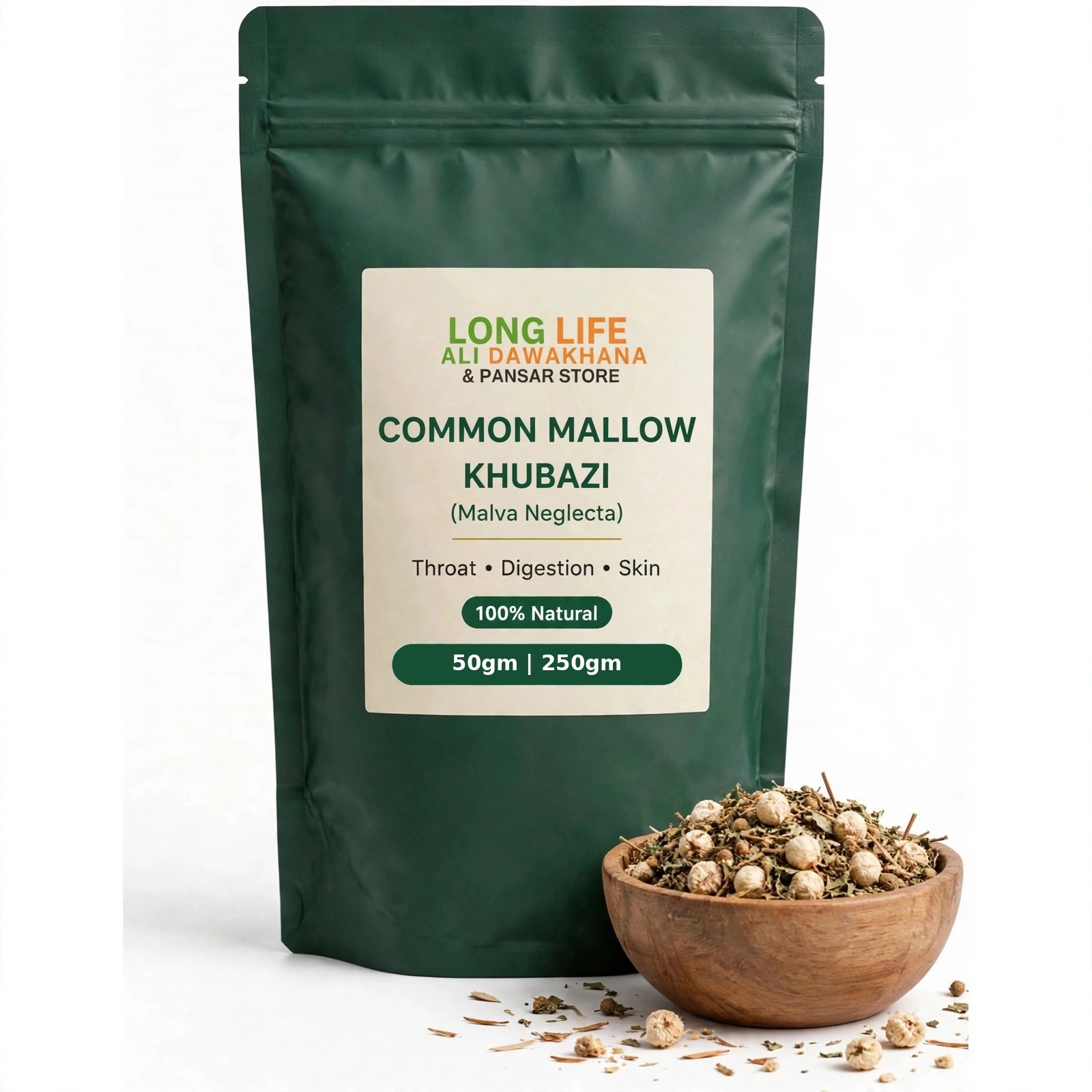
Common Mallow (Khubazi, Malva neglecta) is the dried leaf, fruit and stem of the dwarf mallow — a cooling, mucilage-rich herb used for centuries as a soothing demulcent for dry cough, sore throat, constipation and irritated skin. The European Medicines Agency accepts mallow leaf as a traditional remedy for mouth and throat irritation with dry cough, and small human trials of its close relative Malva sylvestris support its use for constipation. At Long.pk it is available in Whole and Powder forms (50 gm and 250 gm) from Rs 203, with Cash on Delivery across Pakistan.
خبازی (Common Mallow) — مکمل معلومات
خبازی، جسے انگریزی میں Common Mallow یا Dwarf Mallow کہتے ہیں، ایک مشہور یونانی بوٹی ہے جو صدیوں سے کھانسی، گلے کی خراش، قبض اور جلد کی سوزش کے لیے استعمال ہوتی آئی ہے۔
اہم انتباہ: خبازی عام طور پر ایک نرم اور محفوظ بوٹی سمجھی جاتی ہے، لیکن حاملہ خواتین اور 12 سال سے چھوٹے بچے اسے دوا کے طور پر استعمال نہ کریں — ان کے لیے حفاظتی ڈیٹا موجود نہیں ہے۔ دوائیں لینے والے افراد خبازی کو اپنی دوا سے ایک سے دو گھنٹے کے فاصلے پر لیں، کیونکہ اس کی لیس دوا کے جذب کو سست کر سکتی ہے۔
Common Mallow (Khubazi) – Price in Pakistan, Benefits, Uses & Safety
Direct answer: Common Mallow (Khubazi, Malva neglecta) price in Pakistan starts from Rs 203 for 50 gm (Whole form) at Long.pk, going up to Rs 1,036 for 250 gm (Powder form). It is available in two forms — Whole and Powder — in 50 gm and 250 gm packs, with cash on delivery across Pakistan.
- What Is Common Mallow?
- History of Common Mallow
- Active Compounds
- Common Mallow in Unani, Ayurveda & Folk Medicine
- What Does Modern Research Say?
- Detailed Benefits of Common Mallow
- Khubazi: Two Mallows, One Medicine
- Who Is Common Mallow For?
- How to Use Common Mallow
- Traditional Combinations
- Dosage & Duration
- Side Effects & Who Should Avoid It
- How to Identify Original Common Mallow
- Storage & Shelf Life
- Common Mallow vs Marsh Mallow vs Plantain Seeds
- Common Mallow Price in Pakistan
- Product Specifications
- Roman Urdu
- Frequently Asked Questions
What Is Common Mallow?
Common Mallow — Urdu Khubazi (خبازی) — is the dried aerial herb of Malva neglecta Wallr., a low-growing annual or biennial of the Malvaceae (mallow family).
Which part is used? The leaves, fruits and stems — the whole aerial herb — are the product sold here.
History of Common Mallow
Common Mallow is one of the oldest food-medicines in the world: its use as food and medicine dates back to around 3000 BC, and Unani medicine has used Khubazi for more than two thousand years.
Active Compounds
The chemistry of Common Mallow is dominated by one substance: mucilage — a complex of polysaccharides (chiefly rhamnogalacturonans and arabinogalactans) that swells in water to form a thick, slippery gel.
Common Mallow in Unani, Ayurveda & Folk Medicine
In Unani medicine, Khubazi is a cold-and-moist drug — cold and moist in the first degree — and its actions are recorded consistently across the classical texts: Mulayyin (mild laxative), Mugharri (demulcent, soothing), Mufattih-i-Sudad (deobstruent, opening blockages), Mudirr-i-Baul (diuretic) and Muqawwi (tonic).
What Does Modern Research Say?
Here is the honest summary first: mallow has more human-trial evidence than most herbs in this series — but every trial used Malva sylvestris, not Malva neglecta, and most used a standardised flower extract, not the whole dried herb.
Constipation — the best trial evidence. Elsagh et al. (2015, Complementary Therapies in Clinical Practice 21(2):105-11) ran a randomised, placebo-controlled trial in 50 adults with functional constipation: a syrup of M. sylvestris flower aqueous extract (1 g extract/day) for four weeks.
Detailed Benefits of Common Mallow
Every benefit below is labelled with its evidence level: traditional (classical Unani/folk use), clinical (human trials — all on M. sylvestris extracts, flagged as such), or lab/animal (test-tube or animal studies). Nothing here is a proven medical claim for this product.
Dry Cough & Sore Throat (Traditional + EMA Monograph)
This is mallow’s defining use. The mucilage coats the irritated mucous membranes of the mouth and throat with a slippery film.
Constipation & Gut Comfort (Clinical — M. sylvestris Extracts)
The strongest trial evidence in mallow’s record belongs here.
Stomach Acidity & Mild Indigestion (Traditional + EMA Monograph)
The EMA’s second monograph indication is mild gastrointestinal discomfort.
Urinary Irritation (Traditional)
Unani medicine prescribes Khubazi for strangury (painful, difficult urination), cystitis and urinary discharges, and the folk record from Turkey to Iran agrees.
Skin — Wounds, Boils & Bites (Traditional + Animal)
A hot poultice of mallow leaves is one of the oldest wound dressings in the Mediterranean.
Jaundice & Liver (Traditional + Lab)
Unani medicine lists Khubazi for Yarqan (jaundice), and in Mashhad it is one of the most commonly used plants for jaundice.
Mouth Sores & Gum Irritation (Clinical — M. sylvestris)
The triple-blind trial in 70 cancer patients found a mallow mouthwash superior to chlorhexidine for chemotherapy-induced stomatitis.
Khubazi: Two Mallows, One Medicine
This is the section that matters most for a buyer, because the name “common mallow” covers two different plants — and the trade uses both.
Does the difference matter? For practical purposes, much less than it might seem. The two Malva species share the same mucilage chemistry, the same traditional uses and the same safety profile.
Who Is Common Mallow For?
Common Mallow suits people who:
- Have a dry, tickling cough or a sore, irritated throat and want a gentle, traditional demulcent tea.
- Suffer from occasional constipation or hard stools and want a mild, non-griping remedy.
- Have mild stomach acidity or heaviness after meals and want a soothing, coating tea.
How to Use Common Mallow
Hot infusion (the EMA preparation): Put 1.8 g of the dried herb (about 1 teaspoon) in a cup, pour over 150 ml of freshly boiled water, cover and steep for 10–15 minutes, then strain. Drink 3 cups a day, preferably between meals.
Traditional Combinations
- Khubazi + Liquorice (Mulethi) — the classical cough and throat pairing.
- Khubazi + Jujube (Unab) — a Unani cough and chest pairing.
- Khubazi + Plantain Seeds (Bartang) — the gentle-bowel pairing.
Dosage & Duration
The EMA monograph gives a precise dose for mallow leaf, and the Unani tradition gives a range for the whole herb. Both are given below — start at the lower end.
| Preparation | Dose | Frequency |
|---|---|---|
| Hot infusion (EMA dose) | 1.8 g herb in 150 ml boiling water | 3 times daily |
| Cold maceration | 2–3 tsp herb in 1 glass cold water, overnight | 1–2 glasses daily |
Side Effects & Who Should Avoid It
Common Mallow is a food herb with a long record of safe use — the EMA assessment found no side effects reported with mallow leaf medicines — but it still has real cautions.
Pregnancy — avoid medicinal doses. Mallow leaves are eaten as food in many cultures, and folk practice valued them as a source of iron and vitamins for pregnant women.
Breastfeeding — avoid medicinal doses. There is no safety data for nursing mothers. Food-level use is traditional, but teas and powders should wait.
Children under 12 — avoid. The EMA does not recommend medicinal mallow leaf below 12 years for lack of data.
Medicines — leave a gap. Mucilage can slow the absorption of other medicines taken at the same time.
Blood sugar. Laboratory studies show mallow extracts inhibit α-amylase and α-glucosidase (the enzymes that break down starch) — which means it could, in theory, lower blood sugar.
Allergies. People allergic to plants of the mallow family (Malvaceae) — including hibiscus, hollyhock, okra and cottonseed — should be cautious.
How to Identify Original Common Mallow
Appearance: Genuine dried Common Mallow is a mix of crumbled grey-green leaves, thin stems and — most distinctively — small, round, pale beige cheese-round fruits (schizocarps), each about the size of a small button.
Storage & Shelf Life
- Whole herb: keeps 12–18 months in an airtight container in a cool, dry place away from direct sunlight.
- Powder: keeps 9–12 months — ground herb loses its mucilage quality faster, so buy powder in smaller quantities and use it up.
Common Mallow vs Marsh Mallow vs Plantain Seeds
| Feature | Common Mallow (Khubazi) | Marsh Mallow (Khitmi) | Plantain Seeds (Bartang) |
|---|---|---|---|
| Botanical name | Malva neglecta | Althaea officinalis | Plantago major |
| Part used | Leaf, fruit and stem | Root (mainly) | Seeds |
| Key compound | Mucilage polysaccharides | Mucilage (higher content) | Mucilage (seed coat) |
Common Mallow Price in Pakistan
| Form | 50 gm | 250 gm |
|---|---|---|
| Whole | Rs 203 | Rs 861 |
| Powder | Rs 336 | Rs 1,036 |
Best value: Whole 250 gm, Rs 3.44 per gram — the Powder costs more per gram at every size.
Product Specifications
| Product Name | Common Mallow (Khubazi) |
| Urdu Name | خبازی (Khubazi) |
| Botanical Name | Malva neglecta Wallr. (Unani texts describe Khubazi as Malva sylvestris L.; the EMA monograph covers both species) |
| Family | Malvaceae (mallow family) |
| English Names | Dwarf Mallow, Cheeseweed, Cheese Plant, Button Weed, Round-Leaved Mallow |
| Arabic Name | Khubbaizah (خبازی) |
| Part Used | Leaf, fruit and stem (dried aerial herb) |
| Forms | Whole / Powder |
| Weights | 50 gm, 250 gm |
| Price Range | Rs 203 – Rs 1,036 |
| Key Compound | Mucilage polysaccharides |
| Temperament (Unani) | Cold and moist (1st degree) |
| Additives | None — 100% natural |
| Shelf Life | Whole herb 12–18 months; Powder 9–12 months |
| Storage | Airtight container, cool and dry, away from sunlight |
| Seller | Ali Dawakhana and Pansar Store |
| Delivery | Cash on Delivery across Pakistan |
Roman Urdu
Khubazi (Common Mallow) aik mashhoor Yunani booti hai jo sadiyon se khansi, galay ki kharash, qabz aur jild ki sozish ke liye istemal hoti aa rahi hai.
Istemaal: chai ke liye 1.8 gram (taqreeban aik chai ka chamach) khushk booti aik cup ubaltay pani mein daal kar 10 se 15 minute dhak kar rakhein.
Frequently Asked Questions
Q: Khubazi kis kaam aati hai?
Khubazi (Common Mallow) Yunani tib mein aik mashhoor les daar booti hai — khushk khansi, galay ki kharash, qabz aur jild ki sozish ke liye istemal hoti hai.
Q: Common Mallow ki Pakistan mein qeemat kya hai?
Rs 203 se Rs 1,036 tak — Whole 50 gm Rs 203, 250 gm Rs 861; Powder 50 gm Rs 336, 250 gm Rs 1,036.
Q: Khubazi Malva neglecta hai ya Malva sylvestris?
Pansaar ki listing mein is ka naam Malva neglecta (dwarf mallow) hai, jab ke Yunani kutub mein Khubazi ko aam tor par Malva sylvestris kaha jata hai.
Q: Kya Khubazi khansi mein madad karti hai?
Rawayati tor par haan — is ka les galay ki jhilli par naram teh bana kar khushk khansi ko sukoon deta hai, aur EMA ne isi istemal ko tasleem kiya hai.
Q: Khubazi qabz ke liye kaisi hai?
Qabz ke liye is ke sab se achay saboot hain — Malva sylvestris ke extract par teen chhoti randomised trials (2015, 2025) mein pait ki harkat barhi aur sakht pakhana kam hua.
Q: Khubazi ki chai kaisay banatay hain?
Garam chai: 1.8 gram (aek chai ka chamach) khushk booti aik cup ubaltay pani mein 10 se 15 minute dhak kar rakhein, chhaan kar din mein teen baar piyein.
Q: Kya Khubazi hamila khawateen le sakti hain?
Nahi — dawa ke tor par nahi.
Q: Kya Khubazi doosri dawaon ke saath le sakte hain?
Faasla rakh kar — Khubazi ko apni doosri dawa se aik se do ghantay pehle ya baad mein lein.
Q: Khubazi aur marsh mallow mein kya farq hai?
Dono mallow family ki les daar bootiyan hain.
Q: Asli Khubazi ki pehchan kya hai?
Asli khushk Khubazi mein chhotay gol, halke bhure “cheese” phal (button jitnay) nazar aatay hain — yeh is ki sab se achi pehchan hai.
Related Products
- Liquorice Root (Mulethi) — throat and cough comfort, the classical demulcent partner for mallow.
- Plantain Seeds (Bartang) — gentle bowel and gut support.
- Jujube Berries (Unab) — a soothing Unani cough fruit.
- Organic Moringa Leaf Powder — a general daily tonic.
Ali Dawakhana and Pansar Store — Asli desi dawa aur khalis jadi bootiyan, ab ghar baithay Long.pk se mangwayen.
Reviews
There are no reviews yet