
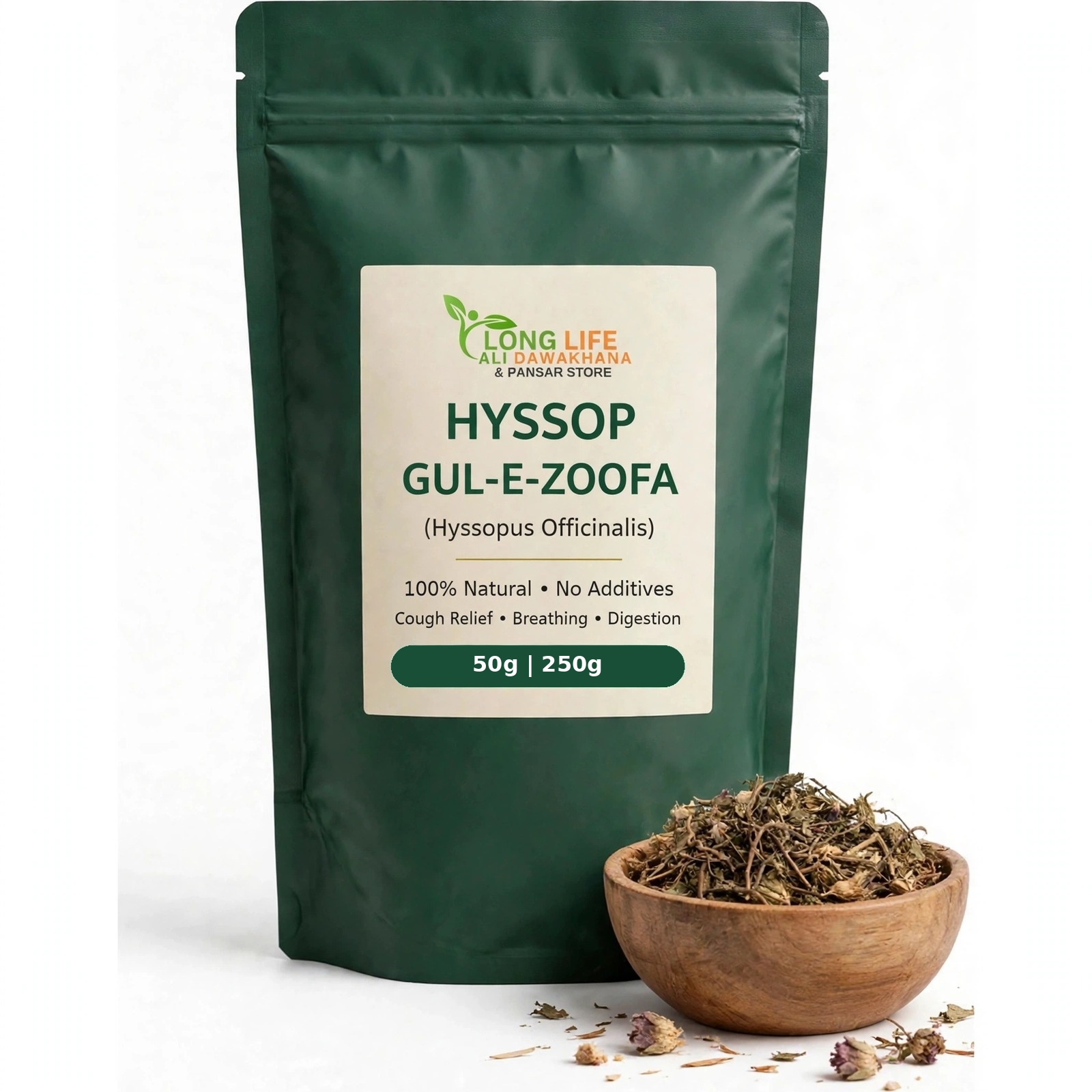
Hyssop (Gul-e-Zoofa) is the dried flowering herb of Hyssopus officinalis, a mint-family plant used for centuries as a cough and breathing remedy in Unani medicine. It is sold as a loose herb for tea and decoction — not the concentrated essential oil, which carries a seizure risk at drop doses. Prices start at Rs 175 for 50 gm, available in Whole and Powder forms (50 gm and 250 gm) with cash on delivery across Pakistan.
زوفا (گل زوفا) — سانس، کھانسی اور ہاضمے کی قدیم جڑی بوٹی
زوفا (گل زوفا) پودینے کے خاندان کی ایک خوشبودار جڑی بوٹی ہے جو صدیوں سے یونانی طب میں کھانسی اور سانس کی تکالیف کے لیے استعمال ہوتی آئی ہے۔
احتیاط: زوفا کا تیل بہت طاقتور ہے اور چند بوندیں بھی دورے کا سبب بن سکتی ہیں، اس لیے تیل کبھی نہ پییں۔ یہ پروڈکٹ خشک جڑی بوٹی ہے، تیل نہیں۔ حاملہ خواتین، مرگی کے مریض اور چھوٹے بچے اسے استعمال نہ کریں۔
Hyssop (Gul-e-Zoofa) — The Ancient Cough & Breathing Herb
Direct answer: Hyssop (Urdu: Gul-e-Zoofa, گل زوفا; Hyssopus officinalis) is a mint-family herb used for over 2,000 years as an expectorant for coughs and chest congestion. Its oil is rich in pinocamphone and isopinocamphone — ketones that make the concentrated oil dangerous to swallow. This product is the dried herb for tea. Evidence: traditional use, but only one small human trial.
- What Is Hyssop?
- History: From Biblical Cleansing to the Pansar’s Shelf
- Active Compounds
- Hyssop in Unani, Ayurveda & Folk Medicine
- What Does Modern Research Say?
- Benefits of Hyssop
- Dried Herb vs Essential Oil: The Safety Distinction That Matters
- Who Is Hyssop For?
- How to Use Hyssop
- Traditional Combinations
- Dosage & Duration
- Side Effects & Who Should Avoid It
- Quality Guide: How to Buy Good Hyssop
- Storage
- Hyssop vs Thyme vs Rosemary
- Price in Pakistan
- Specifications
- Roman Urdu Summary
- Frequently Asked Questions
What Is Hyssop?
Hyssop is a perennial mint-family subshrub with aromatic leaves and flower spikes. The medicine is the dried aerial herb — flowering tops, leaves and thin stems — harvested as the flowers open, when oil content (0.3–1.8%) is highest. In Pakistan it is Gul-e-Zoofa (گل زوفا); not anise hyssop (Agastache foeniculum), a different plant.
History: From Biblical Cleansing to the Pansar’s Shelf
The Hebrew Bible’s ezov, used in cleansing rituals, was probably Syrian oregano, not H. officinalis. Hippocrates, Dioscorides (1st century CE) and Ibn Sina prescribed it for coughs and chest complaints; Ibn Sina called zufa a warming herb for loosening thick phlegm.
Active Compounds
| Compound group | Key constituents | What it does |
|---|---|---|
| Monoterpene ketones | Pinocamphone, isopinocamphone (60–75% of oil) | Expectorant; neurotoxic |
| Monoterpenes | β-pinene, α-pinene, 1,8-cineole | Antimicrobial |
| Flavonoids | Diosmin, apigenin, quercetin, luteolin | Antioxidant |
| Phenolic acids & tannins | Rosmarinic, caffeic, chlorogenic acids; tannins | Astringent |
The decumbens variety is linalool-rich, with only traces of pinocamphones.
Hyssop in Unani, Ayurveda & Folk Medicine
In Unani medicine, Gul-e-Zoofa is hot and dry (garam o khushk) — an expectorant, carminative and mild diuretic, and the classic remedy for the old, hard cough with thick, stuck mucus. Prescribed as a decoction (joshanda) for cough and asthma, and as a gargle for sore throat. Ayurveda has no classical hyssop.
What Does Modern Research Say?
Honest summary: centuries of traditional use and much lab and animal research, but almost no human clinical evidence. Lab and animal studies show antimicrobial, antiviral, antioxidant and anti-inflammatory effects — all preliminary.
The one controlled human trial is Daneshfard 2024 (Tanaffos; IRCT20110811007297N5): 70 adults with mild to moderate asthma took 5 mL of hyssop syrup or sugar syrup twice daily for four weeks alongside their usual inhalers. One small trial cannot settle whether hyssop helps asthma.
Benefits of Hyssop
1. Loosens Phlegm and Eases Coughs
Thins thick mucus; makes coughs more productive.
2. Supports Breathing in Asthma and Bronchitis
A Unani asthma ingredient, usually with liquorice and figs.
3. Soothes Sore Throat and Hoarseness
A cooled infusion as a gargle for sore throats.
4. Eases Digestion, Gas and Bloating
A carminative: it stimulates digestion and dispels gas.
5. Supports Circulation and Joint Comfort
Tea and warm compresses for arthritic joints and poor circulation.
6. Astringent Skin and Wound Care
Tannins tighten tissue — for minor cuts and bruises.
7. Mild Diuretic Action and Fluid Balance
A mild Unani diuretic; no human blood-pressure evidence.
8. Antioxidant Support
Moderate antioxidant capacity in lab assays.
Dried Herb vs Essential Oil: The Safety Distinction That Matters
The essential oil is the dangerous one. Ordinary hyssop oil is 60–75% pinocamphone and isopinocamphone, ketones that act as GABA-A receptor antagonists, blocking the brain’s main inhibitory signal. Documented cases: in 1978, an 18-year-old had convulsions an hour after swallowing 30 drops of hyssop oil (Arditti); in 1981, a 26-year-old woman had a seizure after 10 drops on two consecutive days (Millet). Tisserand and Young (2014) cap oral intake at 0.1 mg/kg — about 7 mg for a 70 kg adult. Never swallow hyssop essential oil, and never give it to children.
The dried herb is a different dose entirely. A cup of tea from 2 g of herb starts with roughly 6–36 mg of total oil, and only part extracts. No study has measured how much pinocamphone ends up in a brewed cup, but it is far below the seizure-causing oil doses. This product is the dried herb for tea and decoction — not the essential oil.
Who Is Hyssop For?
- Adults with a lingering cough, sluggish digestion, or sore throats wanting a traditional gargle.
- Herbalists needing genuine Gul-e-Zoofa for Unani decoctions.
Hyssop is not for pregnant or breastfeeding women, anyone with epilepsy, children under 12, or anyone seeking a proven treatment for any disease.
How to Use Hyssop
Tea: 1–2 tsp (2–4 g) per cup, steep 10–15 minutes, strain — up to 3 cups a day. Decoction: simmer 5 g in 2 cups of water down to 1 cup; twice daily. Gargle: strong infusion, cooled, 30 seconds, 2–3 times a day. Steam: a tablespoon in a bowl of just-boiled water, breathe 5–10 minutes. Compress: a cloth soaked in a strong infusion on bruises, 15–20 minutes. Powder: same doses; steep 8–10 minutes, use a tea strainer.
Traditional Combinations
| Combination | Purpose | How to use |
|---|---|---|
| Hyssop + liquorice (Mulethi) + ginger | Unani cough decoction | Simmer, strain |
| Hyssop + figs + honey | European lung remedy | Steep with figs |
| Hyssop + thyme | Stronger chest tea | 1 tsp each |
| Hyssop + mint (Pudina) | Digestive tea | 10 min |
| Hyssop + chamomile (Babuna) | Calming evening tea | With honey |
| Hyssop + sage gargle | Sore throat | Gargle 2–3× daily |
Dosage & Duration
- Tea: 2–4 g (1–2 tsp) per cup, up to 3× daily (British Herbal Pharmacopoeia). Decoction: 5 g, twice daily.
- Gargle: strong infusion, 2–3× daily; powder: same doses, steep 8–10 minutes.
- Duration: up to 2–3 weeks, then a break of at least a week. A short-course remedy, not a daily tonic.
- Never exceed the dose or ingest the essential oil.
Side Effects & Who Should Avoid It
Do NOT use hyssop if you:
- Epilepsy or any history of seizures — the pinocamphones lower the seizure threshold; this applies to the herb as a precaution, and absolutely to the oil.
- Pregnant or breastfeeding — the ketones cross the placenta; no safe dose is established.
- Children under 12 — the oil is prohibited in young children and the herb tea is not recommended.
Use with caution if you take blood thinners, diabetes medication or sedatives, or are allergic to mint-family plants.
Possible side effects: nausea, dizziness, headache. Seek medical help immediately for twitching, confusion, or any seizure-like symptom — and tell the doctor exactly what you took.
Quality Guide: How to Buy Good Hyssop
- Flowering tops, not bare stems — good hyssop shows small dried flower buds and plenty of grey-green leaves.
- Colour and scent: grey-green with hints of purple; a crushed pinch should smell strongly of warm camphor-mint.
- Cleanliness and form: free of dust, grit and mould. Whole herb keeps its oil longest.
Storage
Store hyssop in an airtight jar, cool, dark and dry. Whole herb keeps 12–18 months; powder 6–9 months. If a crushed pinch no longer smells warm and camphor-like, it is spent.
Hyssop vs Thyme vs Rosemary
| Feature | Hyssop | Thyme | Rosemary |
|---|---|---|---|
| Main use | Cough, phlegm, congestion | Cough, sore throat | Memory, circulation, hair |
| Key compounds | Pinocamphone, isopinocamphone | Thymol, carvacrol | 1,8-cineole, camphor, rosmarinic acid |
| Safety concern | Seizure risk (oil); avoid in epilepsy, pregnancy | Safe as tea; oil irritates skin | Camphor; avoid in epilepsy, pregnancy |
| Human evidence | One small asthma trial | Some cough trials | Small memory, hair trials |
| Best for | Old, phlegmy coughs | Acute sore throat | Circulation, focus, cooking |
Price in Pakistan
| Form | 50 gm | 250 gm |
|---|---|---|
| Whole | Rs 175 | Rs 1,275 |
| Powder | Rs 275 | Rs 1,275 |
Prices follow the source website (Pansaar). Range: Rs 175–1,275. Best value: Whole 50 gm at Rs 3.50/g. Cash on delivery across Pakistan.
Specifications
| Product name | Hyssop (Gul-e-Zoofa) |
| Urdu name | گل زوفا (Gul-e-Zoofa) |
| Botanical name | Hyssopus officinalis L. |
| Family | Lamiaceae (mint family) |
| Part used | Dried aerial herb — flowering tops, leaves and thin stems |
| Forms | Whole / Powder |
| Weights | 50 gm, 250 gm |
| Origin | Imported; native to southern Europe, the Middle East and the Caspian region |
| Purity | 100% natural dried herb, no additives |
| Unani temperament | Hot and dry (garam o khushk) |
| Key compounds | Pinocamphone, isopinocamphone, β-pinene, 1,8-cineole, diosmin, rosmarinic acid |
| Shelf life | Whole herb 12–18 months; powder 6–9 months |
| Storage | Airtight container, cool, dark, dry place |
| Seller | Ali Dawakhana and Pansar Store |
Roman Urdu Summary
Hyssop (Gul-e-Zoofa) podinay ke khandan ki aik qadeem jari booti hai jo sadiyon se khansi aur saans ki takaleef ke liye istemal hoti aa rahi hai.
Is ka tail peena khatarnak hai — pinocamphone aur isopinocamphone doray ka sabab ban sakte hain. Yeh product khushk jari booti hai, tail nahi. Hamila khawateen, mirgi ke mareez aur chhotay bachay isay istemal na karein.
Frequently Asked Questions
Q: Hyssop kis kaam aata hai?
A traditional cough remedy — it loosens phlegm.
Q: Kya hyssop khansi ke liye acha hai?
Yes — a classic expectorant for the old, stuck cough.
Q: Kya hyssop ka tail (essential oil) peena safe hai?
No — never swallow it; seizures have been documented after as little as 10 drops.
Q: Kya pregnant women hyssop use kar sakti hain?
No. Avoided in pregnancy and breastfeeding — the ketones cross the placenta.
Q: Kya mirgi (epilepsy) ke mareez hyssop use kar sakte hain?
No — it lowers the seizure threshold; contraindicated in epilepsy.
Q: Hyssop ki chai kaise banayen?
1–2 tsp per cup, steep 10–15 minutes. Up to 3 cups daily.
Q: Hyssop Whole ya Powder — konsa behtar hai?
Whole keeps its oil longest.
Q: Kya hyssop asthma mein madad karta hai?
Traditionally yes, but never replace prescribed inhalers.
Q: Hyssop ki price kya hai?
Rs 175 to Rs 1,275.
Q: Hyssop ko kitne arse tak use kar sakte hain?
Up to 2–3 weeks, then a break.
Related Products
- Liquorice Root (Mulethi) — the classic cough and throat soother, traditionally combined with Hyssop in Unani cough decoctions.
- Jujube Berries (Unab) — traditionally used for cough, chest complaints and sleep.
- Plantain Seeds (Bartang) — traditionally used for respiratory and digestive complaints.
- Organic Moringa Leaf Powder (Sohanjna Powder) — a daily nutrition tonic rich in vitamins and minerals.
Ali Dawakhana and Pansar Store — Asli desi dawa aur khalis jadi bootiyan, ab ghar baithay Long.pk se mangwayen.
Reviews
There are no reviews yet