
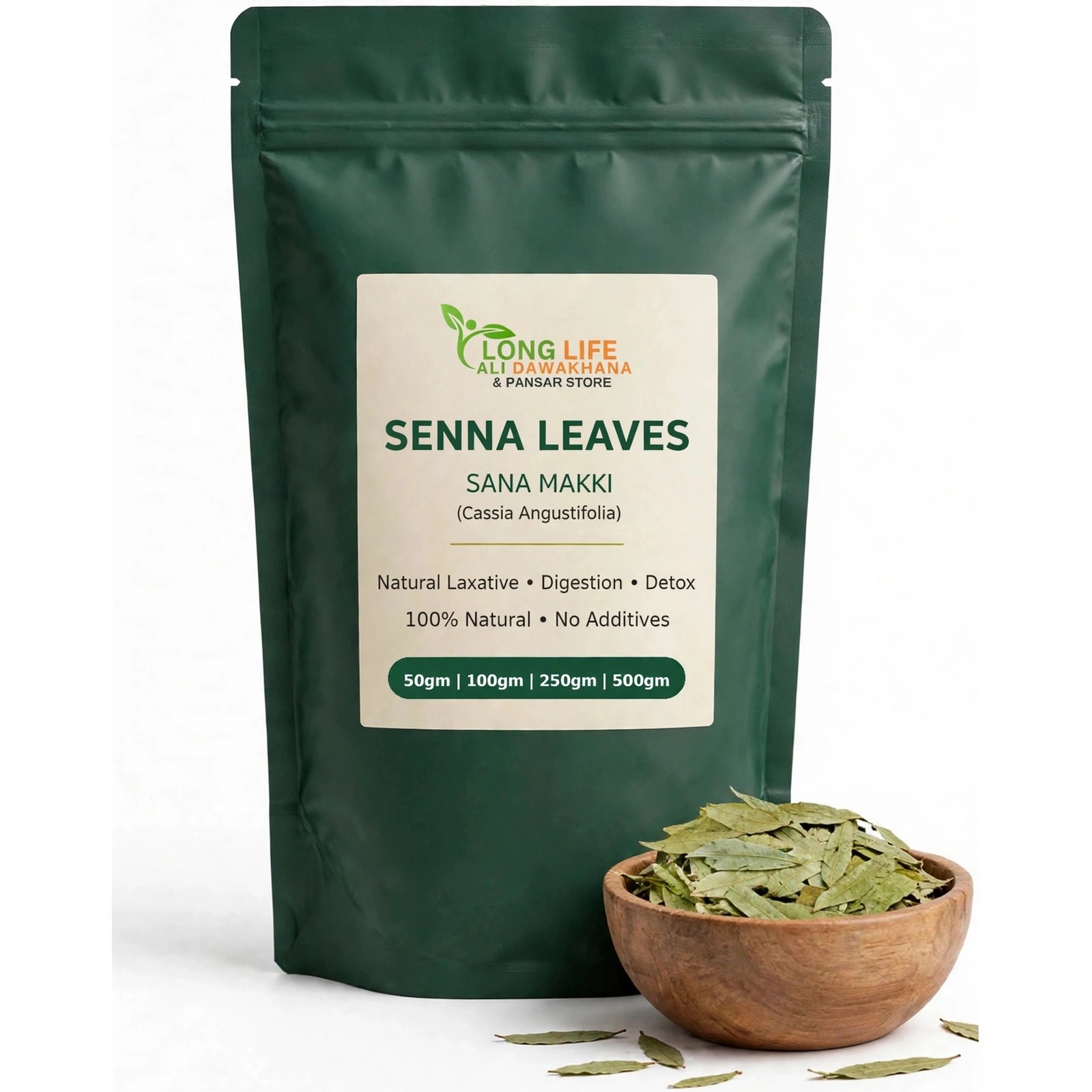
سنا مکی (سنا کے پتے) – قبض کا قدرتی اور آزمودہ علاج
سنا مکی، جسے سنا کے پتے (Senna Leaves) بھی کہا جاتا ہے، ایک مشہور جڑی بوٹی ہے جس کا نباتاتی نام سینا الیگزینڈرینا (Senna Alexandrina) ہے، جسے پہلے کیسیا اینگسٹی فولیا (Cassia Angustifolia) کہا جاتا تھا۔ یہ چھوٹی جھاڑی مصر، سوڈان، صومالیہ اور بھارت کے خشک علاقوں میں پائی جاتی ہے، اور اس کے خشک پتے صدیوں سے قبض کے علاج کے لیے استعمال ہو رہے ہیں۔ سنا مکی کے پتوں میں سینوسائیڈز (Sennosides A اور B) نامی قدرتی مادے پائے جاتے ہیں جو آنتوں کو حرکت دے کر قبض دور کرتے ہیں — اثر عام طور پر 6 سے 12 گھنٹے میں ظاہر ہوتا ہے، اسی لیے سنا مکی رات کو سونے سے پہلے لی جاتی ہے۔ علی دواخانہ اینڈ پانسر اسٹور کی سنا مکی 100 فیصد خالص اور صاف ستھری ہے، اس میں کوئی ملاوٹ، رنگ یا کیمیکل شامل نہیں۔ یہ سالم (Whole)، پاؤڈر (Powder) اور پسی ہوئی (Grounded) تینوں صورتوں میں دستیاب ہے۔
سنا مکی کو اسلامی طب میں بھی خاص مقام حاصل ہے — “سنا” کا ذکر احادیث میں بھی ملتا ہے اور طب نبوی کی کتابوں میں سنا مکی کو پیٹ کی صفائی کی دوا کے طور پر بیان کیا گیا ہے۔ آیوروید میں اسے سورن پتری کہا جاتا ہے اور وریچن (Virechana) یعنی جسم کی صفائی کے لیے استعمال ہونے والی بوٹیوں میں شمار کیا جاتا ہے۔ یورپ اور عرب کے حکیموں نے بھی اسے صدیوں سے قبض کے لیے استعمال کیا ہے، اور آج سنا مکی دنیا بھر میں منظور شدہ قدرتی جلاب (laxative) ہے — امریکہ میں یہ FDA سے منظور شدہ ہے اور یورپی میڈیسن ایجنسی نے بھی اس کا باقاعدہ مونوگراف جاری کیا ہے۔
استعمال کا طریقہ: روایتی طور پر سنا مکی کے چند پتے یا آدھا چائے کا چمچ پاؤڈر ایک کپ نیم گرم پانی میں بھگو کر یا ہلکا سا ابال کر رات کو سونے سے پہلے پیا جاتا ہے — اثر صبح تک ظاہر ہوتا ہے۔ مروڑ سے بچنے کے لیے اس میں سونف، الائچی یا ادرک ملایا جا سکتا ہے۔ سنا مکی صرف عارضی قبض کے لیے ہے — اسے ایک ہفتے سے زیادہ مسلسل استعمال نہ کریں، اور حاملہ خواتین، دودھ پلانے والی مائیں اور 12 سال سے کم عمر بچے اسے ڈاکٹر کے مشورے کے بغیر استعمال نہ کریں۔
Senna Leaves (Sana Makki) – Price in Pakistan, Benefits & How to Use
Direct answer: Senna Leaves (Sana Makki, Senna alexandrina / Cassia angustifolia) are the dried leaflets of the senna shrub, one of the world’s most widely used natural laxatives. Their active compounds, sennosides A and B, stimulate the colon and relieve occasional constipation, usually within 6 to 12 hours. At Ali Dawakhana and Pansar Store (Long.pk) they are available in Whole, Powder and Grounded forms in 50gm, 100gm, 250gm and 500gm packs, starting at Rs 351 for 50gm, with cash on delivery across Pakistan.
Table of Contents
- Senna Leaves (Sana Makki) Kya Hai?
- History of Senna – From Arabian Physicians to Modern Medicine
- How Senna Works – Sennosides and the Colon
- Senna in Ayurveda, Unani & Islamic Medicine
- What Does Modern Research Say?
- Senna Leaves Ke Fayde (Detailed Benefits)
- Who Is Senna For — and Who Should Avoid It?
- Senna Leaves Istemal Ka Tarika (How to Use)
- Traditional Combinations – Senna With Other Herbs
- Dosage & Duration (Standard Guidance)
- Side Effects & Long-Term Risks
- Senna Leaves vs Pods – Which Part to Use?
- How to Identify Original Senna (Quality Guide)
- Storage & Shelf Life
- Senna vs Ispaghol vs Castor Oil
- Senna Leaves Price in Pakistan (All Packs)
- Product Specifications
- Roman Urdu Mein Tafseel
- Aksar Puche Jane Wale Sawalat (FAQ)
Senna Leaves (Sana Makki) Kya Hai?
Senna Leaves are the dried leaflets of Senna alexandrina, a small, drought-tolerant shrub of the legume family (Fabaceae) with yellow flowers and pinnate leaves. Its older botanical names — Cassia angustifolia, Cassia senna and Cassia acutifolia — are still widely used, and the Indian variety grown in Tamil Nadu is traded around the world as Tinnevelly senna. The plant is native to the dry tropical regions of Egypt, Sudan, Somalia and India, and has been cultivated for medicine for over a thousand years.
In Pakistan and the Arab world it is known as Sana Makki (سنا مکی) and Burg-e-Sana. In Ayurveda it is called Swarnapatri or Sona Mukhi. In Tamil it is Nilavarai, in Malay Daun Senna, and in Chinese medicine Fan Xie Ye. The dried leaflets are flat, lance-shaped and pale green — the form in which the herb is sold. The seed pods are also used, and are milder than the leaves (see the leaves vs pods section below). This product is the dried leaves only, sold whole, as a fine powder, or coarsely grounded, with nothing added.
History of Senna – From Arabian Physicians to Modern Medicine
Senna entered formal medicine through the Arabian physicians of the 9th and 10th centuries. Serapion and Mesue the Younger both wrote about it — Mesue preferred the pods, believing them stronger, though they are in fact milder and cause less griping than the leaves. From Arabia, senna spread to Persia, India and Europe, becoming a standard purgative in every medical tradition it touched.
In Ayurveda, senna appears in later compendiums such as the Bhavaprakasha and the Bhaishajya Ratnavali, where it features in “Shonita Shodhaka” purgative blends. Manuscripts from 12th-century Kerala mention senna leaves as a key ingredient in “Sankh Bodhaka” churnas for chronic constipation and bloating. In Islamic traditional medicine, sana holds a special place — senna is mentioned in Hadith literature among the remedies of Tibb-e-Nabawi (Prophetic medicine), often paired with sanoot, and Sana Makki remains one of the most trusted household remedies in the Muslim world.
In Europe, senna became the standard purgative for habitual constipation, always given with aromatics such as cloves, ginger or cinnamon to correct its nauseating taste and griping. In Chinese medicine it arrived as an imported drug — Fan Xie Ye, “the foreign purgative leaf” — classed as a purgative that drains heat and stagnation downward. Today senna is one of the few herbal laxatives with full modern regulatory backing: it is an FDA-approved over-the-counter laxative in the United States, it has a European Union herbal monograph, and it is included in the 2023 gastroenterology guideline for chronic constipation.
How Senna Works – Sennosides and the Colon
Senna’s laxative action comes from its sennosides — mainly Sennoside A and Sennoside B — which are anthraquinone glycosides. They work in a clever two-stage way. First, the sennosides pass through the stomach and small intestine largely unchanged, because the body cannot break them down. When they reach the colon, the gut bacteria convert them into their active form, rhein-anthrone. This active compound then does two things: it stimulates the nerves and muscles of the intestinal wall, increasing peristalsis (the wave-like contractions that move stool along), and it reduces the amount of water the colon absorbs from the stool, keeping it soft.
The result is a bowel movement, usually within 6 to 12 hours — which is why senna is traditionally taken at night, so that it works by morning. Because the effect depends on gut bacteria, it can vary slightly from person to person, and it does not work if the colon’s bacteria are severely disrupted. The effect is dose-dependent: the more sennosides, the stronger the effect — which is why starting with the smallest effective amount is the golden rule with senna.
Senna in Ayurveda, Unani & Islamic Medicine
In Ayurveda, senna (Swarnapatri) is classified under Virechana Dravyas — the herbs used for therapeutic purgation, one of the five cleansing procedures of Panchakarma. In Virechana, a senna decoction is used to cleanse aggravated Pitta dosha lodged in the liver and small intestines. The herb is described as cooling and astringent in nature: it balances Pitta and Kapha, but it tends to aggravate Vata if overused, which is why Ayurvedic practice always combines it with warming, carminative herbs such as ginger or fennel, and never uses it for long periods.
Unani practice uses senna (Sana Makki) as a purgative for biliousness, constipation and the cleansing of morbid humours, often combined with rose petals, fennel or honey to soften its griping action. In Pakistan’s folk medicine, the dried leaves are used as a purgative and for biliousness, gout and rheumatic complaints. In Islamic traditional medicine, sana is one of the most revered household remedies — its mention in Hadith literature gives it a trusted place in Muslim homes, where a senna qahwa at night remains the classic remedy for constipation.
What Does Modern Research Say?
Unlike many traditional herbs, senna has genuine clinical evidence behind it — which is why it is one of the few herbal medicines approved by modern regulators:
- Clinical trials: In a double-blind trial in 90 adults with chronic constipation, senna (1.0 g a day for 28 days) improved symptoms in 69.2% of patients, against 11.7% on placebo. A 2018 randomised trial found that 15 mg of sennosides daily improved stool frequency and ease in 78% of participants within 7 days. A 2021 randomised trial (Morishita et al.) compared senna with magnesium oxide for chronic constipation.
- Regulatory status: Senna is an FDA-approved non-prescription laxative in the United States. The European Medicines Agency has a final EU herbal monograph for senna leaf (Revision 1, April 2020), covering defined preparations for the short-term treatment of occasional constipation. The 2023 AGA–ACG gastroenterology guideline includes senna among its recommended treatments for chronic constipation (a conditional recommendation).
- Bowel preparation: Sennosides are used to clear the bowel before colonoscopy, often combined with osmotic laxatives, and trials have tested doses up to 1,000 mg of sennosides in split doses for this purpose.
- Evidence limits: The evidence is strong for short-term constipation relief, but there is no good evidence that senna helps with weight loss, “detox” cleanses, or long-term bowel health — and long-term use carries real risks (see the side effects section). Regulators in the EU have also been reviewing hydroxyanthracene-containing products as food ingredients, with a draft proposal in 2026 to restrict them in foods and supplements; this does not change senna’s status as a licensed herbal medicine.
The bottom line: senna is a proven short-term laxative with real clinical backing — and equally proven risks when overused. Short courses, smallest effective dose, and medical advice for anything longer than a week.
Senna Leaves Ke Fayde (Detailed Benefits)
1. Relief from occasional constipation — senna’s proven use
This is senna’s main use and the one with genuine trial evidence. The sennosides stimulate colon contractions and soften the stool, producing a reliable bowel movement within 6 to 12 hours. It works for constipation caused by a sedentary lifestyle, travel, a change in diet, or medicines that slow the bowel. It is intended for occasional use — a few days at a time — not as a daily habit.
2. Bowel preparation before medical procedures
Senna is part of bowel-cleansing protocols before colonoscopy and abdominal examinations, because it empties the colon effectively. For this purpose it is used in defined doses under medical direction, often combined with an osmotic laxative. Never prepare for a procedure with senna unless your doctor has told you to.
3. Haemorrhoids, fissures and painful defecation
By producing softer stools, senna reduces the straining that aggravates piles (haemorrhoids) and anal fissures. Ayurvedic sources note that its downward action soothes the aggravated tissues. For this use it is taken for a few days at a time, in the smallest effective dose.
4. Constipation-predominant IBS (under supervision)
Senna’s use is documented in irritable bowel syndrome with constipation predominance (IBS-C), always under medical supervision. Because IBS involves a sensitive gut, the dose must be small and the course short, and a doctor should be involved.
5. Virechana and traditional cleansing
In Ayurvedic Panchakarma, senna is a key herb of Virechana — therapeutic purgation used to cleanse aggravated Pitta from the liver and small intestine. This is a supervised clinical procedure, not a home “detox”. The traditional home version is a short, occasional senna qahwa for bowel cleansing — never a long cleanse.
6. Post-surgery and post-childbirth constipation
After surgery or childbirth, constipation is common and straining is undesirable. Senna is often the laxative doctors recommend in these situations, because it is predictable and effective. Use it only as your doctor advises in these circumstances.
7. Travel-related constipation
Changes in routine, food, water and time zones commonly cause constipation while travelling. A small pack of senna leaves is a traditional travel remedy — a single night-time dose usually restores regularity by morning.
8. Appetite and digestive comfort (indirect)
Chronic constipation often causes bloating, heaviness, loss of appetite and a coated tongue. By clearing the bowel, senna indirectly relieves these symptoms — though the underlying cause of persistent constipation should always be investigated.
Who Is Senna For — and Who Should Avoid It?
Senna is for adults and adolescents over 12 who need short-term relief from occasional constipation — a few days at a time, at the smallest effective dose. It is particularly useful for people who need predictable, overnight relief, and for those who prefer a single-ingredient herbal option over synthetic laxatives.
Senna is NOT for: pregnant women (it can stimulate uterine contractions — the EMA monograph says it must not be used in pregnancy), breastfeeding mothers (the EMA monograph says it must not be used while breastfeeding), children under 12 (EMA monograph), people with intestinal blockage or obstruction, inflammatory bowel disease (Crohn’s disease or ulcerative colitis), appendicitis, unexplained abdominal pain, nausea or vomiting, or severe dehydration. People taking diuretics, digoxin or heart-rhythm medicines should ask their doctor first, because senna’s potassium loss can interact dangerously with these drugs. Anyone with a sudden change in bowel habits lasting more than two weeks should see a doctor before using any laxative.
Senna Leaves Istemal Ka Tarika (How to Use)
As a night-time tea (the classic method): Put a small pinch of senna leaves (about 5 to 8 leaflets, or half a teaspoon of powder) in a cup, pour over hot — not boiling — water, cover and steep for 10 to 15 minutes, then strain and drink at bedtime. The effect comes in 6 to 12 hours, usually by morning. Start with the smallest amount and increase only if needed.
As a cold soak (gentler, less griping): Soak the leaves in room-temperature water for 6 to 8 hours (or overnight), strain and drink. Cold preparation extracts fewer of the griping resins and is traditionally considered gentler on the stomach.
As a powder: Half a teaspoon of senna powder mixed in warm water or honey, taken at night. The powder acts slightly faster than whole leaves.
For bowel cleansing (traditional): A senna qahwa taken for 2 to 3 nights in a row is the traditional short cleanse. Do not extend it beyond a week without medical advice.
What to expect: Mild cramping before the bowel movement is common, especially on the first use. Drink plenty of water — senna works better and more comfortably when you are well hydrated. If you get strong cramps or watery diarrhoea, the dose was too high; use less next time.
Traditional Combinations – Senna With Other Herbs
Senna is almost always combined with carminative herbs that reduce its griping and cramping:
- Senna + Fennel (Saunf): the classic combination — fennel’s carminative oils calm the gut and reduce cramping. This is the most common way senna is taken in Pakistan.
- Senna + Ginger (Adrak): ginger warms the stomach, reduces nausea and counters senna’s cooling, Vata-aggravating nature in Ayurvedic terms.
- Senna + Liquorice (Mulethi): liquorice soothes the gut lining and sweetens the bitter taste.
- Senna + Cloves / Cinnamon: the traditional European correctives — aromatic spices that reduce griping and improve the taste.
- Senna + Rose petals: a Unani combination — rose is believed to soften senna’s harshness and protect the stomach.
- Senna + Honey: honey makes the tea drinkable and adds a mild soothing effect.
A simple, effective home recipe: senna leaves + a pinch of fennel seeds + a small piece of ginger, steeped together in hot water for 15 minutes, strained, with honey to taste, taken at bedtime.
Dosage & Duration (Standard Guidance)
For standardised senna preparations, the European Medicines Agency monograph specifies a single dose equivalent to 10 to 30 mg of hydroxyanthracene derivatives, calculated as sennoside B, taken once at night for adults and adolescents over 12 — using the smallest dose that produces a soft-formed stool. It should not be used for more than one week; taking it two or three times during that week is usually sufficient. The NHS advises that senna is ideally used only for a few days unless it has been prescribed for longer.
For the whole herb (leaves), there is no standardised dose, because the sennoside content varies. The traditional guidance is: start with a small pinch (5 to 8 leaflets, or half a teaspoon of powder) as a night-time tea, and use the smallest amount that works. A typical traditional course is 2 to 3 nights, up to a maximum of one week. The placebo-controlled adult trial used 1.0 g of senna daily for 28 days under medical supervision — but that was a clinical trial, not a recommendation for home use.
The golden rules: smallest effective dose, shortest effective course, never daily for weeks on end, and always with plenty of water. If constipation persists beyond a week of senna use, see a doctor — do not increase the dose.
Side Effects & Long-Term Risks
Senna is safe for short-term use at standard doses, but its risks are real and well documented — and they all come from overuse:
- Common short-term effects: abdominal cramping, diarrhoea, nausea and wind. Urine may turn yellow-brown or reddish from anthranoid metabolites — this is harmless and fades after stopping.
- Laxative dependence: with continued daily use, the colon can come to rely on senna’s stimulation instead of its own signals, making natural bowel movements weaker — a condition sometimes called “cathartic colon” (colonic atony). This is the main reason senna must not become a nightly habit.
- Electrolyte loss: repeated diarrhoea causes loss of water and potassium. Severe potassium loss can cause muscle weakness, heart rhythm problems and, in extreme cases, seizures. This risk is higher for people taking diuretics or heart medicines.
- Melanosis coli: long-term use commonly causes a brown pigmentation of the colon lining, visible during colonoscopy. It is benign — it is not cancer, and it usually fades after stopping senna — but it is a marker of chronic anthranoid exposure.
- Rare serious effects: cases of hepatitis and acute liver failure have followed very large, long-term intakes. Misuse for weight loss or in eating disorders has caused severe fluid and potassium loss.
- Children: senna can cause severe nappy blistering in young children at high doses — never give it to young children without a doctor’s advice.
This product is a traditional herb, not a medicine. Senna is a proven short-term laxative — use it that way, and seek medical advice for anything beyond a week.
Senna Leaves vs Pods – Which Part to Use?
Both the leaves and the seed pods of the senna plant are used, but they are not identical:
| Senna Leaves | Senna Pods | |
|---|---|---|
| Strength | Stronger | Milder |
| Griping / cramping | More likely | Less likely |
| Onset | 6–12 hours | 6–12 hours |
| Best for | Reliable overnight relief | Sensitive stomachs, gentler action |
| Traditional preference | Most common form | Preferred by Mesue and Unani physicians |
This product is the leaves — the stronger, more widely used form. If you find the leaves cause too much cramping, try the cold-soak method, reduce the amount, or add fennel and ginger. The pods are a gentler alternative for sensitive stomachs.
How to Identify Original Senna (Quality Guide)
- Appearance: Genuine senna leaflets are flat, lance-shaped, pale green and mostly intact. They should be dry and crisp, not brown, dusty or mouldy.
- Smell: Mild, herbal, slightly sweet — never musty or chemical.
- Sennoside content: Standardised senna products are tested to contain at least 2.5% sennosides (measured by HPTLC). Whole-leaf senna varies naturally, but pale, intact leaflets from a trusted source are the best guarantee.
- Grade: Tinnevelly senna from Tamil Nadu, India, is considered the premium grade. The leaves sold here are the genuine Cassia angustifolia leaflets.
- Source: Buy from a trusted pansar store. Ali Dawakhana and Pansar Store has sold genuine herbs in Faisalabad for generations, and every pack is the pure herb with nothing added.
Storage & Shelf Life
Keep senna leaves in an airtight jar away from sunlight, heat and moisture. Stored properly, the dried leaves keep their potency for 12 to 18 months. If the leaves turn brown, lose their smell or become damp, they have lost their quality and should be replaced. Keep out of children’s reach.
Senna vs Ispaghol vs Castor Oil
These three are the classic constipation remedies, but they work in completely different ways:
| Senna Leaves | Ispaghol (Psyllium Husk) | Castor Oil | |
|---|---|---|---|
| Type | Stimulant laxative | Bulk-forming laxative | Stimulant laxative (oil) |
| How it works | Stimulates colon contractions | Absorbs water, adds bulk to stool | Ricinoleic acid stimulates the gut |
| Onset | 6–12 hours | 12–72 hours | 2–6 hours |
| Best for | Occasional constipation, quick relief | Long-term regularity, fibre | Fast, strong cleansing |
| Long-term use | Not recommended | Safe for daily use | Not recommended |
| Griping | Common | Rare | Common |
| Pregnancy | Avoid | Generally safe | Avoid |
For long-term regularity, ispaghol is the safer daily choice. For occasional, overnight relief, senna is the more predictable option. Many people use both: ispaghol daily for fibre, senna only when needed for a quick result.
Senna Leaves Price in Pakistan (All Packs)
| Form | 50gm | 100gm | 250gm | 500gm |
|---|---|---|---|---|
| Whole | Rs 351 | Rs 498 | Rs 1,131 | Rs 2,185 |
| Powder | Rs 402 | Rs 422 | Rs 1,288 | Rs 2,447 |
| Grounded | Rs 402 | Rs 548 | Rs 1,181 | Rs 2,236 |
Prices include no hidden charges. Cash on Delivery is available all over Pakistan.
Product Specifications
| Product | Senna Leaves (Sana Makki) |
|---|---|
| Botanical name | Senna alexandrina (syn. Cassia angustifolia) |
| Urdu name | سنا مکی |
| Form | Whole / Powder / Grounded |
| Pack sizes | 50gm, 100gm, 250gm, 500gm |
| Ingredients | 100% senna leaves — no additives, colour or preservative |
| Active compounds | Sennosides A and B (anthraquinone glycosides) |
| Onset of action | 6–12 hours (take at night) |
| Storage | Keep in an airtight jar away from sunlight and moisture |
| Shelf life | 12–18 months stored dry and airtight |
| Seller | Ali Dawakhana and Pansar Store |
| Delivery | Cash on Delivery available all over Pakistan via Long.pk |
Roman Urdu Mein Tafseel
Senna Leaves yani Sana Makki (Cassia Angustifolia) qabz ke liye duniya bhar mein sab se zyada istemal hone wali qudrati booti hai. Is ke patton mein sennosides A aur B naam ke madae paye jate hain jo aant ki harkat ko barha kar qabz door karte hain — asar aam tor par 6 se 12 ghante mein zahir hota hai, is liye isay raat ko sone se pehle liya jata hai. Sana Makki ka zikr Hadees mein bhi milta hai aur Tibb-e-Nabawi mein isay pait ki safai ki dawa ke tor par bayan kiya gaya hai. Ali Dawakhana ki Sana Makki 100% khalis hai — is mein koi rang, khushbu ya milawat shamil nahi. Yeh Whole, Powder aur Grounded teeno forms mein 50gm, 100gm, 250gm aur 500gm ki packing mein dastiyab hai, qeemat sirf Rs 351 se shuru hoti hai.
Rawayati tor par chand patte ya aadha chaye ka chamach powder neem garam pani mein bhigo kar raat ko piya jata hai — subah tak asar zahir ho jata hai. Maror se bachne ke liye is mein sonf ya adrak milaya ja sakta hai. Yaad rahe, sana makki sirf aarzi qabz ke liye hai — isay ek hafte se zyada musalsal istemal na karen, warna aanton ko is ki aadat par sakti hai. Hamal, doodh pilane aur 12 saal se kam umar bachon ke liye doctor ke mashware ke baghair istemal na karen. Achhi sana makki ke patte halke sabz, khushk aur khushbudar hote hain. Hawa-band dabbe mein dhoop aur nami se door rakhne par yeh 12 se 18 mahine tak apni taqat barkarar rakhti hai. Ghar baithay Cash on Delivery par mangwayen.
Aksar Puche Jane Wale Sawalat (FAQ)
Q: Sana Makki kis liye istemal hoti hai?
Sana Makki (Senna Leaves) rawayati tor par aarzi qabz ke liye istemal hoti hai — is ke sennosides aant ki harkat barha kar qabz door karte hain. Is ke ilawa yeh bawaseer aur fissure mein naram stool ke liye, safar ke qabz ke liye aur rawayati jism ki safai (Virechana) mein bhi istemal hoti hai.
Q: Senna Leaves ki price Pakistan mein kya hai?
Ali Dawakhana and Pansar Store par Senna Leaves (Sana Makki) ki price Rs 351 se shuru hoti hai — Whole 50gm Rs 351, 100gm Rs 498, 250gm Rs 1,131 aur 500gm Rs 2,185; Powder aur Grounded Rs 402 se shuru hote hain. Cash on Delivery ke sath.
Q: Sana Makki kaisay istemal karen?
Chand patte ya aadha chaye ka chamach powder neem garam pani mein 10 se 15 minute bhigo kar chhaan kar raat ko sone se pehle piyen — asar 6 se 12 ghante mein zahir hota hai. Maror se bachne ke liye sonf ya adrak mila sakte hain. Thandi pani mein bhigo kar peena bhi halka tareeqa hai.
Q: Sana Makki ka asar kitni der mein hota hai?
Aam tor par 6 se 12 ghante mein — is liye isay raat ko liya jata hai taake subah tak asar ho jaye. Sennosides pehle aant ke bacteria se active hote hain, phir aant ki harkat barhate hain.
Q: Kya sana makki roz istemal ki ja sakti hai?
Nahi — sana makki sirf aarzi qabz ke liye hai. European Medicines Agency ke mutabiq isay ek hafte se zyada musalsal istemal nahi karna chahiye. Rozana istemal se aanton ko is ki aadat par sakti hai aur potassium ki kami ho sakti hai. Lambi muddat ki qabz ke liye doctor se mashwara karen.
Q: Kya hamal mein sana makki istemal ho sakti hai?
Nahi — hamal mein sana makki istemal nahi karni chahiye, kyunke yeh bachadani ke sukrne ka sabab ban sakti hai. Doodh pilane wali maayen aur 12 saal se kam umar bache bhi doctor ke mashware ke baghair istemal na karen.
Q: Sana Makki aur ispaghol mein kya farq hai?
Sana makki stimulant laxative hai — yeh aant ki harkat barha kar 6 se 12 ghante mein asar karti hai aur sirf aarzi istemal ke liye hai. Ispaghol bulk-forming hai — yeh fibre de kar stool ko naram karta hai aur rozana istemal ke liye mehfooz hai. Lambi muddat ke liye ispaghol behtar hai.
Q: Sana Makki ke patte aur phaliyan mein kya farq hai?
Patte zyada taqatwar hote hain aur maror ka imkan zyada hota hai; phaliyan halki hoti hain aur maror kam hota hai. Yeh product patte hain — maror se bachne ke liye sonf ya adrak ke sath istemal karen ya thande pani mein bhigo kar piyen.
Q: Asli sana makki ki pehchan kya hai?
Asli sana makki ke patte halke sabz, chapte aur nezay ki shakal ke hote hain, khushk aur khushbudar hote hain. Bhoora, mitti jaisa ya badbudar patta achhi quality nahi. Bharosemand pansar store se khareeden — Ali Dawakhana and Pansar Store ki har packing 100% khalis booti hoti hai.
Q: Original Senna Leaves kahan se milegi?
Ali Dawakhana and Pansar Store, Faisalabad se Long.pk par online order karen — 100% khalis Senna Leaves (Sana Makki) ghar baithay Cash on Delivery par mil jayegi.
Ali Dawakhana and Pansar Store — Asli desi dawa aur khalis jadi bootiyan, ab ghar baithay Long.pk se mangwayen.
Reviews
There are no reviews yet