
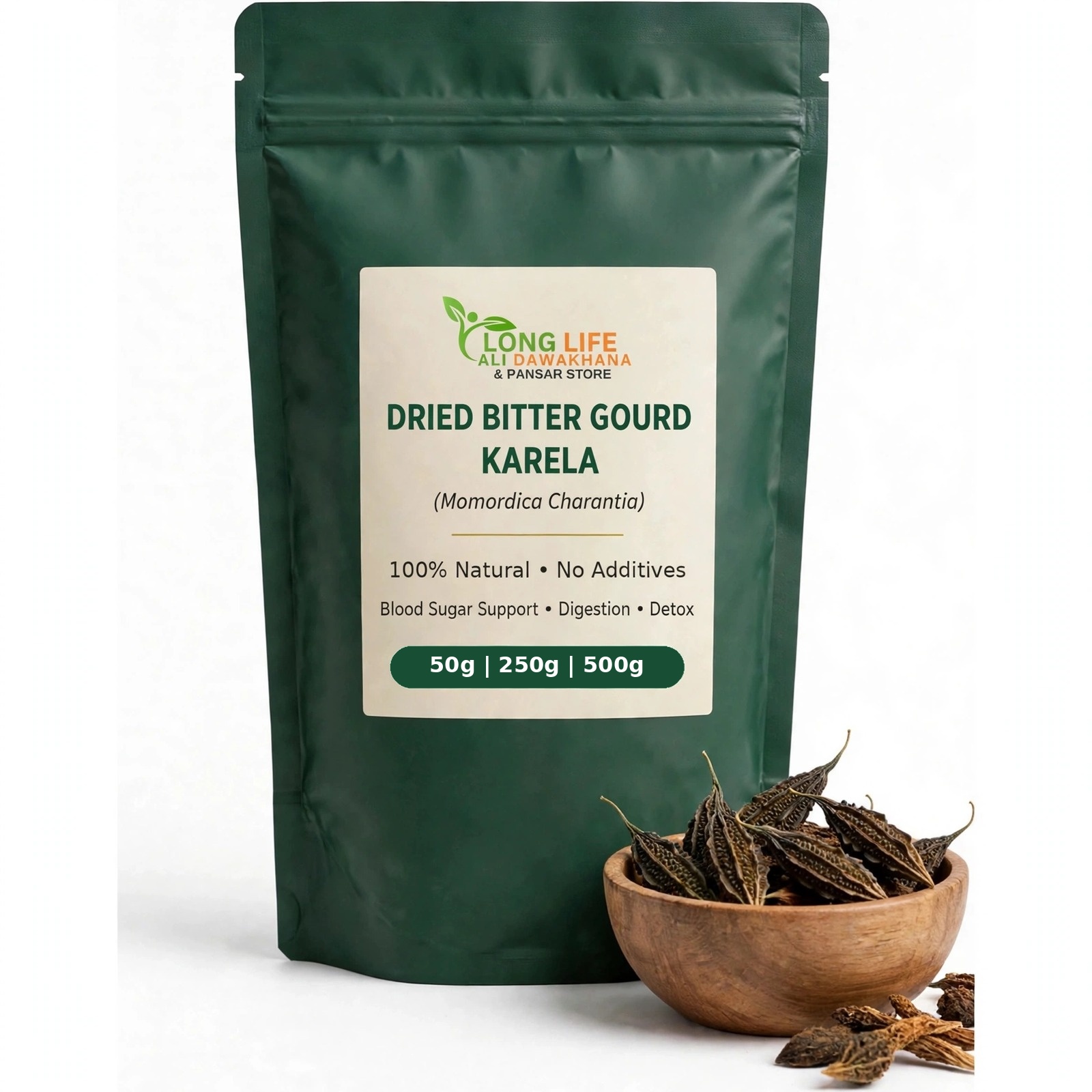
Dried Bitter Gourd (Karela Khushk, Bitter Melon, Momordica charantia) is the classic bitter fruit used for centuries in Ayurvedic and Unani medicine to support healthy blood sugar, digestion and liver health. Its active compounds charantin and polypeptide-p (“plant insulin”) help the body use glucose — though clinical trials show mixed results, so it supports blood-sugar management alongside, never instead of, prescribed diabetes treatment. At Long.pk it is available in Whole and Powder forms (50 gm, 250 gm and 500 gm) from Rs 169, with Cash on Delivery across Pakistan.
کریلہ خشک (Dried Bitter Gourd) — مکمل معلومات
کریلہ پاکستان کی مشہور کڑوی سبزی ہے اور صدیوں سے آیورویدک اور یونانی طب میں استعمال ہوتی ہے۔ خشک کریلہ (Karela Khushk) اس پھل کی خشک شکل ہے جسے پاؤڈر یا قہوے کے طور پر استعمال کیا جاتا ہے۔
اس کا سب سے بڑا فائدہ بلڈ شوگر ہے: charantin اور polypeptide-p گلوکوز استعمال کرنے میں مدد دیتے ہیں۔ کریلہ دوا کا بدل نہیں ہے۔ حاملہ خواتین کریلہ نہ کھائیں۔
Dried Bitter Gourd (Karela) – Price in Pakistan, Benefits, Uses & Safety
Direct answer: Dried Bitter Gourd starts from Rs 169 for 50 gm (Whole) at Long.pk, up to Rs 2,531 for 500 gm (Powder). Trials show mixed results, so it supports blood-sugar management alongside, never instead of, prescribed diabetes treatment.
Table of Contents
- What Is Dried Bitter Gourd?
- History of Bitter Gourd
- Active Compounds
- Bitter Gourd in Ayurveda, Unani & Folk Medicine
- What Does Modern Research Say?
- Detailed Benefits of Bitter Gourd
- Dried Fruit vs Fresh Juice vs Extract
- Who Is Bitter Gourd For?
- How to Use Dried Bitter Gourd
- Traditional Combinations
- Dosage & Duration
- Side Effects & Who Should Avoid It
- How to Identify Original Dried Bitter Gourd
- Storage & Shelf Life
- Bitter Gourd vs Jamun vs Fenugreek
- Bitter Gourd Price in Pakistan
- Product Specifications
- Roman Urdu
- Frequently Asked Questions
What Is Dried Bitter Gourd?
Dried Bitter Gourd (Karela Khushk, Momordica charantia L.) is the dried fruit of the bitter gourd vine. Dried, it shrinks into dark brown, wrinkled pieces. In Urdu it is Karela (کریلہ). The fruit is the medicinal part; the seeds contain vicine (dangerous with G6PD deficiency).
History of Bitter Gourd
Bitter gourd is one of South Asia’s oldest food-medicines — in Sanskrit Karkati, in the Sushruta Samhita and Bhaishajya Ratnavali (16th century), indicated for Prameha (diabetes). Charantin was isolated in the 1960s, polypeptide-p in the 1980s; 25+ trials followed, though results are genuinely mixed.
Active Compounds
| Compound | Type | What researchers looked at |
|---|---|---|
| Charantin | Steroidal glycoside | Insulin-mimetic; increases glucose uptake |
| Polypeptide-p (“plant insulin”) | Small protein | Insulin agonist; supports beta cells |
| Vicine | Alkaloid glycoside | Cuts liver glucose output; seeds dangerous in G6PD deficiency |
| Momordicin | Cucurbitacin triterpenoid | The bitter principle; digestive, anti-inflammatory |
Mechanisms (2025 review): more insulin, better sensitivity, blocked carb enzymes, less liver glucose. Less glucose-dependent than fenugreek’s.
Bitter Gourd in Ayurveda, Unani & Folk Medicine
In Ayurveda, Karela is Tikta rasa (bitter), Ushna virya (heating), Kaphahara and Ruchikara — a Tikta Dravya for skin and digestion. Unani: diabetes, liver, skin, digestive complaints. Folk: eaten as a vegetable, drunk as juice for blood sugar, taken as powder for digestion and skin.
What Does Modern Research Say?
Reviews that found NO significant effect: Cochrane 2012 (4 RCTs, 479 patients): no significant difference vs placebo, metformin or glibenclamide — “insufficient evidence.” 2014 meta-analysis: no significant pooled effect on HbA1c or fasting glucose. 2024 review (9 RCTs, 414 patients): effect “cannot be determined.”
Reviews that found a modest effect: a 2025 review of 25 trials found lower fasting glucose and HbA1c — but certainty low to very low; publication bias cut the HbA1c effect 65%. Pooled: HbA1c −0.26–0.38 points, fasting glucose −0.72–0.85 mmol/L — modest, below metformin. (Korean 2020, Fuangchan 2011, 2015: small fasting-glucose falls.)
NCCIH: not proven effective for diabetes. Weight loss: no effect (2024 meta-analysis, 10 RCTs, 448 participants). Honest summary: a reasonable adjunct to prescribed treatment, never a replacement.
Detailed Benefits of Bitter Gourd
Blood Sugar Support (Traditional + Mixed Clinical Evidence)
Charantin and polypeptide-p help the body use glucose; trials show a modest effect (HbA1c −0.3 points). An adjunct, never a replacement. See also Sweet Chirata.
Digestive Health (Traditional)
The bitter taste stimulates digestive secretions, bile flow and appetite — used for sluggish digestion, constipation and worms.
Liver Health (Traditional + Lab Support)
A traditional liver tonic and blood purifier; hepatoprotective in animal studies, untested in humans. See also Golden Shower (Amaltas).
Skin Health (Traditional)
Traditionally used for acne, boils, eczema and itching — no clinical evidence.
Immune Support (Lab Evidence)
Immunomodulatory in lab and animal models. No human evidence.
Weight Management (No Clinical Evidence)
Low-calorie and high-fibre, but the 2024 meta-analysis (10 RCTs, 448 participants) found no effect on BMI, weight, waist or body fat.
Antioxidant Activity (Lab Evidence)
Vitamin C, flavonoids and phenolics give antioxidant activity in lab tests.
Dried Fruit vs Fresh Juice vs Extract
| Form | What it is | Evidence | Practical notes |
|---|---|---|---|
| Dried fruit (this product) | Whole dried pieces or powder | Centuries of use; some trials | Stable; easy to dose |
| Fresh juice | Juice from the fresh fruit | Several trials (50–100 ml daily) | Made fresh daily |
| Standardised extract | Concentrated capsules | Most RCTs (300–2,380 mg/day) | Most consistent potency |
| Cooked vegetable | Fresh karela as a sabzi | No trial tested cooked karela | Safest form — a food |
Forms are not equivalent — most trials used juice or extract. Dose by weight, start low.
Who Is Bitter Gourd For?
For adults wanting a traditional food-medicine for blood-sugar support — prediabetes or type 2 diabetes, as an adjunct alongside prescribed treatment.
Not for pregnant or breastfeeding women, children, or G6PD deficiency (vicine in seeds). Not a replacement for medication, and not for weight loss.
How to Use Dried Bitter Gourd
Powder. 2–3 g once or twice daily with warm water, 30 minutes before meals.
Decoction (qehwa). Boil 5–10 g in 200 ml water 10–15 minutes, strain, drink once daily.
As a vegetable. Cooked as a sabzi. Salt-water soaking cuts bitterness.
Fresh juice. 50–100 ml daily on an empty stomach; start at 50 ml and monitor blood sugar.
What NOT to do. Max 3 g powder/day without a hakim’s guidance. No homemade extracts, no stopping medication, none for children.
Traditional Combinations
- Karela + Jamun: the classic Pakistani blood-sugar pair.
- Karela + Methi: the two best-studied blood-sugar herbs; preliminary synergy.
- Karela + Gurmar: the “sugar destroyer” — cuts sugar cravings.
- Karela + Vijaysar: a potent combination in integrative diabetology.
- Karela + Amla: digestion and metabolic health.
- Karela + Turmeric: liver health and inflammation.
Dosage & Duration
No medically accepted dose — trials used different, non-equivalent products. Your doctor’s instruction takes priority.
| Form | Dose used in trials / tradition | Notes |
|---|---|---|
| Dried fruit powder | 2–3 g/day, in 2 doses before meals | Max 3 g/day without guidance |
| Standardised extract | 500 mg–2 g/day | 2020 Korean RCT: 2,380 mg/day |
| Fresh juice | 50–100 ml daily | Empty stomach; start at 50 ml |
| Decoction (qehwa) | 5–10 g in 200 ml water, once daily | Traditional pansar preparation |
Timing: effects begin in 2–4 hours, peak at 4–6; allow 4–8 weeks for sustained improvements.
Side Effects & Who Should Avoid It
Hypoglycemia (low blood sugar) is the main risk. Bitter gourd lowers blood sugar, adding to insulin and diabetes drugs. Symptoms: shakiness, sweating, confusion, dizziness. On diabetes medication, monitor and tell your doctor.
Case reports (rare but serious): hypoglycemic coma and convulsions in children; atrial fibrillation after juice; gastric ulceration from homemade extract; kidney inflammation.
Common: gut upset, diarrhoea, cramps — especially above 3 g/day. Nausea, vomiting, heartburn, constipation, headache, dizziness.
Who must avoid it or consult first:
- Pregnant women — avoid. Developmental abnormalities in animals; it can stimulate the uterus.
- Breastfeeding women — safety not established; avoid.
- Children — no concentrated products (hypoglycemic coma reported).
- G6PD deficiency — avoid the seeds (vicine can trigger a favism-like reaction).
- Diabetes medication users — consult your doctor first.
- Blood thinner users — may enhance them; consult your doctor.
- Liver or kidney disease — no human safety data; consult your doctor.
- Before surgery — stop at least 2 weeks before.
Regulatory status: a food, not an approved medicine — not approved to treat diabetes anywhere.
How to Identify Original Dried Bitter Gourd
- Shape: elongated, wrinkled, pointed, rough ridged skin.
- Colour: dark brown to brownish-green; pale is under-dried.
- Smell: intensely bitter; musty means spoilage.
- Taste: unmistakably bitter — if not bitter, not karela.
- No mould: reject white or green mould spots.
- Powder: brownish-green, fine, intensely bitter; pale may be cut.
Storage & Shelf Life
Airtight container, away from light, heat and moisture. Dried fruit: 12–18 months; powder: 6–9 months.
Bitter Gourd vs Jamun vs Fenugreek
| Feature | Bitter Gourd (Karela) | Jamun (Syzygium cumini) | Fenugreek (Methi) |
|---|---|---|---|
| Main traditional use | Blood sugar, digestion, liver | Blood sugar, digestion | Blood sugar, cholesterol |
| Key compounds | Charantin, polypeptide-p, vicine | Jamboline, ellagic acid, anthocyanins | 4-hydroxyisoleucine, soluble fibre |
| Blood-sugar mechanism | Insulin-mimetic | Slows starch-to-sugar conversion | Glucose-dependent insulin secretion |
| Human trial evidence | Mixed — 25 RCTs | Limited — mostly animal | Moderate — several RCTs |
| Hypoglycemia risk | Real — additive | Low | Low (glucose-dependent action) |
| Pregnancy | Avoid (uterine stimulation) | Avoid medicinally | Avoid medicinally |
| G6PD warning | Yes (vicine in seeds) | No | No |
Bitter Gourd Price in Pakistan
Prices checked 19 November 2026 (following pansaar.com, rounded to whole rupees). Cash on Delivery available across Pakistan.
| Form | 50 gm | 250 gm | 500 gm |
|---|---|---|---|
| Whole | Rs 169 | Rs 810 | Rs 1,181 |
| Powder | Rs 304 | Rs 1,451 | Rs 2,531 |
Product Specifications
| Product Name | Dried Bitter Gourd (Karela) |
| Urdu Name | کریلہ خشک (Karela Khushk) |
| Botanical Name | Momordica charantia |
| Family | Cucurbitaceae |
| Forms Available | Whole / Powder |
| Weights Available | 50 gm / 250 gm / 500 gm |
| Price Range | Rs 169 – Rs 2,531 |
| Purity | 100% Natural, No Additives |
| Origin | Indian subcontinent / Southeast Asia |
| Shelf Life | 12–18 months (dried fruit); 6–9 months (powder) |
| Storage | Airtight container, cool & dry place, away from sunlight |
| Seller | Ali Dawakhana and Pansar Store |
| Delivery | Cash on Delivery across Pakistan |
Roman Urdu
Dried Bitter Gourd (Karela Khushk, Momordica charantia) ka sab se bara faida blood sugar hai — charantin aur polypeptide-p glucose istemal karne mein madad dete hain. Karela diabetes ki dawa ka badal nahi hai — trials mein is ka asar mamooli raha hai.
Hamila khawateen aur G6PD wale isay na lein. Long.pk se Whole aur Powder mein 50, 250, 500 gm — Rs 169 se shuru, Cash on Delivery.
Frequently Asked Questions
Q: Karela kis kaam aata hai?
Blood sugar، ہاضمے اور جگر کے لیے۔
Q: Karela ki Pakistan mein qeemat kya hai?
Rs 169–2,531 — Whole aur Powder, 50/250/500 gm.
Q: Kya Karela diabetes ka ilaj hai?
Nahi — dawa ka badal nahi hai.
Q: Karela powder kaisay istemal karte hain?
2–3 gram, din mein do baar, khane se pehle.
Q: Karela khane se blood sugar kitna kam hota hai?
HbA1c ~0.3, fasting glucose 0.7–0.85 mmol/L — mamooli asar.
Q: Karela kis ko nahi khana chahiye?
Hamila khawateen, bachay, G6PD wale — nahi.
Q: Kya Karela wazan kam karta hai?
Nahi — 2024 meta-analysis mein wazan par koi asar nahi.
Q: Karela aur Jamun mein kya farq hai?
Karela insulin jaisa asar karta hai; Jamun starch ko sugar banne se rokta hai.
Q: Karela ka qehwa kaisay banayen?
5–10 gram, 200 ml pani, 10–15 minute ubaalein.
Q: Asli khushk Karela ki pehchan kya hai?
Gehra bhoora, jhurriyon wala, nok-dar, shadeed karwa.
Related Products
- Sweet Chirata (Chiraita Shireen) — another bitter herb traditionally used for blood-sugar and digestive support.
- Senna Leaves (Sana Makki) — the traditional digestive and cleansing herb, often used alongside bitter tonics like Karela.
- Organic Moringa Leaf Powder (Sohanjna Powder) — a daily nutrition tonic rich in vitamins and minerals, complementing Karela’s metabolic support.
- Jujube Berries (Unab) — iron-rich tonic for blood health and energy.
Ali Dawakhana and Pansar Store — Asli desi dawa aur khalis jadi bootiyan, ab ghar baithay Long.pk se mangwayen.
Reviews
There are no reviews yet