
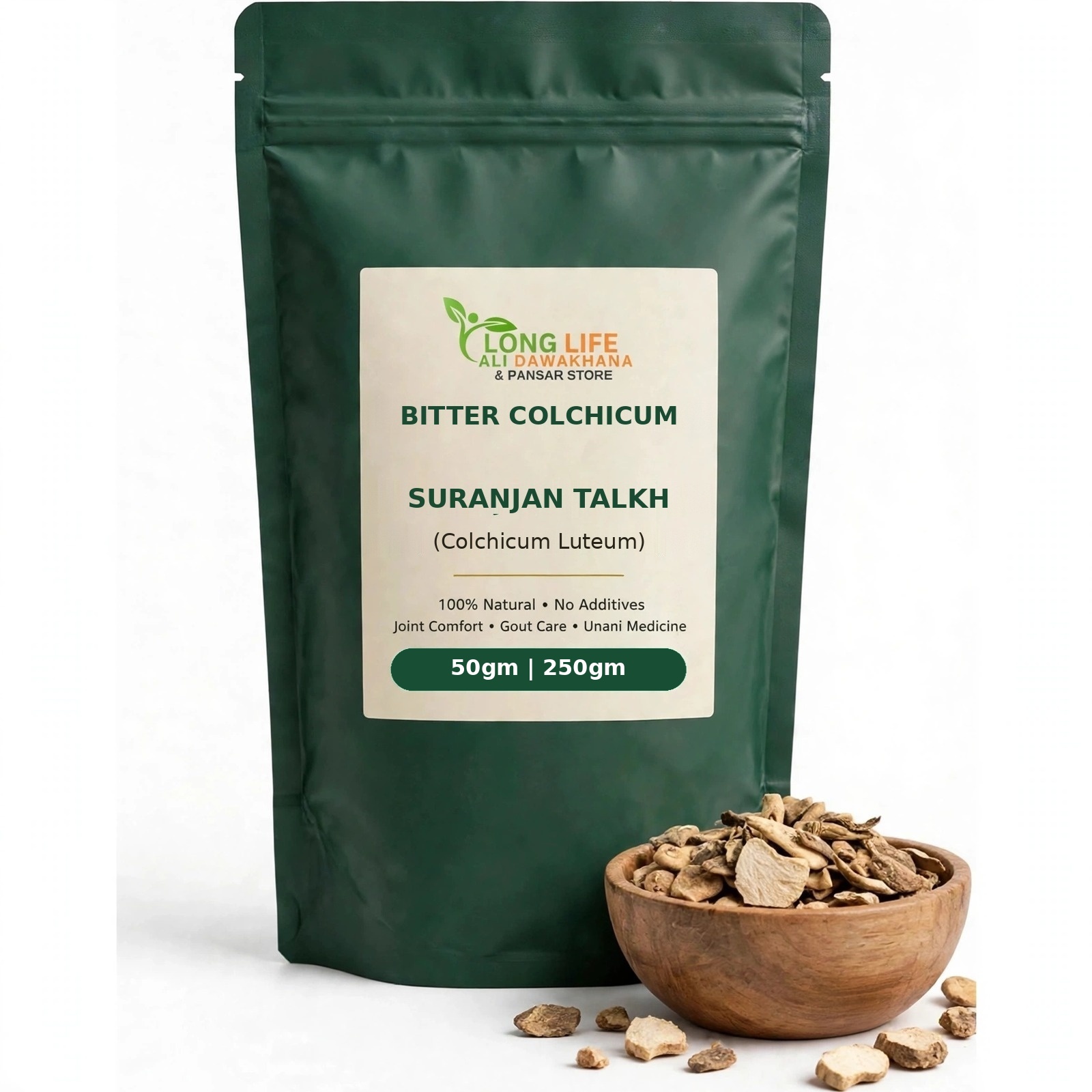
Bitter Colchicum (Suranjan Talkh, Colchicum luteum) is the dried corm of the Himalayan yellow autumn crocus, the Unani first-line drug for gout and arthritis. Its colchicine is the same drug as the prescription gout tablet, but the crude corm holds an unmeasured amount, and overdose has no antidote — so it is for qualified practitioners only. Available in Whole and Powder forms from Rs 675, with Cash on Delivery across Pakistan.
سرانجن تلخ (Bitter Colchicum) — مکمل معلومات
سرانجن تلخ (Bitter Colchicum) ہمالیہ کی پیلی کیسر نما بوٹی Colchicum luteum کی خشک گٹھلی ہے — یونانی طب میں گاؤٹ اور وجع المفاصل کی پہلی درجے کی دوا، اور انتہائی زہریلی: اس میں کولچیسین پایا جاتا ہے، جس کا کوئی تریاق نہیں ہے۔ کبھی خود سے استعمال نہ کریں — صرف مستند حکیم یا ڈاکٹر کی ہدایت پر۔
Bitter Colchicum (Suranjan Talkh) – Price in Pakistan, Benefits, Uses & Safety
Direct answer: Bitter Colchicum (Suranjan Talkh, Colchicum luteum) price in Pakistan starts from Rs 675 for 50 gm (Whole form) at Long.pk, going up to Rs 3,713 for 250 gm (Powder form), in two forms — Whole and Powder — with cash on delivery across Pakistan. Colchicine poisoning has no antidote. This product is for qualified practitioners only.
- What Is Bitter Colchicum?
- History of Suranjan Talkh
- Active Compounds
- Bitter Colchicum in Unani & Ayurvedic Medicine
- What Does Modern Research Say?
- Detailed Benefits of Bitter Colchicum
- Talkh vs Shireen — Two Suranjans, Never Substituted
- Who Is Bitter Colchicum For?
- How to Use Bitter Colchicum
- Traditional Combinations
- Dosage & Duration
- Side Effects & Who Should Avoid It
- How to Identify Original Suranjan Talkh
- Storage & Shelf Life
- Bitter Colchicum vs Sweet Colchicum vs Bonduc Nut
- Bitter Colchicum Price in Pakistan
- Product Specifications
- Roman Urdu
- Frequently Asked Questions
What Is Bitter Colchicum?
Bitter Colchicum — Urdu Suranjan Talkh (سرانجن تلخ) — is the dried corm of Colchicum luteum Baker, a perennial herb of the western Himalayas (600–2,800 metres). The corm is the classical Unani drug: hard, dense, tan-brown pieces with a distinctly bitter taste.
Identity note: the source listing names the plant “Colchicum autumnale” — but the classical Unani identity of Suranjan Talkh is firmly Colchicum luteum, and this article follows the classical identification.
History of Suranjan Talkh
Suranjan is one of the oldest drugs known to mankind: Dioscorides described it in the 1st century AD, and in 1820 Pelletier and Caventou isolated the alkaloid and named it colchicine.
Active Compounds
The chemistry of Bitter Colchicum is the chemistry of one alkaloid. Colchicine (0.21–0.25% of the dried corm) binds tubulin and blocks the neutrophil inflammation that drives gout — and arrests cell division at higher doses. The seeds hold more (0.41–0.43%) and the flowers up to 0.8%.
Bitter Colchicum in Unani & Ayurvedic Medicine
In Unani medicine, Suranjan Talkh holds the first place among anti-arthritic drugs. Its temperament is Hot 3° and dry 2° — a hot, sharp, drying drug, never a casual medicine. Ayurveda uses it for gout (vatarakta) as a sharp (tikshna) medicine in small doses under supervision.
What Does Modern Research Say?
Honest summary first: there are no human clinical trials of Colchicum luteum — not of the corm, not of any extract. Everything below is laboratory or animal work, plus trials of pharmaceutical colchicine tablets (a precise 0.5 mg dose), which say nothing about eating a corm.
The most important paper: Nair et al. (2010, AIIMS New Delhi) tested a hydroalcoholic extract in two rat models of arthritis — dose-dependent inhibition of joint swelling.
Abbasi et al. (2024) tested an extract in a mouse arthritis model: it outperformed ibuprofen. The colchicine tablet trials (COLCOT 2019, LoDoCo2 2020) tested a precise 0.5 mg dose — not the corm.
Detailed Benefits of Bitter Colchicum
Labels: traditional (classical Unani use), animal/lab (extract studies), medicine (colchicine tablets). Nothing here is a proven claim for the corm.
Gout — Acute Flare Relief (Traditional + Medicine)
Colchicine stops a gout attack by blocking neutrophil inflammation; the tablet regimen is first-line worldwide. For the corm: the dose is unmeasurable.
Arthritis & Joint Disease (Traditional + Animal)
The Unani first-line drug for Waja ul Mufasil (Nair 2010; Abbasi 2024, outperforming ibuprofen). Traditional use only, under a hakim.
Sciatica & Chronic Joint Pain (Traditional)
A classical Unani remedy for sciatica (Irqun Nisa) and chronic joint pain, usually in Majoon Suranjan. No modern trial.
Gout Prevention & Heart Protection (Medicine Only)
Low-dose colchicine prevents gout attacks, treats Familial Mediterranean Fever, and cut cardiovascular events ~31% (LoDoCo2). For the corm: it needs a precise daily dose the corm cannot provide.
Talkh vs Shireen — Two Suranjans, Never Substituted
Talkh is Colchicum luteum; Shireen is Colchicum autumnale. Unani rates Talkh stronger, yet its corms hold less colchicine (0.21–0.25%) than Shireen’s (up to 0.6%).
The dose arithmetic is stark: a gout flare is treated with 1.5 mg on the first day, but one gram of Talkh corm holds up to 2.5 mg. For gout, see a doctor — the corm is for qualified practitioners.
Who Is Bitter Colchicum For?
Bitter Colchicum is for:
- Qualified Unani practitioners (hakeems) who prepare Majoon Suranjan.
- Patients with gout — only if your practitioner specifically asks for this corm.
Not for self-medication, children, pregnant or breastfeeding women, or kidney or liver disease.
How to Use Bitter Colchicum
Internal use — practitioner only. There is no home dose. Do not eat the corm, brew it as a tea, or guess a dose.
External use — practitioner-guided. Roghan Suranjan (colchicum oil) is applied to painful joints; a paste is used on joints and old piles. Never apply to open wounds.
Traditional Combinations
- Majoon Suranjan — the classical Unani electuary for gout and joint pain, prepared by a hakim.
- Habb-e-Suranjan (pills) and Roghan Suranjan (oil) — the standard compound forms.
- Suranjan + ginger or liquorice (Mulethi) — traditional correctives (musleh) that moderate colchicum’s harshness.
Dosage & Duration
There is no home dose for the crude corm. The colchicine content varies (0.21–0.25%), so no weight of corm corresponds to any dose of colchicine.
For reference only — prescription tablet regimens, decided by a doctor: acute gout 1.0 mg then 0.5 mg; prevention 0.5 mg daily.
Side Effects & Who Should Avoid It
Colchicine poisoning is a medical emergency with no antidote. After an overdose there is a latent period of 2–12 hours with no symptoms — this delay is dangerous. Then severe vomiting, diarrhoea and abdominal pain, followed within 24–72 hours by multisystem failure: bone marrow suppression, kidney failure, liver damage, heart damage and respiratory failure.
Do NOT use if you: are pregnant or breastfeeding; are a child, or are giving it to a child (accidental ingestion is a documented cause of fatal poisoning); have kidney or liver disease (colchicine accumulates — the 2026 fatal case involved a man with liver disease who died after 15 mg); or are elderly or frail.
Dangerous drug interactions (blocking CYP3A4 or P-glycoprotein can double or quadruple colchicine levels): clarithromycin, erythromycin; itraconazole, ketoconazole, fluconazole; verapamil, diltiazem, amiodarone; ciclosporin; HIV protease inhibitors; statins (muscle toxicity).
If you suspect colchicine poisoning, go to a hospital emergency department immediately and say exactly what was taken. Do not wait for symptoms. Bring the packaging — there is no antidote, and early arrival saves lives.
How to Identify Original Suranjan Talkh
Buy whole corms, not powder — whole pieces can be identified by sight; powder can be adulterated. Look for firm, dense, tan-brown pieces. Taste a tiny amount (do not swallow): genuine Suranjan Talkh is intensely bitter.
Storage & Shelf Life
- Store in an airtight jar in a cool, dark, dry place. Label it POISONOUS and keep it locked away from children.
- Whole corms keep 12–24 months; powder about 6 months.
Bitter Colchicum vs Sweet Colchicum vs Bonduc Nut
| Feature | Bitter Colchicum | Sweet Colchicum | Bonduc Nut |
|---|---|---|---|
| Botanical name | Colchicum luteum | Colchicum autumnale | Caesalpinia bonduc |
| Key compound | Colchicine (0.21–0.25% of corm) | Colchicine (up to 0.6%) | Bonducellin, caesalpins |
| Main traditional use | Gout, arthritis — first-line Unani drug | Gout, arthritis (milder) | Joint pain, stiffness, fever |
Bitter Colchicum Price in Pakistan
| Form | 50 gm | 250 gm |
|---|---|---|
| Whole | Rs 675 | Rs 3,206 |
| Powder | Rs 759 | Rs 3,713 |
Price range: Rs 675 – Rs 3,713. Prices follow the source (pansaar), rounded to whole rupees. Best value: the Whole 250 gm pack at Rs 3,206 (Rs 12.83 per gram). The Powder costs more per gram at every size.
Product Specifications
| Product Name | Bitter Colchicum (Suranjan Talkh) |
| Urdu Name | سرانجن تلخ (Suranjan Talkh) |
| Botanical Name | Colchicum luteum Baker |
| Family | Colchicaceae |
| Part Used | Corm (dried) |
| Forms | Whole / Powder |
| Weights | 50 gm, 250 gm |
| Price Range | Rs 675 – Rs 3,713 |
| Key Compound | Colchicine (0.21–0.25% of dried corm) |
| Origin | Western Himalayas (600–2,800 m) |
| Additives | None — 100% natural |
| Safety class | TOXIC — practitioner use only; no antidote |
| Shelf Life | Whole corm 12–24 months; powder ~6 months |
| Storage | Airtight, cool, dark, dry; labelled POISONOUS; locked away |
| Seller | Ali Dawakhana and Pansar Store |
| Delivery | Cash on Delivery across Pakistan |
Roman Urdu
Suranjan Talkh (Bitter Colchicum) Himalaya ki crocus Colchicum luteum ki khushk gathli hai, jis se gout ki dawa colchicine haasil hoti hai.
Lekin yeh dawa zehreeli hai: colchicine ki shifa bakhsh aur jaan lewa khurak mein bohat kam farq hai, aur is ka koi taryaq nahi hai. Kabhi khud se istemal na karein — sirf hakeem ya doctor ki hidayat par. Qeemat: Rs 675 se Rs 3,713 tak (50 gm aur 250 gm). Cash on Delivery pooray Pakistan mein mojood hai.
Frequently Asked Questions
Q: Suranjan Talkh kis kaam aati hai?
The Unani first-line drug for gout, arthritis and chronic joint pain. Its colchicine is the first-line gout medicine — but the evidence is for tablets, not the corm.
Q: Kya Suranjan Talkh khud use kar sakte hain?
No — never. The corm holds 0.21–0.25% colchicine, varying from corm to corm.
Q: Talkh aur Shireen mein kya farq hai?
Different species. Talkh is Colchicum luteum, the Himalayan yellow crocus. Shireen is Colchicum autumnale, the milder European crocus.
Q: Kya Suranjan Talkh zehreeli hai?
Yes. Colchicine has a narrow therapeutic index and poisoning is fatal, with no antidote. After an overdose there is a 2–12 hour delay, then severe vomiting and diarrhoea, then multi-organ failure.
Q: Gout ke liye behtareen ilaj kya hai?
See a doctor. The standard treatment is prescription colchicine tablets, plus allopurinol for long-term control.
Q: Colchicine kya hai aur goli se kya farq hai?
Colchicine is the alkaloid in the corm. The tablet holds exactly 0.5 mg; the corm holds an unknown, variable amount.
Q: Kin dawaiyon ke saath nahi leni chahiye?
Drugs that block colchicine’s breakdown can double or quadruple its levels: clarithromycin, erythromycin, itraconazole, verapamil, diltiazem and ciclosporin.
Q: Suranjan Talkh ki price kya hai?
Rs 675 se Rs 3,713 tak — Whole 50 gm Rs 675, 250 gm Rs 3,206; Powder 50 gm Rs 759, 250 gm Rs 3,713. Best value Whole 250 gm (Rs 12.83 per gram).
Q: Suranjan ko kaise store karein?
In an airtight container in a cool, dark, dry place, labelled POISONOUS and locked away from children.
Q: Asli Suranjan ki pehchan kya hai?
Asli gathli sakht, ghani, tan-bhuri hoti hai, aur zaiqa shadeed karwa hota hai. Pansar se tasdeeq karwayein ke yeh Colchicum luteum hai.
Related Products
- Bonduc Nut (Karanjwa) — joint pain and stiffness without colchicum’s toxicity.
- Liquorice Root (Mulethi) — a soothing classical partner herb.
- Organic Moringa Leaf Powder — a general daily tonic.
- Chharila (Lichen) — a traditional Unani herb for classical formulations.
Ali Dawakhana and Pansar Store — Asli desi dawa aur khalis jadi bootiyan, ab ghar baithay Long.pk se mangwayen.
Reviews
There are no reviews yet