
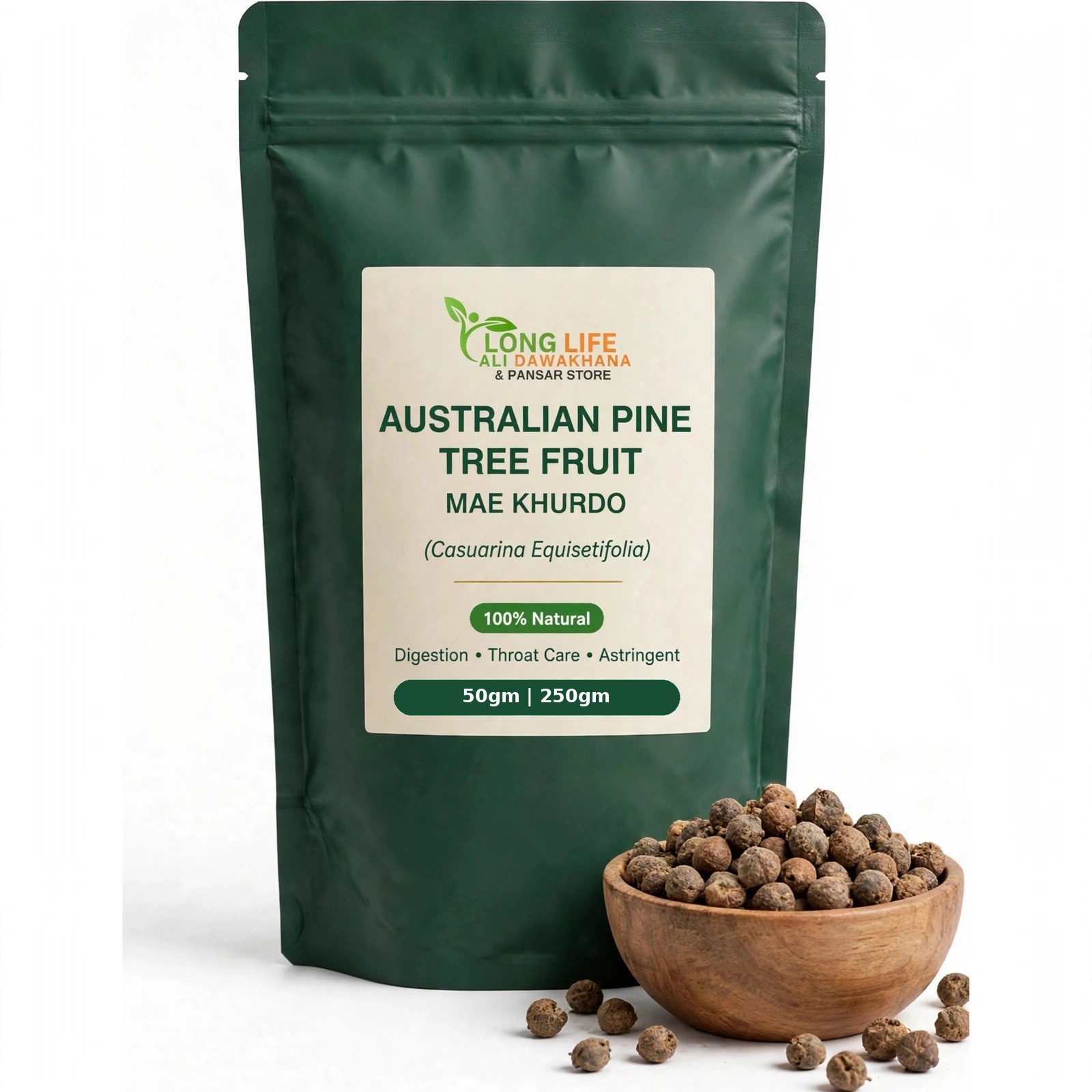
Australian Pine Tree Fruit (Mae Khurdo, Casuarina equisetifolia) is the woody, cone-like fruit of the Australian pine — a tree that is not a true pine at all. In traditional coastal and folk medicine it is used as an astringent for diarrhoea and dysentery, for throat infections and cough, and as a wash for skin complaints and swelling. Its medicine is its tannins, including casuarinin, an ellagitannin named after the tree itself — but there are no human clinical trials of the fruit, and this article says so plainly. At Long.pk it is available in Whole and Powder forms (50 gm and 250 gm) from Rs 169, with Cash on Delivery across Pakistan.
مائیں خوردو (Australian Pine Tree Fruit) — مکمل معلومات
مائیں خوردو، جسے انگریزی میں Australian Pine Tree Fruit کہتے ہیں، آسٹریلین پائن کے درخت کا سخت لکڑی جیسا پھل ہے۔
اہم انتباہ: مائیں خوردو پر انسانوں کے کوئی کلینیکل ٹرائل نہیں ہوئے — اس کے فوائد روایتی استعمال اور لیبارٹری کی تحقیق پر مبنی ہیں۔ دست اگر دو دن سے زیادہ رہے یا خون آئے تو ڈاکٹر سے رجوع کریں، صرف بوٹی پر بھروسہ نہ کریں۔
Australian Pine Tree Fruit (Mae Khurdo) – Price in Pakistan, Benefits, Uses & Safety
Direct answer: Australian Pine Tree Fruit (Mae Khurdo, Casuarina equisetifolia) price in Pakistan starts from Rs 169 for 50 gm (Whole form) at Long.pk, going up to Rs 827 for 250 gm (Powder form). It is available in two forms — Whole and Powder — in 50 gm and 250 gm packs, with cash on delivery across Pakistan.
- What Is Australian Pine Tree Fruit?
- History of Australian Pine Tree Fruit
- Active Compounds
- Australian Pine Tree Fruit in Ayurveda, Unani & Folk Medicine
- What Does Modern Research Say?
- Detailed Benefits of Australian Pine Tree Fruit
- Not a Pine at All — What Mae Khurdo Really Is
- Who Is Australian Pine Tree Fruit For?
- How to Use Australian Pine Tree Fruit
- Traditional Combinations
- Dosage & Duration
- Side Effects & Who Should Avoid It
- How to Identify Original Australian Pine Tree Fruit
- Storage & Shelf Life
- Australian Pine Tree Fruit vs Oak Galls vs Pomegranate Rind
- Australian Pine Tree Fruit Price in Pakistan
- Product Specifications
- Roman Urdu
- Frequently Asked Questions
What Is Australian Pine Tree Fruit?
Australian Pine Tree Fruit — Urdu Mae Khurdo (مائیں خوردو) — is the dried fruit of Casuarina equisetifolia L., a tall evergreen tree of the Casuarinaceae (she-oak family).
History of Australian Pine Tree Fruit
The Australian pine is a newcomer to South Asian medicine, with no attestation in the classical Ayurvedic texts (Charaka Samhita, Sushruta Samhita) or in the classical Unani canon.
Active Compounds
The medicine of Australian Pine Tree Fruit is its tannins — it is one of the most tannin-rich fruits in the pansar trade.
Australian Pine Tree Fruit in Ayurveda, Unani & Folk Medicine
In Ayurveda, Casuarina equisetifolia is a late arrival — it does not appear in the classical Samhitas, and its Ayurvedic profile comes from later compilations and coastal folk practice.
What Does Modern Research Say?
Here is the honest summary first: there are no published human clinical trials of Australian Pine Tree Fruit — or of any part of Casuarina equisetifolia — for any condition.
The fruit study — the only paper on the fruit itself. Mamillapalli et al. (2020) analysed the leaf and fruit extracts for flavonoid content and anti-inflammatory activity in vitro.
Detailed Benefits of Australian Pine Tree Fruit
Diarrhoea & Dysentery (Traditional)
This is the fruit’s defining use — in coastal folk medicine from Tamil Nadu to Goa, a weak decoction of the fruit is the first remedy for loose motions.
Throat Infections & Cough (Traditional)
A decoction gargle is the traditional use for sore throat and throat infections.
Skin, Wounds & Swelling (Traditional + Lab)
A wash or lotion of the fruit decoction is used in folk practice for acne, skin ulcers, minor wounds and swelling — the tannins dry and tighten weeping skin.
Pain Relief (Animal)
The 2010 mouse study is the only direct evidence here.
Blood Sugar (Animal — Aerial Parts, Not the Fruit)
The hypoglycaemic (blood-sugar-lowering) reputation of Casuarina equisetifolia belongs to the aerial parts.
Antioxidant Protection (Lab)
The fruit extracts are rich in flavonoids and phenolic compounds.
Not a Pine at All — What Mae Khurdo Really Is
This is the most important section of the article for a buyer, because the name “Australian pine” is misleading — and the confusion matters for what you are buying.
A pine is a conifer. True pines (Pinus species — chir, chilgoza, deodar) belong to the pine family (Pinaceae).
Who Is Australian Pine Tree Fruit For?
Australian Pine Tree Fruit suits people who want a traditional astringent for short-term diarrhoea, people with throat complaints who want a traditional gargle, and followers of folk and coastal herbal practice who want the genuine Mae Khurdo.
It is not for pregnant or breastfeeding women, children under 12 (no safety data for either), anyone with persistent diarrhoea, bloody dysentery or high fever (see a doctor), or anyone with iron-deficiency anaemia (tannins block iron absorption).
How to Use Australian Pine Tree Fruit
Decoction (the main preparation): Crush 5–10 g of the whole fruit (the cones are hard — crack them with a mortar and pestle or a rolling pin first).
Powder: Take 3–5 g of the powder with water or honey once or twice daily.
Traditional Combinations
- Mae Khurdo + Liquorice (Mulethi) — the classical throat pairing.
- Mae Khurdo + Plantain Seeds (Bartang) — the gut pairing.
- Mae Khurdo + Bael Fruit (Bel Giri) — two astringent fruits for diarrhoea and dysentery.
Dosage & Duration
There is no modern dose-finding study for Australian Pine Tree Fruit, so all doses below are from folk practice and general tannin-herb usage. Start at the lower end and stop if you feel unwell.
| Preparation | Dose | Frequency |
|---|---|---|
| Fruit powder | 3–5 g | Once or twice daily, after meals |
| Decoction (5–10 g crushed fruit, reduced to 200 ml) | 30–50 ml | Twice daily, after meals |
Duration: for acute diarrhoea, 1–3 days — if the motions have not firmed up, see a doctor.
Side Effects & Who Should Avoid It
Australian Pine Tree Fruit is a tannin herb, and its side effects are the side effects of tannins — well understood, and mostly a matter of dose and duration.
Stomach upset and constipation. Tannins are astringent — they tighten tissues, including the stomach lining.
Iron and medicine absorption. Tannins bind iron in food and reduce its absorption — this is the most important practical caution for any tannin herb.
Pregnancy and breastfeeding — avoid medicinal doses. There is no safety data for Mae Khurdo in pregnancy, and tannin-rich herbs are traditionally avoided in pregnancy in medicinal doses.
Children under 12 — avoid. No safety data, and children’s dosing for a tannin herb is unpredictable.
Diabetes medicines. The aerial parts of the tree have a hypoglycaemic reputation in folk medicine and animal studies.
Broken skin — external use only on small areas. Tannic acid absorbed through large areas of damaged skin has historically caused liver damage (this is why tannic acid was removed from burn treatments).
Allergies and surgery. Stop if you develop a rash, itching or breathing difficulty.
How to Identify Original Australian Pine Tree Fruit
Appearance: Genuine dried Australian Pine Tree Fruit is a collection of small, round, hard, warty cones — brown to grey-brown, 1.3–1.9 cm wide, each one feeling like a tiny wooden ball with a rough, knobbly surface.
Storage & Shelf Life
- Whole fruit: keeps 18–24 months in an airtight container in a cool, dry place away from direct sunlight.
- Powder: keeps 9–12 months — ground herbs lose strength faster, so buy powder in smaller quantities and use it up.
- Seal tightly after every use.
Australian Pine Tree Fruit vs Oak Galls vs Pomegranate Rind
| Feature | Australian Pine Tree Fruit (Mae Khurdo) | Oak Galls (Mazu Sabz) | Pomegranate Rind (Anaar Chilka) |
|---|---|---|---|
| Botanical name | Casuarina equisetifolia | Quercus infectoria | Punica granatum |
| Part used | Woody fruit (cone) | Wasp-induced gall | Dried fruit rind |
| Key compound | Casuarinin (ellagitannin) | Tannins (50–70% of dry weight) | Punicalagin, ellagic acid |
Australian Pine Tree Fruit Price in Pakistan
| Form | 50 gm | 250 gm |
|---|---|---|
| Whole | Rs 169 | Rs 405 |
| Powder | Rs 336 | Rs 827 |
Best value: Whole 250 gm at Rs 1.62 per gram — the Powder costs about twice as much per gram.
Product Specifications
| Product Name | Australian Pine Tree Fruit (Mae Khurdo) |
| Urdu Name | مائیں خوردو (Mae Khurdo) |
| Botanical Name | Casuarina equisetifolia L. |
| Family | Casuarinaceae (she-oak family) |
| English Names | Australian Pine, Common Ironwood, Beefwood, Bull-oak, Whistling-pine, Horsetail She-oak, Sea Oak |
| Other Names | Sharu (Hindi/Gujarati), Khairmar (regional manuscripts) |
| Part Used | Fruit — the woody cone (ripe female catkin) |
| Forms | Whole / Powder |
| Weights | 50 gm, 250 gm |
| Price Range | Rs 169 – Rs 827 |
| Key Compound | Casuarinin (ellagitannin) + tannins |
| Temperament (folk) | Cooling and drying (not recorded in classical texts) |
| Additives | None — 100% natural |
| Shelf Life | Whole fruit 18–24 months; Powder 9–12 months |
| Storage | Airtight container, cool and dry, away from sunlight |
| Seller | Ali Dawakhana and Pansar Store |
| Delivery | Cash on Delivery across Pakistan |
Roman Urdu
Mae Khurdo (Australian Pine Tree Fruit) Australian pine ke darakht ka sakht lakri jaisa phal hai — aur hairat ki baat yeh hai ke yeh darakht haqeeqi pine (cheerh) nahi hai.
Rawayati tib mein Mae Khurdo ko kaseela (astringent) dawa samjha jata hai. Whole aur Powder, 50 gm aur 250 gm — Rs 169 se shuru.
Frequently Asked Questions
Q: Mae Khurdo kis kaam aati hai?
Mae Khurdo (Australian Pine Tree Fruit) rawayati tib mein aik kaseela (astringent) booti hai — dast aur paichish, galay ki sozish aur khansi.
Q: Australian Pine Tree Fruit ki Pakistan mein qeemat kya hai?
Rs 169 se Rs 827 tak — Whole 50 gm Rs 169, 250 gm Rs 405; Powder 50 gm Rs 336, 250 gm Rs 827.
Q: Kya Australian pine haqeeqi pine (cheerh) hai?
Nahi — Australian pine (Casuarina) phool dar darakht hai, pine khandan (Pinaceae) ka nahi.
Q: Mae Khurdo dast mein kaisay madad karti hai?
Is mein tannin hota hai jo aanton ki deewaron ko seekairta hai aur pani ke zaya honay ko kam karta hai.
Q: Mae Khurdo kaisay istemal karte hain?
Teen tareeqay hain: (1) qehwa — 5 se 10 gram katay huay phal 2 cup pani mein ubaal kar aadha kar lein, din mein 2 baar 30 se 50 ml; (2) powder — 3 se 5 gram din mein aik ya do baar; (3) gharaara — thanda qehwa, din mein 2 se 3 baar.
Q: Kya Mae Khurdo hamila khawateen le sakti hain?
Nahi — hamal mein is ki safety ka koi data nahi hai, aur tannin wali bootiyan hamal mein dawai ki miqdar mein istemal nahi ki jati hain.
Q: Mae Khurdo aur Oak Galls mein kya farq hai?
Dono tannin wali kaseela dawaein hain, lekin Oak Galls (Mazu Sabz) mein tannin 50 se 70 faisad tak hota hai.
Q: Kya Mae Khurdo ka phal kha saktay hain?
Nahi — phal sakht lakri jaisa cone hai. Isay qehway ke liye kootna ya powder banana zaroori hai.
Q: Mae Khurdo iron ki kami walon ke liye theek hai?
Ehtiyaat zaroori hai — tannin khane mein mojood iron ke jazb honay mein rukawat daalta hai.
Q: Asli Mae Khurdo ki pehchan kya hai?
Asli phal chhota (1.3 se 1.9 cm), gol, sakht aur khurdura hota hai — bhura ya bhura-sunehri rang, lakri jaisa.
Related Products
- Liquorice Root (Mulethi) — throat comfort, the classical partner herb for Mae Khurdo’s gargle.
- Plantain Seeds (Bartang) — gut and diarrhoea support.
- Golden Shower (Amaltas) — digestion and gentle cleansing.
- Organic Moringa Leaf Powder — a general daily tonic.
Ali Dawakhana and Pansar Store — Asli desi dawa aur khalis jadi bootiyan, ab ghar baithay Long.pk se mangwayen.
Reviews
There are no reviews yet