
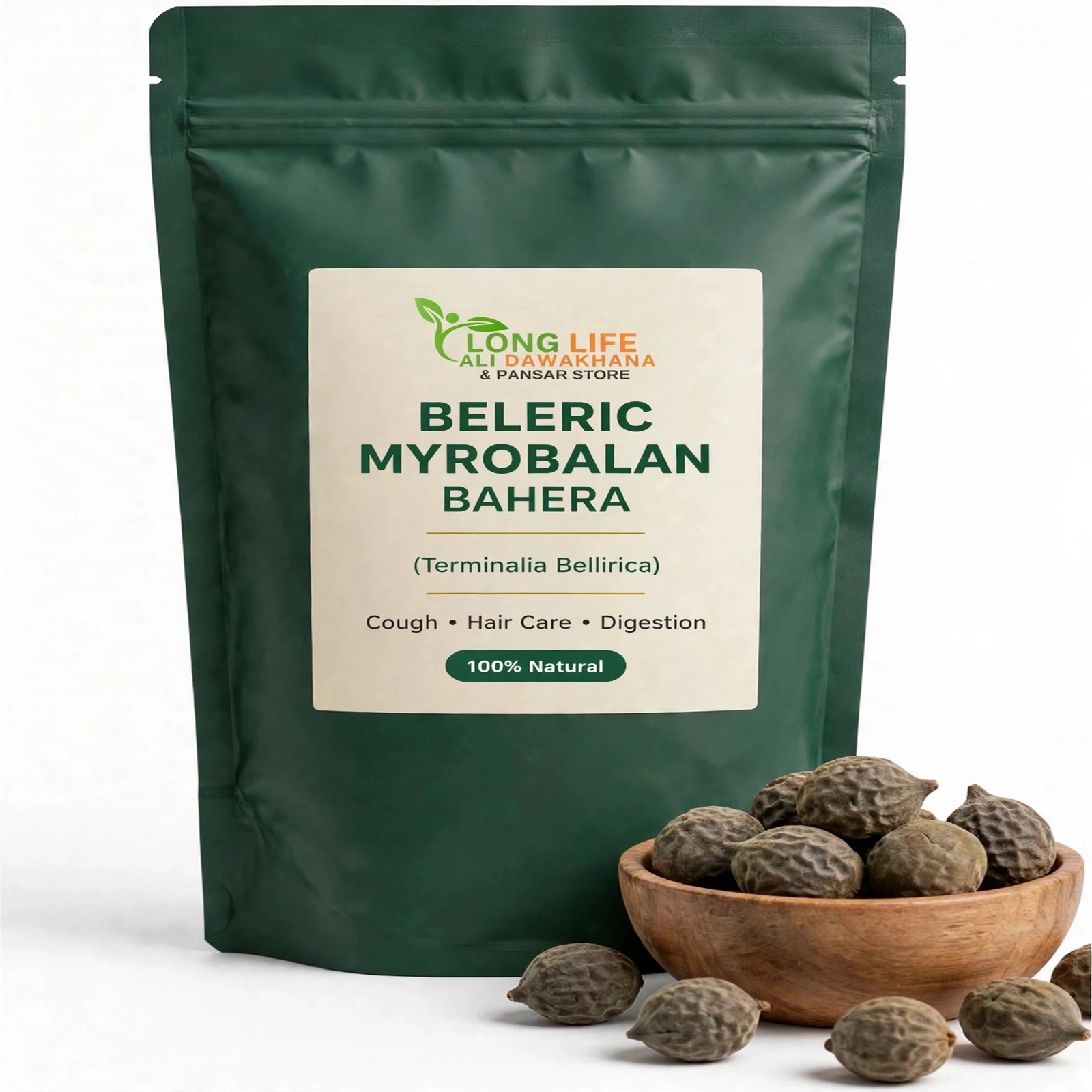
Beleric Myrobalan (Bahera, Terminalia bellirica), known in Ayurveda as Vibhitaki — “the one that keeps away disease” — is one of the three fruits of Triphala, Ayurveda’s most celebrated formula, used traditionally for cough and respiratory conditions, digestion, hair and eyes. It also has the strongest human trial evidence of any herb in the Long.pk range: two randomised trials showing it lowers uric acid. At Long.pk it is available in Whole and Powder forms (50 gm and 250 gm) from Rs 304, with Cash on Delivery across Pakistan.
بہیڑہ (بیلرک مائروبلان) — مکمل معلومات
بہیڑہ (بیلرک مائروبلان، وبھیتکی) تریفلا کا ایک پھل ہے، کھانسی، ہاضمے، بالوں اور آنکھوں کے لیے ہے، دو انسانی ٹرائلز میں یورک ایسڈ کم کیا۔
اہم انتباہ: بہیڑہ حاملہ خواتین کے لیے منع ہے، خون میں شکر کم کرتا ہے، ذیابیطس والے شکر ناپتے رہیں، زیادہ مقدار میں دست ہو سکتے ہیں۔ دوا پھل کا گودا ہے، بیج نہیں، بیج زہریلا ہے۔
Beleric Myrobalan (Bahera) – Price in Pakistan, Benefits, Uses & Safety
Direct answer: Beleric Myrobalan (Bahera, Terminalia bellirica) costs Rs 304 (50 gm Whole) to Rs 1,288 (250 gm Powder) at Long.pk, Whole and Powder, 50/250 gm, cash on delivery across Pakistan. Bahera is Vibhitaki, one of Triphala’s three fruits, used for cough, digestion, hair and eyes, with two randomised trials (2016, 2020) showing it lowers uric acid.
- What Is Beleric Myrobalan?
- History of Beleric Myrobalan
- Active Compounds
- Beleric Myrobalan in Ayurveda, Unani & Folk Medicine
- What Does Modern Research Say?
- Detailed Benefits of Beleric Myrobalan
- Bahera in Triphala: The Three Fruits
- Who Is Beleric Myrobalan For?
- How to Use Beleric Myrobalan
- Traditional Combinations
- Dosage & Duration
- Side Effects & Who Should Avoid It
- How to Identify Original Beleric Myrobalan
- Storage & Shelf Life
- Beleric Myrobalan vs Myrobalan vs Amla
- Beleric Myrobalan Price in Pakistan
- Product Specifications
- Roman Urdu
- Frequently Asked Questions
What Is Beleric Myrobalan?
Beleric Myrobalan (Bahera, Terminalia bellirica) is the dried fruit of a Combretaceae tree native to the Indian subcontinent. Urdu: Bahera (بہیڑہ); Sanskrit: Vibhitaki, “the one that keeps away disease”. The medicine is the fruit pericarp (pulp), not the folk-poisonous seed. Bahera is one of Triphala’s three fruits, with Harar and Amla.
History of Beleric Myrobalan
The Rigveda mentions Vibhitaka, branches used in Yajna. Charaka placed it in the fever-, cough- and purgation-alleviating groups. Sushruta used its ash with honey for eye diseases, calling it Madakara (intoxicating). Vagbhata called it the best herb for breathlessness and cough.
Active Compounds
Bahera is rich in tannins, gallic and ellagic acid, chebulagic acid, corilagin, flavonoids and β-sitosterol. Flavonoids inhibit xanthine oxidase, the gout drug allopurinol’s target, the mechanism behind the uric-acid trials.
Beleric Myrobalan in Ayurveda, Unani & Folk Medicine
In Ayurveda, Vibhitaki is Kasahara (cough-relieving) and Keshya (hair tonic), a rasayana reducing Kapha and aiding digestion. In Triphala it is the Kapha and fat-metabolism fruit. Unani uses it for cough and digestion; folk medicine uses the pulp in hair oils, the fruit with salt and long pepper for throat and chest infections.
What Does Modern Research Say?
Usharani et al. 2016 randomised 110 adults with high uric acid: 500 mg bibhitaki twice daily cut serum uric acid from ~8.07 to 5.78 mg/dL over 24 weeks, smaller than febuxostat (8.53 to 4.28 mg/dL). A 2020 trial in 59 kidney patients found 1000 mg twice daily gave ~34% versus 64% for febuxostat. Both pilot-scale, single-country studies.
Also: bronchodilator and antimicrobial action (lab), liver protection (animal, 2020 rat study), blood-sugar effects (lab, 2014). Cancer claims rest on cell lines only, never make them.
Detailed Benefits of Beleric Myrobalan
1. Cough & Respiratory
Kasahara and Shwasahara for cough, asthma and hoarseness, with Liquorice Root (Mulethi). Lab data supports it; no solo human trial.
2. Uric Acid & Gout
Two RCTs: Usharani 2016 (110 adults, 500 mg twice daily, 8.07 to 5.78) and 2020 CKD (59 patients, ~34% drop). Smaller than febuxostat; never a gout-medication substitute.
3. Digestion & Bowel
A mild purgative for sluggish digestion and constipation, like Golden Shower (Amaltas). Traditional use plus small Triphala trials.
4. Hair & Premature Greying
Keshya (hair tonic); pulp paste or oil for greying and hair loss. Traditional use only.
5. Eyes
Chakshushya (good for eyes); Sushruta used its ash with honey. Traditional use only, never put it in eyes.
6. Blood Sugar
Stimulates insulin secretion in vitro (Journal of Ethnopharmacology 2014). Lab data only, never use for diabetes without a doctor.
7. Liver
A 2020 rat study: bibhitaki extract and ellagic acid cut liver enzyme elevations like silymarin. Animal data only.
8. Weight & Metabolism
Medohara (fat-reducing); the Triphala fruit for excess Kapha and sluggish metabolism. Traditional use plus animal data.
Bahera in Triphala: The Three Fruits
Triphala, “three fruits”: Haritaki (Harar, Vata, the cleanser), Vibhitaki (Bahera, Kapha, the dryer), Amalaki (Amla, Pitta, the cooler). Ratio 1:2:3: one part Haritaki, two Vibhitaki, three Amalaki. Without Bahera, Triphala would lack its Kapha-clearing, mucus-drying, fat-metabolism action.
Who Is Beleric Myrobalan For?
- Cough or congestion: the classical Kasahara remedy.
- High uric acid: the strongest trial evidence, under a doctor’s supervision.
- Sluggish digestion: a mild laxative and gut tonic.
- Premature greying or hair loss: pulp in hair oils.
- Making Triphala: Bahera is one-third of the formula.
- Traditional users: Vibhitaki in Ayurveda and Unani.
Not for pregnant women; not a proven treatment for cough, hair or weight.
How to Use Beleric Myrobalan
- Powder: 3–6 g with warm water or honey, once or twice daily.
- Triphala: mix with Harar and Amla (1:2:3 or 1:1:1); 2–4 g at bedtime.
- Decoction or infusion: boil 5–10 g in two cups down to one, or steep 1–2 teaspoons 5–10 minutes; drink 2–3 times daily.
- Hair paste: powder with water or Amla, apply, leave 30 minutes, wash off.
- Hair oil: powder simmered in coconut or sesame oil, massaged into scalp.
What NOT to do: do not eat the seeds (folk-poisonous). Do not use in pregnancy or large doses. Do not put any preparation in the eyes.
Traditional Combinations
- Bahera + Harar + Amla (Triphala): digestion, detox; 2–4 g at bedtime.
- Bahera + salt + long pepper: throat and chest infections.
- Bahera + honey: cough; powder with honey before meals.
- Bahera + Amla: greying and hair loss; paste on scalp.
- Bahera + ginger: cough and cold; decoction taken warm.
- Bahera + turmeric: inflammation; powder with warm milk.
Dosage & Duration
- Powder: 3–6 g per day with warm water or honey (some sources 1–3 g).
- Triphala: 2–4 g per day, usually at bedtime.
- Extract (trial doses, not whole-fruit): 250–500 mg twice daily (2016); 1000 mg twice daily (2020).
- Infusion: 1–2 teaspoons per cup, 2–3 times daily.
- Tincture: 2–4 mL of 1:5 extract, 2–3 times daily.
- Duration: Triphala long-term as a daily tonic; specific conditions, 4–12 weeks under a practitioner.
- Take 2 hours away from iron and medicines; tannins reduce absorption.
Side Effects & Who Should Avoid It
Trials used 250–1000 mg twice daily for 24 weeks without serious adverse events. Side effects: loose stools, diarrhoea, abdominal pain, flatulence at higher doses. Allergies rare.
Seed warning: the medicine is the dried fruit pericarp (pulp), not the folk-poisonous seed. Do not eat the seeds.
Blood sugar: lowers blood sugar, may add to diabetes medication. Blood pressure: possible mild hypotensive effect. Interactions: may affect NSAIDs and blood-pressure medicines.
Who should avoid it or consult first:
- Pregnant women, AVOID.
- Breastfeeding: no data; consult a doctor.
- Diabetics on medication: may lower blood sugar.
- On blood-pressure medication: may lower blood pressure.
- On NSAIDs: possible interaction.
- Iron-deficiency anaemia: tannins block iron absorption.
- Children under 5: consult a practitioner.
- Elderly with liver or kidney disease: consult first.
Interactions: diabetes and blood-pressure medications, NSAIDs, iron and oral medicines.
How to Identify Original Beleric Myrobalan
- Shape: round drupes, grape-sized, pointed tip, not ridged like Harar.
- Colour: olive-brown, matte. Very dark old; very pale immature.
- Texture: hard, woody, wrinkled; dry, not soft or damp.
- Smell: mild, woody, astringent. Musty means damp, reject it.
- Taste: astringent, slightly bitter. Not astringent means not Bahera.
- Seed: one hard stone inside; the pulp is the medicine.
- Bahera vs Harar: Bahera round, smooth; Harar oval, ridged, wrinkled.
- No mould: reject mould spots or musty smell.
- Powder: greyish-brown, fine, astringent. Very pale may be filler-cut.
Storage & Shelf Life
Store airtight in a cool, dark, dry place. Whole fruits 18–24 months; powder 9–12 months. Replace soft, damp or mouldy fruit.
Beleric Myrobalan vs Myrobalan vs Amla
| Feature | Beleric Myrobalan (Bahera) | Myrobalan (Harar) | Amla (Indian Gooseberry) |
|---|---|---|---|
| Botanical name | Terminalia bellirica | Terminalia chebula | Phyllanthus emblica |
| Family | Combretaceae | Combretaceae | Phyllanthaceae |
| Part used | Dried fruit pericarp | Dried fruit | Dried fruit |
| Tannin content | 20–30% | 30–40% | 20–25% |
| Key compounds | Gallic acid, ellagic acid, chebulagic acid, corilagin | Chebulagic acid, chebulinic acid, gallic acid | Vitamin C, emblicanin A/B, gallic acid, ellagic acid |
| Dosha | Kapha (primary) | Vata (primary) | Pitta (primary) |
| Main traditional use | Cough, respiratory, hair, eyes, uric acid | Digestion, constipation, detox, rejuvenation | Cooling, immunity, hair, vitamin C, rejuvenation |
| Laxative effect | Mild | Moderate-strong | Mild |
| Vitamin C | Low | Low | Very high (one of the richest natural sources) |
| Human trials | 2 RCTs (uric acid) | Some small trials | Several small trials |
| Safety cautions | Avoid in pregnancy; seeds poisonous | Avoid in pregnancy (traditional); avoid in diarrhoea | Generally safe; avoid in pregnancy (traditional) |
| Triphala ratio | 2 parts | 1 part | 3 parts |
| Price (Long.pk, from) | Rs 304 / 50 gm | — | — |
| Best for | Cough, uric acid, hair | Daily digestion, detox | Cooling, immunity, vitamin C |
Price in Pakistan
| Form | 50 gm | 250 gm |
|---|---|---|
| Whole | Rs 304 | Rs 743 |
| Powder | Rs 354 | Rs 1,288 |
Specifications
| Product name | Beleric Myrobalan (Bahera) |
| Urdu name | بہیڑہ (Bahera) |
| Sanskrit name | Vibhitaki, Bibhitaki, Aksha |
| Botanical name | Terminalia bellirica (Gaertn.) Roxb. |
| Family | Combretaceae |
| Part used | Dried fruit pericarp (pulp) |
| Forms | Whole / Powder |
| Weights | 50 gm, 250 gm |
| Price Range | Rs 304 – Rs 1,288 |
| Origin | India, Pakistan, Nepal, Bangladesh, Myanmar, Sri Lanka |
| Purity | 100% natural dried fruit, no additives |
| Key compounds | Gallic acid, ellagic acid, chebulagic acid, chebulinic acid, corilagin, β-sitosterol |
| Shelf life | Whole fruit 18–24 months; powder 9–12 months |
| Storage | Airtight container, cool, dark, dry place |
| Seller | Ali Dawakhana and Pansar Store |
Roman Urdu Summary
Beleric Myrobalan (Bahera), Terminalia bellirica, Vibhitaki hai, Triphala ka aik phal. Khaansi, hazmay, baalon, aankhon ke liye; do trials mein uric acid kam kiya.
Dawa phal ka goda hai, beej nahi, beej zehreela hai. Hamila khawateen na lein. Long.pk par Whole aur Powder, Rs 304 se, cash on delivery.
Frequently Asked Questions
Q: Bahera kis kaam aata hai?
Khaansi, hazmay, baal, aankhon ke liye; Triphala ka phal.
Q: Bahera Triphala mein kya karta hai?
Kapha ka phal. Ratio 1:2:3.
Q: Kya Bahera uric acid kam karta hai?
Ji. 2016: 8.07 se 5.78. 2020: ~34% kami.
Q: Bahera ki khurak kya hai?
Powder 3–6 gram; Triphala 2–4 gram, raat ko.
Q: Kya Bahera ke beej zehreelay hain?
Ji, beej zehreela hai. Dawa goda hai.
Q: Kya Bahera hamila khawateen le sakti hain?
Nahi, hamila khawateen ke liye mana hai.
Q: Asli Bahera ki pehchan kya hai?
Gol, zaitooni bhoora, angoor jitna.
Q: Bahera ki price kya hai?
Rs 304–1,288. Best value Whole 250 gm.
Q: Bahera baalon ke liye kaisay istemal hota hai?
Paste lagayen, 30 minute baad dho lein.
Q: Bahera ko kaise store karein?
Airtight jar mein. Whole 18–24, powder 9–12 mahinay.
Related Products
- Golden Shower (Amaltas) — a traditional bowel tonic and mild laxative, pairing with Bahera’s digestive use.
- Plantain Seeds (Bartang) — a traditional gut remedy that regulates the bowel, complementing Bahera’s Triphala role.
- Liquorice Root (Mulethi) — a classical cough and throat herb, sharing Bahera’s respiratory use.
- Organic Moringa Leaf Powder (Sohanjna Powder) — a daily nutrition tonic rich in iron and vitamins, supporting hair and general health.
Ali Dawakhana and Pansar Store — Asli desi dawa aur khalis jadi bootiyan, ab ghar baithay Long.pk se mangwayen.

Reviews
There are no reviews yet