
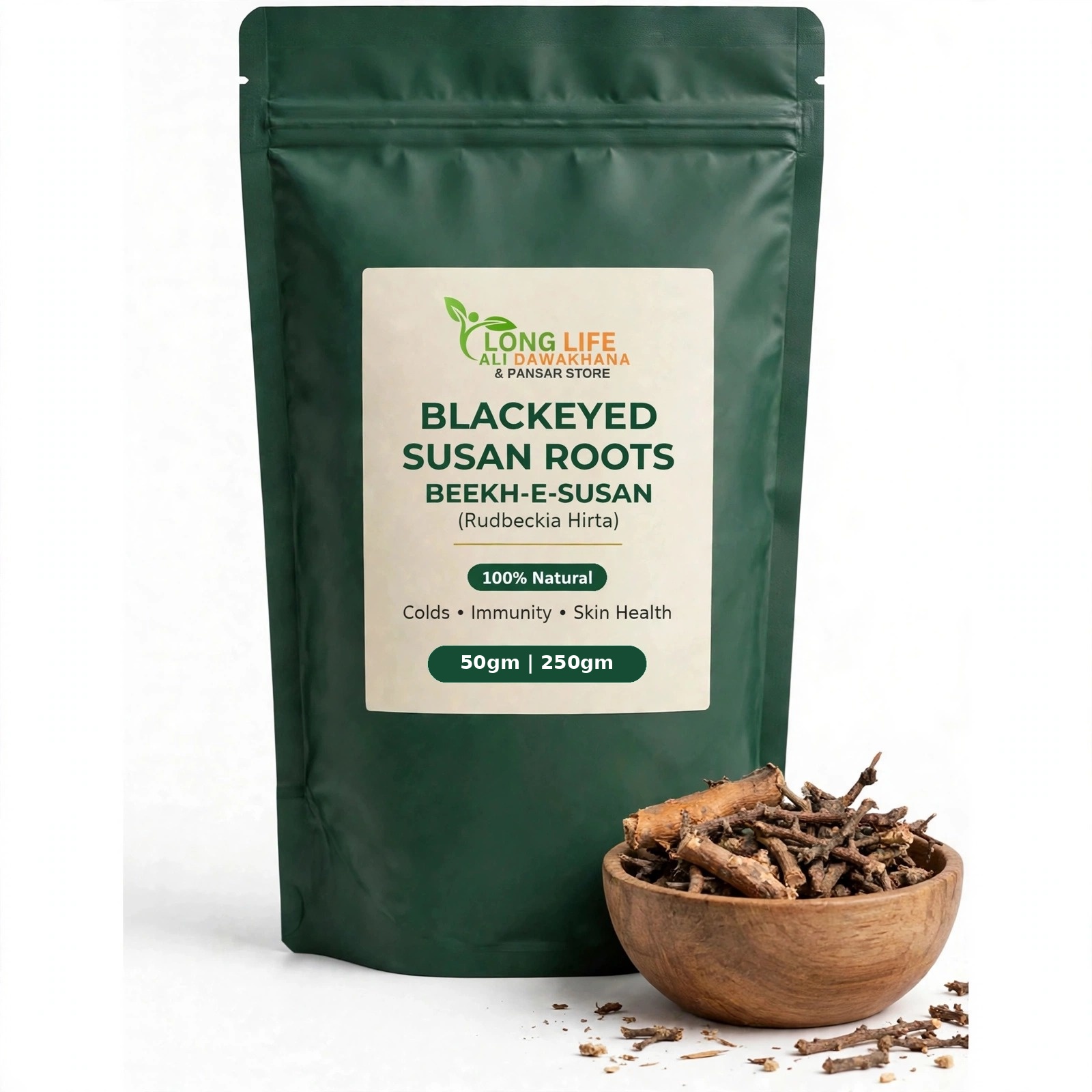
Blackeyed Susan Roots (Beekh-e-Susan, Rudbeckia hirta) is the dried root of the North American black-eyed Susan, a daisy-family flower used for centuries by Native American tribes as a tea for colds, as a poultice for wounds and as a wash for sores. Its chemistry is almost entirely unstudied in the root — the modern research is on the flowers — and there are no human trials of any part. One warning matters more than any benefit: the classical Unani drug called “Susan” is iris root, not this plant, and the seeds of this plant are poisonous. At Long.pk it is available in Whole and Powder forms (50 gm and 250 gm) from Rs 177, with Cash on Delivery across Pakistan.
بیخ سوسن (Blackeyed Susan Roots) — مکمل معلومات
بیخ سوسن، جسے انگریزی میں Blackeyed Susan Roots کہتے ہیں، شمالی امریکہ کے مشہور پھول (Rudbeckia hirta) کی جڑ ہے۔
اہم انتباہ: اس پودے کے بیج انسانوں کے لیے زہریلے ہیں — بیج کبھی نہ کھائیں۔ یونانی طب کی کلاسیکی دوا “سوسن” (عرسہ، iris) ایک بالکل مختلف پودا ہے — یہ پروڈکٹ وہ دوا نہیں ہے۔
Blackeyed Susan Roots (Beekh-e-Susan) – Price in Pakistan, Benefits, Uses & Safety
Direct answer: Blackeyed Susan Roots (Beekh-e-Susan, Rudbeckia hirta) price in Pakistan starts from Rs 177 for 50 gm (Whole form) at Long.pk, going up to Rs 1,148 for 250 gm (Powder form). It is available in two forms — Whole and Powder — in 50 gm and 250 gm packs, with cash on delivery across Pakistan.
- What Is Blackeyed Susan Roots?
- History of Blackeyed Susan Roots
- Active Compounds
- Blackeyed Susan Roots in Folk Medicine
- What Does Modern Research Say?
- Detailed Benefits of Blackeyed Susan Roots
- Beekh-e-Susan: Two Plants, One Name
- Who Is Blackeyed Susan Roots For?
- How to Use Blackeyed Susan Roots
- Traditional Combinations
- Dosage & Duration
- Side Effects & Who Should Avoid It
- How to Identify Original Blackeyed Susan Roots
- Storage & Shelf Life
- Blackeyed Susan Roots vs Echinacea vs Liquorice
- Blackeyed Susan Roots Price in Pakistan
- Product Specifications
- Roman Urdu
- Frequently Asked Questions
What Is Blackeyed Susan Roots?
Blackeyed Susan Roots — Urdu Beekh-e-Susan (بیخ سوسن, “root of Susan”) — is the dried root of Rudbeckia hirta L., a flowering plant of the Asteraceae (daisy family).
Names: In English it is Black-Eyed Susan, Brown-Eyed Susan, Coneflower and Gloriosa Daisy.
History of Blackeyed Susan Roots
The history of Blackeyed Susan Roots is a Native American history, recorded in the Native American Ethnobotany Database (BRIT) from the oral traditions of the tribes who used it.
Active Compounds
The chemistry of Blackeyed Susan Roots comes with the most important caveat in this article: almost every modern chemical study of this plant analysed the flowers or the leaves, not the root.
Blackeyed Susan Roots in Folk Medicine
Blackeyed Susan Roots has no classical Ayurvedic or Unani pedigree — it is a North American plant, and the classical texts of India and the Islamic world never encountered it.
What Does Modern Research Say?
Here is the honest summary first: there are no published human clinical trials of Rudbeckia hirta — not of the root, not of the flowers, not of any part, for any condition. Everything below is laboratory (in vitro) work on flower or leaf extracts.
The flower study (Burlec et al. 2023, Plants). The most thorough modern paper on this plant analysed cultivated R. hirta flowers and tested their extracts in the laboratory.
Detailed Benefits of Blackeyed Susan Roots
Every benefit below is labelled with its evidence level: traditional (Native American ethnobotanical use) or lab (flower-extract studies in the laboratory). Nothing here is a proven human-treatment claim, and the root itself has no modern study behind any benefit.
Colds & Immune Support (Traditional + Lab)
This is the herb’s best-known traditional use. The Potawatomi and Ojibwa brewed the root as a tea for colds.
Wounds & Sores (Traditional + Lab)
The Cherokee bathed sores with a warm root infusion.
Earache (Traditional)
A distinctive Cherokee use: the ooze from the fresh root was dropped into the ear for earache.
Diuretic & Dropsy (Traditional)
The Cherokee gave a root infusion for dropsy.
Worms — Anthelmintic (Traditional; Replaced by Modern Medicine)
The Cherokee used the root as a worm medicine, and the Iroquois gave a root infusion to children with worms.
Beekh-e-Susan: Two Plants, One Name
This is the most important section of the article for a buyer in Pakistan, because the name “Susan” belongs to two completely different plants — and buying the wrong one means getting the wrong medicine.
The classical Unani Susan — iris. In Unani medicine, Susan (سوسن, Sosan) is the iris — specifically the root of Iris ensata Thunb.
Who Is Blackeyed Susan Roots For?
Blackeyed Susan Roots suits people who:
- Want a traditional cold-season tea in the Native American style.
- Want a traditional wound wash or poultice for minor, clean sores and skin complaints.
- Are interested in Native American herbal medicine and want a root with a documented ethnobotanical record.
How to Use Blackeyed Susan Roots
Tea (the traditional preparation): Put 1–2 teaspoons of the dried root (or powder) in a cup, pour over freshly boiled water, cover and steep for 10–15 minutes, then strain. Drink 1–2 cups a day for the duration of a cold.
Decoction: Add 5–10 g of the whole root to 2 cups (about 400 ml) of water.
Traditional Combinations
- Blackeyed Susan + Liquorice (Mulethi) — the cold-season pairing.
- Blackeyed Susan + Ginger — a warming cold and flu combination.
- Blackeyed Susan + Honey — honey as the vehicle and sweetener for the root tea, especially for a sore throat and cough.
Dosage & Duration
There is no modern dose-finding study for Blackeyed Susan Roots, so all doses below are from traditional practice as recorded in the ethnobotanical literature. Start at the lower end and stop if you feel unwell.
| Preparation | Dose | Frequency |
|---|---|---|
| Root tea (1–2 tsp dried root per cup) | 1 cup | 1–2 times daily |
| Decoction (5–10 g root in 400 ml water, reduced to 200 ml) | 30–40 ml | Twice daily |
Side Effects & Who Should Avoid It
Blackeyed Susan Roots has a long folk record and side effects at traditional doses are uncommon — but it is a daisy-family plant with real cautions, and one of them is about the seeds.
Seeds are poisonous — do not eat them. The seeds of Rudbeckia hirta are poisonous to humans (though not to birds, who eat them freely).
Daisy-family allergy — the main caution. Rudbeckia is in the Asteraceae (daisy) family, and its sesquiterpene lactones are the compounds that cause allergy in sensitive people.
Pregnancy — avoid. There is no safety data for black-eyed Susan root in pregnancy, and the traditional record gives no guidance either way.
Breastfeeding — avoid medicinal doses. There is no safety data for nursing mothers. Wait until after weaning.
Children under 12 — avoid. The Iroquois gave a root infusion to children with worms, and the Chippewa poulticed babies’ sores with the blossoms — but that was a different century, and there is no modern safety data for children.
Autoimmune conditions and immunosuppressant medicines. Echinacea, the daisy-family cousin, is traditionally cautioned in autoimmune disease and with immunosuppressant drugs because of its immune-stimulating reputation.
Surgery. As a general precaution, stop using medicinal doses two weeks before planned surgery.
How to Identify Original Blackeyed Susan Roots
Appearance: Genuine dried Blackeyed Susan Roots is a bundle of thin, woody, dark-brown twiggy root pieces — reddish-brown rough bark on the outside, pale wood showing at the cut ends.
Storage & Shelf Life
- Whole root: keeps 18–24 months in an airtight container in a cool, dry place away from direct sunlight.
- Powder: keeps 9–12 months — ground herbs lose their active compounds faster, so buy powder in smaller quantities and use it up.
- Seal tightly after every use.
Blackeyed Susan Roots vs Echinacea vs Liquorice
| Feature | Blackeyed Susan Roots (Beekh-e-Susan) | Echinacea | Liquorice Root (Mulethi) |
|---|---|---|---|
| Botanical name | Rudbeckia hirta | Echinacea purpurea / angustifolia | Glycyrrhiza glabra |
| Family | Asteraceae (daisy) | Asteraceae (daisy) | Fabaceae (legume) |
| Part used | Root | Root, leaf, flower | Root and stolon |
Blackeyed Susan Roots Price in Pakistan
| Form | 50 gm | 250 gm |
|---|---|---|
| Whole | Rs 177 | Rs 810 |
| Powder | Rs 388 | Rs 1,148 |
Best value: Whole 250 gm at Rs 3.24 per gram — the Powder costs more per gram at every size.
Product Specifications
| Product Name | Blackeyed Susan Roots (Beekh-e-Susan) |
| Urdu Name | بیخ سوسن (Beekh-e-Susan) |
| Botanical Name | Rudbeckia hirta L. |
| Family | Asteraceae (daisy family) |
| English Names | Black-Eyed Susan, Brown-Eyed Susan, Coneflower, Gloriosa Daisy |
| Part Used | Root (dried) |
| Forms | Whole / Powder |
| Weights | 50 gm, 250 gm |
| Price Range | Rs 177 – Rs 1,148 |
| Key Compound | Sesquiterpene lactones (flowers studied; root unstudied) |
| Temperament (Unani) | Not assigned — no classical Unani record for this plant |
| Additives | None — 100% natural |
| Shelf Life | Whole root 18–24 months; Powder 9–12 months |
| Storage | Airtight container, cool and dry, away from sunlight |
| Seller | Ali Dawakhana and Pansar Store |
| Delivery | Cash on Delivery across Pakistan |
Roman Urdu
Beekh-e-Susan (Blackeyed Susan Roots) shumali America ke mashhoor phool (Rudbeckia hirta) ki jarr hai, jo daisy (gul-e-dawoodi) khandan ka pauda hai.
Do ahem baatein yaad rakhein: pehli — Yunani tib ki classical dawa “Susan” (Irsa, iris ki jarr) aik bilkul mukhtalif pauda hai; yeh product woh dawa nahi hai. Doosri — is pauday ke beej insanon ke liye zehreelay hain; beej kabhi na khayein.
Qeemat: Rs 177 se Rs 1,148 tak — Whole aur Powder, 50 gm aur 250 gm. Cash on Delivery pooray Pakistan mein mojood hai.
Frequently Asked Questions
Q: Beekh-e-Susan kis kaam aati hai?
Beekh-e-Susan (Blackeyed Susan Roots, Rudbeckia hirta) America ke qadeem qabail ki rawayati dawa hai — jarr ki chai nazla zukam ke liye.
Q: Blackeyed Susan Roots ki Pakistan mein qeemat kya hai?
Rs 177 se Rs 1,148 tak — Whole 50 gm Rs 177, 250 gm Rs 810; Powder 50 gm Rs 388, 250 gm Rs 1,148.
Q: Kya Beekh-e-Susan sardi zukam mein madad karti hai?
Rawayati tor par haan — Potawatomi aur Ojibwa qabail jarr ki chai zukam ke liye peetay thay, aur Menominee qabeela isay taqat ke liye istemal karta tha.
Q: Beekh-e-Susan aur Yunani Susan (Irsa) mein kya farq hai?
Yeh do bilkul mukhtalif pauday hain jinka sirf naam aik hai.
Q: Beekh-e-Susan kaisay istemal karte hain?
Teen tareeqay hain: (1) chai — 1 se 2 chammach khushk jarr aik cup garam pani mein 10 se 15 minute bhigo kar chhaan kar din mein aik ya do baar piyein; (2) qehwa — 5 se 10 gram jarr 2 cup pani mein ubaal kar 1 cup reh janay par chhaan kar din mein 2 baar 30 se 40 ml piyein; (3) leep ya dhulaai — zakham ya phoray par jarr ka paste ya thandi chai se dhulaai karein.
Q: Kya Black-eyed Susan ke beej kha sakte hain?
Nahi — beej insanon ke liye zehreelay hain (parindon ke liye nahi).
Q: Kya Beekh-e-Susan echinacea jaisi hai?
Dono daisy khandan ki qareebi rishtedaar hain aur dono ka rawayati istemal zukam aur zakhmon ke liye hai.
Q: Kya Beekh-e-Susan hamila khawateen le sakti hain?
Nahi. Hamal mein is ki safety ka koi data nahi hai, is liye hamila khawateen is se parhez karein.
Q: Kya Beekh-e-Susan se allergy ho sakti hai?
Haan — yeh daisy (Asteraceae) khandan ka pauda hai, aur is ke sesquiterpene lactones allergy ka sabab ban saktay hain.
Q: Asli Beekh-e-Susan ki pehchan kya hai?
Asli jarr patli, lakri jaisi, gehri bhoori tehniyon jaisi hoti hai — bahar se surkh-bhoori khurdari chhaal, katnay par andar halki lakri.
Related Products
- Liquorice Root (Mulethi) — throat and cold comfort, the classical partner herb for a cold-season tea.
- Jujube Berries (Unab) — cough and throat soothing.
- Organic Moringa Leaf Powder — a general immunity tonic.
- Golden Shower (Amaltas) — gentle cleansing and digestion.
Ali Dawakhana and Pansar Store — Asli desi dawa aur khalis jadi bootiyan, ab ghar baithay Long.pk se mangwayen.
Reviews
There are no reviews yet