
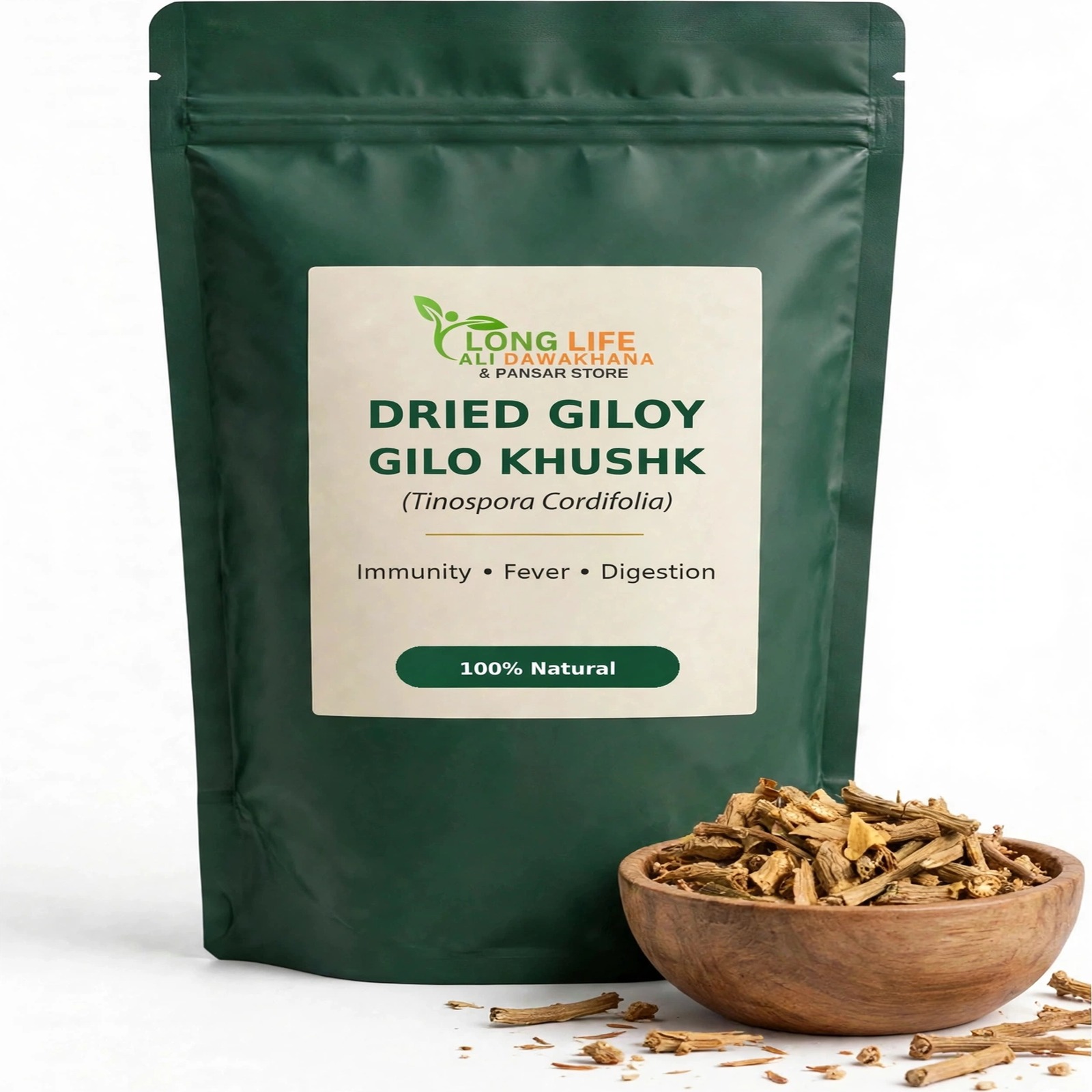
Dried Giloy (Gilo Khushk, Tinospora cordifolia), known in Ayurveda as Guduchi and Amrita — the “nectar of immortality” — is one of India’s most famous herbs, used for over 2,000 years as a Rasayana (rejuvenator) for immunity, fever, blood sugar and joints. At Long.pk it is available in Whole and Powder forms (50 gm and 250 gm) from Rs 177, with Cash on Delivery across Pakistan.
گلو خشک (گلائے) — مکمل معلومات
گلو خشک، آیوروید میں گڈوچی (Guduchi) یا امرتا (Amrita)، ایک پودے (Tinospora cordifolia) کی سوکھی ٹہنیاں ہیں۔
روایتی فائدے: قوت مدافعت، بخار، ذیابیطس، جوڑوں کا درد، ہاضمہ اور جلد کے امراض۔
اہم انتباہ: 2022 میں گلوئے سے جگر کے نقصان کے 43 مریضوں کی رپورٹ شائع ہوئی۔ جگر یا خودکار مدافعتی بیماری والے، یا مدافعتی نظام دبانے والی دوا لینے والے، استعمال نہ کریں۔ 4–8 ہفتے کے بعد وقفہ کریں۔
Long.pk سے Whole یا Powder میں 50 اور 250 گرام میں دستیاب — Rs 177 سے شروع۔
Dried Giloy (Gilo Khushk) – Price in Pakistan, Benefits, Uses & Safety
Direct answer: Dried Giloy (Gilo Khushk, Tinospora cordifolia) starts from Rs 177 for 50 gm (Whole) at Long.pk, up to Rs 702 for 250 gm (Powder). Human trial evidence is small, and the 2022 liver-injury case series of 43 patients is the most important safety fact about this herb.
- What Is Dried Giloy?
- History of Giloy
- Active Compounds
- Giloy in Ayurveda, Unani & Folk Medicine
- What Does Modern Research Say?
- Detailed Benefits of Dried Giloy
- Stem vs Satva: Two Forms of Giloy
- Who Is Dried Giloy For?
- How to Use Dried Giloy
- Traditional Combinations
- Dosage & Duration
- Side Effects & Who Should Avoid It
- How to Identify Original Dried Giloy
- Storage & Shelf Life
- Dried Giloy vs Ashwagandha vs Tulsi
- Dried Giloy Price in Pakistan
- Product Specifications
- Roman Urdu
- Frequently Asked Questions
What Is Dried Giloy?
Dried Giloy (Gilo Khushk, Tinospora cordifolia) is the dried stem of a climbing vine. In Urdu Gilo Khushk (گلو خشک); in Sanskrit Guduchi and Amrita. Tan to golden-brown woody cuttings, 2–8 cm long — an Ayurvedic Rasayana.
History of Giloy
Used in Ayurveda for over 2,000 years, Tinospora cordifolia appears in the Charaka Samhita, Sushruta Samhita and Bhavaprakasha for fever, diabetes and diarrhoea. During COVID-19, mass unsupervised use produced the liver-injury reports of 2021–2022.
Active Compounds
Key compounds: alkaloids berberine, palmatine, tinosporin, magnoflorine (anti-diabetic); glycosides cordifolisides, syringin and arabinogalactan polysaccharide (immunomodulatory); diterpenoid lactones columbin, tinosporides (anti-inflammatory); bitter principles giloin, giloinin (digestive).
Giloy in Ayurveda, Unani & Folk Medicine
In Ayurveda, Guduchi is bitter (Tikta) and pacifies all three doshas. A Rasayana and Jwaraghna (fever-reducing), it is used for fever, diabetes, arthritis, jaundice and skin diseases; Unani and Siddha use it for fever and debility.
What Does Modern Research Say?
Human evidence is small: a 2026 review found only four PubMed-indexed RCTs (n ≥ 30). Best human evidence: a 2015 RCT (75 patients, allergic rhinitis). A 2021 RCT (Devpura et al.) tested a Giloy compound in 100 mild COVID-19 patients — multi-herb, open-label. Anticancer activity is cell lines only.
Detailed Benefits of Dried Giloy
1. Immunity
A Rasayana; lab studies show its compounds activate immune cells. No human trial shows fewer infections.
2. Fever
Classical Jwaraghna use for chronic and periodic fever. (Traditional use only.)
3. Blood Sugar
In the Ayurvedic Pharmacopoeia of India; alkaloids lower blood sugar in animals.
4. Joints & Arthritis
Used for rheumatoid arthritis and joint pain. Evidence: traditional use plus animal data.
5. Digestion
Used for dyspepsia, chronic diarrhoea and dysentery. (Traditional use only.)
6. Skin
Used for skin diseases, erysipelas and itching. (Traditional use only.)
7. Allergies
A 2015 RCT (75 patients, allergic rhinitis) reported fewer nasal symptoms.
8. Liver & Jaundice
Traditionally used for jaundice — but the 2022 case series overrides this for liver disease.
Stem vs Satva: Two Forms of Giloy
The dried stem (this product) is taken as a decoction or powder for fever, diabetes, immunity and joints. Guduchi Satva is the starch from the fresh stem — a fine white powder, for diarrhoea and weakness.
Who Is Dried Giloy For?
For people who want the traditional Ayurvedic Rasayana — for debility, fever, joint pain or digestive complaints — in short courses, practitioner-guided.
Not for liver disease, autoimmune disease, immunosuppressants or hepatotoxic medications — and not for long-term daily use.
How to Use Dried Giloy
Stem decoction: boil 5–10 g of stem in two cups of water until one cup remains, strain, drink warm, once or twice daily.
Powder: ½–1 teaspoon (2–4 g) with warm water or honey, twice daily, before meals.
What NOT to do: never take it daily for months without a break (median onset: 46 days).
Traditional Combinations
Traditionally combined with ginger (fever), turmeric (joints), amla (debility), neem (skin), black pepper (digestion) and honey (vehicle).
Dosage & Duration
- Powder (churna): ½–1 teaspoon (2–4 g) with warm water or honey, twice daily.
- Stem decoction: 5–10 g of dried stem per cup, once or twice daily.
- Duration — the critical rule: 4–8 weeks, then a break. Median onset in the 2022 case series was 46 days.
Side Effects & Who Should Avoid It
Giloy is well tolerated short-term, but it has the most serious safety signal of any herb in this series.
Common side effects: mild nausea, bloating and loose stools; occasional headache.
The liver-injury reports — the most important safety fact about Giloy.
The largest report is the 2022 multi-centre case series by Kulkarni et al. (Hepatology Communications, PMC 9134809):
- 43 patients across 13 hospitals in 9 Indian cities developed Giloy-associated liver injury.
- Acute hepatitis, acute-on-chronic liver disease, or acute liver failure.
- Median onset was 46 days — suggesting immune-mediated injury, not direct toxicity.
- More than half were female; most showed autoimmune features, many ANA-positive.
- Most recovered after stopping Giloy; some needed steroids. Others developed acute liver failure, which can be fatal.
A 2021 case series (Nagral et al.) documented six patients with autoimmune-feature hepatitis. The 2024 NIH LiverTox database now lists Tinospora cordifolia.
The mechanism: Giloy’s immunostimulatory properties can trigger autoimmune-like hepatitis in susceptible individuals.
The dispute: AYUSH blamed substitution with the hepatotoxic look-alike Tinospora crispa; liver specialists confirmed their patients’ herb was T. cordifolia.
Who should avoid Giloy or consult first:
- Anyone with diagnosed liver disease — hepatitis, fatty liver, cirrhosis.
- Anyone with an autoimmune condition — immune stimulation can worsen it.
- Anyone taking immunosuppressants — Giloy may counteract them, including after organ transplant.
- Anyone taking hepatotoxic medications — including high-dose acetaminophen (paracetamol), certain anticonvulsants, statins, methotrexate and isoniazid.
- Anyone planning daily use beyond 6 weeks — median onset was 46 days.
- Pregnant and breastfeeding women — the NHS advises against herbal medicines without advice.
- People with diabetes on medication — Giloy may lower blood sugar further.
- People with low blood pressure — Giloy may lower blood pressure.
Warning signs — stop and seek medical advice at once: yellowing of the skin or eyes (jaundice), dark urine, itching, unusual tiredness, or pain in the upper right abdomen.
Interactions: diabetes medications (hypoglycaemia risk), immunosuppressants (may counteract them), hepatotoxic medications (additive liver risk), blood-pressure medications (may lower blood pressure further).
How to Identify Original Dried Giloy
- Shape: irregular woody cuttings, 2–8 cm, light tan to golden-brown.
- Cross-section: pale, porous and spongy, with a wheel-like fibre pattern.
- Taste: intensely bitter — if not bitter, it is not Giloy.
- T. crispa warning: the look-alike Tinospora crispa is more hepatotoxic — buy from a trusted pansar.
Storage & Shelf Life
Store in an airtight jar, cool, dark and dry. Whole stem keeps 18–24 months; powder 9–12 months. Replace if soft or mouldy.
Dried Giloy vs Ashwagandha vs Tulsi
| Feature | Dried Giloy (Gilo Khushk) | Ashwagandha | Tulsi (Holy Basil) |
|---|---|---|---|
| Botanical name | Tinospora cordifolia | Withania somnifera | Ocimum sanctum |
| Part used | Dried stem | Root | Leaves |
| Key compounds | Berberine, palmatine, tinosporin, cordifolisides | Withanolides | Eugenol, ursolic acid, rosmarinic acid |
| Main traditional use | Immunity, fever, diabetes, joints | Stress, strength, sleep, vitality | Respiratory, stress, immunity, fever |
| Human trials | 4 RCTs (n≥30); allergic rhinitis trial (n=75) | Many RCTs — stress, sleep, testosterone, cognition | A few small trials |
| Evidence level | Limited — mostly lab and animal | Moderate — the best-studied adaptogen | Limited — mostly lab and animal |
| Safety signal | Liver injury (43-patient case series, 2022) | Liver injury reports also exist (rare); thyroid effects | Generally safe; may lower blood sugar |
| Avoid in | Liver disease, autoimmune disease, immunosuppressants | Pregnancy, hyperthyroidism, liver disease (caution) | Pregnancy (traditional caution), blood thinners |
| Taste | Intensely bitter | Bitter, earthy | Pungent, clove-like |
| Price (Long.pk, from) | Rs 177 / 50 gm | — | — |
| Best for | Fever, short-course immunity support | Stress, sleep, strength | Respiratory complaints, daily tonic |
For fever and short-course immune support, Giloy — only in short courses, never with liver or autoimmune disease. For daily nutritional support, Organic Moringa Leaf Powder (Sohanjna Powder) is a widely used tonic.
Price in Pakistan
| Form | 50 gm | 250 gm |
|---|---|---|
| Whole | Rs 177 | Rs 624 |
| Powder | Rs 191 | Rs 702 |
Prices follow the source website (Pansaar), rounded to whole rupees. Best value is the Whole 250 gm pack at Rs 2.50 per gram.
Specifications
| Product name | Dried Giloy (Gilo Khushk) |
| Urdu name | گلو خشک (Gilo Khushk) |
| Sanskrit name | Guduchi, Amrita |
| Botanical name | Tinospora cordifolia (Willd.) Miers (heart-leaved moonseed) |
| Family | Menispermaceae |
| Part used | Dried stem |
| Forms | Whole / Powder |
| Weights | 50 gm, 250 gm |
| Origin | India, Pakistan, South and Southeast Asia |
| Purity | 100% natural dried stem, no additives |
| Key compounds | Berberine, palmatine, tinosporin, magnoflorine, cordifolisides, syringin |
| Shelf life | Whole stem 18–24 months; powder 9–12 months |
| Storage | Airtight container, cool, dark, dry place |
| Seller | Ali Dawakhana and Pansar Store |
Roman Urdu Summary
Dried Giloy (Gilo Khushk) — Tinospora cordifolia — Ayurveda ki mashhoor dawa Guduchi (Amrita) hai, quwwat-e-mudafiat, bukhar aur diabetes ke liye istemal hoti hai.
Intebah: 2022 mein Giloy se jigar ke nuqsan ke 43 mareezon ki case series shaya hui — jigar ya autoimmune bemari walay istemal na karein.
Frequently Asked Questions
Q: Gilo Khushk kis kaam aata hai?
Quwwat-e-mudafiat, bukhar, diabetes, joron ke dard, hazmay aur jild ke liye.
Q: Kya Giloy se jigar ko nuqsan pahunch sakta hai?
Ji — 2022 ki case series mein 43 mareezon ko rozana istemal ke baad jigar ki bemari hui.
Q: Giloy kitne arsay tak le sakte hain?
4–8 haftay ka course, phir waqfa. 6 hafton se ziyada musalsal istemal khatarnak hai.
Q: Giloy ki khurak kya hai?
Powder aadha se aik chammach din mein do baar; qahwa 5–10 gram tehni se.
Q: Giloy aur Giloy Satva mein kya farq hai?
Gilo Khushk sookhi tehni hai; Satva taza tehni ka nishasta hai, dast ke liye naram.
Q: Kya Giloy diabetes ke liye kaam karta hai?
Rawayati tor par khoon ki shakar kam karta hai, lekin insani saboot kamzor hai.
Q: Asli Gilo Khushk ki pehchan kya hai?
Tan se sunehri bhooray rang ki tehni, 2–8 cm, andar surakh daar pattern, shadeed karwa zaiqa.
Q: Giloy ki price kya hai?
Rs 177 (50 gm Whole) se Rs 702 (250 gm Powder) tak.
Q: Kya Giloy immunity barhata hai?
Laboratory mein immune cells activate hotay hain, lekin insani trial nahi hai.
Q: Giloy ko kaise store karein?
Airtight jar mein, thandi khushk jagah par. Tehni 18–24 mahinay, powder 9–12 mahinay.
Related Products
- Organic Moringa Leaf Powder (Sohanjna Powder) — a daily nutrition and energy tonic, a gentle companion to a short Giloy course.
- Brahmi Booti (Centella) — another classical Rasayana, traditionally used for the mind, memory and calm.
- Jujube Berries (Unab) — a traditional blood tonic and nourishing fruit, used in convalescence and for sleep.
- Shatavari Powder (Satawar) — a Rasayana for strength and recovery, traditionally taken for vitality and digestion.
Ali Dawakhana and Pansar Store — Asli desi dawa aur khalis jadi bootiyan, ab ghar baithay Long.pk se mangwayen.
Reviews
There are no reviews yet