
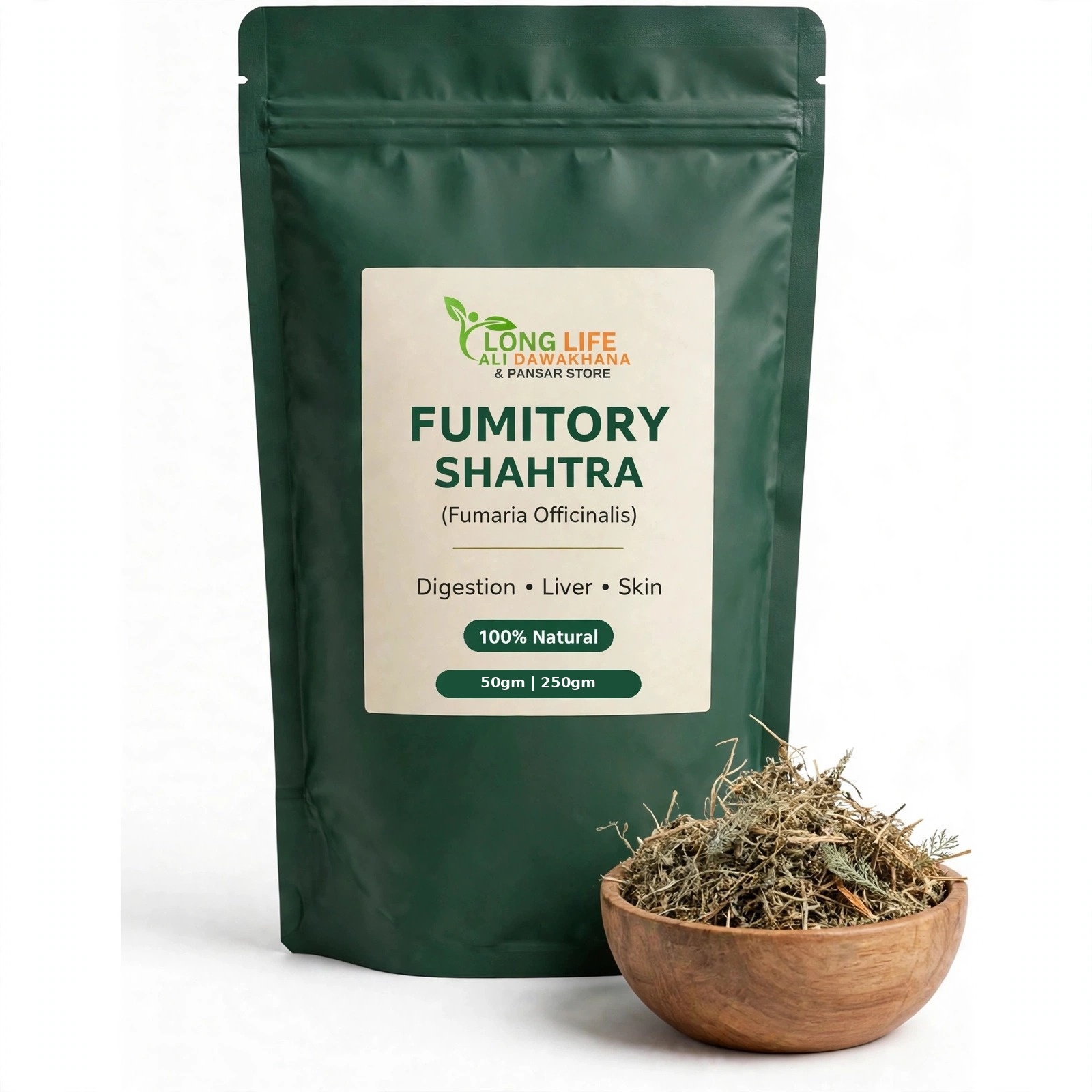
Fumitory (Shahtra, Fumaria officinalis) is the dried flowering herb of the “earth smoke” plant — a bitter Unani blood purifier traditionally used for digestion, sluggish bile flow, liver complaints and chronic skin conditions. The European Medicines Agency accepts it as a traditional remedy for digestive disturbances, and Germany’s Commission E approved it for spastic discomfort of the gallbladder — but its one modern trial for IBS was negative, and it is not a psoriasis treatment. At Long.pk it is available in Whole and Powder forms (50 gm and 250 gm) from Rs 167, with Cash on Delivery across Pakistan.
شاہترہ (Fumitory) — مکمل معلومات
شاہترہ، جسے انگریزی میں Fumitory یا Earth Smoke کہتے ہیں، ایک مشہور یونانی بوٹی ہے جو صدیوں سے خون کی صفائی، ہاضمے، جگر اور جلد کی بیماریوں کے لیے استعمال ہوتی آئی ہے۔
اہم انتباہ: شاہترہ حاملہ خواتین استعمال نہ کریں۔ پتھری، پتے کی نالی کی رکاوٹ یا جگر کی بیماری والے افراد بھی اسے استعمال نہ کریں — یہ صفرا کے بہاؤ کو بڑھا سکتی ہے۔
Fumitory (Shahtra) – Price in Pakistan, Benefits, Uses & Safety
Direct answer: Fumitory (Shahtra, Fumaria officinalis) price in Pakistan starts from Rs 167 for 50 gm (Whole form) at Long.pk, going up to Rs 878 for 250 gm (Powder form). It is available in two forms — Whole and Powder — in 50 gm and 250 gm packs, with cash on delivery across Pakistan.
- What Is Fumitory?
- History of Fumitory
- Active Compounds
- Fumitory in Unani, Ayurveda & Folk Medicine
- What Does Modern Research Say?
- Detailed Benefits of Fumitory
- Fumitory and the Psoriasis Drugs — A Name That Misleads
- Who Is Fumitory For?
- How to Use Fumitory
- Traditional Combinations
- Dosage & Duration
- Side Effects & Who Should Avoid It
- How to Identify Original Fumitory
- Storage & Shelf Life
- Fumitory vs Sweet Chirata vs Dried Aloe
- Fumitory Price in Pakistan
- Product Specifications
- Roman Urdu
- Frequently Asked Questions
What Is Fumitory?
Fumitory — Urdu Shahtra (شاہترہ) — is the dried flowering aerial herb of Fumaria officinalis L., an annual plant of the Papaveraceae (poppy family).
Which part is used? The flowering aerial parts — the whole herb above ground, stems, leaves and flowers together.
History of Fumitory
Fumitory has been a medicine since antiquity. Dioscorides described it in De Materia Medica in the 1st century AD, and Pliny the Elder recorded its use for the eyes and the liver.
Active Compounds
The chemistry of Fumitory is defined by its alkaloids — a family of isoquinoline alkaloids that make up 0.3–1% of the dried herb.
The main alkaloids are protopine (also called fumarine — the dominant one, antispasmodic and mildly sedative), cryptopine, and the protoberberines (stylopine and sinactine).
Fumitory in Unani, Ayurveda & Folk Medicine
In Unani medicine, Shahtra is a hot-and-dry drug and one of the most important blood purifiers in the whole materia medica.
Ayurveda knows the plant as Parpata, using F. parviflora and F. indica for fevers, blood disorders and skin diseases.
What Does Modern Research Say?
Here is the honest summary first: fumitory has a regulatory monograph and a century of clinical use, but only one modern randomised trial — and it was negative. The older clinical record is large but methodologically weak, and the laboratory record is promising but preliminary.
The IBS trial — the one modern test, and it failed. Brinkhaus et al. (2005, Scandinavian Journal of Gastroenterology) ran a three-arm, double-blind, placebo-controlled trial in 106 adults with irritable bowel syndrome.
Detailed Benefits of Fumitory
Every benefit below is labelled with its evidence level: traditional (classical Unani/folk use), monograph (accepted by the EMA or Commission E on long-standing use), clinical (human trials), or lab/animal (test-tube or animal studies). Nothing here is a proven medical claim for this product.
Digestion — Fullness, Slow Digestion & Gas (Monograph + Traditional)
This is the use the regulators accept.
Bile Flow & Gallbladder Comfort (Monograph + Old Clinical)
Fumitory’s most distinctive pharmacology is its amphicholeretic action.
Liver Support (Traditional + Lab)
In Unani medicine Shahtra is a liver drug first and foremost.
Skin — Eczema, Itch & “Blood Purification” (Traditional Only)
The Unani name says it all: Shajaratuddam, the tree of blood.
Mild Diuretic & Cleansing (Traditional + Animal)
Fumitory is mildly diuretic — the 2017 rat study found increased urine output.
Fever & Melancholy (Traditional)
Two old uses complete the picture.
Fumitory and the Psoriasis Drugs — A Name That Misleads
This is the most important section of the article for a buyer, because fumitory’s name is attached to one of modern medicine’s psoriasis treatments — and the connection is real but deeply misleading.
But the drugs are not the herb. Dimethyl fumarate is a single synthetic molecule, made in a factory, dosed in hundreds of milligrams a day.
Who Is Fumitory For?
Fumitory suits people with mild, occasional post-meal heaviness who want a traditional bitter tea, people with sluggish bile flow (without gallstones or obstruction), and followers of Unani medicine who want the classical Shahtra as a blood purifier.
It is not for pregnant or breastfeeding women, children under 12, anyone with gallstones, bile duct obstruction, cholangitis or active liver disease, or anyone with low blood pressure or on blood-pressure medication without medical advice.
How to Use Fumitory
Herbal tea (the EMA preparation): Put 2 g of the comminuted herb (about 1 teaspoon) in a cup, pour over 250 ml of freshly boiled water (or 1.6 g in 150 ml), cover and steep for 10 minutes, then strain.
Decoction (the Unani preparation): Add 5 g of the whole herb to 2 cups (about 400 ml) of water.
Traditional Combinations
- Shahtra + Senna — the classical Unani pairing.
- Shahtra + Sweet Chirata — two bitter digestive tonics together.
- Shahtra + Dried Aloe — a liver combination in the Unani tradition.
Dosage & Duration
The EMA monograph gives a precise dose for fumitory herb, and the Unani tradition gives a decoction dose. Both are given below — do not exceed the EMA daily total.
| Preparation | Dose | Frequency |
|---|---|---|
| Herbal tea (EMA dose) | 2 g herb in 250 ml boiling water (or 1.6 g in 150 ml) | 3–4 times daily, before meals |
| Daily total (EMA) | 4.8–6.4 g herb per day | Divided in 3–4 doses |
Side Effects & Who Should Avoid It
Fumitory is generally well tolerated at traditional doses — the EMA monograph lists no known side effects, and the older clinical studies (about 700 patients) reported good tolerability — but it is an alkaloid herb with firm contraindications. Read this section carefully.
Bile duct obstruction, gallstones, cholangitis — do NOT use. Fumitory stimulates bile flow. Against a blocked bile duct or an inflamed gallbladder, that can cause severe pain, jaundice or a medical emergency.
Active liver disease — do NOT use. The EMA monograph also contraindicates fumitory in liver disease. One published case report (Bonnet et al. 2007, Gastroentérologie Clinique et Biologique) describes acute hepatitis in a 56-year-old woman who took a multi-herb product containing fumitory and red vine (plus dandelion, boldo, artichoke and horsetail) for about 7 months.
Pregnancy — do NOT use. Fumitory is contraindicated in pregnancy in the European and Unani traditions alike.
Children under 12 — do NOT use. The EMA does not recommend fumitory below 12 years for lack of data, and the monograph restricts extracts and tinctures to adults.
Low blood pressure and blood-pressure medicines. Protopine is hypotensive (lowers blood pressure) and bradycardic (slows the heart) at small doses.
Sedatives. Protopine is sedative at small doses and may add to the effect of sedative medicines or alcohol.
Overdose — toxic. Fumitory can be dangerous in large amounts: protopine causes excitation and convulsions at high doses, and the old literature records that large doses can be fatal.
Surgery. As a general precaution, stop using medicinal doses two weeks before planned surgery, because of the possible effects on blood pressure and heart rate.
How to Identify Original Fumitory
Appearance: Genuine dried Fumitory is a tangle of fine, wiry, grey-green to golden-brown stems with small, finely divided, feathery leaves — the “smoke” of its name is visible even in the dried herb, which looks wispy and grey-green rather than dark green.
Storage & Shelf Life
- Whole herb: keeps 12–18 months in an airtight container in a cool, dry place away from direct sunlight.
- Powder: keeps 9–12 months — ground herb loses its alkaloid strength faster, so buy powder in smaller quantities and use it up.
- Seal tightly after every use.
Fumitory vs Sweet Chirata vs Dried Aloe
| Feature | Fumitory (Shahtra) | Sweet Chirata (Chiraita Shireen) | Dried Aloe (Elwa) |
|---|---|---|---|
| Botanical name | Fumaria officinalis | Swertia chirata | Aloe vera (dried latex) |
| Part used | Flowering aerial herb | Whole herb | Dried latex (sap) |
| Key compound | Protopine (alkaloid) | Amarogentin, swertiamarin (bitter secoiridoids) | Aloin (anthraquinone) |
Fumitory Price in Pakistan
| Form | 50 gm | 250 gm |
|---|---|---|
| Whole | Rs 167 | Rs 759 |
| Powder | Rs 270 | Rs 878 |
Best value: Whole 250 gm at Rs 3.04 per gram — the Powder costs more per gram at every size.
Product Specifications
| Product Name | Fumitory (Shahtra) |
| Urdu Name | شاہترہ (Shahtra) |
| Botanical Name | Fumaria officinalis L. (South Asian Unani practice also applies the name Shahtra to Fumaria parviflora Lam.) |
| Family | Papaveraceae (poppy family) |
| English Names | Earth Smoke, Drug Fumitory, Common Fumitory |
| Arabic Name | Shahatra (شاہترہ), Shajaratuddam |
| Part Used | Flowering aerial herb (dried) |
| Forms | Whole / Powder |
| Weights | 50 gm, 250 gm |
| Price Range | Rs 167 – Rs 878 |
| Key Compound | Protopine (isoquinoline alkaloid; min. 0.40% total alkaloids per European Pharmacopoeia) |
| Temperament (Unani) | Hot and dry |
| Additives | None — 100% natural |
| Shelf Life | Whole herb 12–18 months; Powder 9–12 months |
| Storage | Airtight container, cool and dry, away from sunlight |
| Seller | Ali Dawakhana and Pansar Store |
| Delivery | Cash on Delivery across Pakistan |
Roman Urdu
Shahtra (Fumitory) aik mashhoor Yunani booti hai jo sadiyon se khoon ki safai, hazme, jigar aur jild ki beemariyon ke liye istemal hoti aa rahi hai. Yunani tib mein ise “Shajaratuddam” (khoon ka darakht) kaha jata hai. Whole aur Powder, 50 gm aur 250 gm — Rs 167 se shuru.
Frequently Asked Questions
Q: Shahtra kis kaam aata hai?
Shahtra (Fumitory) Yunani tib mein aik mashhoor musaffi khoon (blood purifier) hai.
Q: Fumitory ki Pakistan mein qeemat kya hai?
Rs 167 se Rs 878 tak — Whole 50 gm Rs 167, 250 gm Rs 759; Powder 50 gm Rs 270, 250 gm Rs 878.
Q: Kya Shahtra psoriasis ka ilaaj hai?
Nahi. Psoriasis ki dawaen (dimethyl fumarate) synthetic chemicals hain — booti par psoriasis ka koi trial nahi hua.
Q: Kya Shahtra IBS mein madad karta hai?
Nahi — is ka aik modern randomised trial (106 mareez, 18 haftay) negative raha: fumitory placebo se behtar nahi tha.
Q: Shahtra ki chai kaisay banatay hain?
2 gram (aek chai ka chamach) khushk booti aik cup ubaltay pani mein daal kar 10 minute dhak kar rakhein, chhaan kar khane se pehle piyein.
Q: Kya Shahtra hamila khawateen le sakti hain?
Nahi — hamal mein Shahtra mana hai. Is ke alkaloids (protopine) ki hamal mein safety nahi jaanchi gayi.
Q: Kya Shahtra pathri walay le sakte hain?
Nahi — bilkul nahi.
Q: Shahtra kitne arsay tak le sakte hain?
Mukhtasar muddat ke liye — 2 haftay ke baad apni haalat ka jaiza lein, aur agar takleef barqarar rahe to doctor se rujoo karein.
Q: Shahtra aur chirata mein kya farq hai?
Dono karwi hazme ki bootiyan hain.
Q: Asli Shahtra ki pehchan kya hai?
Asli khushk Shahtra bareek, taar jaisi, surmai-sabz tehniyon aur chhotay par-daar patton ka uljha hua guchha hota hai — sookhi hui bhi “dhuaan” jaisi lagti hai.
Related Products
- Sweet Chirata (Chiraita Shireen) — bitter digestive and liver support, the closest bitter partner to fumitory.
- Dried Aloe (Elwa) — liver and bowel care, a powerful purgative latex, used with care.
- Golden Shower (Amaltas) — gentle cleansing.
- Organic Moringa Leaf Powder — a general daily tonic.
Ali Dawakhana and Pansar Store — Asli desi dawa aur khalis jadi bootiyan, ab ghar baithay Long.pk se mangwayen.
Reviews
There are no reviews yet