
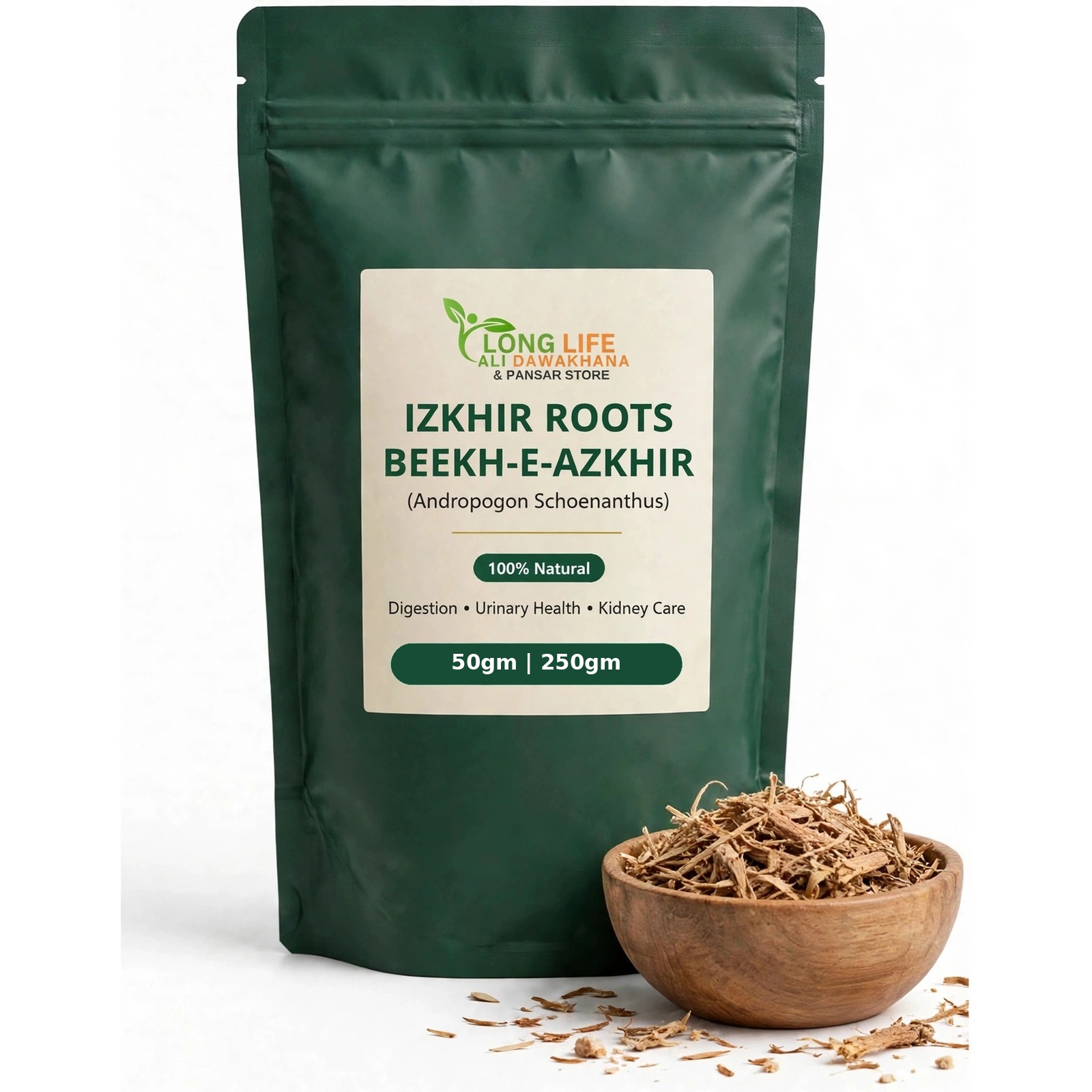
Izkher Roots (Beekh-e-Azkhir, Camel Grass, Andropogon schoenanthus) is the dried root of the desert camel grass, a classical Unani medicine used as a diuretic for kidney and urinary health, for digestion, bloating and fevers. Its oil is rich in piperitone — but the root’s benefits rest on traditional use, not human trials. Whole and Powder (50 gm and 250 gm) from Rs 219, Cash on Delivery across Pakistan.
بیخ اذخر (Izkher Roots) — مکمل معلومات
بیخ اذخر ایک صحرائی گھاس کی جڑ ہے جو عرب، شمالی افریقہ اور جنوبی ایشیا میں اگتی ہے۔ یونانی طب میں یہ صدیوں سے پیشاب کی تکلیف، گردے کی پتھری، ہاضمے اور بخار کے لیے استعمال ہوتی ہے۔
اہم انتباہ: بیخ اذخر حیض لانے والی (emmenagogue) جڑی بوٹی ہے — حاملہ خواتین استعمال نہ کریں۔ اس کا تیل (essential oil) کبھی خالص حالت میں نہ پیئیں۔
Izkher Roots (Beekh-e-Azkhir) – Price in Pakistan, Benefits, Uses & Safety
Direct answer: Izkher Roots (Beekh-e-Azkhir, Camel Grass, Andropogon schoenanthus) cost Rs 219 for 50 gm to Rs 894 for 250 gm at Long.pk, in Whole and Powder forms. The root is a classical Unani diuretic — and one of the few herbs named in the Hadith. There are no human clinical trials of the root itself.
- What Is Izkher Roots?
- History of Izkher Roots
- Active Compounds
- Izkher Roots in Unani, Ayurveda & Folk Medicine
- What Does Modern Research Say?
- Detailed Benefits of Izkher Roots
- Izkher vs Lemongrass — One Name, Three Plants
- Who Is Izkher Roots For?
- How to Use Izkher Roots
- Traditional Combinations
- Dosage & Duration
- Side Effects & Who Should Avoid It
- How to Identify Original Izkher Roots
- Storage & Shelf Life
- Izkher Roots vs Lemongrass vs Vetiver
- Izkher Roots Price in Pakistan
- Product Specifications
- Roman Urdu
- Frequently Asked Questions
What Is Izkher Roots?
Izkher Roots — Urdu Beekh-e-Azkhir (بیخ اذخر, “root of izkher”) — is the dried root of Andropogon schoenanthus L., a perennial aromatic grass of the Poaceae family (modern name Cymbopogon schoenanthus). A desert species from North Africa, Arabia and South Asia. The root is the classical Unani drug.
History of Izkher Roots
Izkher Roots is one of the few plants named in the Hadith. In Sahih al-Bukhari, when the Prophet ﷺ declared Makkah’s plants protected, Abbas said, “Except for Izkhir” — and the Prophet ﷺ agreed. Ibn Sina, Ibn al-Baytar, Ibn al-Qayyim and Dawood Antaki all wrote about it. In modern Egypt, the subspecies proximus became Proximol, for passing ureteric stones.
Active Compounds
The chemistry is dominated by the essential oil, whose signature compound is piperitone — 14.6% (Saudi) to 59.8% (Burkina Faso). Proximadiol, in the Egyptian subspecies, is the compound behind Proximol. Most studies analysed the oil of the aerial parts — the root is far less studied.
Izkher Roots in Unani, Ayurveda & Folk Medicine
In Unani medicine, Izkher Roots is hot and dry — warm in the second degree, dry in the first. Ibn al-Qayyim: it “opens blockages; promotes urination and menstrual flow; dissolves stones.” Ibn Sina gives doses: ~1.25 g with pepper for cramps, ~4.25 g for nausea. Dawood Antaki records combinations with mastic gum and vetiver water. Ayurveda uses it far less.
What Does Modern Research Say?
The kidney study. Al-Ghamdi et al. (2007) induced kidney damage in rats; the extract corrected the nephrotoxicity and showed “highly potent diuretic activity”.
Proximol. In Egypt, an extract of subsp. proximus is sold as Proximol for expelling ureteric stones (active compound: proximadiol). Caveat: a different subspecies.
Antimicrobial + antispasmodic (laboratory). Hashim et al. (2017) found the oil effective against MRSA and E. coli. Pavlović et al. (2017) found it relaxed rat ileum contractions.
Detailed Benefits of Izkher Roots
1. Urinary Health & Kidneys
The defining use — a diuretic that “promotes urination and dissolves stones” (Ibn al-Qayyim). Plantain Seeds (Bartang) is another urinary herb. It does not mean the root dissolves stones in people.
2. Digestion & Bloating
“Strengthen the stomach, relieve nausea and reduce bloating” (Ibn al-Qayyim). Rat-ileum study (2017): the oil relaxed intestinal contractions.
3. Fever & Malaria
“Fever Grass” in North and West Africa — for fevers and chills. No modern trial.
4. Teeth & Mouth
The roots “strengthen the teeth” (Ibn al-Qayyim); a mouthwash for dental pain.
5. Muscle Cramps & Rheumatism
Ibn Sina: ~1.25 g with pepper for cramps. Used for rheumatism in Pakistani folk medicine.
6. Skin — Itching & Inflammation
The oil relieves itching (Ibn Sina). Apply diluted — never undiluted oil on broken skin.
7. Antimicrobial & Antiparasitic
The oil kills MRSA and E. coli in the laboratory (Hashim 2017).
Izkher vs Lemongrass — One Name, Three Plants
| Feature | Izkher (C. schoenanthus) | Lemongrass (C. citratus) | Rusa Grass (C. martinii) |
|---|---|---|---|
| Part used | Root | Stalk and leaves | Grass tops |
| Key compound | Piperitone (up to 59.8%) | Citral (~100%) | Geraniol (rose-scented) |
The practical point: “izkhar” that looks and smells like kitchen lemongrass stalks is probably C. citratus — a fine herb, but not the Unani drug, and not the plant of the Hadith, the Canon or the Proximol story. Long.pk’s Izkher Roots is the true izkhir.
Who Is Izkher Roots For?
- People who want a traditional diuretic — occasional urinary discomfort or a family history of kidney stones (alongside medical care).
- Followers of Unani medicine who want the classical izkhir of the Canon — the Hadith-named herb, not lemongrass.
Not for pregnancy, breastfeeding, children under 12, or kidney disease, low BP or grass/citrus allergy without medical advice.
How to Use Izkher Roots
Decoction (the classical preparation). Simmer 5–10 g of root in 2 cups of water until reduced to 1 cup; drink 30–40 ml twice daily, after meals.
Tea. Steep 1–2 teaspoons in a cup of hot water for 10 minutes, covered, then strain. Drink 1–2 cups a day.
Powder. Take 3–5 g with water or honey once or twice daily. For nausea, Ibn Sina gives ~4.25 g with an equal amount of black pepper. Never swallow the undiluted essential oil.
Traditional Combinations
| Combination | Purpose |
|---|---|
| Izkher + Black Pepper | Ibn Sina’s pairing — for muscle cramps and nausea |
| Izkher + Mastic Gum (Mastagi Roomi) | Dawood Antaki’s combination for excess phlegm |
| Izkher + Liquorice (Mulethi) | Soothing pairing — liquorice coats while izkher promotes flow |
Dosage & Duration
| Preparation | Dose | Frequency |
|---|---|---|
| Root powder | 3–5 g | Once or twice daily |
| Decoction (5–10 g root, reduced to 1 cup) | 30–40 ml | Twice daily |
| Tea (1–2 tsp per cup) | 1 cup | 1–2 times daily |
Duration: use in courses of 2–4 weeks, then a break of at least a week. Do not use continuously for months without a hakim’s supervision — a long-term diuretic can disturb fluid and electrolyte balance.
Side Effects & Who Should Avoid It
Side effects at traditional doses are uncommon — but Izkher Roots is a real medicine with real cautions.
- Pregnancy — AVOID. It “promotes menstrual flow” (emmenagogue). Do not use in pregnancy.
- Breastfeeding — avoid medicinal doses. No safety data. Children under 12 — avoid. No safety data.
- Kidney disease — consult a doctor first. A diuretic herb with impaired kidneys is not a self-treatment decision. A blocked stone is a medical emergency.
- Low blood pressure / BP medicines. The oil has shown a hypotensive effect in experimental models. Monitor BP and tell your doctor.
- Diuretic medicines and lithium. Izkher may add to prescribed diuretics and change lithium levels. Tell your prescriber.
- Blood-sugar medicines. The proximus subspecies is used as an anti-diabetic in Egyptian folk medicine. Monitor blood sugar.
- Allergies. Grass or citrus allergy — the oil contains citral and geraniol, recognised skin sensitisers. Stop if a rash or breathing difficulty develops.
- Stomach upset. Strong decoctions on an empty stomach can cause nausea. Take after meals. Head heaviness: Ibn al-Baytar records a “slight heaviness in the head”.
- The essential oil — never swallow it undiluted. It can burn the mouth and stomach and irritate the kidneys. Surgery: stop medicinal doses two weeks before.
How to Identify Original Izkher Roots
- Appearance: thin, fibrous, straw-coloured to golden-brown root stalks — wiry and light, not thick or woody.
- Smell — the best test: true izkher smells pungent, camphoraceous and minty. Lemon smell means lemongrass; rosy means palmarosa; no smell means old grass.
- Taste: mildly pungent and slightly bitter, with a warming aftertaste. The root is astringent.
- What to avoid: musty or mouldy bundles, roots mixed with stem or leaf, and “izkhar” that is lemongrass stalks.
Storage & Shelf Life
Whole root: 18–24 months; Powder: 9–12 months. Airtight container, cool and dry. Seal tightly after every use.
Izkher Roots vs Lemongrass vs Vetiver
| Feature | Izkher Roots (Beekh-e-Azkhir) | Lemongrass (C. citratus) | Vetiver (Khus) |
|---|---|---|---|
| Part used | Root | Stalk and leaves | Root |
| Key compound | Piperitone (up to 72%) | Citral (~100%) | Vetivone, khusimol |
| Temperament (Unani) | Hot and dry | Warm | Cold and dry |
| Main traditional use | Diuretic, kidney stones, digestion | Digestion, fever, calming tea | Cooling, fever, skin, urinary |
Which to choose? For kidney and urinary complaints, izkher. For a calming evening tea, lemongrass. For cooling in summer heat, vetiver.
Price in Pakistan
| Form | 50 gm | 250 gm |
|---|---|---|
| Whole | Rs 219 | Rs 709 |
| Powder | Rs 354 | Rs 894 |
Range: Rs 219–894. Best value: Whole 250 gm at Rs 2.84 per gram. Powder costs more per gram.
Specifications
| Product name | Izkher Roots (Beekh-e-Azkhir) |
| Urdu name | بیخ اذخر (Beekh-e-Azkhir) |
| Botanical name | Andropogon schoenanthus L. (modern name Cymbopogon schoenanthus (L.) Spreng.) |
| Family | Poaceae (grass family) |
| English names | Camel Grass, Camel Hay, Desert Lemongrass, Fever Grass |
| Part used | Root (dried) |
| Forms | Whole / Powder |
| Weights | 50 gm, 250 gm |
| Price Range | Rs 219 – Rs 894 |
| Key compound | Piperitone (essential oil) |
| Additives | None — 100% natural |
| Shelf life | Whole root 18–24 months; Powder 9–12 months |
| Storage | Airtight container, cool and dry, away from sunlight |
| Seller | Ali Dawakhana and Pansar Store |
Roman Urdu Summary
Beekh-e-Azkhir (Izkher Roots) ek sahrai ghaas ki jarr hai. Yunani tib mein yeh sadiyon se peshab ki takleef, gurday ki pathri, hazme aur bukhaar ke liye istemal hoti hai. Nabi Kareem ﷺ ne Makkah ke paudon ke kaatne ki mumanat mein Azkhir ko mustasna qarar diya tha. Hamila khawateen istemal na karein — yeh haiz laane wali booti hai. Whole aur Powder, 50 gm aur 250 gm — Rs 219 se shuru.
Frequently Asked Questions
Q: Beekh-e-Azkhir kis kaam aati hai?
Peshab ki takleef, gurday ki pathri, hazme aur bukhaar ke liye. Fawaid rawayati hain.
Q: Izkher Roots ki Pakistan mein qeemat kya hai?
Rs 219 se Rs 894 tak. Cash on Delivery dastiyab hai.
Q: Izkher aur lemongrass mein kya farq hai?
Izkher ka tail piperitone hai; lemongrass ka citral. Izkher ki dawa jarr hai.
Q: Kya Izkher gurday ki pathri mein madad karti hai?
Rawayati tor par haan — choohon par study mein extract mufeed paya gaya.
Q: Izkher Roots kaisay istemal karte hain?
Qehwa (5–10 gram jarr, 2 cup pani ubaal kar 1 cup), powder (3–5 gram), ya chai.
Q: Kya Izkher hamila khawateen le sakti hain?
Nahi — yeh haiz laane wali booti hai. Doodh pilane wali maaen aur bachay bhi na lein.
Q: Izkher ka qehwa kaisay banatay hain?
5–10 gram jarr 2 cup pani mein ubaal kar 1 cup kar lein. Din mein 2 baar 30–40 ml piyein.
Q: Izkhir Makki kya hai?
Makkah ki qism — sab se behtareen: khushbudar aur bareek.
Q: Kya Izkher ka tail (essential oil) pee sakte hain?
Nahi — khalis oil kabhi na piyein.
Q: Asli Beekh-e-Azkhir ki pehchan kya hai?
Patli, resha daar, straw rang ki jarr; khushboo teekhi aur pudinay jaisi.
Related Products
- Liquorice Root (Mulethi) — the classical partner herb for izkher, for digestion and throat.
- Plantain Seeds (Bartang) — for urinary and gut support, complementing izkher.
- Organic Moringa Leaf Powder (Sohanjna Powder) — a general daily tonic rich in iron.
- Golden Shower (Amaltas) — for digestion and gentle cleansing.
Ali Dawakhana and Pansar Store — Asli desi dawa aur khalis jadi bootiyan, ab ghar baithay Long.pk se mangwayen.
Reviews
There are no reviews yet