
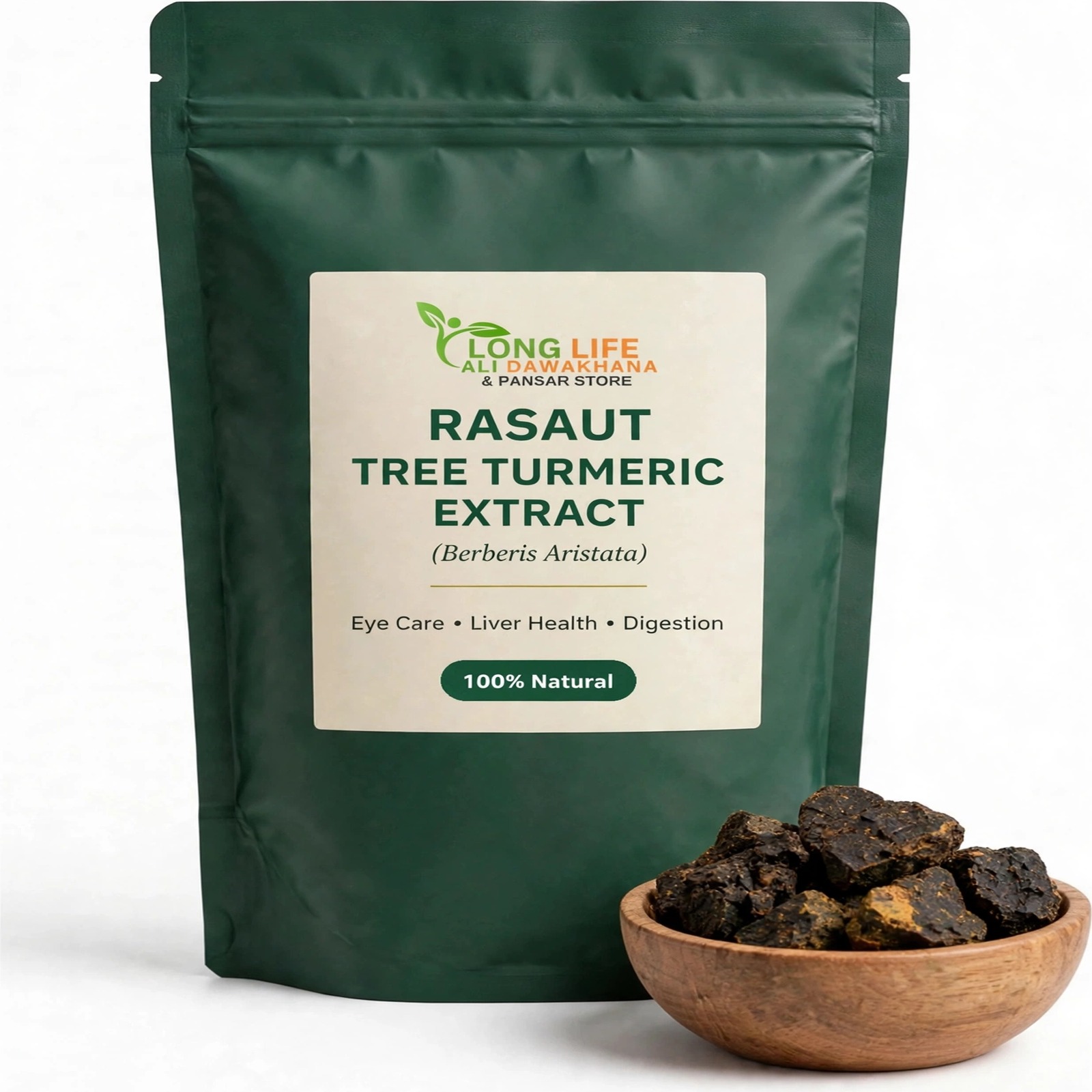
Rasaut (Tree Turmeric Extract) is a dark, resinous extract made by boiling the roots and stem bark of the Himalayan tree turmeric (Berberis aristata) and evaporating the liquid to a solid mass — a concentrated source of berberine, one of the most studied plant compounds in modern medicine. In Ayurveda it is Rasanjana, the classic remedy for eye diseases, and in modern clinical trials berberine has lowered blood sugar about as much as metformin in small studies and modestly improved cholesterol. It is not turmeric — despite the name, it comes from a completely different plant family. Prices start at Rs 175 for 50 gm, available in Whole and Powder forms (50 gm and 250 gm) with cash on delivery across Pakistan.
رسوت — آنکھوں، جگر اور شوگر کی قدیم دوا
رسوت (Berberis aristata) دراہلدی کی جڑ اور چھال کا کاڑھا ہے — اس کا اہم مرکب بربیرین ہے۔
احتیاط: حاملہ خواتین، دودھ پلانے والی مائیں اور بچے رسوت استعمال نہ کریں — بربیرین نوزائیدہ بچوں میں یرقان اور دماغی نقصان کا سبب بن سکتا ہے۔
Rasaut (Tree Turmeric Extract) — The Berberine-Rich Eye Medicine
Direct answer: Rasaut (Urdu: رسوت; Sanskrit: Rasanjana; Berberis aristata) is a dried extract of the root and stem bark of the Himalayan tree turmeric, rich in berberine. In Ayurveda it is the classic eye medicine; in trials, berberine lowered HbA1c by 0.5–0.9 points. But the trials used purified berberine capsules, not rasaut. Despite its name, rasaut is not turmeric: it contains no curcumin.
- What Is Rasaut?
- History: The Himalayan Eye Medicine
- Active Compounds
- Rasaut in Ayurveda & Unani Medicine
- What Does Modern Research Say?
- Benefits of Rasaut
- Rasaut vs Berberine Capsules
- Who Is Rasaut For?
- How to Use Rasaut
- Traditional Combinations
- Dosage & Duration
- Side Effects & Who Should Avoid It
- Quality Guide: How to Buy Good Rasaut
- Storage
- Rasaut vs Turmeric vs Neem
- Price in Pakistan
- Specifications
- Roman Urdu Summary
- Frequently Asked Questions
What Is Rasaut?
Rasaut is not a plant part — it is a preparation: the root and stem bark of Berberis aristata (Indian barberry) are boiled in water, strained and evaporated to a dark mass — dark brown to almost black, intensely bitter with berberine. The plant is a spiny Himalayan shrub, now listed as endangered (Mazumder et al., 2011). Despite the name “tree turmeric”, it is not turmeric: true turmeric (Curcuma longa) is a ginger-family rhizome; the yellow is berberine, not curcumin.
History: The Himalayan Eye Medicine
One of the oldest prepared medicines in Ayurveda, paired with turmeric as Haridra dvaya — the “two turmerics”. Charaka, Sushruta and Vagbhata prescribed Daruharidra or Rasanjana for diseases of the eyes, ears and mouth. The modern phytopharmacology was reviewed by Das et al. in 2011.
Active Compounds
Berberine is the chief compound, with palmatine, berbamine and tannins. It is poorly absorbed: in a 2025 German study, less than 1% of a 1,000 mg dose reached the bloodstream.
Rasaut in Ayurveda & Unani Medicine
In Ayurveda, Daruharidra is bitter, astringent, light and dry. Classical uses: eye diseases (conjunctivitis, ophthalmia, eyelid infections); mouth ulcers and gargle; skin (wounds, ulcers, itching); liver (jaundice); digestion (diarrhoea, dysentery, piles). In Unani medicine, the decoction is used for leprosy, skin infections and blood purification.
What Does Modern Research Say?
Blood sugar. Wang et al. (2024): 37 trials, 3,048 patients — HbA1c down 0.69 points with standard drugs. PREMOTE (Zhang et al., 2020; 409 adults): HbA1c down 0.99% vs 0.59% on placebo.
Cholesterol. Ye et al. (PMID 36941490): LDL down 0.46 mmol/L, triglycerides down 0.34 mmol/L.
Caveats. The trials tested purified berberine capsules, not rasaut. Most trials are short (8–13 weeks), small, and conducted in China; long-term safety is not established. Lan et al. (2015; 33,646 participants) found no serious liver or kidney toxicity at standard doses.
Benefits of Rasaut
1. Eye Health
Charaka, Sushruta and Vagbhata prescribed Rasanjana for eye diseases. No modern trial has tested rasaut for eyes.
2. Blood Sugar Control
Berberine lowers HbA1c by 0.5–0.9 points in type 2 diabetes. Evidence: moderate-to-good, for purified berberine only.
3. Cholesterol
LDL down 0.30–0.46 mmol/L, triglycerides down 0.34–0.35 mmol/L. Moderate evidence, for purified berberine only.
4. Diarrhoea
Barely absorbed, berberine stays in the gut and acts on the organisms causing bacterial dysentery (MIC 0.3 µg/ml). Severe diarrhoea needs medical care.
5. Liver Health
In Ayurveda, Daruharidra is a liver herb for jaundice. A 2026 trial found no effect on liver fat.
6. Skin & Wound Healing
Sushruta called it ropana — a wound healer. The bark decoction is used externally for wounds and skin infections.
7. Mouth Ulcers
Applied with honey to mouth ulcers; used as a gargle. Traditional use only.
8. Fever
The classical texts list Daruharidra for chronic fever and malaria. Historical use only — malaria needs modern drugs.
Rasaut vs Berberine Capsules
| Rasaut (this product) | Berberine capsules | |
|---|---|---|
| What it is | Whole extract — boiled root and stem bark | Purified berberine HCl |
| Berberine content | Not standardised — the exact dose is unknown | Standardised — typically 500 mg per capsule |
| Form used in trials | Never — no trial has tested rasaut | Yes — all the trials used purified berberine |
For the trial effects, you need standardised berberine under a doctor’s supervision. For the traditional medicine, rasaut is the right product.
Who Is Rasaut For?
- People with type 2 diabetes or high cholesterol who want to discuss berberine with their doctor — never a replacement for prescribed treatment.
- Traditional medicine users who want the classical remedy, in small doses.
Not for pregnant or breastfeeding women, infants or children, anyone on cyclosporine, or weight loss.
How to Use Rasaut
Powder in water or honey. Dissolve 250–500 mg of powder in warm water or honey, once or twice daily before meals. Whole extract: simmer a pea-sized piece in water until dissolved.
Mouth ulcers and skin. Mix a pinch of powder with honey for ulcers; or dissolve a small piece in warm water as a skin wash. Do not apply to deep wounds without medical advice.
Eye use — practitioner only. Eye preparations must be sterile and practitioner-made. Never put a home-made preparation in your eyes — it can cause a serious eye infection.
Traditional Combinations
With honey (the classic vehicle, for mouth ulcers); with turmeric — Haridra dvaya — for liver, skin and blood purification; with neem for skin; and with rose water as an eye-wash base (practitioner only, sterile preparation).
Dosage & Duration
- Rasaut extract (traditional): 250–500 mg once or twice daily, in warm water or honey. Start low for the first week.
- Berberine capsules (trial dose): 500 mg two or three times daily (1,000–1,500 mg/day) — purified berberine only, not rasaut.
- Duration: 4–8 weeks at a time, then a break. Longer use needs a doctor’s supervision.
- Do not exceed the dose. Maximum studied: 1,500 mg/day of purified berberine.
Side Effects & Who Should Avoid It
Possible side effects: gut effects are common — constipation, diarrhoea, bloating, cramping, nausea — usually mild, resolving within one to two weeks.
Do NOT use rasaut if you:
- Are pregnant. Berberine can displace bilirubin in the blood, raising the risk of kernicterus — brain damage from jaundice — in the newborn. Avoid completely during pregnancy.
- Are breastfeeding. The same bilirubin risk applies to the nursing infant.
- Are giving it to an infant or young child. Never give berberine products to infants.
Use only with a doctor’s supervision if you:
- Take diabetes medication (metformin, sulfonylureas, insulin) — berberine lowers blood sugar further, risking hypoglycaemia.
- Take cyclosporine — berberine raises its blood levels; avoid unless your transplant team approves.
- Take statins, blood-pressure medication, warfarin or some antidepressants — berberine inhibits liver enzymes CYP3A4, CYP2D6 and CYP2C9.
- Have liver disease — safety data are limited.
- Have low blood pressure — berberine can lower it further.
Surgery: stop medicinal use two weeks before surgery — berberine affects blood sugar and may affect bleeding.
Quality Guide: How to Buy Good Rasaut
- Hard, dark lumps — dark brown to almost black, hard and resinous.
- Intensely bitter; dissolves yellow-brown in water.
- Buy whole chunks from a reputable source — powder can be adulterated.
Storage
Store in an airtight jar, cool, dark and dry. Whole chunks keep 18–24 months; powder 9–12 months. Replace if mouldy or sticky.
Rasaut vs Turmeric vs Neem
| Feature | Rasaut | Turmeric | Neem |
|---|---|---|---|
| Part used | Root/stem bark extract | Rhizome | Leaves, bark, seeds |
| Key compound | Berberine | Curcumin | Azadirachtin, nimbin |
| Human evidence | Strong for berberine | Moderate — modest effects | Limited — mostly lab |
| Safety cautions | Pregnancy, breastfeeding, infants; drug interactions | Food-safe; care in pregnancy | Pregnancy; no neem oil for children |
Sweet Chirata is another classical bitter tonic, often used alongside rasaut for blood-sugar support.
Price in Pakistan
| Form | 50 gm | 250 gm |
|---|---|---|
| Whole | Rs 175 | Rs 975 |
| Powder | Rs 335 | Rs 1,075 |
Specifications
| Product name | Rasaut (Tree Turmeric Extract) |
| Urdu name | رسوت (Rasaut / Rasoot / Rasont) |
| Sanskrit name | Rasanjana |
| Botanical name | Berberis aristata DC. (Indian barberry / tree turmeric) |
| Family | Berberidaceae (barberry family) |
| Part used | Dried aqueous extract of root and stem bark |
| Forms | Whole / Powder |
| Weights | 50 gm, 250 gm |
| Origin | Himalayan region (Pakistan, India, Nepal, Bhutan) |
| Purity | 100% natural extract, no additives |
| Key compounds | Berberine, palmatine, berbamine, oxyacanthine, jatrorrhizine |
| Shelf life | Whole extract 18–24 months; powder 9–12 months |
| Storage | Airtight container, cool, dark, dry place |
| Seller | Ali Dawakhana and Pansar Store |
Roman Urdu Summary
Rasaut Berberis aristata ki jar aur chhaal ka kaarha hai. Is ka ahem markab berberine hai — trials mein is ne type 2 diabetes mein HbA1c 0.5–0.9 points kam kiya. Lekin trials mein khalis berberine capsules istemal hue thay, rasaut nahi. Ayurveda mein rasaut aankhon ki mashhoor dawa hai.
Hamila khawateen, doodh pilanay wali maaen aur bachay isay istemal na karein.
Frequently Asked Questions
Q: Rasaut kis kaam aata hai?
The classical Ayurvedic eye medicine.
Q: Kya rasaut haldi hai?
No — rasaut is Berberis aristata. It contains berberine, not curcumin.
Q: Kya rasaut diabetes mein madad karta hai?
Purified berberine has good trial evidence — but the trials used capsules, not rasaut.
Q: Rasaut aur berberine capsules mein kya farq hai?
Rasaut is the whole extract, unstandardised. Capsules are purified berberine — the trial form.
Q: Rasaut aankhon ke liye kaisa hai?
The classical eye medicine — but eye preparations must be sterile and practitioner-made.
Q: Rasaut kaise khayen?
Dissolve 250–500 mg in warm water or honey, once or twice daily.
Q: Kya pregnant women rasaut use kar sakti hain?
No — never. Berberine risks kernicterus in newborns. Avoid in pregnancy and breastfeeding.
Q: Rasaut ke side effects kya hain?
Gut effects are common — mild, resolving in one to two weeks.
Q: Rasaut ki price kya hai?
Rs 175 for 50 gm Whole, up to Rs 1,075 for 250 gm Powder. Best value: Whole 50 gm.
Q: Asli rasaut ki pehchan kya hai?
Dark brown to almost black, hard, resinous, intensely bitter. Buy whole chunks.
Related Products
- Sweet Chirata (Chiraita Shireen) — another classical bitter tonic, traditionally used for blood sugar, fever and liver health alongside rasaut.
- Senna Leaves (Sana Makki) — the traditional bowel-regulating herb, a natural partner for rasaut’s digestive and gut action.
- Dried Aloe (Elwa) — a bitter digestive and liver tonic in the same tradition, used for constipation and skin health.
- Organic Moringa Leaf Powder (Sohanjna Powder) — a daily nutrition and energy tonic that complements rasaut’s metabolic role.
Ali Dawakhana and Pansar Store — Asli desi dawa aur khalis jadi bootiyan, ab ghar baithay Long.pk se mangwayen.
Reviews
There are no reviews yet