
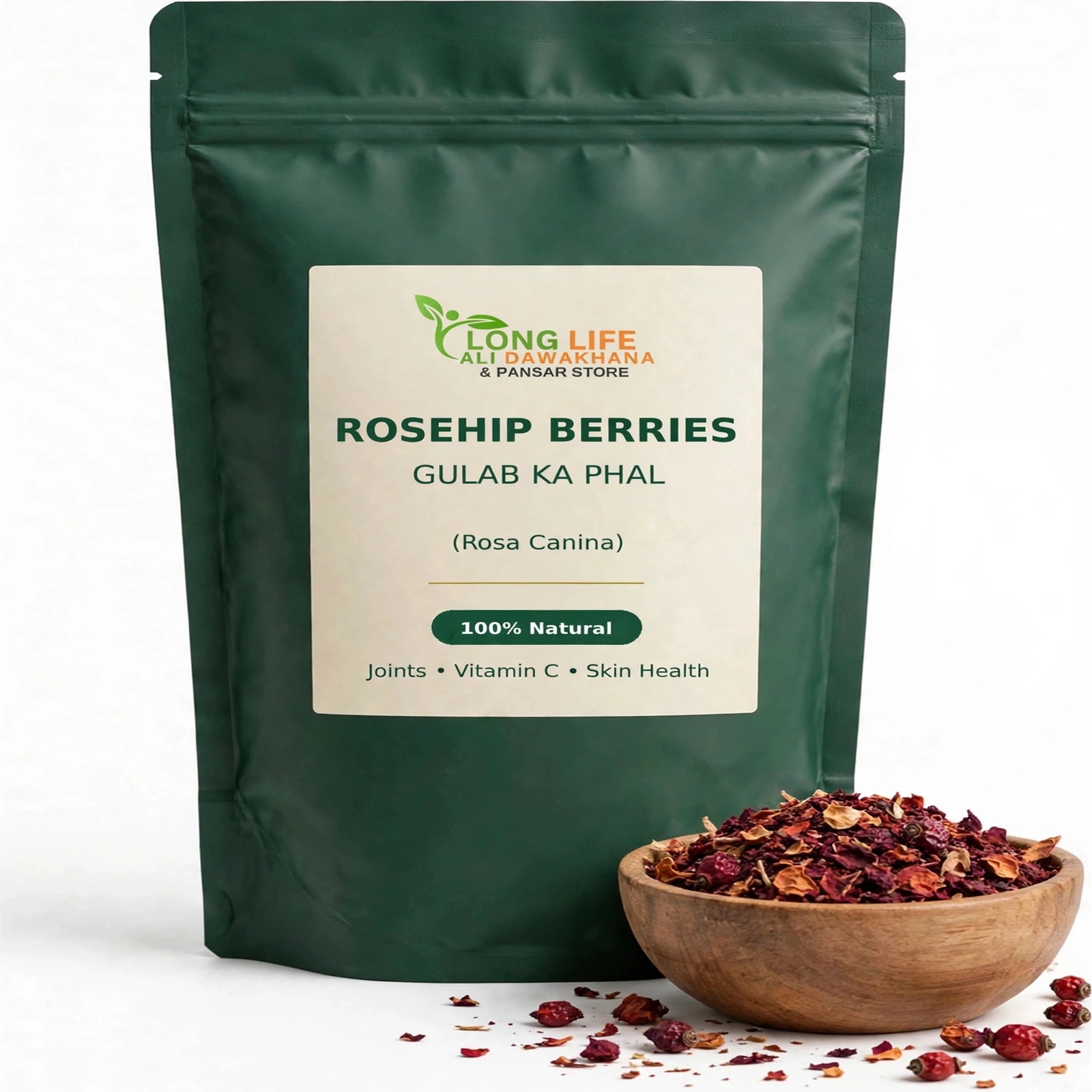
Rosehip Berries (Gulab Ka Phal, Rosa canina) are the dried fruit of the dog rose, a tart red berry famous for its vitamin C — though most of it is lost in drying — and for GOPO, a natural compound that reduced osteoarthritis pain in clinical trials. The dried hips are brewed as a tea or ground into a powder, taken at 5 g a day for joint support. At Long.pk they are available in a single 500 gm pack at Rs 977, with Cash on Delivery across Pakistan.
گلاب کا پھل (Rosehip Berries) — مکمل معلومات
گلاب کا پھل، جسے انگریزی میں Rosehip کہتے ہیں، گلاب کے پھول کے گرنے کے بعد بننے والا سرخ پھل ہے۔
اہم انتباہ: گلاب کے پھل کے اندر بیجوں کے گرد باریک بال ہوتے ہیں جو منہ اور گلے میں خارش کرتے ہیں — چائے ہمیشہ باریک کپڑے یا چھنی سے اچھی طرح چھان کر پیئیں۔ گردے کی پتھری، خون پتلا کرنے والی دوا یا حاملہ ہونے کی صورت میں ڈاکٹر سے مشورہ کر کے استعمال کریں۔
Rosehip Berries (Gulab Ka Phal) – Price in Pakistan, Benefits, Uses & Safety
Direct answer: Rosehip Berries (Gulab Ka Phal, Rosa canina) are the dried fruit of the dog rose — the red hips left behind when the petals fall. At Long.pk they are available in a single 500 gm pack at Rs 977, with cash on delivery across Pakistan.
- What Are Rosehip Berries?
- History of Rosehip Berries
- Active Compounds
- Rosehip in Unani, Ayurveda & Folk Medicine
- What Does Modern Research Say?
- Detailed Benefits of Rosehip Berries
- The Vitamin C Question — Fresh Hips vs Dried Hips
- Who Are Rosehip Berries For?
- How to Use Rosehip Berries
- Traditional Combinations
- Dosage & Duration
- Side Effects & Who Should Avoid Them
- How to Identify Original Rosehip Berries
- Storage & Shelf Life
- Rosehip vs Turmeric vs Boswellia
- Rosehip Berries Price in Pakistan
- Product Specifications
- Roman Urdu
- Frequently Asked Questions
What Are Rosehip Berries?
Rosehip Berries — Urdu Gulab ka Phal (گلاب کا پھل, “rose fruit”) — are the fruit of Rosa canina L., the dog rose, a wild thorny shrub of the Rosaceae (rose family) that grows across Europe, western Asia and North Africa.
History of Rosehip Berries
Rosehip Berries have been gathered for food and medicine since antiquity. The Greek physician Hippocrates used rose preparations, and the Roman naturalist Pliny recorded rose hips as a remedy — the dog rose’s Latin name, canina, comes from the ancient belief that its root cured the bite of a rabid dog (it does not).
Active Compounds
The chemistry of Rosehip Berries is the chemistry of a fruit that is two medicines at once — a vitamin fruit in the flesh, and an anti-inflammatory medicine in the seeds. The compounds that matter are GOPO (mostly in the seeds — the anti-inflammatory behind the osteoarthritis trials) and vitamin C (very high in fresh hips, mostly lost on drying).
Rosehip in Unani, Ayurveda & Folk Medicine
Here is the honest position: rosehip is not a classical Unani or Ayurvedic herb. The classical texts know the rose as a flower — Gulab (گلاب) in Unani — and prescribe the petals as a cooling, heart-strengthening medicine.
What Does Modern Research Say?
Here is the honest summary first: rosehip has real, if modest, human-trial evidence for one thing — osteoarthritis pain — and only preliminary or laboratory evidence for everything else.
Osteoarthritis pain (Christensen et al., 2008 meta-analysis). The most rigorous synthesis is a patient-data meta-analysis in Osteoarthritis and Cartilage (16(9):965-972), which pooled three randomised, placebo-controlled trials with 287 patients with hip or knee osteoarthritis.
Detailed Benefits of Rosehip Berries
Joints & Osteoarthritis Pain (Trial — Moderate Evidence)
The strongest claim, and the reason most people buy rosehip.
Vitamin C & Immunity (Traditional + Indirect)
Fresh rosehips are among the richest vitamin C foods known.
Skin & Collagen (Lab + Indirect)
Vitamin C is required for collagen synthesis, and the fruit’s polyphenols and lycopene protect skin cells from oxidative damage in laboratory studies.
Digestion & Gut Health (Traditional)
In European folk medicine, rosehip tea is a gentle stomach remedy.
Urinary Health & Kidneys (Traditional)
A mild diuretic in folk use — rosehip tea is taken for urinary complaints.
Heart & Cholesterol (Preliminary)
A few small trials have reported modest improvements in cholesterol with rosehip powder drinks.
The Vitamin C Question — Fresh Hips vs Dried Hips
This is the most important section of the article for a buyer, because rosehip’s famous vitamin C claim is true of the fresh fruit and mostly untrue of the dried fruit — and most sellers do not say so.
The fresh numbers are extraordinary. Fresh rosehips contain 300–1,300 mg of vitamin C per 100 g depending on the species, the ripeness and where they grew.
Who Are Rosehip Berries For?
Rosehip Berries suit people who:
- Have osteoarthritis of the hip or knee and want a natural adjunct to their prescribed treatment.
- Want a winter tonic tea — tart, warming, mildly diuretic, and rich in polyphenols.
- Are interested in antioxidant-rich dried fruit for general health, skin and digestion.
How to Use Rosehip Berries
Tea (the classic preparation): Put 5–10 g of the dried hips (about a tablespoon) in a cup, pour over freshly boiled water, cover and steep for 10–15 minutes, then strain through a fine mesh strainer or a cloth.
Traditional Combinations
- Rosehip + Moringa — a daily nutrition pairing: rosehip for joints and antioxidants, moringa as the general tonic.
- Rosehip + Hibiscus — the vitamin C tea.
- Rosehip + Honey — honey as the sweetener and vehicle.
Dosage & Duration
The joint dose below is the trial dose (Christensen 2008; Rein 2004; Winther 2005) — the only dose with human evidence behind it. The tea doses are traditional.
| Preparation | Dose | Frequency |
|---|---|---|
| Powder (whole hips, ground) | 5 g (about a level teaspoon) | Once daily, with food |
| Tea (dried hips) | 5–10 g per cup | 2–3 cups daily |
Side Effects & Who Should Avoid Them
Rosehip Berries are a food — the hips are eaten across Europe — and the dried fruit is rated LIKELY SAFE for adults taken by mouth in appropriate amounts. No serious side effects were reported in the osteoarthritis trials.
The seed hairs — strain your tea. The inside of every rosehip holds a cluster of seeds wrapped in fine, irritating hairs.
Possible side effects: nausea, vomiting, diarrhoea, constipation, heartburn, stomach cramps, fatigue, headache and difficulty sleeping have all been reported, usually mild and at higher doses.
Pregnancy — avoid medicinal doses. There are no research studies on rosehip in pregnancy, and most doctors advise avoiding medicinal doses (the 5 g powder, strong teas) during pregnancy and breastfeeding.
Kidney stones — caution with large amounts. The vitamin C in rosehip is converted in the body partly to oxalate, which can increase the risk of oxalate kidney stones in people prone to forming them.
Blood thinners — caution. Rosehip contains rugosin E, a tannin that may slow blood clotting, and large amounts of vitamin C might reduce the effectiveness of warfarin.
Kidney disease. Check with your nephrologist first — vitamin C can build up as oxalate in kidney disease, and the diuretic effect may not suit everyone with impaired kidneys.
Allergy. People allergic to roses or to other members of the Rosaceae family (apples, almonds, peaches, plums) may react to rosehip — itching, rash, swelling or breathing difficulty.
Children. Food amounts (a cup of weak tea, a spoonful of jam) are traditional for children in Scandinavia.
How to Identify Original Rosehip Berries
Appearance: Genuine dried Rosehip Berries are cut pieces of deep red to dark red hip shell, with visible seeds — small, hard, pale, oval seeds mixed through the pieces.
Storage & Shelf Life
- Whole / cut dried hips: keep 18–24 months in an airtight container in a cool, dry place away from direct sunlight.
- Powder (ground at home): keep 6–9 months — ground hips lose their GOPO and colour faster, so grind small batches and use them up.
- Seal tightly after every use.
Rosehip vs Turmeric vs Boswellia
| Feature | Rosehip Berries (Gulab Ka Phal) | Turmeric (Haldi) | Boswellia (Salai Guggul) |
|---|---|---|---|
| Botanical name | Rosa canina | Curcuma longa | Boswellia serrata |
| Part used | Dried fruit (shell + seeds) | Rhizome | Gum resin |
| Key compound | GOPO (galactolipid) | Curcumin | Boswellic acids (AKBA) |
Rosehip Berries Price in Pakistan
| Pack | Price |
|---|---|
| 500 gm | Rs 977 |
Single 500 gm pack — Rs 977 (Rs 1.95 per gram). At the trial dose of 5 g a day, one pack lasts 100 days.
Product Specifications
| Attribute | Detail |
|---|---|
| Product Name | Rosehip Berries (Gulab Ka Phal) |
| Urdu Name | گلاب کا پھل (Gulab ka Phal) |
| Botanical Name | Rosa canina L. |
| Family | Rosaceae (rose family) |
| English Names | Dog Rose, Rose Haw, Rose Hep |
| Part Used | Dried fruit (hips — shell + seeds, cut) |
| Forms | Whole (dried, cut) |
| Weights | 500 gm |
| Price Range | Rs 977 (single pack) |
| Key Compound | GOPO (galactolipid, mostly in the seeds) |
| Vitamin C (fresh hips) | 300–1,300 mg/100g (mostly lost on drying) |
| Temperament | Cooling, mildly astringent (folk) |
| Additives | None — 100% natural |
| Shelf Life | Dried hips 18–24 months; Powder (ground at home) 6–9 months |
| Storage | Airtight container, cool, dry and dark |
| Seller | Ali Dawakhana and Pansar Store |
| Delivery | Cash on Delivery across Pakistan |
Roman Urdu
Gulab ka Phal (Rosehip Berries) gulab ke phool ke girne ke baad banne wala surkh phal hai — Rosa canina (dog rose) ka phal, jo Europe ki purani dawa hai.
Istemaal: powder 5 gram rozana (taqreeban aik chai ka chammach) khane ke saath lein. Aik hi pack hai — 500 gm, Rs 977.
Frequently Asked Questions
Q: Gulab ka Phal kis kaam aata hai?
Gulab ka Phal (Rosehip) Europe ki purani dawa hai.
Q: Rosehip Berries ki Pakistan mein qeemat kya hai?
Rs 977 — aik hi pack hai, 500 gm.
Q: Rosehip mein vitamin C kitna hota hai?
Taaza phal mein bohat zyada — 300 se 1,300 mg/100g (USDA ke mutabiq 426 mg/100g, santray se taqreeban 8 guna).
Q: Rosehip joron ke dard mein kaise madad karta hai?
Is mein GOPO naam ka qudrati compound hota hai (zyada tar beejon mein) jo joron ki sozish barhane walay safed khaliyon (neutrophils) ko shaant karta hai.
Q: Rosehip kaisay istemal karte hain?
Teen tareeqay: (1) powder — 5 gram rozana khane ke saath; (2) chai — 5–10 gram, 10–15 minute bhigo kar chhaan kar, din mein 2–3 baar; (3) thanda pani — raat bhar bhigo kar subah chhaan kar piyein.
Q: Rosehip ki chai chhaan na kyun zaroori hai?
Phal ke andar beejon ke gird bareek baal hote hain jo munh, galay aur pait mein kharish karte hain — yeh wohi baal hain jo khujli ke powder mein istemal hote hain.
Q: Kya Rosehip hamila khawateen le sakti hain?
Dawa ki miqdaar mein nahi — hamal mein is ki safety par koi tehqeeq nahi hui, is liye zyada tar doctor mana karte hain.
Q: Rosehip aur gulab ke phool mein kya farq hai?
Gulab ka phool (Gulab/Gul-e-Surkh) Yunani tib ki classical dawa hai — thanda, dil aur jild ke liye.
Q: Rosehip kitni der mein asar karta hai?
Joron ke dard ke liye 3 se 4 mahine — trials mein dard ki kami 3 mahine ke baad napi gayi (aek trial mein 3 haftay baad bhi farq nazar aaya).
Q: Asli Rosehip ki pehchan kya hai?
Asli khushk phal gehray surkh rang ke tukray hote hain jin mein beej nazar aate hain — beejon mein GOPO hota hai.
Related Products
- Bonduc Nut (Karanjwa) — traditional joint and rheumatism support, the folk remedy for stiff, aching joints.
- Organic Moringa Leaf Powder — a general daily tonic.
- Jujube Berries (Unab) — a sweet Unani fruit for sleep and blood building.
- Plantain Seeds (Bartang) — gut and urinary support.
Ali Dawakhana and Pansar Store — Asli desi dawa aur khalis jadi bootiyan, ab ghar baithay Long.pk se mangwayen.
Reviews
There are no reviews yet