
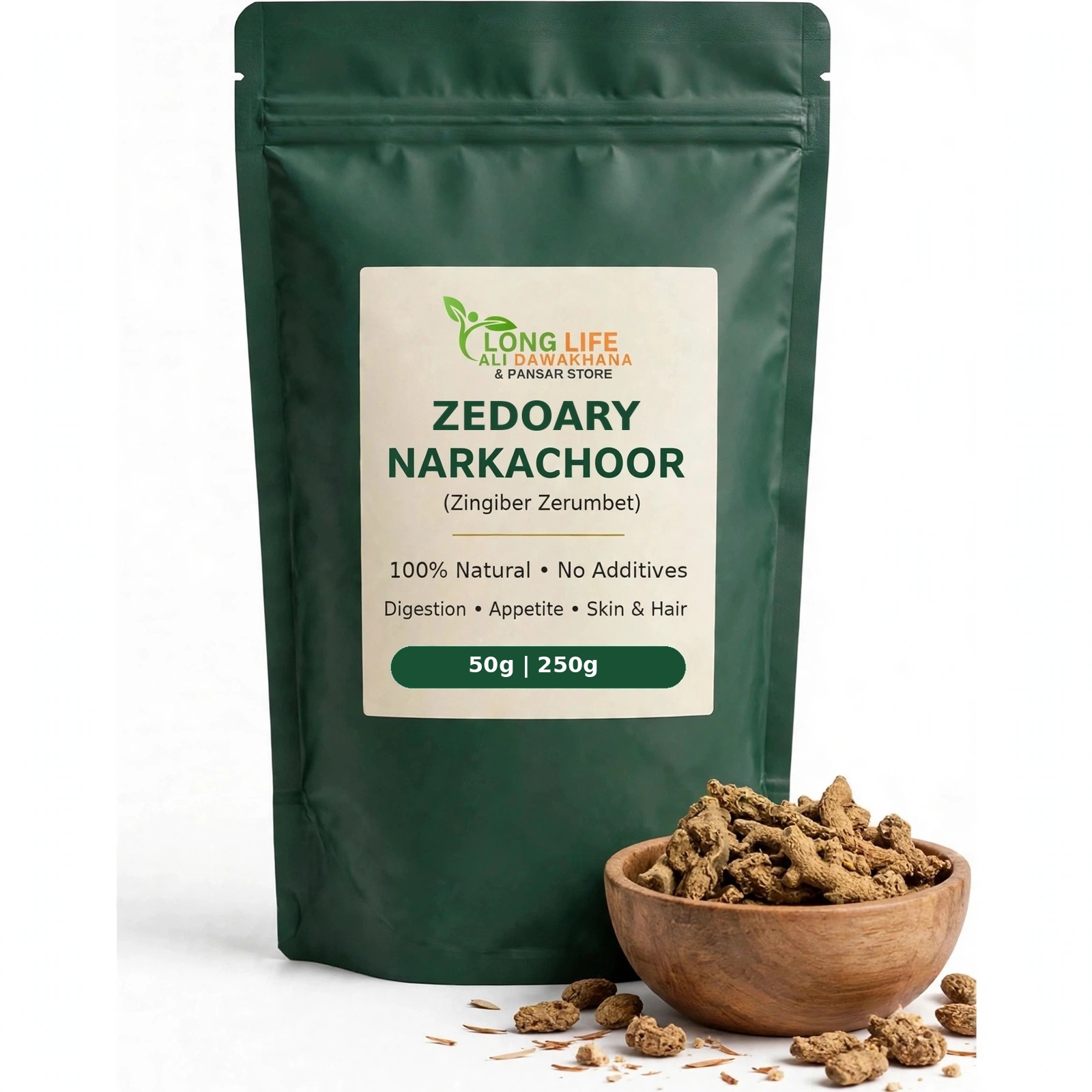
Zedoary (Narkachoor) is a dried rhizome from the ginger family, sold as bitter ginger (Zingiber zerumbet) — the pinecone or shampoo ginger whose rhizome has been used across Asia for digestion, appetite, stomach ache, toothache and joint pain. Its key compound, zerumbone, shows strong anti-inflammatory and antibacterial activity in laboratory studies, though human trials are still lacking. One honest note: the name “zedoary” properly belongs to a different plant, Curcuma zedoaria (white turmeric), and the two have been mixed up in the herb trade for centuries — this article explains both. Prices start at Rs 167 for 50 gm, available in Whole and Powder forms (50 gm and 250 gm) with cash on delivery across Pakistan.
نرکچور — ہاضمے، بھوک اور دانت درد کی قدیم جڑی بوٹی
نرکچور ادرک کے خاندان کی خشک جڑ ہے، ہاضمے، بھوک اور دانت درد کے لیے استعمال ہوتی ہے۔
احتیاط: حاملہ خواتین دوا کی مقدار میں استعمال نہ کریں؛ پتھری یا خون پتلا کرنے والی دوا والے معالج سے مشورہ کریں۔
Zedoary (Narkachoor) — The Bitter Ginger with Two Names
Direct answer: Zedoary (Urdu: Narkachoor, نرکچور; sold as bitter ginger, Zingiber zerumbet) is a dried ginger-family rhizome for digestion, appetite, toothache and joint pain. Its compound zerumbone is anti-inflammatory and antibacterial in lab studies; no human trials exist. “Zedoary” properly means Curcuma zedoaria (white turmeric).
- What Is Zedoary?
- History: A Spice That Travelled the World
- Active Compounds
- Zedoary in Unani & Ayurvedic Medicine
- What Does Modern Research Say?
- Benefits of Zedoary
- Two Plants, One Name: Zingiber zerumbet vs Curcuma zedoaria
- Who Is Zedoary For?
- How to Use Zedoary
- Traditional Combinations
- Dosage & Duration
- Side Effects & Who Should Avoid It
- Quality Guide: How to Buy Good Narkachoor
- Storage
- Zedoary vs Ginger vs Turmeric
- Price in Pakistan
- Specifications
- Roman Urdu Summary
- Frequently Asked Questions
What Is Zedoary?
Zedoary is a ginger-family (Zingiberaceae) perennial; the part used is the rhizome — bitter, aromatic pieces. This product is Zingiber zerumbet (bitter ginger, pinecone ginger, shampoo ginger), whose flower-head juice is a traditional Hawaiian shampoo. “Zedoary” properly means Curcuma zedoaria (white turmeric); both share the Urdu name Narkachoor, hence the mix-up.
History: A Spice That Travelled the World
Curcuma zedoaria was carried by Austronesian peoples (~3000 BCE) and reached Europe as jadwar — the origin of “zedoary”. Unani adopted it as Zaranbad (Kayum et al., 2021). Z. zerumbet‘s folk history is reviewed by Yob et al. (2011).
Active Compounds
| Compound | Found in | What it does |
|---|---|---|
| Zerumbone (~73% of the oil) | Z. zerumbet | Anti-inflammatory, antibacterial, anti-cancer in cell lines |
| Curcumenol | C. zedoaria | Anti-inflammatory, antioxidant, liver-protective |
| Curzerenone, curzerene, germacrone | C. zedoaria | Anti-inflammatory, cytotoxic in lab studies |
| Curdione | C. zedoaria | Inhibits PGE2 and COX-2 |
| 1,8-Cineole | Both | Decongestant, anti-inflammatory |
Zedoary in Unani & Ayurvedic Medicine
Unani: Zaranbad for cough and cold, arthritis, liver and stomach complaints, fever (Kayum et al., 2021). Ayurveda: Kachuraka — warming, pungent — for dyspepsia, flatulence, diarrhoea, toothache. Z. zerumbet belongs to Malay, Indonesian and Hawaiian folk medicine; overlapping uses entangled the names.
What Does Modern Research Say?
All research is preclinical — lab and animal studies only. No human trials; no evidence for weight loss.
Inflammation: zerumbone suppressed NLRP3 and NF-κB and eased dermatitis in mice (Pradhan & Sarkar).
Cancer (lab only): zerumbone induced apoptosis in liver (Sakinah et al., 2007) and colorectal cancer cells. Not a cancer treatment.
Antibacterial: the oil (72.86% zerumbone) was active against S. aureus, S. mutans and E. coli.
Benefits of Zedoary
1. Digestive Comfort
A warming carminative: stimulates digestive secretions, dispels gas. No human trial.
2. Appetite Stimulant
A recognised Malay appetizer; the bitter taste stimulates digestive secretions.
3. Diarrhoea and Dysentery
Traditional anti-diarrhoeal; zerumbone is antibacterial against E. coli. Severe diarrhoea needs medical care.
4. Toothache Relief
The softened rhizome was pressed into tooth cavities in Hawaii; zerumbone inhibits S. mutans. A stopgap — see a dentist.
5. Joint and Muscle Pain
Paste or poultice for sprains, bruises and achy joints; zaranbad is a Unani arthritis remedy.
6. Skin and Hair Care
The shampoo reputation belongs to the flower-head juice, not this rhizome. A paste is used for ringworm.
7. Worm Infestation
Juice of boiled rhizomes is given for worms; lab studies support this. Worms in children need a doctor.
8. Fever and Respiratory Complaints
Zaranbad is a Unani remedy for cold, cough and fever. Its 1,8-cineole — the eucalyptus decongestant — gives this a plausible basis.
Two Plants, One Name: Zingiber zerumbet vs Curcuma zedoaria
| Zingiber zerumbet (this product) | Curcuma zedoaria (true zedoary) | |
|---|---|---|
| Common names | Bitter ginger, pinecone ginger | Zedoary, white turmeric, Zaranbad |
| Genus | Zingiber (ginger) | Curcuma (turmeric) |
| Key compound | Zerumbone (up to ~73% of the oil) | Curcumenol, curzerenone, curdione |
| Famous for | Shampoo juice | White turmeric, once a European spice |
| Urdu trade name | Narkachoor | Narkachoor / Kachur / Zaranbaad |
| Traditional home | Malay, Indonesian, Hawaiian folk use | Ayurveda, Unani, classical medicine |
| Human trials | None | None |
Why the confusion? Both are bitter ginger-family rhizomes called Narkachoor/Kachur. Buyer tip: for zerumbone, this product is right; for curcumenol, ask for Curcuma zedoaria.
Who Is Zedoary For?
- Sluggish digestion, gas, bloating — a traditional warming digestive.
- Poor appetite — a bitter appetizer.
- Toothache — a stopgap while awaiting a dentist.
- Joint sprains, bruises, muscle aches — for poultices.
- Unani/Ayurvedic practitioners (confirm the species).
Not for anyone seeking a cancer treatment, weight-loss product, or shampoo.
How to Use Zedoary
Powder: stir 1–3 g (¼–½ teaspoon) into warm water, milk or honey water, once or twice daily — before meals for appetite.
Decoction: simmer 5–10 g in two cups of water, reduced to one cup; strain, drink warm.
Toothache: soften a small piece and press it into the cavity. See a dentist soon.
Paste: mix powder with warm water or mustard oil; apply 30–60 minutes. Not on broken skin.
Note: the dried rhizome is not a shampoo — that use belongs to the fresh flower-head juice.
Traditional Combinations
| Combination | Purpose | How to use |
|---|---|---|
| Zedoary + ginger (Adrak) | Gas, bloating, sluggish digestion | Equal parts, 1 teaspoon after meals |
| Zedoary + turmeric (Haldi) | Anti-inflammatory pairing | ½ teaspoon each in warm milk |
| Zedoary + black pepper (Kali Mirch) | Aids absorption, adds warmth | A pinch with the powder |
| Zedoary + honey (Shehed) | Masks bitterness | 1 teaspoon powder in 1 teaspoon honey |
| Zedoary + liquorice (Mulethi) | Cough (Unani) | Equal parts, decoction with honey |
Dosage & Duration
- Powder: 1–3 g (¼–½ teaspoon) once or twice daily in warm water, milk or honey. Start low.
- Decoction: 5–10 g in two cups of water, reduced to one cup, once or twice daily.
- External paste: as needed, 30–60 minutes per application.
- Toothache: a softened piece in the cavity as needed.
- Duration: 2–4 weeks at a time, then a break. No long-term dose established.
- Do not exceed the dose — large amounts irritate the stomach and cause nausea.
Side Effects & Who Should Avoid It
Culinary amounts are generally safe; medicinal doses need care.
Possible side effects: stomach irritation, nausea, heartburn (especially on an empty stomach); skin irritation; allergy in ginger-family-sensitive people.
Do NOT use medicinal amounts if you:
- Are pregnant — zaranbad is a traditional menstruation regulator and uterine tonic.
- Are breastfeeding — safety data are lacking.
Use with caution if you:
- Have gallstones or bile duct obstruction — bile flow can trigger colic.
- Take blood thinners (warfarin, aspirin, clopidogrel) — zerumbone is antiplatelet in lab studies.
- Take diabetes medication — blood sugar falls in animal studies; monitor closely.
- Surgery scheduled — stop medicinal use two weeks before, as a bleeding precaution.
- Giving it to a child — dosing is a practitioner’s decision.
Quality Guide: How to Buy Good Narkachoor
- Firm, dense, gnarled pieces — hard and dry, not soft, crumbly or mouldy.
- Smell: warm, aromatic, camphor-like; musty or flat means old stock.
- Cut face: pale and dense; reject dark, hollow or insect-damaged pieces.
- Buy whole when you can — powder can be adulterated.
- Ask which species — Z. zerumbet or C. zedoaria. If the seller cannot say, buy elsewhere.
- Free of soil, mould and foreign matter.
Storage
Airtight jar, cool, dark, dry. Whole rhizomes 12–18 months; powder 6–9 months. Never store damp pieces; replace stock that has lost its aroma.
Zedoary vs Ginger vs Turmeric
| Feature | Zedoary (Narkachoor) | Ginger (Adrak) | Turmeric (Haldi) |
|---|---|---|---|
| Botanical name | Zingiber zerumbet / Curcuma zedoaria | Zingiber officinale | Curcuma longa |
| Key compound | Zerumbone / curcumenol | Gingerols, shogaols | Curcumin |
| Taste | Bitter, camphor-like, warming | Pungent, hot, sharp | Earthy, bitter, mild |
| Main traditional use | Digestion, appetite, toothache, sprains | Nausea, digestion, colds | Inflammation, wounds, liver |
| Human evidence | None (lab and animal only) | Strong — many trials | Moderate — many trials |
| Pregnancy caution | Avoid medicinal doses | Food-safe; medicinal doses need care | Food-safe; medicinal doses need care |
| Best for | Bitter digestive tonic, toothache stopgap | Nausea, colds, everyday warming | Daily anti-inflammatory support |
Price in Pakistan
| Form | 50 gm | 250 gm |
|---|---|---|
| Whole | Rs 167 | Rs 726 |
| Powder | Rs 354 | Rs 1,686 |
Prices follow the source website (Pansaar), rounded to whole rupees. Range Rs 167–1,686; best value is Whole 250 gm at Rs 2.90/gm. Cash on delivery across Pakistan.
Specifications
| Product name | Zedoary (Narkachoor) |
| Urdu name | نرکچور (Narkachoor) |
| Botanical name | Zingiber zerumbet (L.) Roscoe ex Sm. — bitter ginger / pinecone ginger (sold as); true zedoary is Curcuma zedoaria |
| Family | Zingiberaceae (ginger family) |
| Part used | Dried rhizome (underground stem) |
| Forms | Whole / Powder |
| Weights | 50 gm, 250 gm |
| Origin | Cultivated across tropical Asia; native to South and Southeast Asia |
| Purity | 100% natural dried rhizome, no additives |
| Key compounds | Zerumbone (up to ~73% of the essential oil), α-humulene, camphene, camphor |
| Shelf life | Whole rhizome 12–18 months; powder 6–9 months |
| Storage | Airtight container, cool, dark, dry place |
| Seller | Ali Dawakhana and Pansar Store |
Roman Urdu Summary
Zedoary (Narkachoor) adrak ke khandan ki khushk jar hai — bitter ginger (Zingiber zerumbet). Hazme, bhook aur daant dard ke liye istemal hoti hai; zerumbone laboratory mein mazboot hai, insanon par koi trial nahi hua.
“Zedoary” asal mein Curcuma zedoaria (safed haldi) hai. Rozana 1–3 gram powder garam pani ke saath; hamila khawateen dawa ki miqdar mein na lein. Qeemat Rs 167 se shuru.
Frequently Asked Questions
Q: Narkachoor kis kaam aata hai?
Digestive and appetizer for gas, bloating and toothache. Zerumbone is anti-inflammatory in lab studies.
Q: Zedoary aur bitter ginger mein kya farq hai?
“Zedoary” is Curcuma zedoaria; “bitter ginger” is Zingiber zerumbet. This product is Z. zerumbet.
Q: Kya narkachoor se cancer ka ilaj hota hai?
No — zerumbone kills cancer cells in lab dishes only. No human trial exists.
Q: Kya narkachoor se wazan kam hota hai?
No evidence — no animal study, no human trial. Not a fat burner.
Q: Shampoo ginger se baal kaise dhoyen?
Shampooing uses the fresh flower-head juice, not the dried rhizome.
Q: Daant dard mein narkachoor kaise use karein?
Soften a small piece and press it into the cavity. See a dentist soon.
Q: Narkachoor kaise khayen?
Stir 1–3 g of powder into warm water or milk, once or twice daily.
Q: Kya pregnant women narkachoor use kar sakti hain?
Not in medicinal doses — zaranbad is a uterine tonic. Avoid in pregnancy.
Q: Narkachoor ki price kya hai?
Rs 167 (50 gm Whole) to Rs 1,686 (250 gm Powder). Cash on delivery.
Q: Narkachoor ko kitne arse tak store kar sakte hain?
Whole rhizomes 12–18 months, powder 6–9 months, airtight and dry.
Related Products
- Liquorice Root (Mulethi) — a soothing digestive and throat herb, classically paired with zedoary in Unani combinations for cough and digestion.
- Golden Shower (Amaltas) — the traditional gentle laxative and digestive cleanser, a natural partner for sluggish digestion.
- Organic Moringa Leaf Powder (Sohanjna Powder) — a daily nutrition and energy tonic that complements zedoary’s digestive role.
- Jujube Berries (Unab) — an iron-rich tonic for sleep, blood health and digestion.
Ali Dawakhana and Pansar Store — Asli desi dawa aur khalis jadi bootiyan, ab ghar baithay Long.pk se mangwayen.
Reviews
There are no reviews yet