
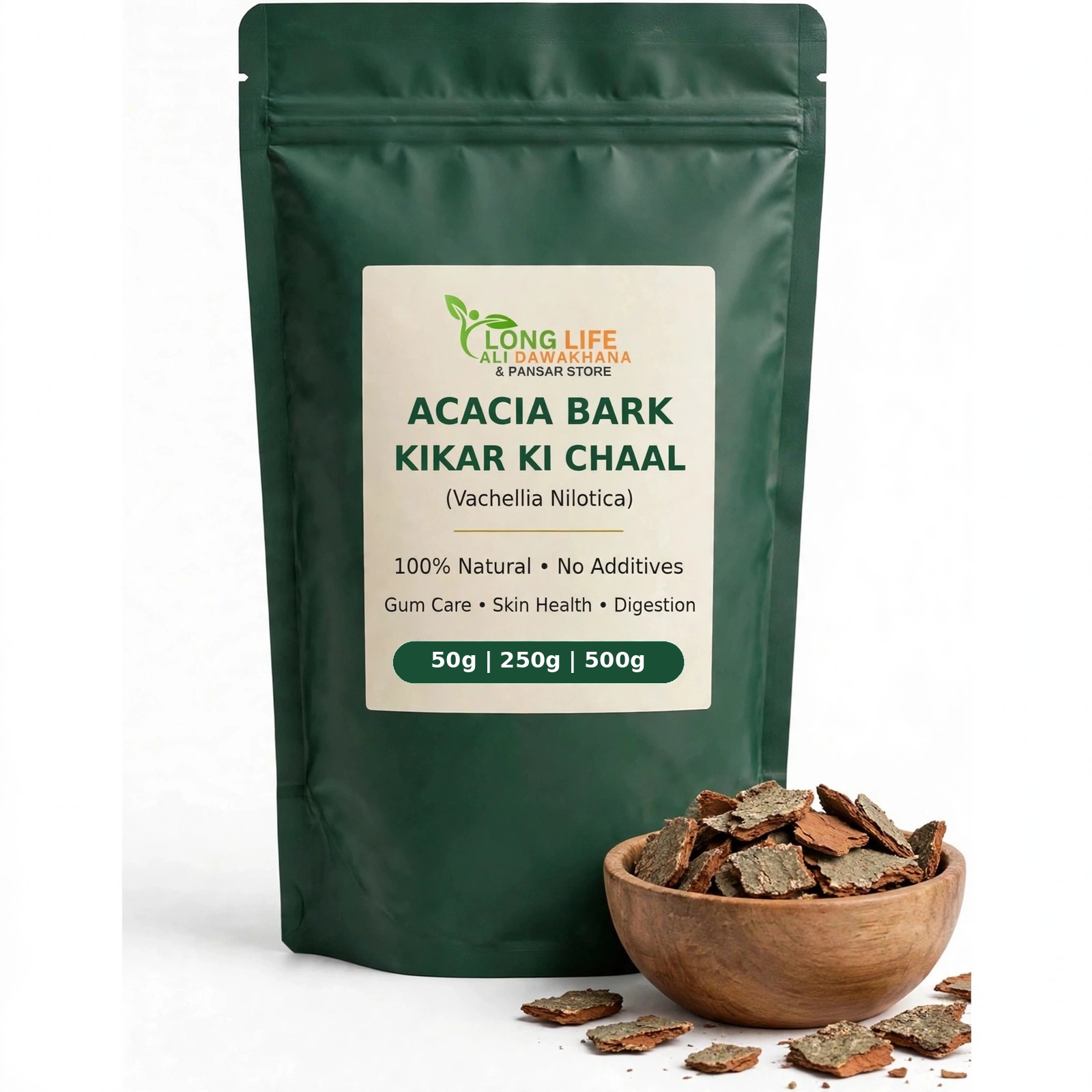
Acacia Bark (Kikar ki Chaal, Babul, Vachellia nilotica) is the tannin-rich bark of Pakistan’s kikar tree — traditionally used for gum and teeth care, wound healing, diarrhoea and skin health. Its tannins (12–20% of the bark) kill the bacteria that cause tooth decay: in a clinical trial, an Acacia mouthwash reduced decay-causing bacteria by 85%, matching chlorhexidine. At Long.pk it is available in Whole and Powder forms (50 gm, 250 gm and 500 gm) from Rs 135, with Cash on Delivery across Pakistan.
کیکر کی چھال (Acacia Bark) — مکمل معلومات
کیکر پاکستان کا عام درخت ہے، اس کی چھال صدیوں سے طب میں استعمال ہوتی ہے۔ چھال میں 12 سے 20 فیصد ٹینن ہوتا ہے۔
سب سے بڑا فائدہ دانتوں اور مسوڑھوں کے لیے ہے، ایک ٹرائل میں کیکر کے ماؤتھ واش نے دانتوں کے جراثیم 85 فیصد کم کر دیے، chlorhexidine جتنا۔
انتباہ: زیادہ ٹینن معدے کو خراب کر سکتا ہے۔ حاملہ خواتین اندرونی استعمال سے گریز کریں۔
Long.pk سے Whole یا Powder میں، قیمت 135 روپے سے شروع۔
Acacia Bark (Kikar ki Chaal) – Price in Pakistan, Benefits, Uses & Safety
Direct answer: Acacia Bark (Kikar ki Chaal, Vachellia nilotica) starts from Rs 135 for 50 gm (Whole), up to Rs 1,181 for 500 gm (Powder) at Long.pk, 50/250/500 gm, cash on delivery across Pakistan. Its tannins (12–20%) cut decay bacteria by 85% in a double-blind trial, matching chlorhexidine. (Pansaar’s “Acacia Karoo” is an African species; the Pakistani kikar is Vachellia nilotica.)
Table of Contents
- What Is Acacia Bark?
- History of Acacia Bark
- Active Compounds
- Acacia Bark in Ayurveda, Unani & Folk Medicine
- What Does Modern Research Say?
- Detailed Benefits of Acacia Bark
- Bark vs Gum — Two Medicines from One Tree
- Who Is Acacia Bark For?
- How to Use Acacia Bark
- Traditional Combinations
- Dosage & Duration
- Side Effects & Who Should Avoid It
- How to Identify Original Acacia Bark
- Storage & Shelf Life
- Acacia Bark vs Arjuna Bark vs Peepal Bark
- Acacia Bark Price in Pakistan
- Product Specifications
- Roman Urdu
- Frequently Asked Questions
What Is Acacia Bark?
Acacia Bark (Kikar ki Chaal, Babul, Vachellia nilotica) is the dried stem bark (Twak) of Pakistan’s kikar tree, richest in tannins (12–20%). Pansaar lists “Acacia Karoo”, an African species; the Pakistani kikar is Vachellia nilotica. Sold as rough chips or powder.
History of Acacia Bark
Babbula is absent from the classical Ayurvedic texts, first appearing in the Shodhala Nighantu. The gum (gum arabic) was traded from Egypt for thousands of years (still food additive E414); the bark tanned leather, the twig served as a miswak for centuries.
Active Compounds
12–20% tannins (up to 20–30% in some analyses).
| Compound | Type | What researchers looked at |
|---|---|---|
| Condensed tannins | Tannins | Strongest antibacterial fraction (MIC 0.25 mg/mL vs S. mutans) |
| Gallic acid | Phenolic acid | Antioxidant, antimicrobial, anti-inflammatory |
| Catechins | Flavanols | Antioxidant, antimicrobial (as in green tea) |
| Saponins & anthraquinones | Mixed | Only in A. nilotica of four plants tested |
Acacia Bark in Ayurveda, Unani & Folk Medicine
Ayurveda: Babbula is Kashaya rasa (astringent), light and dry, primarily Kapha Har, a classical Mala Stambhaka (anti-diarrhoeal). Unani: Babul for sexual debility, urinary issues, diarrhoea, wounds. Folk: decoction for diarrhoea, mouthwash for gums, wash for wounds, gargle for tonsillitis; twig as toothbrush, gum as tonic food.
What Does Modern Research Say?
Gupta & Gupta 2015 (General Dentistry), double-blind RCT: 90 volunteers rinsed twice daily for 30 days with 50% Acacia, 0.2% chlorhexidine or saline. Decay bacteria fell 85% (Acacia) vs 83% (chlorhexidine) at 30 days (P < 0.0001), matching chlorhexidine without its staining and taste side effects.
Yılmaz 2026: condensed tannins had the lowest MICs (S. mutans 0.25, P. gingivalis 0.20 mg/mL).
Kripalani et al. 2023: in vitro, A. nilotica inhibited S. mutans at all dilutions except 1/1000.
Combination study: with guava, the highest S. mutans zone (21.08 mm), above chlorhexidine (14.50 mm).
Beyond dental care: other claims (anti-diabetic, anti-cancer, anti-HIV) come only from lab and animal studies, never present these as treatments.
Detailed Benefits of Acacia Bark
Gum & Teeth Care (Clinical Trial Evidence)
In the Gupta & Gupta 2015 RCT, an Acacia mouthwash cut decay bacteria by 85%.
Wound Healing (Traditional + Lab Support)
Tannins tighten tissues, stopping minor bleeding. No human trial.
Diarrhoea & Dysentery (Traditional + Lab Support)
Classical Mala Stambhaka; targets E. coli and Shigella. No human trial.
Skin Health (Traditional)
For eczema, rashes, leucoderma. No clinical evidence.
Throat & Tonsils (Traditional)
Gargled for sore throat, tonsillitis, mouth ulcers. No clinical evidence.
Digestive Health (Traditional)
For digestive complaints and bleeding piles. No clinical evidence.
Blood Pressure (Animal Evidence Only)
Animal studies only; people on BP medication should be cautious.
Blood Sugar (Animal Evidence Only)
Animal studies only; diabetics should watch for low blood sugar.
Bark vs Gum — Two Medicines from One Tree
| Feature | Acacia Bark (this product) | Acacia Gum (Babul Gond) |
|---|---|---|
| Main chemistry | Tannins (12–20%), gallic acid, catechins | Arabinogalactan polysaccharide |
| Action | Astringent, tightens, kills bacteria | Demulcent, soothes, coats |
| Main uses | Gum care, wounds, diarrhoea, skin | Coughs, sore throat; tonic food |
Gums, bleeding, diarrhoea: bark. Cough, sore throat: gum.
Who Is Acacia Bark For?
For adults wanting a traditional remedy for gum and teeth care, a natural mouthwash with clinical evidence, or wound care, diarrhoea, skin and throat problems. Not for pregnant or breastfeeding women or children (internal use, no safety data), or iron-deficiency anaemia.
How to Use Acacia Bark
Mouthwash. Boil 10 g in 200 ml water 15 min, strain, cool; rinse 10 ml twice daily. Do not swallow.
Tooth powder. Powder + salt + turmeric; brush once daily, soft brush.
Decoction. Boil 10–20 g in 400 ml water to half; drink 50–100 ml twice daily.
Powder. 3–6 g once or twice daily with warm water, 1 hour before or 2 hours after meals.
Wound wash / paste. Cool decoction for minor wounds and rashes; powder paste on boils, 15–20 min.
Don’t. Max 6 g/day without a hakim; never with iron supplements; no mouthwash under 12; no deep wounds, burns or infected wounds without medical advice.
Traditional Combinations
- Guava Leaves (Amrood): best lab activity vs S. mutans (21.08 mm).
- Neem: oral care and skin, two antibacterials.
- Turmeric: wounds and skin.
- Catechu (Katha): gum care, two astringent barks.
- Pomegranate Rind (Anar Chilka): diarrhoea, two tannin-rich astringents.
- Liquorice (Mulethi): throat, soothes and disinfects.
Dosage & Duration
No established modern dose. Traditional figures below; your hakim’s instruction takes priority.
| Form | Traditional dose | Notes |
|---|---|---|
| Bark powder | 3–6 g/day, 1–2 doses | With warm water; away from meals |
| Decoction | 10–20 g in 400 ml to 200 ml; 50–100 ml twice daily | Diarrhoea, dysentery |
| Mouthwash | 10 g in 200 ml, boiled 15 min; rinse 10 ml twice daily | Do not swallow |
4-week mouthwash courses; 2–4 week internal courses only.
Side Effects & Who Should Avoid It
Well tolerated at traditional doses; overuse can cause stomach irritation, nausea, constipation. Tannins bind iron, take it 1 hour before or 2 hours after meals, never with iron supplements.
- Pregnant/breastfeeding women and children under 12: no safety data for internal use.
- People with iron-deficiency anaemia: tannins block iron absorption.
- People on blood-pressure or diabetes medication, or with liver or kidney disease: consult a doctor first.
A traditional herb, not an approved medicine. The gum is food additive E414, that approval does not extend to the bark.
How to Identify Original Acacia Bark
- Appearance: rough chips, reddish-brown inside, grey-green outside.
- Taste: intensely astringent; if it does not pucker the mouth, it is not kikar bark.
- Not vilayati kikar: Prosopis juliflora bark is darker and more fibrous, a different tree.
- Powder: reddish-brown and fine; pale powder may be cut with filler. Reject mouldy pieces.
Storage & Shelf Life
Airtight container, cool and dry, away from light and heat. Dried bark: 18–24 months; powder: 9–12 months.
Acacia Bark vs Arjuna Bark vs Peepal Bark
| Feature | Acacia Bark (Kikar ki Chaal) | Arjuna Bark (Terminalia arjuna) | Peepal Bark (Ficus religiosa) |
|---|---|---|---|
| Main traditional use | Gum care, wounds, diarrhoea | Heart health, blood pressure | Blood sugar, skin, teeth |
| Best clinical evidence | Dental RCT (matches chlorhexidine) | Small cardiac trials | One small pilot (blood sugar) |
Gum and teeth: Acacia Bark. Heart: Arjuna Bark. Blood sugar: Peepal Bark.
Acacia Bark Price in Pakistan
Prices checked 19 November 2026 (following pansaar.com). Cash on Delivery across Pakistan.
| Form | 50 gm | 250 gm | 500 gm |
|---|---|---|---|
| Whole | Rs 135 | Rs 564 | Rs 1,107 |
| Powder | Rs 304 | Rs 624 | Rs 1,181 |
Product Specifications
| Product Name | Acacia Bark (Kikar ki Chaal) |
| Urdu Name | کیکر کی چھال (Kikar ki Chaal) |
| Botanical Name | Vachellia nilotica (syn. Acacia nilotica) |
| Family | Fabaceae |
| Forms Available | Whole / Powder |
| Weights Available | 50 gm / 250 gm / 500 gm |
| Price Range | Rs 135 – Rs 1,181 |
| Purity | 100% Natural, No Additives |
| Origin | Pakistan / Indian subcontinent |
| Shelf Life | 18–24 months (dried bark); 9–12 months (powder) |
| Storage | Airtight container, cool & dry place, away from sunlight |
| Seller | Ali Dawakhana and Pansar Store |
| Delivery | Cash on Delivery across Pakistan |
Roman Urdu
Acacia Bark (Kikar ki Chaal) Pakistan ke kikar darakht ki chhaal hai, daanton, masooron, zakhmon, dast aur jild ke liye. Is mein 12–20% tannin hota hai. Trial mein is ke mouthwash ne daant kharab karne wale جراثیم 85% kam kar diye.
Qehwa: 10 gram chhaal 200 ml pani mein ubaal kar, din mein do baar kulli karein. Powder: 3–6 gram rozana, khane se door.
Frequently Asked Questions
Q: Kikar ki Chaal kis kaam aati hai?
Daanton, masooron, zakhmon, dast aur jild ke liye.
Q: Kikar ki Chaal ki Pakistan mein qeemat kya hai?
Rs 135 se Rs 1,181 tak.
Q: Kya Kikar ki Chaal daanton ke liye achi hai?
Ji, trial mein is ke mouthwash ne daant kharab karne wale جراثیم 85% kam kar diye.
Q: Kikar ki Chaal ka mouthwash kaisay banayen?
10 gram chhaal 200 ml pani mein ubaal kar, din mein do baar kulli karein.
Q: Kikar ki Chaal aur Babul Gond mein kya farq hai?
Chhaal kasaeli hai; gond naram karne wala hai.
Q: Kikar ki Chaal kaisay khayen?
3–6 gram powder din mein aik ya do baar.
Q: Kikar ki Chaal kis ko nahi leni chahiye?
Hamila aur doodh pilane wali khawateen, bachay, iron ki kami wale afraad.
Q: Asli Kikar ki Chaal ki pehchan kya hai?
Andar surkh-bhoori, bahar grey-green; zaiqa shadeed kasaela.
Q: Kya Kikar ki Chaal se dast ka ilaj hota hai?
Qehwa dast aur pechish ke liye istemal hota hai.
Q: Kikar ki Chaal aur Arjun ki Chaal mein kya farq hai?
Kikar daanton ke liye; Arjun dil ke liye.
Related Products
- Liquorice Root (Mulethi) — soothing for throat and mouth, traditionally paired with Acacia Bark for throat care.
- Peepal Bark (Peepal ki Chaal) — another tannin-rich medicinal bark, used for blood sugar, skin and teeth.
- Chharila (Lichen) — the fragrant Stone Flower, traditionally used for skin problems and digestion.
- Organic Moringa Leaf Powder (Sohanjna Powder) — a daily nutrition tonic rich in iron and vitamins.
Ali Dawakhana and Pansar Store — Asli desi dawa aur khalis jadi bootiyan, ab ghar baithay Long.pk se mangwayen.
Reviews
There are no reviews yet