
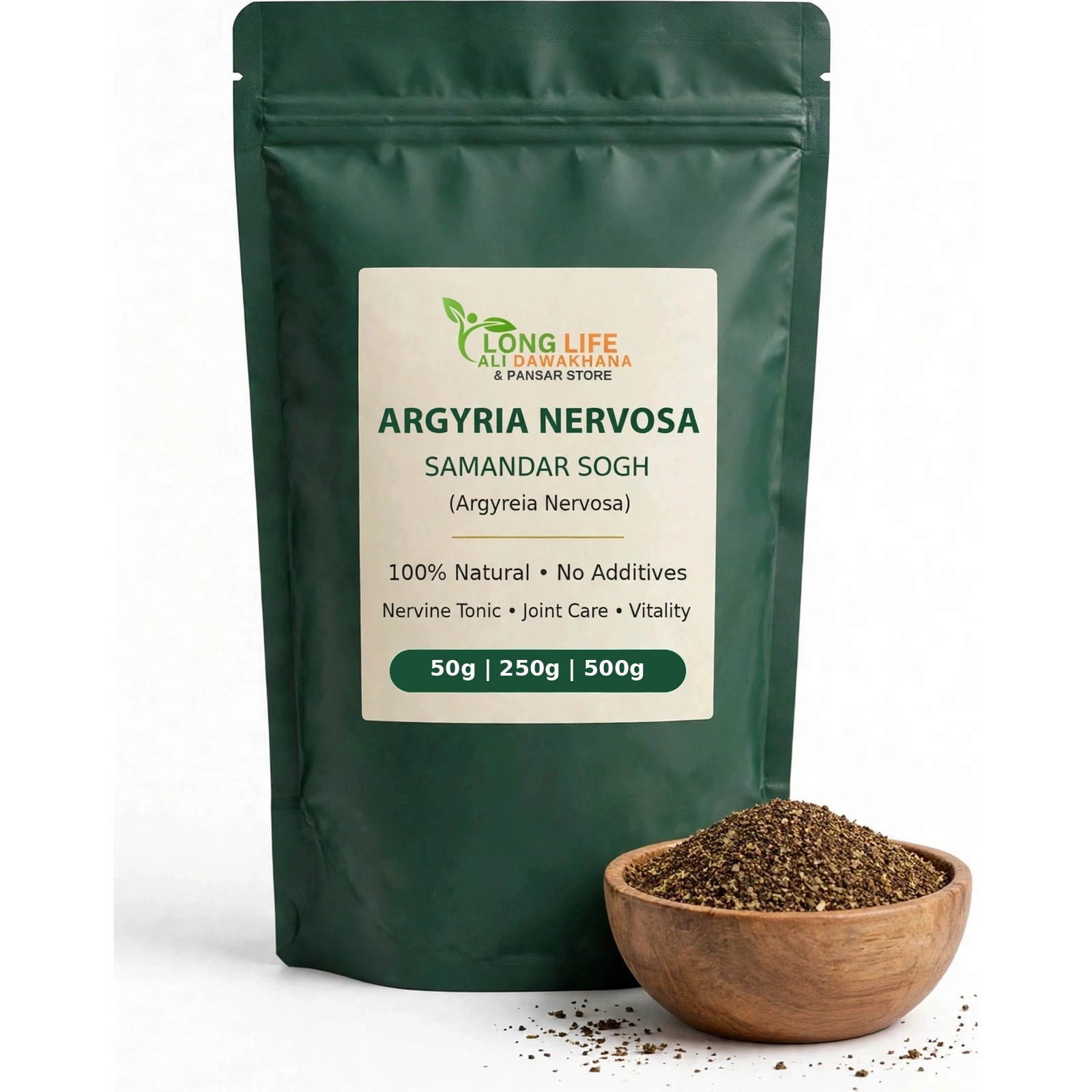
Argyria nervosa (Samandar Sogh, Elephant Creeper, Argyreia nervosa) is a perennial climbing vine whose root is a classical Ayurvedic Rasayana (rejuvenative) — traditionally used as a nervine tonic, aphrodisiac and remedy for rheumatism, joint pain and nervous disorders. Its seeds contain the psychoactive alkaloid LSA (ergine) and must never be taken for their mind-altering effects — the traditional medicine is the root, used in small measured doses. At Long.pk it is available in Whole and Powder forms (50 gm, 250 gm and 500 gm) from Rs 219, with Cash on Delivery across Pakistan.
سمندر سوگھ (Argyria nervosa) — مکمل معلومات
سمندر سوگھ، جسے انگریزی میں Elephant Creeper یا Hawaiian Baby Woodrose کہتے ہیں، ایک بڑی بیل ہے جو برصغیر پاک و ہند کی مقامی ہے۔ آیوروید میں اسے وردھ دارک (Vridhadaraka) کہتے ہیں جس کا مطلب ہے “بڑھاپے کو روکنے والی” — یہ ایک مشہور رسائن (rejuvenative) جڑی بوٹی ہے۔
اہم انتباہ: سمندر سوگھ کے بیجوں میں LSA (ergine) نامی نشہ آور مادہ ہوتا ہے جو ذہن پر اثر ڈالتا ہے — بیجوں کو کبھی نشے کے لیے استعمال نہ کریں۔ روایتی دوا اس کی جڑ ہے، جو چھوٹی مقدار میں نروس ٹانک، طاقت اور جوڑوں کے درد کے لیے استعمال ہوتی ہے۔
سمندر سوگھ کے فائدے (روایتی استعمال)
- نروس سسٹم: روایتی طور پر اعصابی کمزوری، فالج اور اعصابی امراض کے لیے استعمال ہوتی ہے۔
- جوڑوں کا درد: گٹھیا (arthritis) اور جوڑوں کے درد کے لیے جڑ کا قہوہ استعمال ہوتا ہے۔
- طاقت: رسائن اور مقوی باہ کے طور پر — جسمانی طاقت اور مردانہ کمزوری کے لیے۔
- ذیابیطس: روایتی طور پر جڑ کا قہوہ بلڈ شوگر کے لیے استعمال ہوتا ہے۔
- جلد: پتے گرم کر کے زخموں، پھوڑوں اور سوجن پر لگائے جاتے ہیں۔
استعمال کا طریقہ
- جڑ کا پاؤڈر: 3 سے 5 گرام، دودھ یا شہد کے ساتھ۔
- قہوہ: 10 سے 15 گرام جڑ 200 ملی لیٹر پانی میں ابال کر آدھا رہ جانے پر دن میں دو بار 30 سے 40 ملی لیٹر پیئیں۔
- بیرونی: پتے گرم کر کے سر درد یا زخم پر لگائیں۔
- بیج کبھی نہ کھائیں — ان میں نشہ آور LSA ہوتا ہے جو ذہنی مسائل، بلڈ پریشر اور ہسپتال میں داخلے کا سبب بن سکتا ہے۔
سمندر سوگھ Long.pk سے Whole یا Powder فارم میں 50، 250 اور 500 گرام میں منگوایا جا سکتا ہے۔ قیمت صرف 219 روپے سے شروع ہوتی ہے اور پورے پاکستان میں کیش آن ڈیلیوری دستیاب ہے۔
Argyria nervosa (Samandar Sogh) – Price in Pakistan, Benefits, Uses & Safety
Direct answer: Argyria nervosa (Samandar Sogh, Elephant Creeper, Argyreia nervosa) price in Pakistan starts from Rs 219 for 50 gm (Whole form) at Long.pk, going up to Rs 3,080 for 500 gm (Whole form). It is available in two forms — Whole and Powder — in 50 gm, 250 gm and 500 gm packs, with cash on delivery across Pakistan. In Ayurveda its root is Vridhadaraka (“anti-aging”), a classical Rasayana (rejuvenative) used as a nervine tonic, aphrodisiac and remedy for rheumatism, joint pain and nervous disorders. Its seeds contain LSA (ergine), a psychoactive alkaloid related to LSD — they must never be taken for their mind-altering effects, and the traditional medicine is the root, used in small measured doses of 3–5 g.
Table of Contents
- What Is Argyria nervosa?
- History of Argyria nervosa
- Active Compounds
- Argyria nervosa in Ayurveda, Unani & Folk Medicine
- What Does Modern Research Say?
- Detailed Benefits of Argyria nervosa
- Root vs Seeds — The Critical Distinction
- Who Is Argyria nervosa For?
- How to Use Argyria nervosa
- Traditional Combinations
- Dosage & Duration
- Side Effects & Who Should Avoid It
- How to Identify Original Argyria nervosa
- Storage & Shelf Life
- Argyria nervosa vs Ashwagandha vs Shatavari
- Argyria nervosa Price in Pakistan
- Product Specifications
- Roman Urdu
- Frequently Asked Questions
What Is Argyria nervosa?
Argyria nervosa — correctly spelled Argyreia nervosa (Burm. f.) Bojer, synonym Argyreia speciosa Sweet — is a large perennial climbing vine of the Convolvulaceae (morning glory) family. (The product is listed as “Argyria nervosa” on pansaar and long.pk; the correct botanical spelling is Argyreia nervosa, and this article uses the correct spelling for the plant itself.) It is native to the Indian subcontinent and has been introduced to Hawaii, Africa and the Caribbean, where it can become invasive. It is a vigorous climber with large, broadly ovate leaves (9–30 × 7.5–25 cm), green above and silvery-woolly beneath, and showy flowers surrounded by enlarged sepals that are red within. Its seeds are black, nearly round, 4–4.5 mm across, grey and finely hairy around a large scar.
Names: In Urdu it is Samandar Sogh (سمندر سوگھ); in Hindi Samandar-ka-pat, Samundarsokha, Vidhara, Ghav-patta; in Sanskrit Vridhadaraka / Vriddhadaru (“anti-aging”), Samundrasosha, Antakotarapushpi, Bastantri, Sthavira; in Unani Samudra Sokh; in Gujarati Samudrasokh; in English Elephant Creeper, Woolly Morning Glory, Hawaiian Baby Woodrose, Silver Morning Glory, Elephant-vine, Wood-rose. The Sanskrit name Samudra Patra (“sea leaf”) refers to the leaves appearing like sea foam from a distance.
Which part is used? In Ayurvedic practice, the root is the most commonly employed part — for tonic and medicinal decoctions. The leaves are used externally (warmed and applied to wounds, boils and swellings). The seeds are used in some traditional preparations but are the part that contains the psychoactive ergoline alkaloids, and they demand the greatest caution. The two botanical varieties, A. nervosa var. nervosa and var. speciosa, both have their roots used in Ayurvedic medicine.
A note on identity: Vidhara is considered a “controversial” or doubtful drug in Ayurveda — some scholars identify Ipomoea petaloidea or the root of Ipomoea biloba as the true Vriddhadaraka, and some identify Ghavapatta as Vidhara. These related morning-glory species are used interchangeably in practice when the authentic drug is unavailable, since they show similar therapeutic properties.
History of Argyria nervosa
Argyria nervosa is one of the most documented plants in the classical Ayurvedic literature. It appears in the great Nighantus (materia medica texts) — Dhanvantari Nighantu, Madanpala Nighantu, Kaiyadeva Nighantu, Raj Nighantu, Bhavaprakash Nighantu and Adarsha Nighantu — where it is praised as a Rasayana (rejuvenative), Balya (strength-promoting) and Vajikarana (aphrodisiac) herb. The name Vridhadaraka itself means “anti-aging” — the plant that holds back old age.
In traditional practice across India, the root has held the central position for centuries: root decoctions for rheumatism and nervous disorders, medicated milk from the roots in West Bengal and Kerala for sexual vigour and muscle bulk, warmed leaves applied to wounds and to the forehead for headache. Rajasthani tribal communities used the leaves to prevent conception — a use that modern science has never validated and that must not be relied upon.
The plant travelled with trade and colonisation: from its Indian home it was introduced to Hawaii (where it became the “Hawaiian baby woodrose”), to Africa and to the Caribbean, valued both as an ornamental vine and as a medicine. In the West it was barely known until 1960, when Albert Hofmann (the discoverer of LSD) and H. Tscherter identified lysergic acid amide (LSA, ergine) in its seeds — a discovery that made the seeds famous as a “legal high” and, in time, the subject of forensic toxicology studies, poison-centre reports and a 2025 systematic review of LSA’s risks.
Active Compounds
Argyria nervosa’s chemistry falls into two very different groups: the ergoline alkaloids (concentrated in the seeds) and the sterols, flavonoids and triterpenoids (found across the plant, including the root).
| Compound | Type | What researchers looked at |
|---|---|---|
| Ergine (LSA, lysergic acid amide) | Ergoline alkaloid | The main psychoactive compound in the seeds (~0.14% of dry weight — the richest common source); partial agonist at serotonin 5-HT2A and 5-HT1A receptors; 10–20× weaker than LSD; sedative-narcotic effects, nausea, hallucinations; dose highly variable between batches |
| Isoergine (iso-LSA) | Ergoline alkaloid | The epimer of ergine, also present in seeds; detected in serum and urine after seed ingestion |
| Agroclavine, chanoclavine-I & -II, festuclavine, lysergine, lysergol, isolysergol, molliclavine, penniclavine, steoclavine, isosetoclavine, pennidavine, elymoclavine, ergometrine | Ergoline alkaloids | The “alkaloid soup” of the seeds — a dozen or more ergot alkaloids alongside ergine; ergometrine is a known uterotonic (contracts the uterus) |
| β-sitosterol, stigmasteryl p-hydroxycinnamate | Plant sterols | Anti-inflammatory and cholesterol-related activity in lab models; sitosterol is also present in the leaves |
| Kaempferol-3-O-L-rhamnopyranoside | Flavonoid glycoside | Antioxidant activity |
| Caffeic acid, ethyl caffeate | Phenolic acids | Antioxidant and anti-inflammatory activity |
| 1-triacontanol, n-tricontanol, tetradecanyl palmitate, p-hydroxy cinnamoyloctadecanolate | Long-chain alcohols/esters | Growth-regulating and antioxidant properties in lab studies |
| Epifriedeline, triterpenoids | Triterpenoids | Anti-inflammatory activity in animal models |
| Argyreioside | Glycoside | Characteristic constituent of the plant |
| Saponins, tannins, amber-coloured resin | Mixed | Contribute to the traditional tonic and astringent actions |
The key point about the chemistry: the ergoline alkaloids are concentrated in the seeds. The root — the traditional Ayurvedic medicine — contains the sterols, flavonoids and triterpenoids that underlie its tonic and anti-inflammatory reputation, with far lower ergoline content. This is why the root and the seeds are, in practice, two different medicines with two different safety profiles.
Argyria nervosa in Ayurveda, Unani & Folk Medicine
In Ayurveda, Vidhara (Argyria nervosa) is renowned for three classical actions: Rasayana (rejuvenating — it slows aging and restores vitality), Balya (strength-promoting) and Vajikarana (aphrodisiac). It is particularly valued for Vata-related disorders — paralysis, arthritis, muscular weakness and neurological ailments. The root is described as tonic and alterative, hot in potency (ushna), and is given for rheumatic affections and diseases of the nervous system. The classical list of root indications is long: pain (shula), swelling (shopha), epilepsy (Apasmara), piles (Arsha), loss of appetite (Aruci), rheumatoid arthritis (Amavata), abdominal distension (Anaha), tumours (Gulma), heart pain (Hridruja), cough (Kasa), worms (Krimi), painful urination (Mutrakrcha), diabetes (Meha), anaemia (Pandu), bleeding disorders (Raktapitta), insanity (Unmada), gout (Vatarakta), oedema (Svayathu), wasting (Kshaya) and elephantiasis (Shlipada). It is also used for digestive, eye and ear diseases, irregular menstruation and asthma, and as a tonic, analgesic and anthelmintic.
In Unani medicine, Samandar Sogh is used as a nervine tonic and aphrodisiac, and for rheumatism and joint pain — the same core indications as in Ayurveda.
In folk medicine, the uses are practical and hands-on: the leaf is slightly heated and applied over wounds with pus for quicker healing; a paste of mature green leaves (sometimes with tamarind leaves) is warmed and applied to the forehead for acute headache; medicated milk prepared from the roots is drunk in West Bengal and Kerala to enhance sexual vigour, improve body strength and promote muscle bulk; the leaves are applied topically to ringworm, eczema, boils and swellings for their rubefacient action (they dilate capillaries and increase local blood circulation). The seeds mixed with those of Hygrophila auriculata are used in some traditional preparations.
What Does Modern Research Say?
Argyria nervosa has been studied in two very different ways: as a traditional medicine (mostly animal and lab studies of the root and leaf) and as a psychoactive plant (human studies of the seeds — mostly documenting harm). The honest summary is: the root’s traditional benefits have animal and lab support but no large human trials; the seeds’ psychoactive effects and dangers are well documented in humans.
The seeds and LSA — human evidence of harm. The most important modern document is the 2025 systematic review (Pharmacy 13(4):98, July 2025), which reviewed 17 studies with original human data on LSA up to December 2023. Its findings: LSA is primarily consumed through preparations made from the seeds of Convolvulaceae plants (chiefly Argyreia nervosa); reported effects include euphoria, hallucinations, nausea and anxiety; severe adverse outcomes — psychosis, hypertension and hospitalisation — are documented. The review concludes that LSA “poses significant health risks, exacerbated by online misinformation and variability in its effects.”
The German human study (Paulke et al. 2012). In a controlled human behavioural study, volunteers who ingested A. nervosa seeds had serum LSA levels of 0.66–3.15 ng/mL about 2 hours after ingestion. The effects were severe enough to terminate the study: nausea, weakness, fatigue, tremor, blood-pressure elevation and a psychosis-like state. The researchers characterised the psychic effects as sedative-narcotic, “very different from those” of LSD.
Variable dose, unpredictable effect (Kremer et al. 2012). A forensic study found that equal doses of seeds from different batches produced variable adverse effects — because LSA concentration in seeds varies unpredictably between batches (Paulke et al. 2014, 2015). There is no safe, standard dose of the seeds.
Case reports. Legriel et al. (2008) reported a man who ingested LSA and developed a seizure and posterior reversible encephalopathy syndrome (PRES), requiring 9 days in hospital. Forrester (2019) reviewed 29 patients from Texas poison centres who ingested LSA: symptoms included tachycardia, hypertension, nausea, hallucinations and lethargy, and 20 of the 29 needed hospitalisation or further medical care.
Receptor pharmacology (Paulke et al. 2013). Receptor-profiling work confirmed that LSA binds to serotonin 5-HT2A (pKi ~7.6) and 5-HT1A (pKi ~8.0) receptors, plus α1- and α2-adrenergic receptors and dopamine D2 sites. The 5-HT1A action explains the heavy sedation; the adrenergic action explains the blood-pressure effects.
One possible therapeutic lead. The 2025 review notes some evidence for LSA as a preventive treatment for cluster headaches — 20% of users in one report found it effective. This is preliminary, uncontrolled evidence, not a recommendation.
The root and leaf — animal and lab evidence. The IJRAP 2011 review lists the plant’s reported pharmacological activities as aphrodisiac, immunomodulatory, hepatoprotective, hypoglycemic, anti-inflammatory, anticonvulsant and nootropic — but these come from animal and laboratory studies, not human trials. Seeds (in animal studies) showed hypotensive, spasmolytic and anti-inflammatory action. The root’s traditional use for rheumatism and nervous disorders has a plausible chemical basis (sterols, flavonoids, triterpenoids with anti-inflammatory activity in animals), but no human clinical trial has confirmed it.
The honest summary: the root is a respected traditional medicine with a long safety record at traditional doses and promising but unproven modern evidence. The seeds are a documented health hazard — psychoactive, unpredictable in dose, and responsible for hospitalisations. Use the root; do not eat the seeds.
Detailed Benefits of Argyria nervosa
Every benefit below is described as it appears in the traditional literature and research, with the evidence level stated honestly. All benefits refer to the root (and, where stated, the leaf) — not the seeds.
Nervine Tonic (Traditional + Animal Support)
The root is a classical nervine tonic in Ayurveda — used for diseases of the nervous system, muscular weakness and neurological ailments. The traditional reasoning links it to its Vata-pacifying action. Animal studies report nootropic (brain-supporting) and anticonvulsant activity, but no human trial has tested it for any neurological condition.
Rheumatism & Joint Pain (Traditional + Animal Support)
The root decoction is the standard Ayurvedic preparation for Amavata (rheumatoid arthritis), joint pain and body aches — 10–15 g of coarse root powder boiled and reduced to half, taken as 30–40 ml twice daily. The anti-inflammatory activity of its sterols, flavonoids and triterpenoids in animal models gives this a plausible basis. No human trial exists.
Aphrodisiac & Reproductive Health (Traditional)
As a Vajikarana (aphrodisiac) herb, the root is used for loss of libido, emaciation and sexual weakness — traditionally as medicated milk in West Bengal and Kerala, and as root powder (3–5 g) for oligospermia (low sperm count). Animal studies report aphrodisiac activity. No human clinical trial has confirmed these effects.
Rejuvenation & Anti-Aging (Traditional)
The very name Vridhadaraka (“anti-aging”) reflects its Rasayana reputation — a rejuvenative that restores strength and vitality and slows the effects of aging. This is a classical Ayurvedic concept; modern science has no equivalent trial evidence.
Blood Sugar Support (Traditional + Animal Support)
A cold infusion or decoction of the plant (40–50 ml) is traditionally given to control diabetes, and animal studies report hypoglycemic activity. This is not a substitute for diabetes medication, and diabetics must monitor their blood sugar if they use it.
Wound Healing (Traditional + Topical Use)
The warmed leaf is applied over wounds with pus for quicker healing, and the leaves are used externally on ringworm, eczema, boils and swellings. The rubefacient action (dilating capillaries, increasing local circulation) is the traditional explanation. Bimbima’s monograph calls the plant “scientifically proven for treating wounds, cuts, gangrene, internal bleeding, chronic ulcer and rheumatism” — but this overstates the evidence, which is traditional and preclinical, not clinical.
Cough & Respiratory Complaints (Traditional)
Root powder with honey is traditionally given for cough, and the plant is used for asthma in the classical literature. No clinical evidence.
Headache (Traditional, Topical)
A paste of mature green leaves, warmed and applied to the forehead, is a traditional remedy for acute headache. No clinical evidence.
Root vs Seeds — The Critical Distinction
This is the most important section in this article. The root and the seeds of the same plant are, in practice, two different medicines with two different safety profiles.
| Aspect | Root (the traditional medicine) | Seeds (the psychoactive part) |
|---|---|---|
| Main compounds | Sterols (β-sitosterol), flavonoids, triterpenoids, saponins | Ergoline alkaloids — ergine (LSA), isoergine, agroclavine, chanoclavine, lysergol, ergometrine and more |
| LSA content | Very low | ~0.14% by dry weight — the richest common source of LSA |
| Traditional use | Nervine tonic, aphrodisiac, rheumatism, diabetes, cough — the Ayurvedic Vridhadaraka | Small traditional doses (2–3 g powder) for insomnia; also mixed with Hygrophila seeds |
| Modern evidence | Animal/lab support for anti-inflammatory, hypoglycemic, nootropic activity; no human trials | Human studies document hallucinations, psychosis, hypertension, hospitalisation |
| Dose predictability | Standardised by weight (3–5 g powder) | Unpredictable — LSA concentration varies hugely between batches |
| Safety at traditional dose | Long safety record; hot potency (avoid excess) | Dangerous — even a few seeds can cause severe effects; 20 of 29 poison-centre patients needed hospital care |
| Legal status | Sold as a herb | LSA is a controlled substance in several countries; seeds are restricted in some jurisdictions |
The rule is simple: use the root. Do not eat the seeds. The seeds are not a safe or legal “natural high” — they are an unpredictable psychoactive drug that has put people in hospital.
Who Is Argyria nervosa For?
Argyria nervosa (the root) is for adults who want a traditional Ayurvedic nervine tonic — for nervous weakness, joint pain and rheumatism, general debility, or as a Rasayana (rejuvenative) under a hakim’s guidance.
It is not for pregnant or breastfeeding women (ergoline alkaloids affect the uterus — ergometrine is a uterotonic — and the leaves were traditionally used to prevent conception), children, or anyone with a mental health condition, heart disease, or blood-pressure problems. It is not for anyone taking psychiatric medication, blood-pressure medication or diabetes medication without a doctor’s advice. And it is not for anyone seeking a psychoactive experience — the seeds are dangerous and the root will not provide one.
How to Use Argyria nervosa
Root powder. Take 3–5 g of root powder once or twice daily with warm milk or honey — the traditional dose for a nervine tonic and aphrodisiac effect. For cough, take it with honey.
Root decoction (kwath). Boil 10–15 g of coarse root powder in 200 ml of water until reduced to half (about 100 ml). Strain and drink 30–40 ml twice daily — the traditional preparation for arthritis, joint pain and body aches.
Cold infusion. Soak the root powder in cold water overnight, strain in the morning, and drink 40–50 ml — the traditional preparation for blood-sugar support.
Medicated milk. Simmer the root powder in milk (the traditional West Bengal/Kerala preparation) and drink warm — used for sexual vigour, body strength and muscle bulk.
Leaf (external only). Warm a mature green leaf slightly and apply it over a wound with pus, a boil or a swelling. For headache, apply a paste of warmed leaves to the forehead. Do not eat the leaves in medicinal quantities without a hakim’s guidance.
What NOT to do. Do not eat the seeds. Do not take the root in large doses or for long periods without a hakim’s guidance. Do not use it during pregnancy. Do not mix it with psychiatric medication.
Traditional Combinations
- Argyria root + Ashwagandha: the classical nervine-tonic pair — both are Rasayana herbs for strength, nerves and vitality.
- Argyria root + Shatavari: for reproductive health and general rejuvenation.
- Argyria root + Milk: the traditional vehicle — medicated milk is the standard preparation in West Bengal and Kerala for sexual vigour and muscle bulk.
- Argyria root + Honey: the traditional vehicle for cough — root powder with honey.
- Argyria root + Lodhra (Symplocos racemosa): equal parts, traditionally used for leucorrhea (per Planet Ayurveda).
- Argyria leaf + Tamarind leaves: warmed together as a paste for the forehead — the traditional headache remedy.
- Argyria seeds + Hygrophila auriculata seeds: a traditional combination — not recommended; the seeds are psychoactive and this combination has no safety data.
Dosage & Duration
The figures below come from the classical literature and Ayurvedic practitioner sources. They are given for information — your hakim’s instruction takes priority. There are no established modern dosages for Argyria nervosa; the doses below are traditional.
| Form | Dose | Notes |
|---|---|---|
| Root powder | 3–5 g, once or twice daily | With warm milk or honey; the standard tonic dose |
| Root decoction | 10–15 g coarse powder boiled in 200 ml water, reduced to half; 30–40 ml twice daily | For arthritis, joint pain, body aches |
| Cold infusion | 40–50 ml | For blood-sugar support; soak overnight |
| Leaf (external) | As needed | Warmed leaf or paste on wounds, boils, forehead |
| Seed powder (traditional) | 2–3 g for insomnia | Not recommended — seeds are psychoactive; dose unpredictable; hospitalisations documented |
Duration: as a tonic, the root is traditionally taken in courses of a few weeks to a few months, with breaks. Do not take it continuously for long periods without a hakim’s guidance. The root is hot in potency (ushna) — long, heavy use may aggravate Pitta (heat, acidity, skin irritation).
Side Effects & Who Should Avoid It
The seeds are the danger. Eating Argyria nervosa seeds can cause nausea, vomiting, weakness, fatigue, tremor, blurred vision, constipation, vertigo, anxiety, hallucinations and a psychosis-like state, with blood-pressure elevation and tachycardia. Effects begin 20–60 minutes after ingestion and last 4–8 hours, with drowsiness lingering up to 12 hours. In the German human study, the effects were severe enough to terminate the study. In the Texas poison-centre series, 20 of 29 patients needed hospitalisation. One case report describes a seizure and posterior reversible encephalopathy syndrome (PRES) requiring 9 days in hospital. The dose is unpredictable — LSA concentration varies hugely between seed batches, so there is no safe number of seeds.
The root is well tolerated at traditional doses (3–5 g). Possible side effects at higher doses: stomach upset, nausea, or a feeling of heat (the root is hot in potency). Long-term heavy use without guidance is not recommended.
Who must avoid it or consult first:
- Pregnant women — avoid. Ergoline alkaloids affect the uterus (ergometrine is a uterotonic), and the leaves were traditionally used to prevent conception.
- Breastfeeding women — no safety data; avoid.
- Children — no safety data; do not give to children.
- People with mental health conditions — avoid, especially any history of psychosis; the plant’s ergoline alkaloids affect serotonin receptors.
- People with heart disease or blood-pressure problems — consult a doctor first; the seeds lower blood pressure and raise it unpredictably, and the root’s effects on blood pressure are not established.
- People taking psychiatric medication, blood-pressure medication or diabetes medication — consult a doctor first.
- People with liver or kidney disease — no safety data; consult a doctor first.
Regulatory status: no regulatory approval as a medicine in any major jurisdiction. Used as a traditional herb in Ayurvedic and Unani practice. LSA (ergine) is a controlled substance in several countries (including the USA, where it is a Schedule III substance, and the UK, where it is a Class A drug) — the seeds are restricted or illegal in some jurisdictions. The root is sold as a herb in Pakistan.
How to Identify Original Argyria nervosa
- Root: genuine Vridhadaraka root is brown, woody, and fibrous — sold as cut pieces or coarse powder. The powder is dark brown and granular (as in the reference image), with a slightly earthy, bitter smell.
- Seeds: black, nearly round, 4–4.5 mm across, grey and finely hairy around a large scar. If you are buying the root product, it should not contain whole seeds.
- Leaves: large, broadly ovate, green above and silvery-woolly beneath — the “woolly” underside is distinctive.
- Smell: the root powder has a mild, earthy, slightly bitter aroma. A chemical or musty smell means contamination or spoilage.
- Not morning glory seeds: Argyria nervosa is sometimes confused with ornamental morning glory (Ipomoea tricolor) — a different plant with smaller seeds and far less LSA. Buy from a trusted pansar source.
- Adulteration: the “controversial drug” problem means some Vidhara sold in the market may be Ipomoea species instead. Long.pk sources its Argyria nervosa from established pansar suppliers.
Storage & Shelf Life
Store Argyria nervosa in an airtight container or its sealed pouch, away from light, heat and moisture. A cool, dry cupboard is ideal. The dried root keeps its potency for 18–24 months when stored properly. The powder loses strength faster (use within 9–12 months of grinding). Do not store it in the bathroom or near the stove, where steam and heat degrade it. Keep it out of reach of children — especially any seeds.
Argyria nervosa vs Ashwagandha vs Shatavari
These three are the best-known Ayurvedic Rasayana (rejuvenative) tonics — all used for strength, nerves and vitality, but with different strengths.
| Feature | Argyria nervosa (Vridhadaraka) | Ashwagandha (Withania somnifera) | Shatavari (Asparagus racemosus) |
|---|---|---|---|
| Main traditional use | Nervine tonic, aphrodisiac, rheumatism | Stress, anxiety, strength, sleep | Female reproductive health, cooling tonic |
| Potency | Hot (ushna) | Hot (ushna) | Cold (sheeta) |
| Key compounds | Ergoline alkaloids (seeds), sterols, flavonoids | Withanolides | Steroidal saponins (shatavarins) |
| Best for | Nervous disorders, joint pain, male vitality | Stress and fatigue, sleep, muscle strength | Hormonal balance, digestion, cooling |
| Human trial evidence | None for the root; seeds studied for harm | Moderate (stress, anxiety, testosterone) | Limited (some small trials) |
| Safety concern | Seeds are psychoactive (LSA) | Generally safe; avoid in pregnancy, thyroid issues | Generally safe; avoid in oestrogen-sensitive conditions |
| Availability in Pakistan | Common in pansar shops | Common | Common |
| Price (Long.pk, from) | Rs 219 / 50 gm | — | — |
Which to choose: for nervous disorders and joint pain with a warming action, Argyria nervosa (root only). For stress, anxiety and sleep, Ashwagandha. For a cooling tonic and female reproductive health, Shatavari. All three are Rasayana herbs and are sometimes combined.
Argyria nervosa Price in Pakistan
Prices checked 19 November 2026 (following pansaar.com, rounded to whole rupees). Cash on Delivery available across Pakistan.
| Form | 50 gm | 250 gm | 500 gm |
|---|---|---|---|
| Whole | Rs 219 | Rs 1,401 | Rs 3,080 |
| Powder | Rs 405 | Rs 1,586 | Rs 3,038 |
Best value: unusually, the 50 gm Whole pack at Rs 219 is the best value per gram (about Rs 438 per 100 gm, against Rs 616 for the 500 gm pack) — pansaar’s pricing for this herb is non-monotonic, with the larger Whole packs costing more per gram. For the Powder form the usual pattern holds: the 500 gm pack is the best value (about Rs 608 per 100 gm). At the usual dose of 3–5 g per day, the 50 gm pack lasts 10–16 days and the 500 gm pack lasts 3–5 months.
Product Specifications
| Product Name | Argyria nervosa (Samandar Sogh) |
| Urdu Name | سمندر سوگھ (Samandar Sogh) |
| Botanical Name | Argyreia nervosa (syn. Argyreia speciosa) |
| Family | Convolvulaceae |
| Forms Available | Whole / Powder |
| Weights Available | 50 gm / 250 gm / 500 gm |
| Price Range | Rs 219 – Rs 3,080 |
| Purity | 100% Natural, No Additives |
| Origin | Indian subcontinent |
| Shelf Life | 18–24 months (dried root); 9–12 months (powder) |
| Storage | Airtight container, cool & dry place, away from sunlight |
| Seller | Ali Dawakhana and Pansar Store |
| Delivery | Cash on Delivery across Pakistan |
Roman Urdu
Argyria nervosa (Samandar Sogh, Elephant Creeper, Argyreia nervosa) aik bari bail hai jis ki jar Ayurvedic tib mein Vridhadaraka ke naam se mashhoor hai — is ka matlab hai “burhapa rokne wali”. Yeh aik Rasayana (tazgi dene wali) jar hai jo aasaabi kamzori, joron ke dard, gathiya aur mardana kamzori ke liye rawayati tor par istemal hoti hai.
Ahem intebah: is ke beejon mein LSA (ergine) hota hai jo dimagh par asar karta hai — beej kabhi na khayen. Rawayati dawa is ki jar hai, jo 3 se 5 gram ki miqdar mein doodh ya shehed ke saath li jati hai. Joron ke dard ke liye jar ka qehwa (10–15 gram ubaal kar aadha kar ke, din mein do baar 30–40 ml) istemal hota hai.
Long.pk se Argyria nervosa Whole aur Powder form mein 50 gm, 250 gm aur 500 gm mein dastiyab hai — qeemat sirf Rs 219 se shuru. Pure Pakistan mein Cash on Delivery ki sahulat mojood hai.
Frequently Asked Questions
Q: Samandar Sogh kis kaam aati hai?
Argyria nervosa (Samandar Sogh) ki jar Ayurvedic tib mein nervine tonic, aphrodisiac aur joron ke dard ke liye istemal hoti hai. Yeh aik Rasayana (tazgi dene wali) jar hai.
Q: Samandar Sogh ki Pakistan mein qeemat kya hai?
Long.pk par Samandar Sogh ki qeemat Rs 219 se shuru hoti hai (50 gm Whole) aur Rs 3,080 tak jati hai (500 gm Whole). Whole aur Powder — dono forms 50, 250 aur 500 gm mein dastiyab hain.
Q: Kya Samandar Sogh ke beej kha saktay hain?
Nahi — beejon mein LSA (ergine) hota hai jo dimagh par asar karta hai aur hallucinations, psychosis, blood pressure aur hospital mein daakhil hone ka sabab ban sakta hai. Beej kabhi na khayen.
Q: Samandar Sogh ki jar kaisay istemal karte hain?
Jar ka powder 3 se 5 gram doodh ya shehed ke saath lein, ya 10–15 gram jar ka qehwa bana kar din mein do baar 30–40 ml peeyen.
Q: Samandar Sogh aur Ashwagandha mein kya farq hai?
Dono Rasayana jarri bootiyan hain — Samandar Sogh aasaabi amraz aur joron ke dard ke liye behtar hai, jabke Ashwagandha stress, neend aur thakan ke liye zyada mashhoor hai.
Q: Kya Samandar Sogh diabetes mein madad karti hai?
Rawayati tor par is ka qehwa blood sugar ke liye istemal hota hai aur janwaron par tehqeeq mein hypoglycemic asar dekha gaya hai — lekin yeh diabetes ki dawa ka badal nahi hai.
Q: Samandar Sogh kis ko nahi leni chahiye?
Hamila aur doodh pilane wali khawateen, bachay, zehni amraz wale afraad, aur dil ya blood pressure ke mareez — doctor se mashwara kiye baghair na lein.
Q: Vridhadaraka ka matlab kya hai?
Vridhadaraka Sanskrit mein “burhapa rokne wali” ke matlab hai — yeh Samandar Sogh ka Ayurvedic naam hai, is ki Rasayana (tazgi dene wali) khasiyat ki wajah se.
Q: Samandar Sogh ke patay kis kaam aate hain?
Patay garam kar ke zakhmon, phoron aur soojan par lagaye jate hain, aur sar dard ke liye peshani par paste lagaya jata hai. Patay sirf bahari istemal ke liye hain.
Q: Asli Samandar Sogh ki pehchan kya hai?
Asli jar bhoori, lakri jaisi aur reshe-dar hoti hai; is ka powder gehra bhoora aur dana-dar hota hai. Beej kaale, gol aur 4–4.5 mm ke hote hain.
Related Products
- Brahmi Booti (Centella) — the classical nervine and memory herb, the closest companion to Argyria for nervous weakness and mental wellbeing.
- Shatavari Powder (Satawar) — another Rasayana rejuvenative, traditionally paired with Argyria root for reproductive health and vitality.
- Bonduc Nut (Karanjwa) — traditionally used for joint pain and fever, a natural partner for Argyria’s rheumatism use.
- Organic Moringa Leaf Powder (Sohanjna Powder) — a daily nutrition and energy tonic that complements Argyria’s Rasayana (rejuvenative) role.
Ali Dawakhana and Pansar Store — Asli desi dawa aur khalis jadi bootiyan, ab ghar baithay Long.pk se mangwayen.
Reviews
There are no reviews yet