
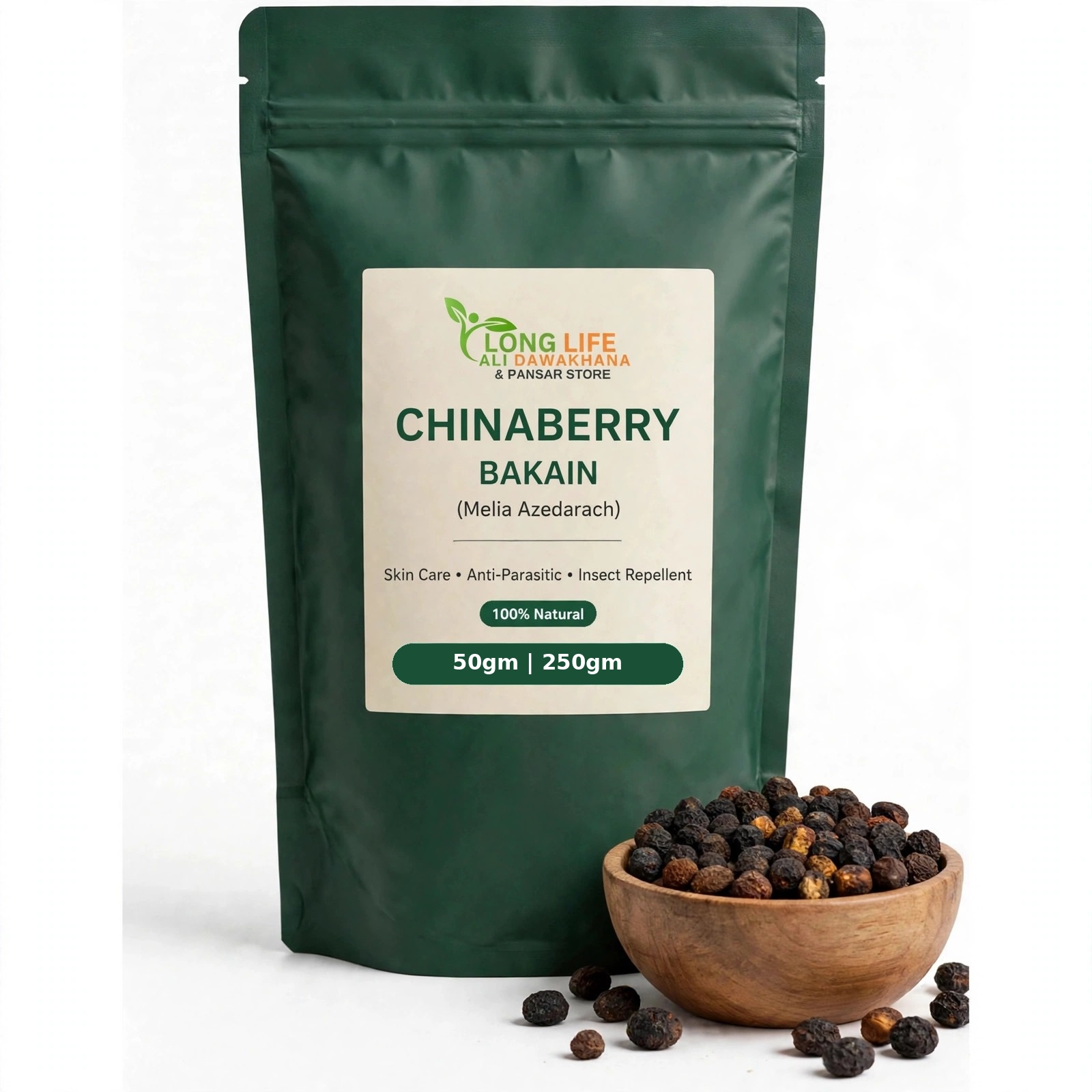
Chinaberry (Bakain, Melia azedarach) is the dried fruit of the Persian lilac tree, a classical Unani remedy traditionally used externally for skin conditions, as an anthelmintic (against intestinal worms) and as an insect repellent — but the fruit is poisonous if eaten, and as few as six berries have caused deaths in children, so it must never be eaten and must be kept away from children. Its active compounds are meliatoxins, limonoid tetranortriterpenes that kill insects and parasites in laboratory studies, but there are no human clinical trials of the fruit for any condition. At Long.pk it is available in Whole and Powder forms (50 gm and 250 gm) from Rs 169, with Cash on Delivery across Pakistan.
بکائن (Chinaberry) — مکمل معلومات
بکائن، جسے انگریزی میں Chinaberry یا Persian Lilac کہتے ہیں، ایک درخت (Melia azedarach) کا خشک پھل ہے۔
اہم انتباہ — بکائن کا پھل زہریلا ہے: بکائن کا پھل کھانے سے زہر چڑھ سکتا ہے۔ صرف چھ دانے بچوں کی موت کا سبب بن چکے ہیں۔
Chinaberry (Bakain) – Price in Pakistan, Benefits, Uses & Safety
Direct answer: Chinaberry (Bakain, Melia azedarach) price in Pakistan starts from Rs 169 for 50 gm (Whole form) at Long.pk, going up to Rs 506 for 250 gm (Powder form). It is available in two forms — Whole and Powder — in 50 gm and 250 gm packs, with cash on delivery across Pakistan.
- What Is Chinaberry (Bakain)?
- History of Chinaberry
- Active Compounds
- Chinaberry in Unani, Ayurveda & Folk Medicine
- What Does Modern Research Say?
- Detailed Benefits of Chinaberry
- Chinaberry vs Neem — Related Trees, Different Medicine
- Who Is Chinaberry For?
- How to Use Chinaberry
- Traditional Combinations
- Dosage & Duration
- Side Effects & Who Should Avoid It
- How to Identify Original Chinaberry
- Storage & Shelf Life
- Chinaberry vs Neem vs Bonduc Nut
- Chinaberry Price in Pakistan
- Product Specifications
- Roman Urdu
- Frequently Asked Questions
What Is Chinaberry (Bakain)?
Chinaberry — Urdu Bakain (بکائن), also called Dharek or Drek — is the dried fruit of Melia azedarach L., a fast-growing deciduous tree of the Meliaceae (mahogany family).
Which part is sold here? The dried fruit — the round yellow drupe of the tree, about 1–1.5 cm across when fresh.
History of Chinaberry
Chinaberry is one of the most widely travelled trees in the herbal world. Native to the foothills of the Himalayas and the forests of South and Southeast Asia, Melia azedarach was carried to every warm continent.
Active Compounds
The chemistry of Chinaberry is dominated by one family: the limonoids — highly oxidised tetranortriterpenes, the signature chemistry of the mahogany family (Meliaceae) and of citrus. They are bitter, biologically aggressive molecules, and in chinaberry they are both the medicine and the poison.
Chinaberry in Unani, Ayurveda & Folk Medicine
In Unani medicine, Chinaberry (Bakain) is described as a hot and dry drug, used for centuries across India, Pakistan and the Arab world.
The fruit (the product sold here). The fruit pulp is the classical vermifuge.
What Does Modern Research Say?
Here is the honest summary first: there are no published human clinical trials of Chinaberry fruit — or of any part of the tree — for any medical condition. Everything below is laboratory (in vitro) or animal work, plus the poisoning case record.
The poisoning record — the most important evidence for this product. The human toxicity of the fruit is documented in clinical toxicology references on three continents.
Detailed Benefits of Chinaberry
Every benefit below is labelled with its evidence level: traditional (classical Unani/Ayurvedic/folk use) or animal/lab (test-tube or animal studies). Nothing here is a proven human-treatment claim, and the fruit is never presented as safe to eat.
Skin Conditions — Itching, Eczema, Scabies & Ringworm (Traditional + Lab)
This is the herb’s defining use, and the safest one — because it is external.
Lice & External Parasites (Traditional + Lab)
The seed oil and fruit wash are traditional remedies for head lice and skin parasites.
Intestinal Worms — Anthelmintic (Traditional + Animal/Lab)
The fruit pulp and seeds are the classical vermifuge of Unani.
Insect Repellent & Stored-Grain Protection (Traditional + Lab)
The oldest and best-evidenced use of all: chinaberry leaves hung with stored grain.
Chinaberry vs Neem — Related Trees, Different Medicine
This is the most important section for a buyer, because Bakain and neem are constantly confused — and the confusion is dangerous. Same family (Meliaceae), similar looks, both bitter, and Bakain is even called Mahanimb (“great neem”) and Ghora Neem in India and Pakistan.
They are different genera, not just different species. Neem is Azadirachta indica A. Juss.
Who Is Chinaberry For?
Chinaberry suits people who:
- Are hakims, herbalists or traditional practitioners who know the plant and use the fruit in classical Unani or Ayurvedic preparations under professional supervision.
- Want a traditional external wash for itchy, irritated skin, scabies-type complaints or scalp problems.
- Need a botanical insecticide — a fruit decoction for plants, stored grain or household pest control.
How to Use Chinaberry
The governing rule: external use, and practitioner-guided internal use only. Every preparation below is external unless it says otherwise.
Decoction wash (the main external preparation): Add 10–20 g of the whole dried fruit to 1 litre of water, boil, then simmer 15–20 minutes.
Traditional Combinations
- Chinaberry + Neem leaves — the classical Meliaceae pairing for skin washes.
- Chinaberry + Mint (Podina) + Salt — the Pakistani folk combination (Islam et al. 2009).
- Chinaberry + Henna — for scalp complaints: a bakain decoction rinse followed by henna, in the traditional style for itchy scalp and dandruff.
Dosage & Duration
There is no established safe internal dose for Chinaberry fruit, and this article gives none.
External preparations — the safe doses:
| Preparation | Amount | Use |
|---|---|---|
| Decoction wash (skin) | 10–20 g whole fruit per litre of water, simmered 15–20 min | Wash affected skin once daily; rinse off |
| Paste / poultice | 1–2 tsp powder + warm water | Apply 20–30 min, then wash off; once daily |
Side Effects & Who Should Avoid It
Chinaberry is a poisonous plant, and this section is the longest safety section in the Long.pk series for a reason. Read it before you buy.
Poisoning — the central risk. Eating the fruit causes nausea, vomiting, abdominal pain and diarrhoea (sometimes bloody) within a few hours, followed in serious cases by drowsiness, weakness, loss of coordination, numbness, double vision, fast heartbeat, low blood pressure.
Children — never. Do not give Chinaberry fruit to a child in any form without a doctor’s direct advice.
Pregnancy and breastfeeding — avoid entirely. The tree is recorded as an emmenagogue (promoting menstrual flow) in the classical texts, the fruit is toxic, and there is no safety data of any kind for pregnancy or nursing.
Skin absorption. The toxins can be absorbed through the skin, especially broken or inflamed skin and over large areas.
Allergies. As with any plant preparation, stop if you develop a rash, itching, swelling or breathing difficulty.
Drug interactions. There is no human interaction data. Because the plant is recorded as hypoglycaemic, hypotensive and emmenagogue in the traditional literature, anyone on diabetes, blood-pressure or hormone-affecting medication should not use it internally, and should tell their doctor about any external use.
Pets and livestock. The fruit is poisonous to pigs (most prone), cattle, sheep, goats and dogs; chickens are less susceptible (Botha & Venter 2002).
Storage safety. Keep the pack sealed, labelled and out of reach of children and animals — ideally in a locked cupboard, not in the kitchen with food.
How to Identify Original Chinaberry
Appearance: Genuine dried Chinaberry fruit is a round to oval berry, about 1–1.5 cm across, dried to a dark brown-black colour, deeply wrinkled like a small dried plum.
Storage & Shelf Life
- Whole fruit: keeps 18–24 months in an airtight container in a cool, dry place away from direct sunlight.
- Powder: keeps 9–12 months — ground fruit loses strength faster.
- Seal tightly after every use.
Chinaberry vs Neem vs Bonduc Nut
| Feature | Chinaberry (Bakain) | Neem (Azadirachta indica) | Bonduc Nut (Karanjwa) |
|---|---|---|---|
| Botanical name | Melia azedarach | Azadirachta indica | Caesalpinia bonduc |
| Family | Meliaceae | Meliaceae | Fabaceae (legume family) |
| Part used | Dried fruit (berry) | Leaves, seeds, oil | Seed (nut) |
Chinaberry Price in Pakistan
| Form | 50 gm | 250 gm |
|---|---|---|
| Whole | Rs 169 | Rs 388 |
| Powder | Rs 211 | Rs 506 |
Best value: Whole 250 gm at Rs 1.55 per gram — the Powder costs more per gram at every size.
Product Specifications
| Product Name | Chinaberry (Bakain) |
| Urdu Name | بکائن (Bakain) |
| Botanical Name | Melia azedarach L. |
| Family | Meliaceae (mahogany family) |
| English Names | Persian Lilac, Cape Lilac, Indian Lilac, Syringa Berry, Bead Tree, White Cedar, Pride of India |
| Other Names | Dharek, Drek, Mahanimb, Ghora Neem |
| Part Used | Fruit (dried berry, whole) |
| Forms | Whole / Powder |
| Weights | 50 gm, 250 gm |
| Price Range | Rs 169 – Rs 506 |
| Key Compounds | Meliatoxins (A1, A2, B1), toosendanin, meliartenin |
| Temperament (Unani) | Hot and dry |
| Safety Warning | Fruit poisonous if eaten — 6 berries reported lethal to a child; external and practitioner-guided use only; keep away from children and animals |
| Additives | None — 100% natural |
| Shelf Life | Whole fruit 18–24 months; Powder 9–12 months |
| Storage | Airtight container, cool and dry, away from sunlight; stored separately from food, out of children’s reach |
| Seller | Ali Dawakhana and Pansar Store |
| Delivery | Cash on Delivery across Pakistan |
Roman Urdu
Bakain (Chinaberry) Persian lilac ke darakht (Melia azedarach) ka khushk phal hai — gol, jhurri daar, gehra bhoora-kaala dana jo Pakistan mein Dharek ya Drek ke naam se bhi jana jata hai.
Sab se bara inzar: Bakain ka phal zehreela hai. Sirf 6 danay bachay ki maut ka sabab ban chuke hain.
Frequently Asked Questions
Q: Kya Bakain ka phal zehreela hai?
Jee haan — Bakain ka phal zehreela hai.
Q: Chinaberry (Bakain) ki Pakistan mein qeemat kya hai?
Rs 169 se Rs 506 tak — Whole 50 gm Rs 169, 250 gm Rs 388; Powder 50 gm Rs 211, 250 gm Rs 506.
Q: Bakain kis kaam aata hai?
Bakain rawayati tor par jild ki beemariyon (kharish, khujli, dad), jooon, pait ke keeron aur keeron ke khilaaf istemal hota hai.
Q: Kya Bakain pait ke keeron ke liye mufeed hai?
Rawayati tor par haan — Yunani, Ayurvedic aur cheeni tib mein is ka phal keeron ke khilaaf istemal hota hai.
Q: Bakain aur Neem mein kya farq hai?
Dono aik hi family (Meliaceae) ke mukhtalif darakht hain.
Q: Bakain ko jild par kaisay istemal karte hain?
10 se 20 gram khushk phal aik litre pani mein 15 se 20 minute ubaal kar.
Q: Agar bachay ne Bakain ka phal kha liya to kya karein?
Foran qareebi hospital le jayein — alamat ka intezar na karein.
Q: Kya Bakain hamila khawateen istemal kar sakti hain?
Nahi. Bakain haiz laane wali (emmenagogue) booti samjhi jati hai, is ka phal zehreela hai, aur hamal mein safety ka koi data nahi hai.
Q: Asli Bakain ki pehchan kya hai?
Asli khushk phal gol, 1 se 1.5 cm, gehra bhoora-kaala aur jhurri daar hota hai.
Q: Kya Bakain ko keeron ke khilaaf spray ke tor par istemal kar sakte hain?
Jee haan — yeh is ka sab se purana aur behtareen istemal hai.
Related Products
- Bonduc Nut (Karanjwa) — a safer traditional worm remedy, the classical anthelmintic seed of Unani practice.
- Henna Leaves (Mehndi Patti) — scalp and skin care alongside Bakain washes.
- Liquorice Root (Mulethi) — a soothing skin partner herb.
- Black Nightshade (Mako) — cooling skin support.
Ali Dawakhana and Pansar Store — Asli desi dawa aur khalis jadi bootiyan, ab ghar baithay Long.pk se mangwayen.
Reviews
There are no reviews yet