
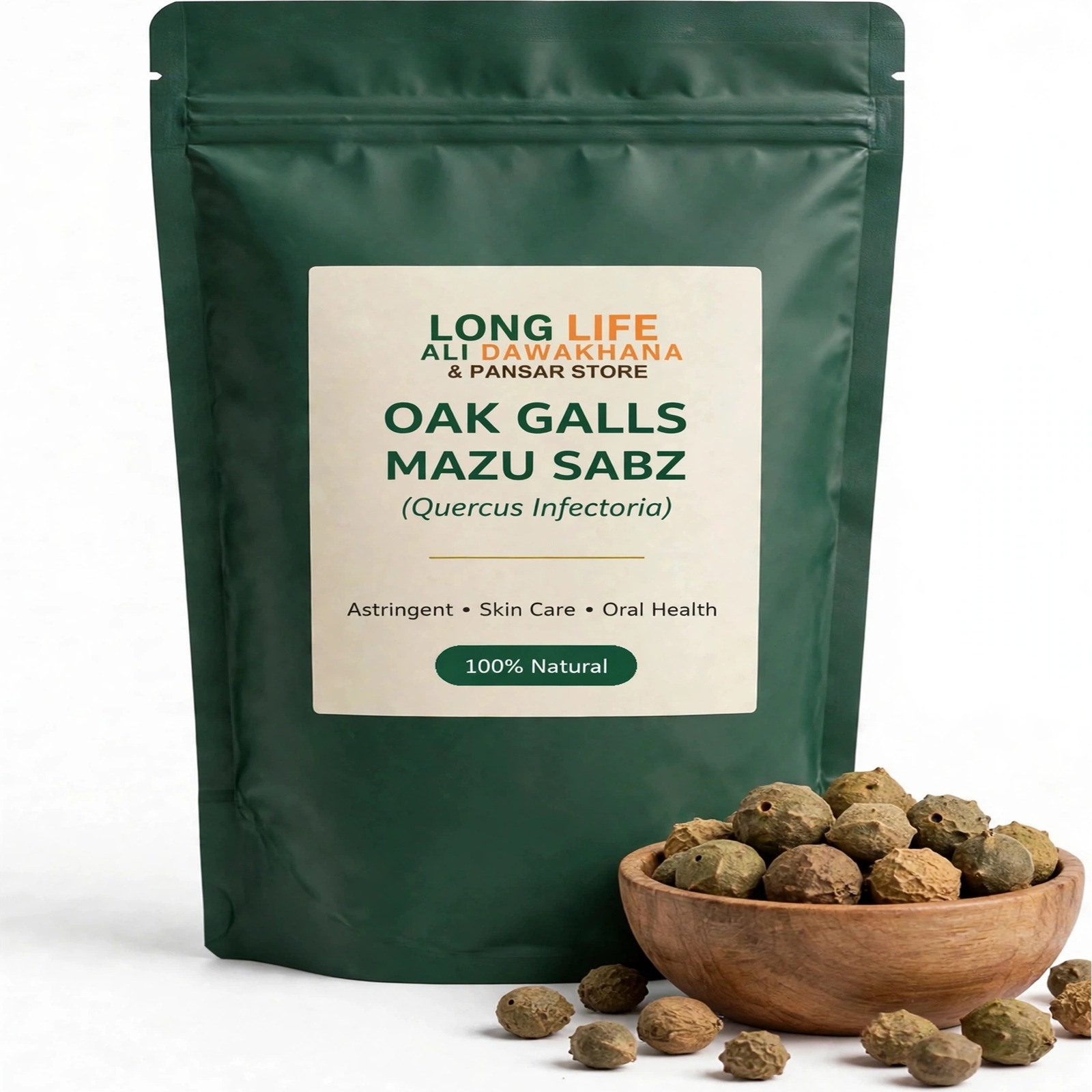
Oak Galls (Mazu Sabz, Quercus infectoria) are one of the most tannin-rich natural medicines known — 50–70% tannic acid — used for centuries as a powerful astringent for gums and teeth, diarrhoea, wounds, piles and skin. They are not a fruit or a seed: each gall is a tree’s growth around a wasp egg. At Long.pk they are available in Whole and Powder forms (50 gm and 250 gm) from Rs 422, with Cash on Delivery across Pakistan.
مازو سبز (اوک گالز) — مکمل معلومات
مازو سبز بلوط کے درخت (Quercus infectoria) کی شاخوں پر بننے والی گانٹھیں ہیں — یہ کوئی پھل یا بیج نہیں، بلکہ درخت کا ردعمل ہے جب ایک بھڑ (wasp) انڈا دیتی ہے۔ اس میں 50 سے 70 فیصد ٹینک ایسڈ ہوتا ہے۔ یونانی طب میں یہ مسوڑھوں اور دست و پیچش کے لیے استعمال ہوتا ہے۔
اہم انتباہ: ٹینن بہت زیادہ ہے — لمبے عرصے تک یا زیادہ مقدار میں نہ لیں، معدے میں جلن اور جگر کو نقصان پہنچا سکتا ہے۔ ٹینن آئرن کے جذب کو روکتا ہے، اس لیے کھانے سے دور رکھیں۔ حاملہ خواتین ڈاکٹر سے مشورہ کریں۔
Direct answer: Oak Galls (Mazu Sabz, Quercus infectoria) cost Rs 422 for 50 gm (Whole) to Rs 2,531 for 250 gm (Powder) at Long.pk, in Whole and Powder forms, with cash on delivery across Pakistan. The dried galls contain 50–70% tannic acid — one of the strongest natural astringents known. The “fat burner” claim has no evidence behind it.
- What Are Oak Galls?
- History of Oak Galls
- Active Compounds
- Oak Galls in Ayurveda, Unani & Folk Medicine
- What Does Modern Research Say?
- Detailed Benefits of Oak Galls
- What Is a Gall? The Wasp, the Tree and the Hole
- Who Are Oak Galls For?
- How to Use Oak Galls
- Traditional Combinations
- Dosage & Duration
- Side Effects & Who Should Avoid Them
- How to Identify Original Oak Galls
- Storage & Shelf Life
- Oak Galls vs Myrobalan vs Pomegranate Rind
- Oak Galls Price in Pakistan
- Product Specifications
- Roman Urdu
- Frequently Asked Questions
What Are Oak Galls?
Oak Galls (Mazu Sabz, Quercus infectoria) are the dried galls of the Aleppo oak — in Hindi Majuphal. A gall is not a fruit or a seed: the tree grows it around a gall wasp’s egg. The galls contain 50–70% tannic acid: tannin binds proteins, tightens tissue and stops bleeding.
History of Oak Galls
Used in Unani medicine for centuries — for diarrhoea, haemorrhage, gingivitis, leucorrhoea, wounds and prolapse. Hakim Najmul Ghani (Khazain-ul-Advia) and the Minhajuddukan say the best Mazu Sabz is the gall without the wasp’s exit hole.
Active Compounds
The main compound is tannic acid (gallotannic acid) — 50–70% of dry weight — the source of the astringent, haemostatic, antimicrobial and wound-healing activity. Supporting compounds: gallic acid, ellagic acid, catechin. Tannic acid binds proteins and chelates iron — it blocks iron absorption.
Oak Galls in Ayurveda, Unani & Folk Medicine
In Unani medicine, Mazu is Qābiḍ (astringent), Hābisuddam (haemostatic) and Mudammil-i-Qurūḥ (wound healer), used for gingivitis, leucorrhoea, wounds and diarrhoea — as a decoction (Joshanda), 3–5 g. In Ayurveda, Majuphal is Kashaya (astringent), used for piles and leucorrhoea.
What Does Modern Research Say?
Reviews by Alam et al. (2022), Shaikh Imtiyaz et al. (2013), Banc et al. (2023) and Dove Medical Press (2026) agree: lab and animal evidence is strong, clinical evidence is thin. Anticancer claims rest on cell lines only.
Clinical evidence — limited but real: a double-blind randomised trial in 84 women with bacterial vaginosis found oak gall cream similar to metronidazole gel (82.1% vs 87.5%); no trial supports vaginal tightening claims.
Detailed Benefits of Oak Galls
1. Oral Health — Gums & Teeth
The signature use — the Unani rinse for gingivitis and bleeding gums.
2. Diarrhoea & Dysentery
The classical internal use — tannin tightens the gut lining, reducing fluid loss.
3. Wound Healing & Skin
A Unani wound healer and antiseptic, confirmed in animal studies.
4. Leucorrhoea & Women’s Health
For leucorrhoea; the one trial (84 women) matched metronidazole gel.
5. Piles & Bleeding
A haemostatic — it stops bleeding by tightening tissue.
6. Prolapse — Rectal & Uterine
A classical Unani use for rectal and uterine prolapse — not a home treatment.
7. Skin — Pigmentation & Tightening
Used for pigmentation and skin tightening. No clinical trial.
8. Blood Sugar
Blood-sugar effects in animal studies only — no human trial.
What Oak Galls Do NOT Do — The “Fat Burner” Claim
Listed as a “Fat Burner” on the source website. There is no evidence for this.
What Is a Gall? The Wasp, the Tree and the Hole
A gall is a tree’s reaction to a wasp: the female gall wasp Adleria gallae-tinctoriae lays an egg in a young oak twig, and the tree grows a hard ball around it, packed with tannin (50–70%).
When the wasp matures, it bores a hole and escapes: holed galls are the lower grade, unholed galls the preferred grade. The same tannin made iron gall ink.
Who Are Oak Galls For?
Best for gum problems (bleeding gums, gingivitis), mild diarrhoea, and practitioners using Mazu in Unani and Ayurvedic practice. Not for weight loss, long-term internal use, or internal use in pregnancy without a doctor’s advice.
How to Use Oak Galls
Mouth rinse: boil 3–5 g in a cup of water for 10 minutes, strain and cool; rinse twice daily, spit out — do not swallow. Decoction for diarrhoea: boil 3–5 g in two cups of water until reduced to one, drink warm once or twice daily for a few days.
External use: wash minor wounds with a cooled decoction — never on large areas of broken skin, burns or deep wounds. Skin paste: powder with rose water, 15–20 minutes; patch-test first.
Traditional Combinations
Traditional combinations: with rose water as a skin paste; with vinegar for ringworm and alopecia; with honey for mouth ulcers; with alum for bleeding; with myrobalan or pomegranate rind for diarrhoea.
Dosage & Duration
- Classical Unani dose: 3–5 g as a decoction, once or twice daily — traditional only; no modern safe dose is established.
- Mouth rinse: 3–5 g per cup, boiled 10 minutes, twice daily; spit out. Short courses only — a few days for diarrhoea, 1–2 weeks for gums.
- Take 2 hours away from meals, iron supplements and other medicines. Do not exceed the dose.
Side Effects & Who Should Avoid Them
- Mild effects: stomach irritation, nausea, vomiting, constipation, skin irritation — patch-test first.
- Liver damage. Tannic acid absorbed through damaged tissue has caused fatal liver necrosis; the FDA considers it unsafe on burns and sunburn. Never apply to large areas of broken skin.
- Long-term risks. Repeated oral dosing caused organ lesions and reduced thyroid hormones in rats (500 mg/kg/day); regular consumption of high-tannin herbs seems associated with nose or throat cancer (IARC Group 3). Internal use must stay short-course.
- Vaginal use. Gall extracts inhibit Lactobacillus acidophilus (the protective vaginal bacterium); douching increases bacterial vaginosis risk, and intravaginal tightening products have been associated with HIV acquisition. Do not use oak galls as a vaginal douche.
Avoid or consult first: pregnancy, breastfeeding, liver disease, kidney disease (no safety data); iron-deficiency anaemia (tannins block iron absorption); children (adult dose only).
Interactions: tannins reduce absorption of iron and some medicines — take oak galls 2 hours away from other medicines. Do not store in iron containers.
How to Identify Original Oak Galls
- Shape: round, hard, nut-like balls, 10–25 mm across.
- The hole test: the best grade has no hole.
- Colour: olive-green to brownish-tan, rough and wrinkled. Black or mouldy galls are spoiled.
- Taste: intensely astringent — a tiny piece puckers the tongue immediately.
- Cut one open: dense, pale and starchy inside.
Storage & Shelf Life
Store in an airtight jar, cool, dark and dry. Never in iron containers. Whole galls keep 24+ months; powder 9–12 months.
Oak Galls vs Myrobalan vs Pomegranate Rind
| Feature | Oak Galls (Mazu Sabz) | Myrobalan (Harar) | Pomegranate Rind (Anar Chilka) |
|---|---|---|---|
| Botanical name | Quercus infectoria | Terminalia chebula | Punica granatum |
| Part used | Gall | Dried fruit | Fruit rind |
| Tannin content | 50–70% (highest) | 30–40% | 25–30% |
| Key compounds | Tannic acid | Chebulagic acid | Punicalagin |
| Main use | Gums, wounds | Digestion | Diarrhoea |
| Internal use | Short courses | Daily tonic | Short courses |
| Safety cautions | Liver risk via broken skin | Blocks iron | Blocks iron |
| Price (from) | Rs 422 / 50 gm | — | — |
| Best for | Gums, wounds | Daily digestion | Diarrhoea, mouth care |
Which to choose: oak galls for gums and wounds; myrobalan for digestion; pomegranate rind for diarrhoea. All three block iron absorption. Peepal Bark is another astringent bark medicine.
Price in Pakistan
| Form | 50 gm | 250 gm |
|---|---|---|
| Whole | Rs 422 | Rs 2,109 |
| Powder | Rs 548 | Rs 2,531 |
Prices follow the source website (Pansaar). Range: Rs 422–2,531. Best value: Whole 250 gm at Rs 8.44/g. Cash on delivery across Pakistan.
Specifications
| Product name | Oak Galls (Mazu Sabz) |
| Urdu name | مازو سبز (Mazu Sabz) |
| Sanskrit name | Majuphal |
| Botanical name | Quercus infectoria Olivier (Aleppo oak) |
| Family | Fagaceae (beech family) |
| Part used | Dried galls (wasp-induced growths on young twigs) |
| Forms | Whole / Powder |
| Weights | 50 gm, 250 gm |
| Origin | Greece, Turkey, Syria, Iraq, Iran |
| Purity | 100% natural dried galls, no additives |
| Key compounds | Tannic acid (50–70%), gallic acid, ellagic acid, catechin |
| Shelf life | Whole galls 24+ months; powder 9–12 months |
| Storage | Airtight container, cool, dark, dry place; never in iron containers |
| Seller | Ali Dawakhana and Pansar Store |
Roman Urdu Summary
Oak Galls (Mazu Sabz) — Quercus infectoria — baloot ke darakht ki gaanthen hain jo aik chhoti bharr ke anday dene par banti hain. Is mein 50 se 70 feesad tannic acid hota hai.
Aik chhoti trial (84 khawateen) mein oak gall cream metronidazole gel jitni muassar thi; vaginal tightening aur “fat burner” ke dawon ka koi saboot nahi hai. Tannin bohat ziyada hai — lambay arsay tak na lein.
Frequently Asked Questions
Q: Mazu Sabz kis kaam aata hai?
Mazu Sabz masoorhon, dast o pechish aur zakhmon ke liye istemal hota hai.
Q: Oak gall kya hota hai — yeh phal hai ya beej?
Na phal hai, na beej — darakht ki growth hai.
Q: Mazu Sabz masoorhon ke liye kaisay istemal hota hai?
3–5 gram aik cup pani mein 10 minute ubaal kar chhaan lein; din mein do baar kullee karein.
Q: Kya Mazu Sabz wazan kam karta hai (fat burner)?
Nahi — is daway ka koi saboot nahi hai.
Q: Mazu Sabz ki khurak kya hai?
Classical khurak 3–5 gram hai, qahwa bana kar din mein aik ya do baar.
Q: Kya Mazu Sabz ke koi side effects hain?
Ziyada miqdar mein pait mein jalan aur mutli ho sakti hai. Jigar ka nuqsan ho sakta hai agar tannic acid kharab jild se jazb ho.
Q: Kya Mazu Sabz vaginal tightening ke liye kaam karta hai?
Kisi trial ne vaginal tightening ke daway ko sabit nahi kiya. Isay vaginal douche ke tor par istemal na karein.
Q: Asli Mazu Sabz ki pehchan kya hai?
Asli gall gol, sakht, 10–25 mm ki hoti hai. Behtareen gall baghair surakh wali hai.
Q: Mazu Sabz ki price kya hai?
Rs 422 (50 gm Whole) se Rs 2,531 (250 gm Powder) tak.
Q: Mazu Sabz ko kaise store karein?
Airtight jar mein, thandi aur khushk jagah par. Lohay ke bartan mein na rakhen.
Related Products
- Peepal Bark (Peepal ki Chaal) — another traditional bark medicine in the same astringent tradition, used for wounds and digestion.
- Liquorice Root (Mulethi) — soothing for the mouth, throat and digestion, a natural partner for oak galls’ oral-health use.
- Plantain Seeds (Bartang) — a traditional gut herb used for diarrhoea and digestive comfort, complementing oak galls’ astringent action.
- Chharila (Lichen) — traditionally used for skin problems and digestion, a milder companion herb.
Ali Dawakhana and Pansar Store — Asli desi dawa aur khalis jadi bootiyan, ab ghar baithay Long.pk se mangwayen.
Reviews
There are no reviews yet