
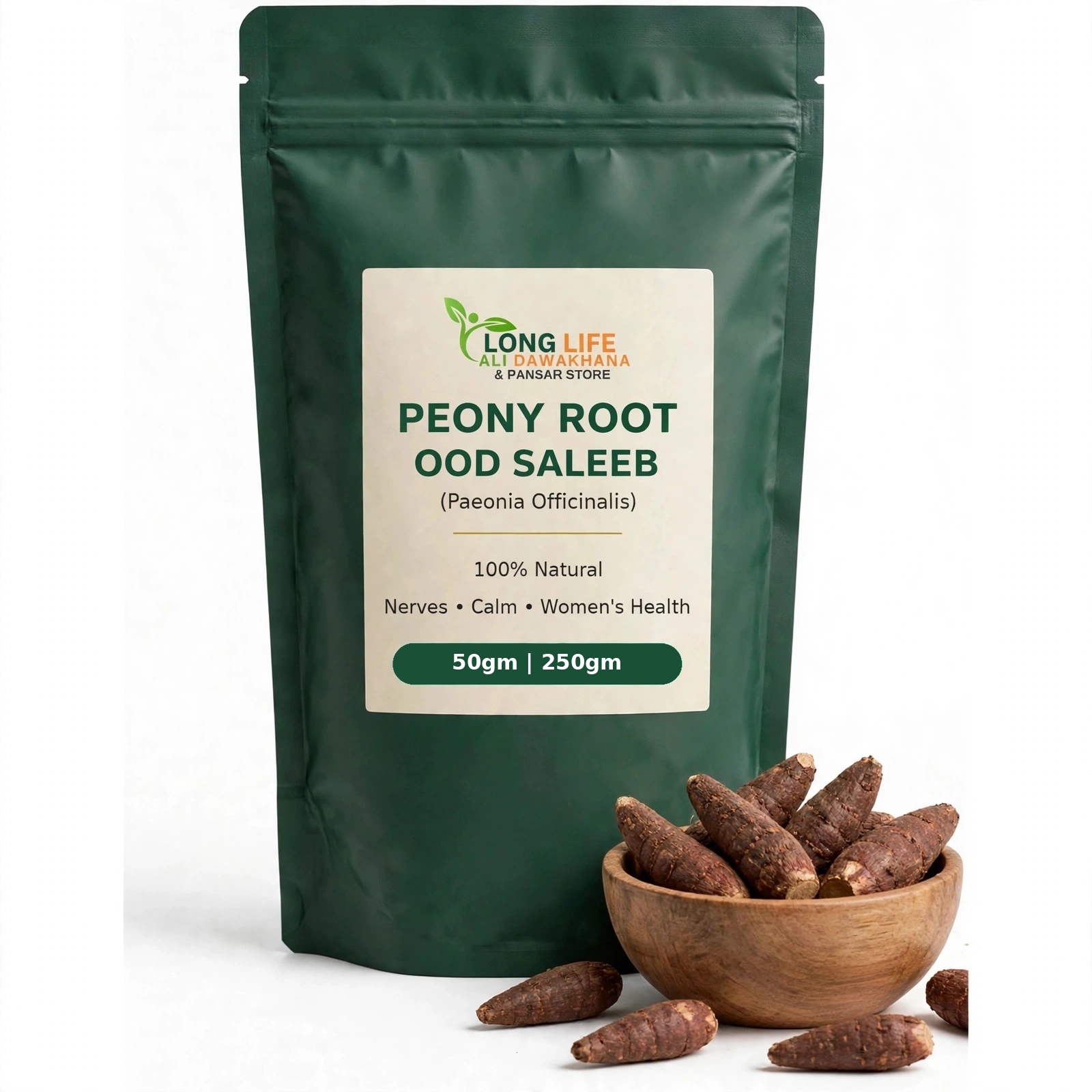
Peony Root (Ood Saleeb, Paeonia officinalis) is the dried root of the peony, a classical Unani herb used for nervous conditions, calm and women’s health. It is a proven abortifacient — absolutely avoid in pregnancy. At Long.pk it is available as Whole or Powder in 50 and 250 gm packs from Rs 548, with Cash on Delivery across Pakistan.
عود صلیب (Peony Root) — اعصاب، سکون اور خواتین کی صحت کی روایتی جڑی بوٹی
عود صلیب، جسے انگریزی میں پیونی روٹ (Peony Root) کہتے ہیں، یونانی طب کی ایک قدیم اور معتبر جڑی بوٹی ہے۔
اہم انتباہ: عود صلیب حاملہ خواتین کے لیے ممنوع ہے — تجربات سے ثابت ہے کہ یہ اسقاط حمل کا باعث بن سکتی ہے۔ دودھ پلانے والی مائیں اور بچے بھی اس کا استعمال نہ کریں۔
Peony Root (Ood Saleeb) — The Classical Unani Root for Nerves and Women’s Health
Direct answer: Peony Root (Ood Saleeb, Paeonia officinalis) is the dried root of the common peony, used in Unani medicine for over 2,000 years — chiefly for epilepsy and nervous conditions, and for women’s health. Its key compound is paeoniflorin, a monoterpene glycoside studied for anti-inflammatory and nerve-calming effects.
- Peony Root (Ood Saleeb) Kya Hai?
- Tareekh aur Riwayat
- Peony Root ke Active Compounds
- Ayurveda aur Unani Mein Ood Saleeb
- Jadeed Tehqiq: Science Kya Kehti Hai
- Peony Root (Ood Saleeb) ke Faide
- Ood Saleeb: Two Peonies, One Name
- Peony Root Kis ke Liye Hai?
- Peony Root Istemal Karne ka Tareeqa
- Peony Root ke Behtareen Combinations
- Peony Root ki Miqdar (Dosage)
- Side Effects aur Ehtiyat
- Asli Peony Root Pehchanne ka Tareeqa
- Peony Root Store Karne ka Tareeqa
- Peony Root vs Doosri Jadi Bootiyan
- Peony Root (Ood Saleeb) ki Qeemat Pakistan Mein
- Product Specifications
- Roman Urdu Mein Peony Root (Ood Saleeb)
- Frequently Asked Questions
Peony Root (Ood Saleeb) Kya Hai?
Peony Root is the dried root of the common peony, Paeonia officinalis L. — the garden peony of Europe, a perennial plant with large, showy flowers that has been grown in gardens for centuries.
The root has been used medicinally for over 2,000 years.
Tareekh aur Riwayat
Ood Saleeb is one of the oldest medicines in the Greco-Arab tradition. Dioscorides, the Greek physician of the first century CE, described peony root for epilepsy and for women’s complaints.
In the Unani system the root became a standard medicine for epilepsy.
Peony Root ke Active Compounds
The chemistry of Paeonia officinalis root is well characterised. The key compounds are:
- Paeoniflorin — the main active compound, a monoterpene glycoside.
- Albiflorin — a closely related monoterpene glycoside.
- Oxypaeoniflorin — another monoterpene glycoside of the same family.
- Paeonol — a phenolic compound with anti-inflammatory and analgesic activity in lab studies.
Ayurveda aur Unani Mein Ood Saleeb
In the Unani system, Ood Saleeb is classed as hot and dry in temperament. Its classical actions centre on the nerves and the womb.
The classical indications follow from these actions. For the nervous system: epilepsy and convulsions first, then hysteria, nightmares, anxiety and depression.
Jadeed Tehqiq: Science Kya Kehti Hai
This section needs care, because the peony evidence is easy to misread. There are two different bodies of evidence, and they belong to two different things.
The only human trial of Paeonia officinalis itself. Zangooei Pourfard et al. (2021, Epilepsy Research 176:106735) ran an open-label pilot study in 30 children aged 1 to 14 with intractable epilepsy — children whose seizures were not controlled by their medicines.
The stronger clinical evidence belongs to TGP — a different product. TGP (total glucosides of paeony) is a standardised extract of Paeonia lactiflora (Chinese white peony).
Peony Root (Ood Saleeb) ke Faide
The benefits below are organised by how strong the evidence is. Traditional use is stated as traditional use; trial evidence is stated as trial evidence.
1. Nervous conditions and epilepsy (traditional + one pilot). This is the oldest and most important use of Ood Saleeb.
2. Calm, anxiety and sleep (traditional). Peony Root is a traditional calming herb for anxiety, restlessness, nightmares and sleeplessness.
3. Women’s health (traditional). Ood Saleeb is a classical emmenagogue — used for delayed or scanty menstruation, menstrual pain and uterine disorders.
4. Pain and inflammation (traditional + lab). Traditional use covers headaches, colic, joint pain and muscle spasm.
5. Liver protection (traditional). Ood Saleeb is used traditionally for jaundice and liver conditions, and paeoniflorin has shown liver-protective effects in animal studies.
6. Blood pressure (limited evidence). Paeoniflorin is a vasodilator in animal studies, but there is no human trial showing Peony Root lowers blood pressure in people.
7. Skin and circulation (traditional). Traditional use includes haemorrhoids and varicose veins (as suppositories or external applications) and vitiligo — the vitiligo trial used TGP, not the raw root.
Ood Saleeb: Two Peonies, One Name
This is the identity question every buyer of Ood Saleeb should understand, because the name covers two species.
Paeonia officinalis — the common peony, garden peony or European peony — is the species the source (pansaar) sells as Ood Saleeb, and the species in this product.
Paeonia emodi (Himalayan peony) is the other species sometimes sold as Ood Saleeb — some Unani sources describe Ood Saleeb as P. emodi. Long.pk’s Peony Root is Paeonia officinalis.
Peony Root Kis ke Liye Hai?
Peony Root may suit people who:
- Follow Unani medicine and want the classical root for nervous conditions, as part of a practitioner-guided regimen
- Want a traditional calming herb for anxiety, restlessness or sleeplessness
- Are looking for a traditional women’s-health herb for menstrual irregularity, under a practitioner’s guidance
Peony Root Istemal Karne ka Tareeqa
Peony Root is used in three main ways. The Whole root is for decoctions; the Powder is for direct use or for mixing into compounds.
1. Decoction (joshanda) — the standard method. Take 6–10 gm of Whole Ood Saleeb root and add to 400 ml of water.
Peony Root ke Behtareen Combinations
In Unani practice, Ood Saleeb is used both alone and in compounds. These are the combinations that make sense by product use:
- Peony Root + Brahmi (Centella) — the nerve-calming pairing.
- Peony Root + Shatavari (Satawar) — the women’s-health pairing.
- Peony Root + Jujube (Unab) — the calm-and-sleep pairing.
Peony Root ki Miqdar (Dosage)
There is no dose of Paeonia officinalis root established by good human trials. The doses below are the traditional ones.
- Decoction: 6–10 gm of Whole root a day, as a decoction in two divided doses (the Chinese peony decoction dose is commonly 6–15 gm a day of crude root under practitioner guidance)
- Dried powder (sufoof): 3–5 gm, twice daily, with warm water or milk
- In classical compounds: as directed by the formula and the practitioner
Side Effects aur Ehtiyat
Peony Root has serious cautions that must be read before use. This is not a herb to take casually.
Pregnancy — absolutely contraindicated. Ood Saleeb is an experimentally proven abortifacient: it stimulates the uterus and can cause miscarriage.
Breastfeeding and children. No safety data exists for breastfeeding mothers or for children.
Blood thinners — a real risk. Peony Root reduces platelet clumping in lab studies, and there is a published case report of a 61-year-old man, previously stable on warfarin, who developed easy gum bleeding.
Stomach and digestion. The tannins in the root can cause abdominal distension, nausea and diarrhoea.
Drug interactions. No formal interaction studies exist in humans for the raw root.
Toxicity. No formal toxicology of the common peony root has been found.
Allergy. Allergy to peony is not well documented. Stop using it and seek advice if you develop a rash, itching or swelling.
Asli Peony Root Pehchanne ka Tareeqa
Good-quality Ood Saleeb is easy to recognise once you know what to look for:
- Appearance: thick, tapered, finger-shaped root pieces, dark reddish-brown outside with rough bark and lighter patches.
- Texture: hard and dense when dry; it should snap rather than bend.
- Smell: faintly earthy and slightly sweet when dry, with no musty or mouldy note.
- Cleanliness: free from soil, stones and other root material.
Peony Root Store Karne ka Tareeqa
- Keep Peony Root in an airtight container — a glass jar or a sealed food-grade pouch — away from light, heat and moisture.
- Store in a cool, dry cupboard.
- The Whole root keeps well for 12–18 months if stored dry.
Peony Root vs Doosri Jadi Bootiyan
| Feature | Peony Root (Ood Saleeb) | Brahmi Booti (Centella) | Shatavari Powder (Satawar) |
|---|---|---|---|
| Botanical name | Paeonia officinalis | Centella asiatica | Asparagus racemosus |
| Part used | Dried root | Whole herb (leaves) | Root powder |
| Main traditional use | Nerves, epilepsy, women’s health | Brain, nerves, memory | Women’s health, lactation, menopause |
Peony Root (Ood Saleeb) ki Qeemat Pakistan Mein
| Form | 50 gm | 250 gm |
|---|---|---|
| Whole | Rs 548 | Rs 2,320 |
| Powder | Rs 683 | Rs 2,236 |
Best value: Powder 250 gm, Rs 8.94 per gram — the Powder is cheaper than the Whole root at 250 gm (Rs 2,236 vs Rs 2,320).
Product Specifications
| Attribute | Detail |
|---|---|
| Product name | Peony Root (Ood Saleeb) |
| Urdu name | عود صلیب (Ood Saleeb) |
| Botanical name | Paeonia officinalis L. |
| Family | Paeoniaceae |
| Part used | Dried root |
| Forms | Whole, Powder |
| Weights | 50 gm, 250 gm |
| Price range | Rs 548 – Rs 2,320 |
| Origin | Europe / cultivated (source: pansaar) |
| Purity | 100% natural, no additives, no preservatives |
| Shelf life | Whole 12–18 months; Powder 6–12 months after opening |
| Seller | Ali Dawakhana and Pansar Store |
| Delivery | Cash on delivery across Pakistan |
Roman Urdu Mein Peony Root (Ood Saleeb)
Peony Root (Ood Saleeb) aam peony (Paeonia officinalis) ki khushk jar hai, jo Unani tib mein 2,000 saal se zyada arse se istemal ho rahi hai — khaas tor par mirgi aur aasabi amraz, aur khawateen ki sehat ke liye.
Frequently Asked Questions
Q: Peony Root (Ood Saleeb) kya hai?
Peony Root (Ood Saleeb, Paeonia officinalis) aam peony ki khushk jar hai, jo Unani tib mein 2,000 saal se zyada arse se mirgi, aasabi amraz aur khawateen ki sehat ke liye istemal ho rahi hai.
Q: Kya Ood Saleeb mirgi ka ilaj hai?
Nahi — ye sabit shuda ilaj nahi hai.
Q: Peony Root ki qeemat kya hai?
Rs 548 se Rs 2,320 tak — Whole 50 gm Rs 548, 250 gm Rs 2,320; Powder 50 gm Rs 683, 250 gm Rs 2,236.
Q: Peony Root ka behtareen faida kya hai — Whole ya Powder?
Dono aik hi jadi booti hain. Whole jar joshande ke liye behtar hai; Powder safoof ke tor par aasan hai.
Q: Kya Ood Saleeb hamal mein mehfooz hai?
Bilkul nahi — Ood Saleeb tajurbat se sabit shuda abortifacient hai, yani ye isqaat-e-hamal ka sabab ban sakti hai.
Q: Kya Peony Root blood thinner ke saath le sakte hain?
Nahi — doctor ki wazeh ijazat ke baghair hargiz nahi.
Q: Ood Saleeb kaun si species hai — Paeonia officinalis ya Paeonia emodi?
Is product mein Paeonia officinalis (aam peony) hai, jaisa ke source ne bataya hai.
Q: TGP kya hai, aur kya us ki tehqiq is jar par lagu hoti hai?
TGP (total glucosides of paeony) aik standardised extract hai jo doosri species Paeonia lactiflora se banta hai aur China mein prescription dawa hai.
Q: Ood Saleeb ka istemal kaise karein?
Joshande ke liye 6–10 gram khushk jar 400 ml pani mein ubaal kar aadha rehne par chhaan lein.
Q: Peony Root ke side effects kya hain?
Aam side effects mein pait mein gas, matli aur dast shamil hain (tannins ki wajah se).
Related Products
- Brahmi Booti (Centella) — the classical Ayurvedic brain tonic; pairs with Ood Saleeb for nerves, calm and memory.
- Shatavari Powder (Satawar) — the Ayurvedic women’s tonic with human trials for lactation and menopause; the nourishing partner to Peony Root’s regulating action.
- Bonduc Nut (Karanjwa) — a traditional remedy for joint pain and inflammation; pairs with Peony Root for pain and spasm.
- Jujube Berries (Unab) — a gentle traditional sedative and sleep aid; the calm-and-sleep partner to Peony Root.
Ali Dawakhana and Pansar Store — Asli desi dawa aur khalis jadi bootiyan, ab ghar baithay Long.pk se mangwayen.

Reviews
There are no reviews yet